Y
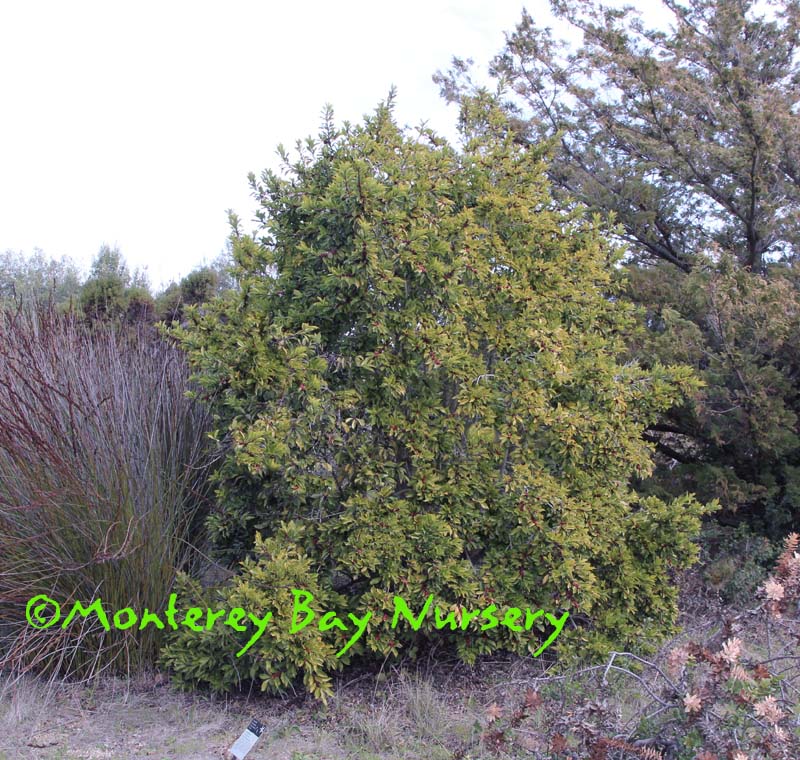
Yerba Mate (Ilex paraguayense) nice female specimen, winter, UCSC
a formal-looking, evergreen woody shrub grown for its tender young
new leaves and stems, which are harvested and processed to make
the famous South American tea beverage and uncountable modern
energy drinks. These are male plants being offered, which are
considered superior for their stronger caffeine (and related
compounds) levels and better flavor. To about 8' tall at maturity
here with similar spread. Dark green, glossy leaves are tidy and
neat, should make a good, tough Mediterranean landscape shrub.
Full sun, average to good drainage. Has demonstrated respectable
drought tolerance at the UCSC Arboretum, at least for a supposedly
tropical-subtropical plant, where a large female specimen receives
minimal summer watering. For best yield at least some summer
watering must be beneficial. That plant has also survived every
major freeze since being planted, including I believe 1990 and
1998. Commercial processing of the leaves involves harvesting,
blanching, drying, drying at relatively high temperature, aging
(up to 24 months for some grades) and finally grinding/milling.
Homeowner processing can be an abbreviated version of that!
Southern Brazil, Paraguay. Aquifoliaceae. rev 5/2017
Yucca semiwoody succulents ranging in habit
from dwarfs under 2' to medium size, branching trees. Flowers can
be edible, but degree and palatability varies by species. They are
mostly picked very young and fried up, often with eggs or
vegetables. They have a pleasant flavor and crunchy texture, but
can taste alkaloidal (bitter and alkaloidal) depending on species
and/or time of harvest. Sometimes removing the stigma and ovary
can reduce this problem. Yuccas in the trade are uniformly deer
resistant but one source writing for the Native Plant Society of
Texas notes they very greatly enjoy new flower spikes as they are
emerging. Yuccas utilize Crassulatic Acid Metabolism (CAM), a
variation of photosynthesis which is ten times more
water-efficient than the standard process. Yuccas are in general
heavily utilized by native communities, often all portions fully
utilized in some way for a range of needs. Asparagaceae, formerly
Agavaceae. rev 6/2020
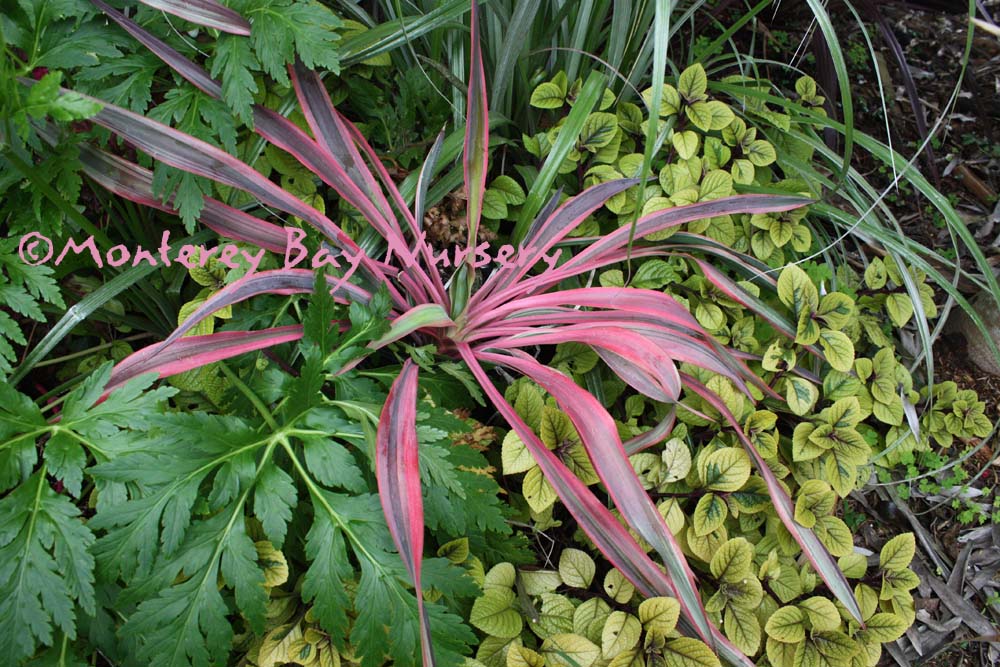
aloifolia 'Magenta Magic' young 1g order this is a sport found within tissue-culture propagated crop 'Blue Boy' with stiffer, more vertical foliage and a more upright habit but otherwise very similar features, especially leaf color. Growth characteristics and ultimate specs are not yet known but we estimate a little faster and ultimately taller then the original 'BB.' We have never seen this flower and maybe never will (see 'Blue Boy') but if so appreciate the fact that this is reportedly the only bee-pollinated species. All others are pollinated by moths and can host larvae of a few butterfly species as well. rev 6/2020
baccata BANANA YUCCA, BLUE YUCCA, SPANISH BAYONET Clark Mountain fibers RSA I - blooming plant RSA II - spike RSA III - giant flowers O'Byrne's Williamette Valley plant UCSC plant, ~20 years old a clustering or solitary species, one of our four California native species, along with Y. brevifolia (Joshua Tree), Y. schidigera (Mohave Yucca) and Y. whipplei (Chaparral Yucca). This is found mostly in the Eastern Mojave and higher elevations of the Colorado Desert in California, mainly clustered around Clark Mountain. It ranges far beyond, from Utah and Texas south into Mexico's deserts to about the latitude of mid-Baja. It is variable, with grassy, highly clustering forms and more solitary, trunking populations. It has a distinctive blue grey leaf color and conspicuous leaf-edge fibers. In cultivation it seems to readily form a decent short trunk, slowly, but I've never seen any tree-like specimens in the California wild populations (yet). Some plants seem to grow reasonably well in cooler, moister climates but the more sun and drier the better. Nevertheless the most impressive cultivated specimen I've seen, outside the near-desert habitat at Rancho Santa Ana Botanic Gardens, was at Ernie and Marietta O'Byrne's backyard garden in the foothills at the south end of the Williamette Valley (!!). Just shows to go ya' - never be afraid to try. The worst that happens is the plant dies, then you've learned something. This species produces a large, fat, fleshy fruit, something like a fat banana, that encloses the seeds and is important for wildlife. It was also used historically and to some degree currently by human desert dwellers. It is reportedly quite good when cooked, like sweet potatoes. I'd like to try it so please send me some fruits if you find them. Sun, good drainage etc. etc. Probably hardy to USDA zone 7 in most cases, some populations are native to zone 5 climates. rev 8/2020
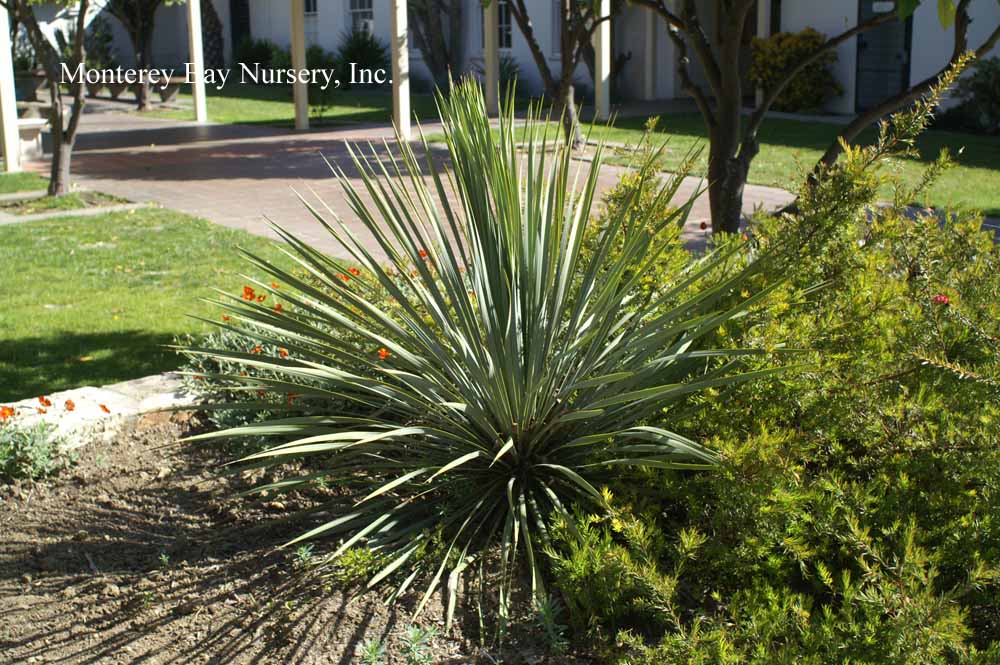
'Blue Boy' SPANISH BAYONET, SPANISH DAGGER nicest specimen, UCB juvenile phase, new landscape, Capitola same landscape, mature phase possibly a hybrid of Y. aloifolia, with Y. desmetiana? And that would be Yucca d., not Agave d.! A compact, narrowly upright, evergreen variety grown for the bronzy red to dark burgundy purple leaf color when grown in full sunlight. In the wild Y. aloifolia trunks can reach 12-20' with age, but I've personally never seen a 'Blue Boy' over ~6'. From the leaf size of that plant (UCB) I'm sure they can get quite large. I've never seen this one flower either, in fact I can't find even an image of one in flower, maybe it doesn't, and maybe that points to hybrid origin? Flower spikes of true Y. aloifolia are your typical stunning terminal arrangements, reaching about 2' above the trunk apex and covered in ivory white flowers up to 4" across, often tinted purplish on the outside. If this is just truly variant of Y. aloifolia it's flowers should be edible, even raw, which is often not the case - proceed carefully! Seed pods were eaten by Native Americans at least to some degree, leaves were used for fiber, roots for soaps and shampoo. Grow in full to half sun (you'll lose most of that purple color) and use average soil and drainage precautions. Can be grown with ample to very infrequent watering, depending on how much you like to water. It is very drought tolerant when it needs to be, though not desert-tough. It will also survive in dismal, long-wet-winter climates. If it truly is a Y. aloifolia selection, which is the type species for the genus Yucca, then it's native range is Atlantic Coastal regions from Florida to North Carolina, and along the Gulf Coast west to Texas. Also Bermuda, other Caribbean islands and the Yucatan Peninsula. This genus was originally described by the flamboyantly weird Linnaeus himself. USDA zone 7/Sunset zones 7-24, but can die in colder areas when young without protection. rev 5/2020
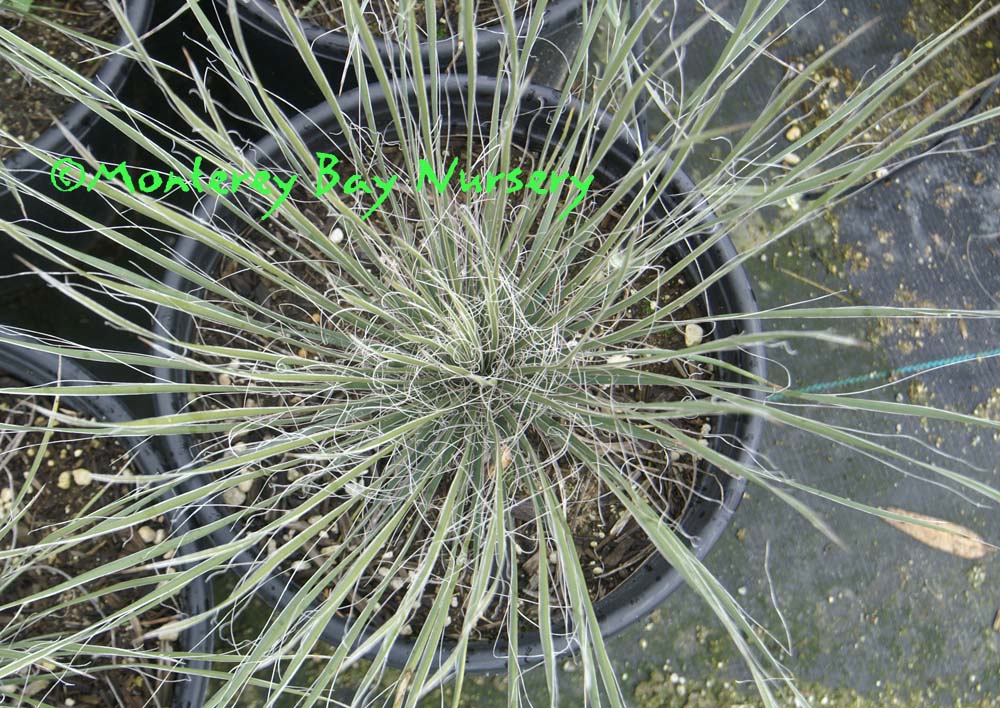
elata SOAPTREE
YUCCA container plant
a very grassy species, especially when young, quickly
forming wonderful white fibers curling off the tough, leathery,
shoestring-thin grey green leaves. Mature crowns get about 3'
across and form a trunk often within just a year or two, reaching
an impressive 20' in height with time. It likes the Central
Valley, true Mojave Desert, Great Basin-like situations, inland
SoCal and similar hot/dry situations. It's growable but slower in
cooler areas, ending up at about the same place, eventually, if a
little more attention is paid to watering. It retains its
old leaves as distinctive, dense, downward-pointing thatch, like
many other large species such as Joshua Trees (Y. brevipes),
Y. rostrata. That dense skirt of dry foliage should not be
removed in most situations - it prevents damage to the succulent
trunk by gophers, voles, pack rats, rabbits and all the other hard
working creatures that find it tasty. The reason for growing it
are those tangled white filaments, which slowly and continuously
erode from the leaf margins. Spikes of bright ivory white flowers
emerge from each crown in spring, rising to about 6' above the
foliage. Found in many desert communities of the Southwest, and it
had a wide range of Native American uses. It is quite adaptable
and has done very well for us along the coast, even during the
very cold, wet year of 2005, except for always trying to lift
itself out of the container by swelling it's roots. USDA zone
7/Sunset zones 7-24. rev 12/2006
elephantipes (not currently in production) SPANISH DAGGER, PALM LILY flower spike another a large, infrequently branched, clumping evergreen species commonly encountered in landscapes statewide. Easily distinguished by wide, flexible medium green to bright green leaves to 2" wide, about 2' long, that lack a hard, sharp point. It can become treelike with great age and form very large clumps, many feet across the cojoined, elephantine bases. Ivory white flowers (fragrant!) appear in late summer or early fall, heaviest in warm summer/warm winter climates such as Southern California. It can be extremely showy but usually not all the terminals in a clump flower at the same time in cooler climates. It is valuable for form and foliage and makes a very effective focal point or accent plant. It also does superbly in containers, especially because it provides a yucca form without the spines. Likes sun, at least average drainage, and at least occasional summer watering, at least in the hottes climates. This species was incorrectly sold as Y. gloriosa in the past, and mostly remains known in the trade as such, but the true Y. gloriosa is much closer to Y. recurvifolia and is rarely seen. Sunset zones 7-9, 12-24/USDA zone 9. Southeastern US. Not currently in production. rev 1/2013
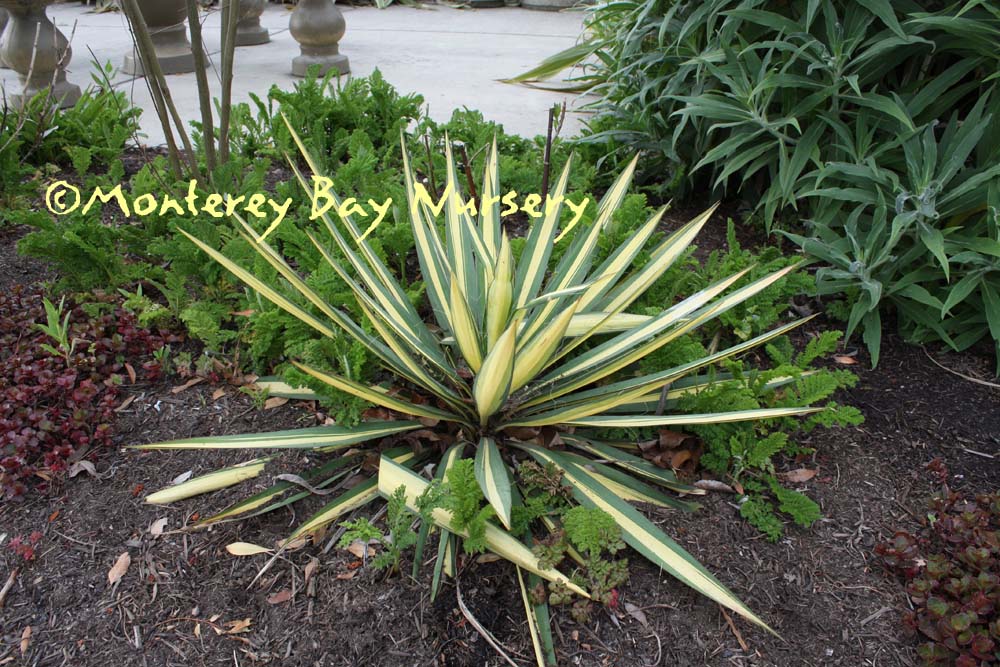
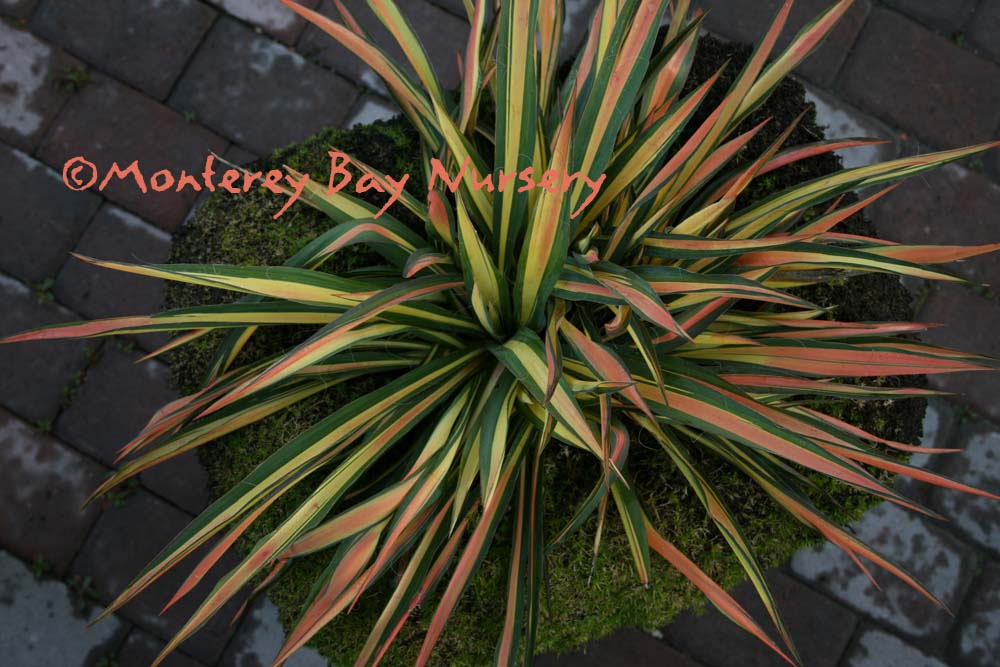
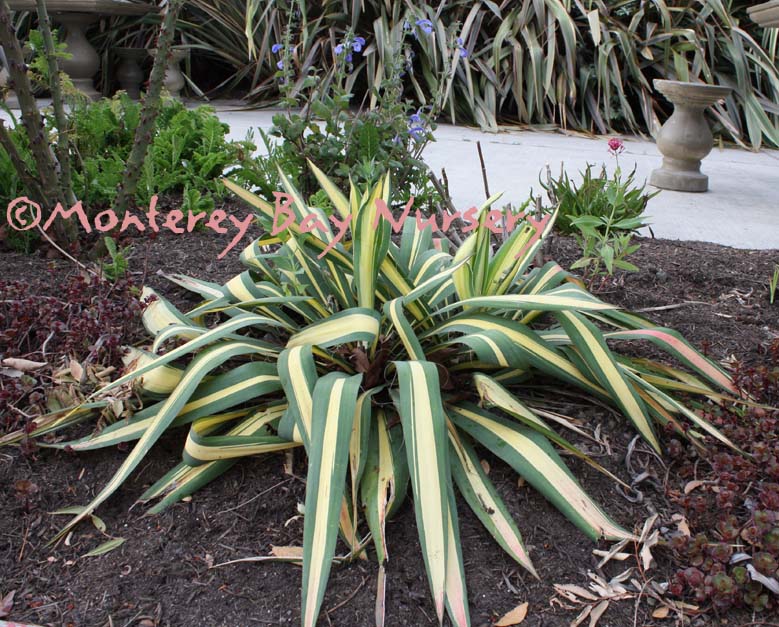
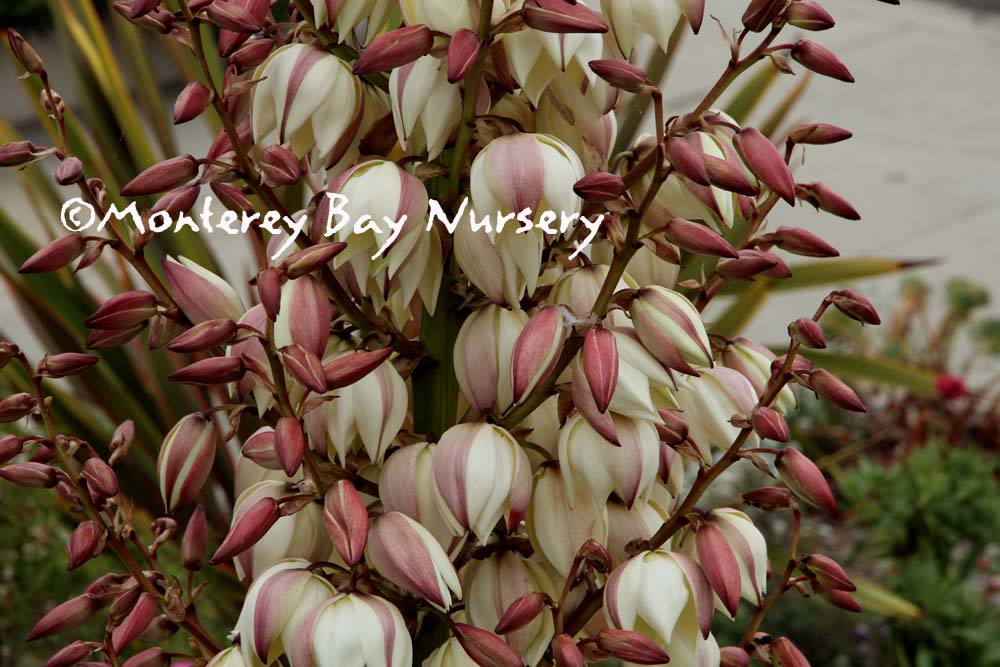
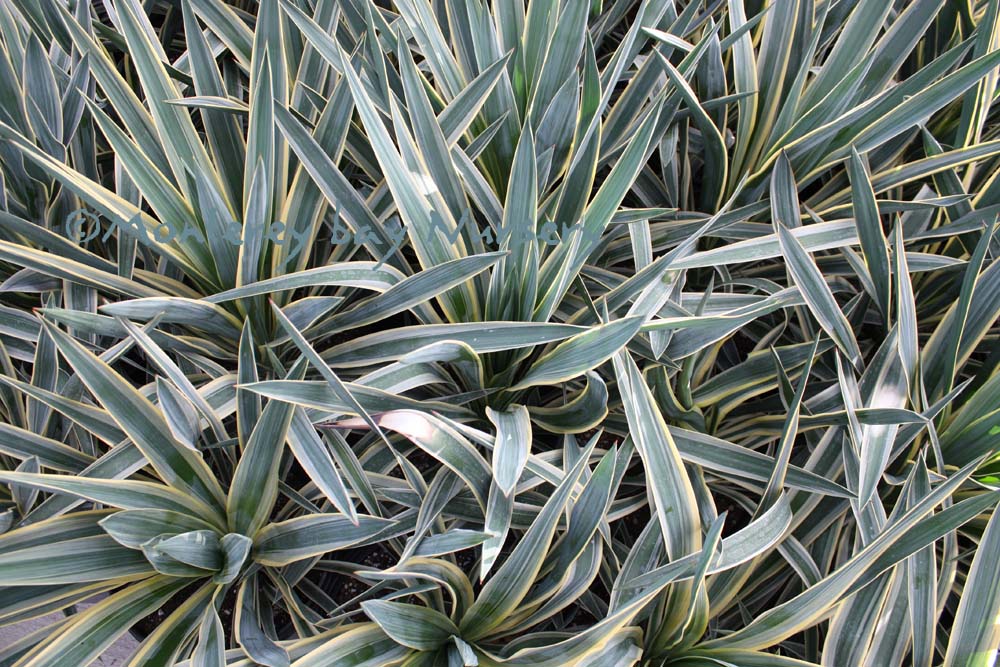
note: all above text and images ©Luen Miller and Monterey Bay Nursery, Incgloriosa 'Variegata' (not currently in production) PALM LILY, SPANISH DAGGER West Cliff Drive, young landscape specimen flower closeup foliage color on young nursery plants fall/winter color a species confused in the past with Y. elephantipes. This true form of the species is much closer in form and requirements to Y. flaccida or Y. recurvifolia, two other Eastern US species. It forms a trunk very slowly under California conditions, and should be considered mostly as a low rosette in shape until quite old. This is one of its most interesting forms, featuring rough, dark blue green leaves with a powdery white coating, broadly margined with creamy white, which turns intense coral pink for about four months starting in October or November. The leaves have a modest, sharp spine, but the flat leaves fold under pressure from the tip. They are soft enough to move in breezes for a fountain effect. So you get prickled, but usually not pierced. Flowers are to 4" across, white tinged with a little green, on a spectacular spike to 2-3' above the plant. Choice, and rare! Very frost hardy, Sunset zones 5-9, 14-24/USDA 7. Needs moderate to infrequent summer watering. North Carolina to Florida. rev 2/2010
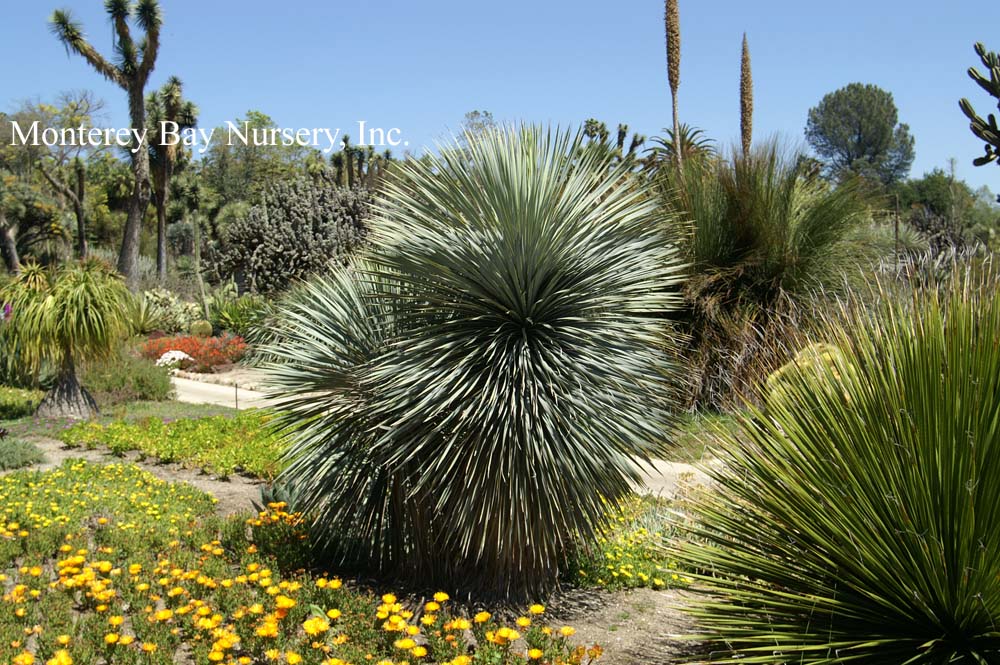
luminosa (rigida) BLUE YUCCA at the Huntington a large, robust, species with stiff, blue white, needle-like leaves. My problem with this plant is that I can't stop taking pictures of it. It does what Y. rostrata does only bigger, bluer/whiter, showier, and more alluring and dangerous. There are spectacular specimens at the Huntington, probably the best you are going to find anywhere. This large, dome-shaped species is eventually tree-like and branching, with its trunk clothed in old, dry, downward pointing leaves which, like in Y. rostrata, protect its base from chewing and tunneling rodents. It is at its best in hot, dry climates in very well drained soils but has grown well for us along the foggy coast and is well worth trying outside of its native desert or hot inland environments. The rather small creamy white flowers are produced in huge, dense, branched upright clusters above the foliage in summer when plants are happy and sufficiently mature. Probably hardy to 10F, USDA zone 7/Sunset zones 5-24. Mexico. rev 5/2019
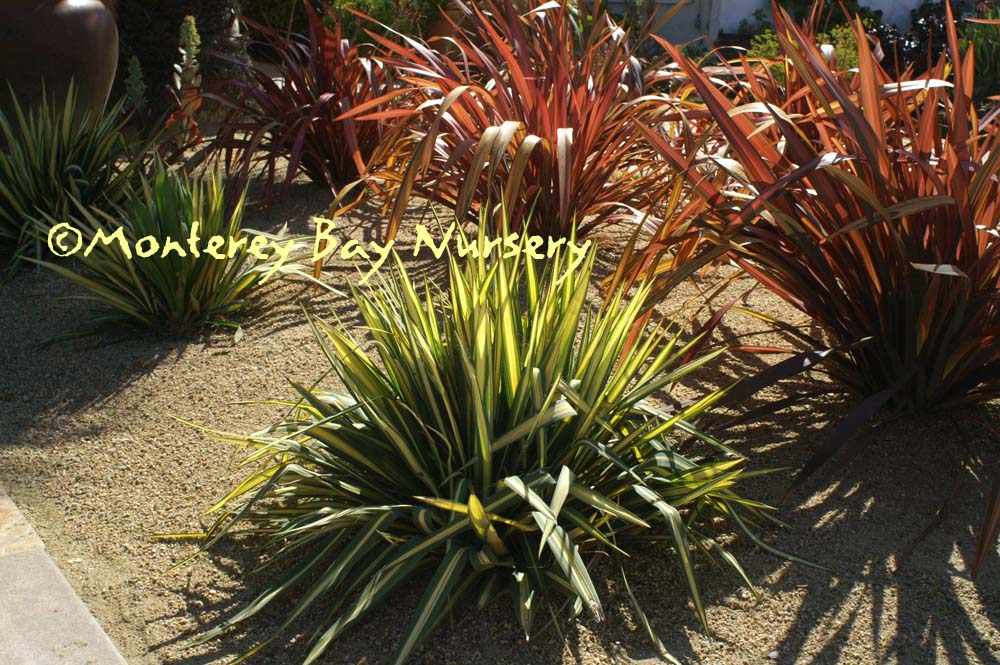
recurvifolia 'Bright Star' ('Walbristar') PP17653 mature clump Spring Trials booth babe, older juvenile-phase juvenile foliage, 5g mature-phase, 5g maroon leaf colors the best variegated Yucca I've seen, a stunning eye-catcher when it catches direct sunlight. At its best it grows as a low single rosette or tight cluster of plants to 2-3' tall. Leaves are bright gold with light grey green centers and reddish highlights at the leaf tips and close to the trunk, especially when young, in full sun and after exposure to cool conditions. Juvenile plants have broader, more lax foliage and greener color, mature plants develop narrower, stiffer, more upright leaves with stronger colors. Full sun is usually best except for honest desert climates but it will take half or even full bright shade. Takes most soils, with at least average drainage of course, and makes a great container specimen. (But not near walkways or seating areas - the single, sharp, terminal spine is annoying even though the leaves flex enough that it's not officially dangerous.) Mature plants should be expected to produce the usual stunning 2-3' spike of ivory white flowers in late summer or fall but I haven't seen that myself. It do see images online of striking pink buds, probably taken under under cool conditions, so I suspect it will bloom, at least infrequently, in areas with higher summer heat. Native to the Atlantic coast, sometimes considered a subspecies of Y. gloriosa. USDA zone 7-8. rev 11/2019
rostrata BIG BEND YUCCA, BEAKED YUCCA Santa Cruz City Hall at the Huntington one of the best foliage/form plants ever invented, of all time.The very regular, even habit, outstanding foliage color, spectacular flower display, fast growth, forgiving culture and relatively unarmed leaves make this one of the best focal point or accents of all for containers, gardens and landscapes. The flexible leaves move easily in any breeze, catching your attention like a fountain. Own this plant for its amazing, fine blue foliage, for its stunning flower display, its captivating silhouette and its completely hands-free culture. It 's the hardiest (USDA zone 5? 6?) and most climatically adaptable of the large, tree-forming Yuccas, eventually forming trunks over 10-12' tall with age, great age in our cool-summer climates. It's usually seen as a single, solitary column but it can throw a pup or two, especially with with age, and some populations form branched crowns (sometimes classified as Y. thompsoniana). When plants are sufficiently mature in late spring they will produce a flower spike rising 2' above the crown of foliage, with a mind-bendingly beautiful display of hundreds of creamy white flowers in full bloom, usually by early-mid summer. Old leaves turn straw-colored and fold down against the stem. rev 6/2020
Leaves are flat and flexible but terminate in a single long, black terminal spine. Here's a simple, handy test: if you push on it with your finger and it hurts but the leaf bends, it's Y. rostrata. If it goes through your finger and doesn't bend, it's Y. luminosa. Also those leaf edges look smooth but are actually finely serrated. They demand some respect but won't saw your finger quickly and efficiently like a Nolina can.
Seedling crops show worthy and interesting variation as far as leaf color, edge color, width etc. Drainage must be at least average to good for reliable survival, and plants should be sited where winter sun will warm and help dry soil.
This species will tolerate very hot or very bright sites, even with reflected heat from walls or rock groundcovers, even in the true desert if you keep the old leaves on (see below). It receives warm-season rain in its native range, especially late summer/early fall, and so will not do well or even survive our California dry-summer, wet-winter, near-desert climates or true desert climates (inland or easterly SoCal areas, Mojave, Colorado) without occasional irrigation. Gophers can quickly remove all the roots quickly if not protected. Few sights are more annoying, while you're enjoying a front yard stroll with your rich morning cup of joe, than seeing your intimidating, 6' tall, neighborhood-dominating specimen lying sideways on the ground for all your snarky, catty neighbors to see. Use a galvanized Diggers Gopher Basket if there is any remote chance, and don't remove all that dense, tight leaf thatch, especially where it skirts outward from the base. It is excellent protection from gophers, pack rats, marmots, voles, rabbits, groundhogs, rattlesnakes, ground squirrels, prairie dogs, armadillos, peccaries, rednecks etc. from crawling up and eating the roots off at the base or gnawing the (relatively) succulent trunk. This has been reported as surviving most winters as cold as USDA zone 5-6, and is certainly reliable to zone 7. It would probably survive a Sierra Nevada winter if located east of the crest, where there is less snowfall. US Southwest, Mexico. rev 6/2020
'Sapphire Skies' Portland 1998, Sean Hogan's parking strip landscape, with Jeff Brooks after Stalin got mad a very nice improved blue form from Sean Hogan's Cistus Nursery in Portland (Oregon that is, not Maine). A shimmering vision you can't take your eyes off of. rev 9/2019
schidigera MOHAVE YUCCA mature clump, Clark Mountain another Clark Mountain specimen dwarf woodland, southeastern Nevada adjacent to Death Valley tree specimen, Kingston Range leaf-margin fibers a medium-size clustering to short trunking species, native to the southern Mojave (winter-rainfall) and Colorado Deserts (winter and/or summer rainfall, or sometimes neither). There are small populations in Clark County, Nevada and it occurs in small areas of Utah and Arizona. It ranges from there west to the inland and coastal scrub communities of southern San Diego County and south to about a quarter of the way down the Baja California peninsula. Within that area it is farmed on a massive scale for yucca-extract products along with several other species such as Y. schottii, Y. elata and Y. brevifolia. Rosettes are composed of dark olive green to golden green leaves one to two inches wide by 2-3' long, with heads spanning 3-6' or so. Margins display coarse threads but they are straighter than the curled versions on Y. baccata, to which it is closely related and can form hybrids with. In cultivation leaves are much darker green and glossier than anything I have seen in the wild, plus rosettes are cleaner and more perfect. Ivory white flowers are much like those of Y. whipplei, spikes are shorter, broader and denser, appearing in spring. Old plants can form short, sparingly-branched trees and grow in groves, so they probably can be considered to form "woodlands," like Joshua Trees, but dwarf, sparingly to non-branched versions. However one specimen in the eastern Mojave was measured at 27'. This plant is slow growing and long-lived. At Rancho Santa Ana Botanic Garden they grow about an inch of trunk a year. Estimates of old specimens in southern Nevada yielded ages of 200 years or so. At the Deep Canyon Desert Research Center just south of Palm Desert few clones were younger than 200 years, and half were 500 years or older (!!). Grow this in full sun, with good drainage and little or no water outside true desert environments. It can accept some summer watering due to being adapted to the late summer/fall thunderstorms infrequently encountered its native habit when hurricane remnants spin up from the south. Probably hardy to below 15°F. rev 12/2024
whipplei CHAPARRAL YUCCA, OUR LORD'S CANDLE Santa Lucia Mountains form, under oaks massive ssp. parishii at RSABG how do I love thee? Let me count the ways. Just this plant's name immediately sweeps me away to the steep, rugged slopes of the Santa Lucia Mountains looming over the Big Sur coastline, where their silvery white clumps are dramatically sited against striking rock formations and picturesque chaparral native plants. Keep your eyes open, populations are variable depending on where they are found. The largest individuals are seen in the the San Gabriel Mountains, in the population sometimes recognized as subspecies (or variety) parishii. Except for that form (see below) plants will usually flower after 4-10 years, sending up a stunning, terminal, vertical plume of dazzling ivory white flowers on a robust spike to 8-10' or more, and up to 15' for ssp. parishii. Plants of all types will look and grow best in full to part sun with average to good drainage, mineral soils or very light pottings mixes, little or no fertilizing and for almost all sites no summer watering after established. Site it well away from paths, entries etc. USDA zone 8-7, some forms are hardy to ~0F. This species is often listed, in it's own genus, Hesperoyucca. This is an old idea resurrected and recognized by some (but not most) recent authors, along with two other very similar forms (H. peninsularis of Baja California and H. newberryi of Arizona) based on recent DNA evidence separating it more widely from Yucca than other species. rev 9/2024
We grow crops from a varying selection of populations/ecotypes, sometimes offered under their site-names and sometimes sold mixed, derived from the following areas:
Santa Maria form between Santa Maria and Cuyama Valley recent burn coastal and near-coastal ranges from Santa Maria up to about Cuyama Valley. Along the Maricopa Highway (CA 166) there it often forms pure stands across the slopes. Mostly large plants, some are grey-silver, some very green, often tinted bronzy or purplish under cool or foggy conditions. Usually pups, usually not many, sometimes not at all. rev 4/2021
Santa Lucias form Pine Valley Trail why you grow it under oaks, Fort Hunter Ligget Big Sur, or the rugged, frequently burned range rising abruptly behind. Mostly heavenly silvery white or bluish foliage, even when growing in mostly shade situations. Small, solitary or almost so until flowering, then almost always offsetting at least 1-2 pups. rev 4/2021
ssp. parishii native ssp. parishii in its habitat giant old flower stalk Rancho Santa Ana Botanic Gardens the San Gabriel Mountains population, easily the Unholy Mother of all whippleis. Very often reaches over 6' across, almost always showing shimmering, silvery white leaves. It's almost always monocarpic, dying completely after flowering and producing no offsets. Bart O'Brien, when he was working there, told me some of their specimens at Rancho Santa Ana Botanic Garden were over 60 years old and had never flowered. They may be more truly "century plants" than Century Plants (Agave americana)! rev 9/2019
Cuyama River/Carrizo form roadcut north end of the Matilija Highway (CA 33, north of Ojai) east into the hills around the Carizzo Plains. Compact, grey green to silvery, often clustering happily and copiously long before flowering. Tall spikes relative to the leaves. rev 4/2021
Tehachapi form rolling downhill at high speed on Highway 158 toward Bakersfield just outside Tehachapi you will notice, if you can spare a very brief, one-half-second glance towards the roadcut banks while screaming along at 75 mph running tire-to-tire with wobbling empty double-trailers and flatbed semis, you will notice tall, very green clumps growing with a conspicuously more vertical habit. LOOK OUT!!! rev 9/2024