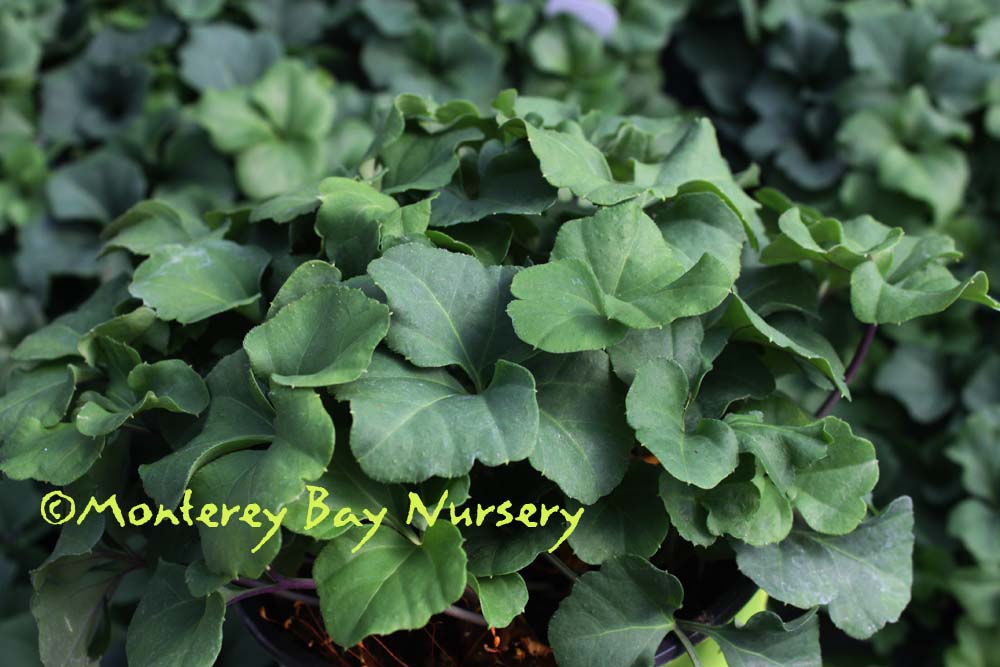
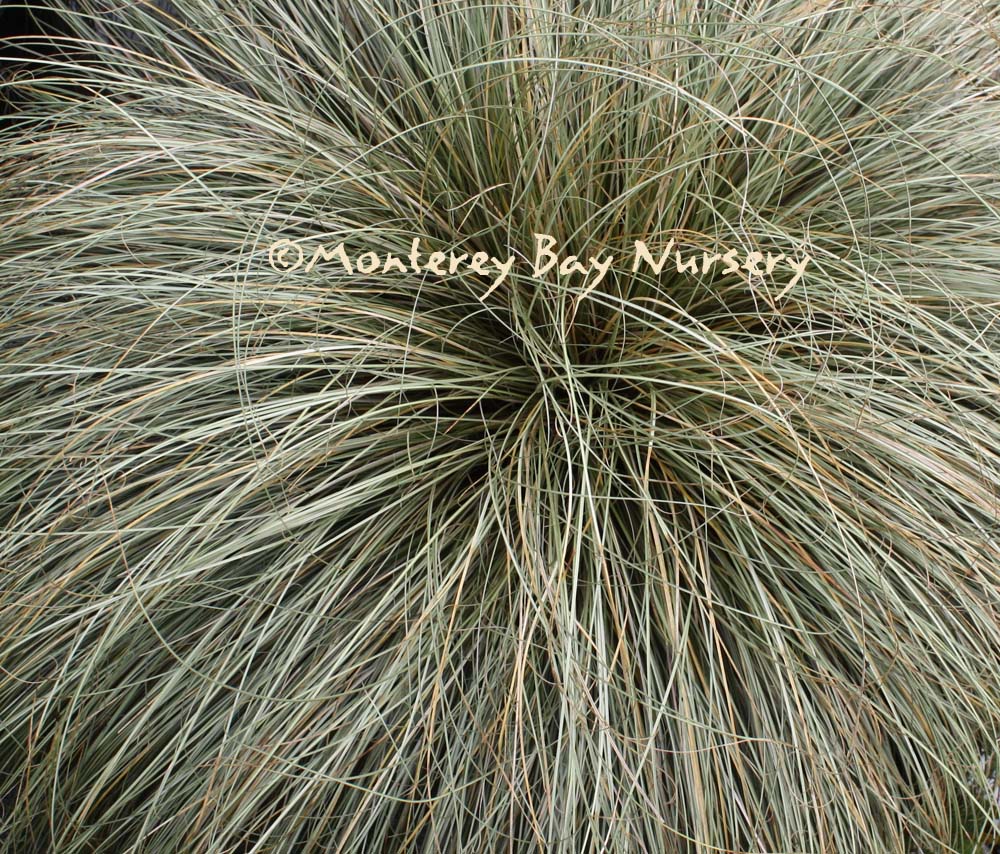
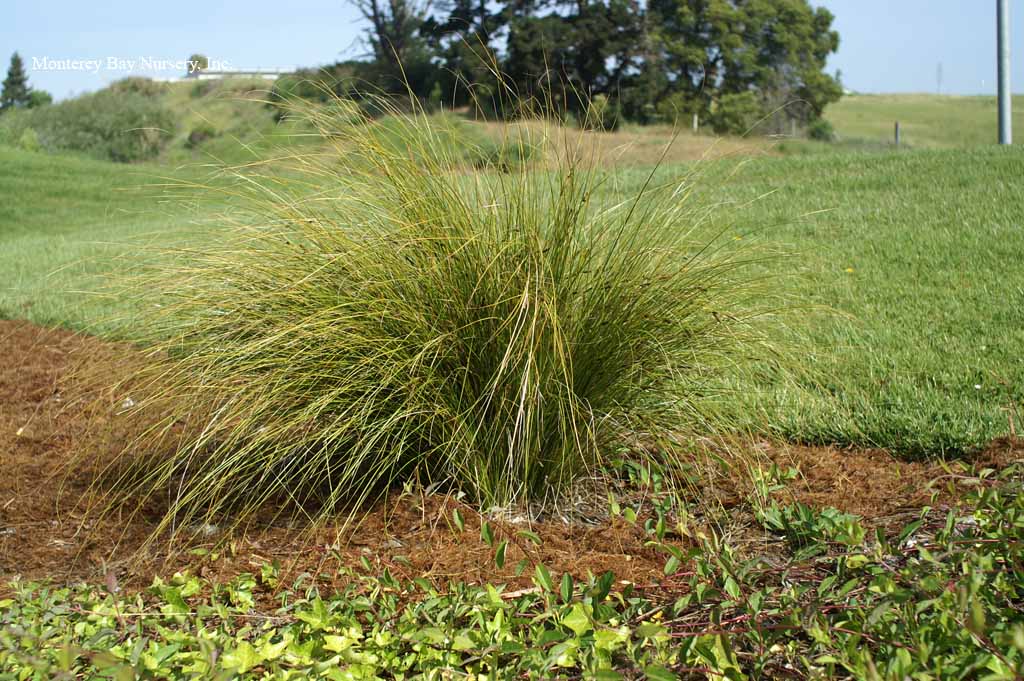
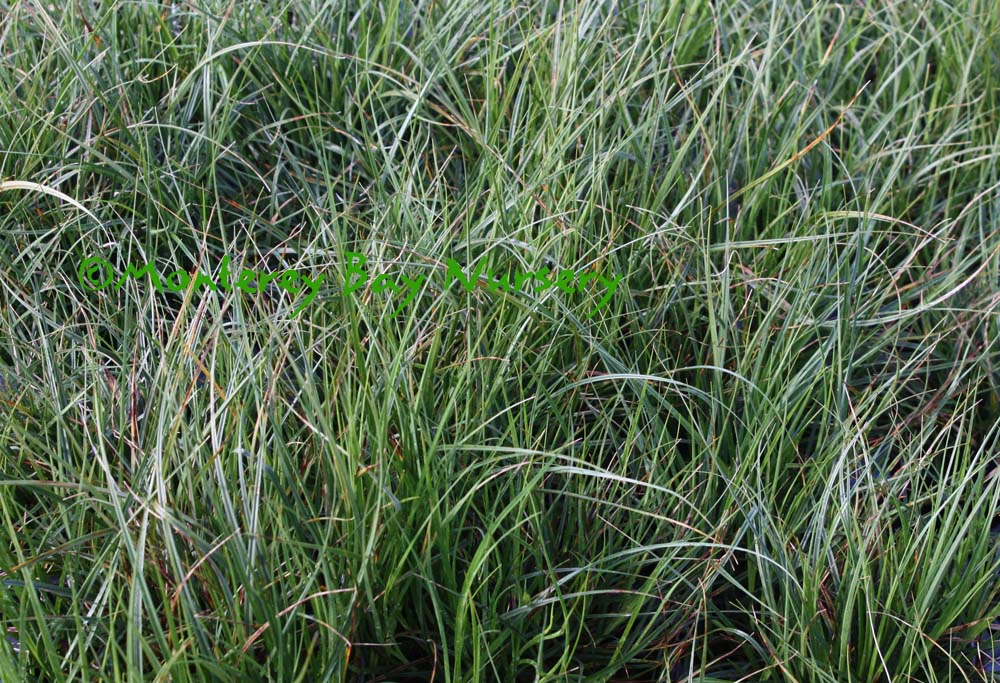
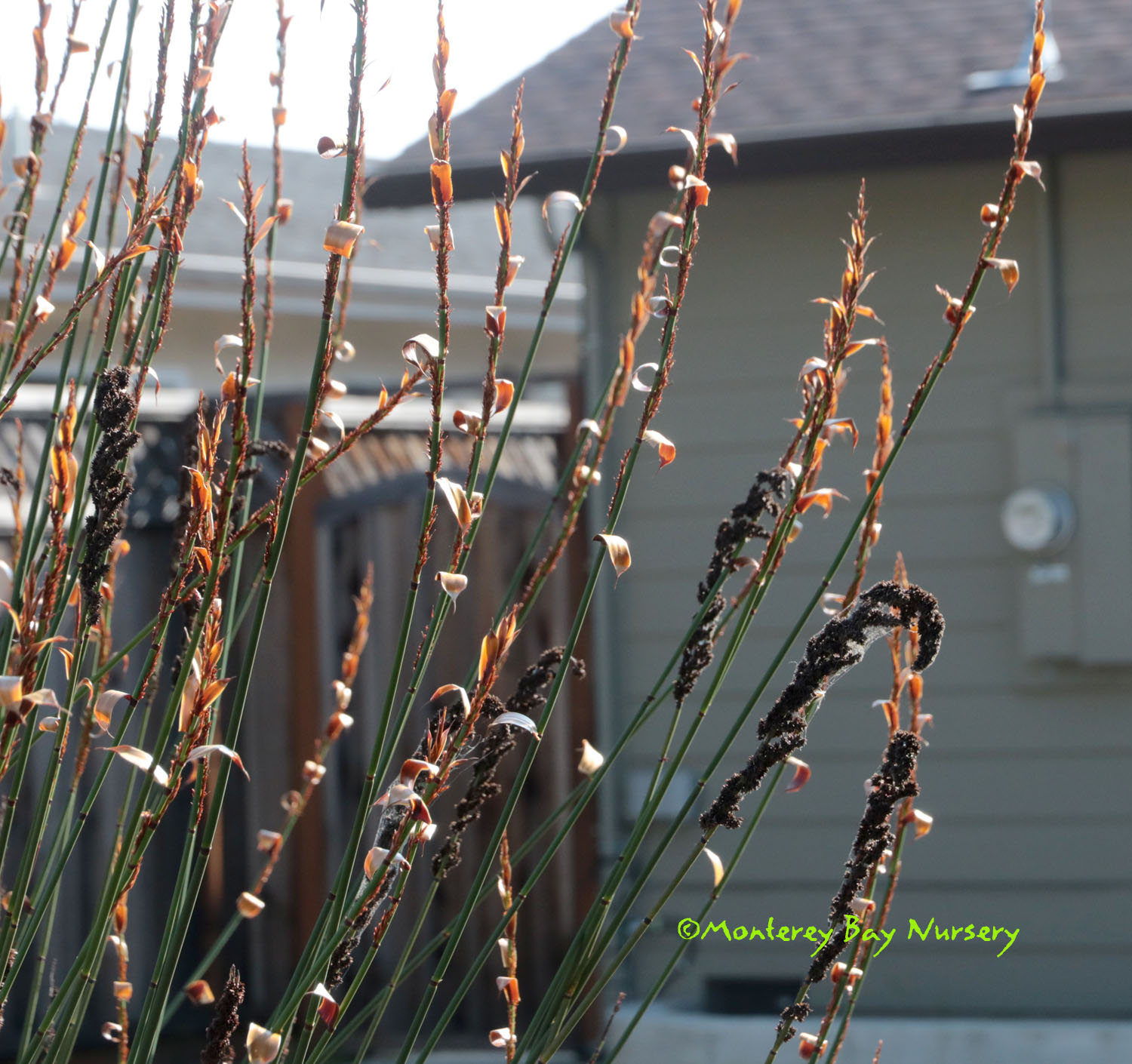
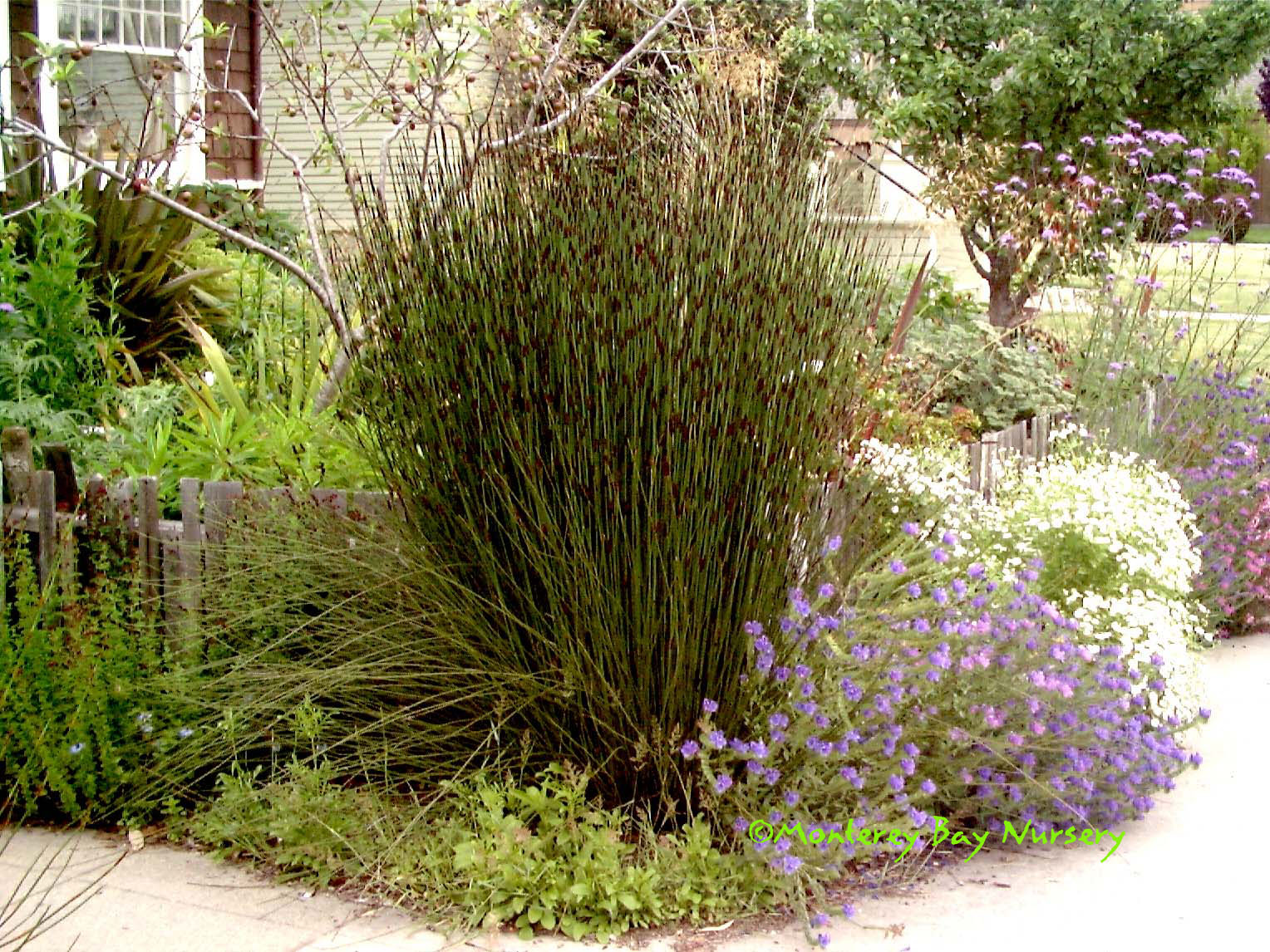
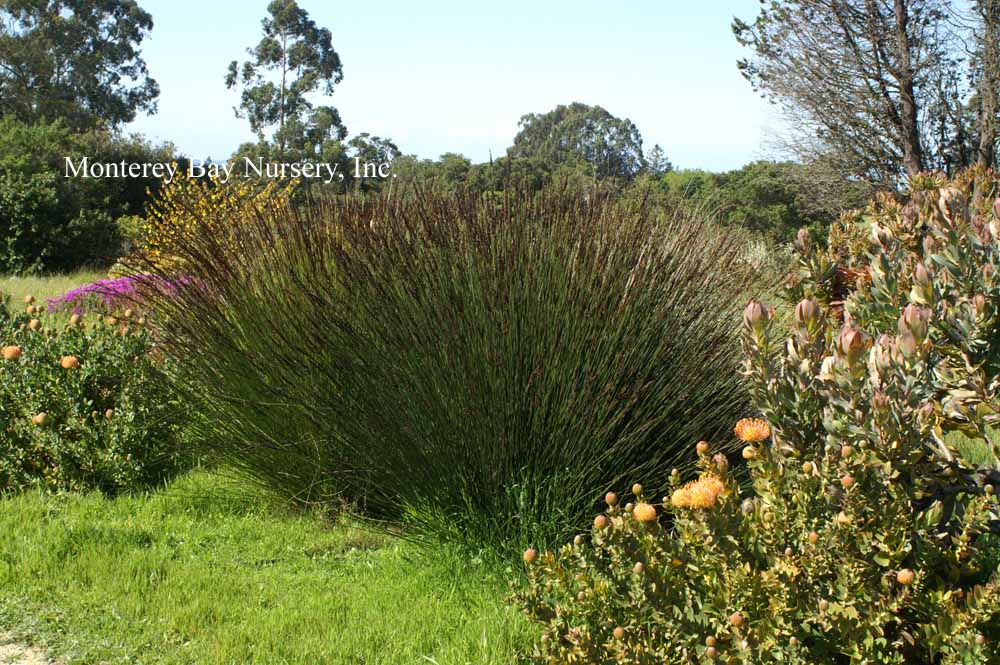
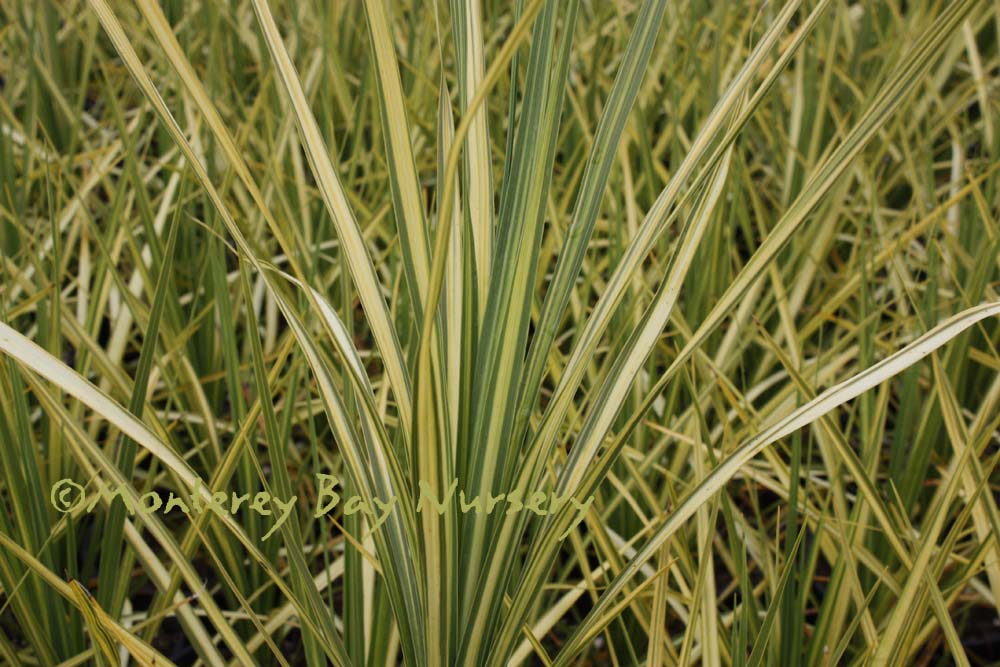
foliosa LEAFY REEDGRASS Ramsey Park, Watsonville Ramsey Park, with 'Aulon' Beach Strawberry (Fragaria) June, no water, Watsonville civic landscape a low, compact, evergreen, rare California native endemic bunchgrass found in very cool locations along the North Coast. It produces nice, chunky, tan flower/seed heads against grey to dark green foliage. It only gets about a foot tall by 18-24" across, takes full sun or grows in part shade mixed with shrubs, and can grow with immediate coastal exposure or in the Coast Range valleys. Good drainage, moderate to infrequent watering, stressed by Central Valley heat or Santa Anas. USDA zone 8/Sunset zones 5-7, 14-17, 22-24. Graminae/Poaceae. rev 4/2021
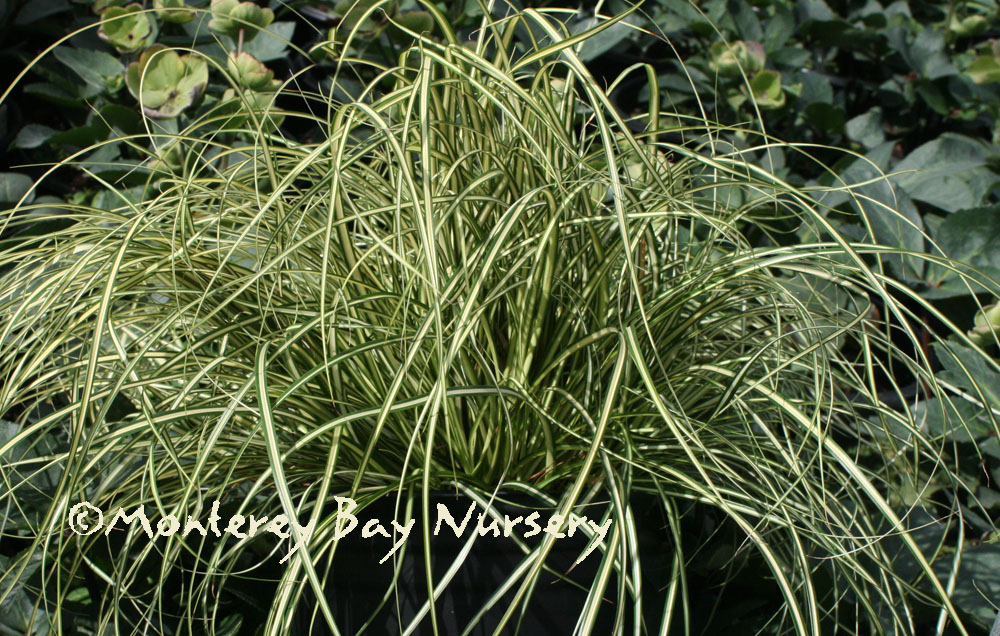
'Karl Foerster' FEATHER GRASS commercial application a hybrid between C. arundinacea and C. epigejos, this clumping form sends deep green vertical stems to around 4' tall. Erect panicles of wispy purplish flowers extend 2' higher then mature and age to straw yellow, holding as an attractive ornamental feature through winter. Cut it back in late winter before new growth emerges. Sun, average to infrequent watering (when established), frost hardy to USDA zone 7. rev 10/2024Calandrinia spectabilis nice landscape plant flowers up close center divider, downtown Watsonville at our San Juan facility it's quick, it's spectacular, and it's got blue foliage. This low, shrubby succulent is grown for its striking powdery blue foliage and iridescent magenta purple flowers to about an inch across that wave from long wand-like flower spikes well above the plant from spring through fall. In reality it seems to be a truly Daylength Neutral bloomer, depending simply on energy input for flower production, and can bloom through our cyclic warm, wet winters.. It is fast, easy, and rewarding, though it can fall apart with any physical damage, if overwatered, or from any frost. Still it is so easy and noticeable that it is easy to plug into any blank spot in your garden, usually rewarding you within a month with architectural foliage and very showy flowers. For best results grow it in full to part sun with at least reduced watering when established. Tops are pretty frost tender, damaged to near the ground at 25F in my garden in 2007, but established plants can take perhaps 5 degrees colder, maybe more if mulched or with overhead cover to reflect ground heat. In very high winter-rainfall areas it is likely to melt. To about 18" tall (foliage only), 3' across. It can get old and cruddy within 2-3 years and should be either cut back to within an inch of its life or replaced. USDA zone 9. Chile. Portulacaceae. rev 11/2019
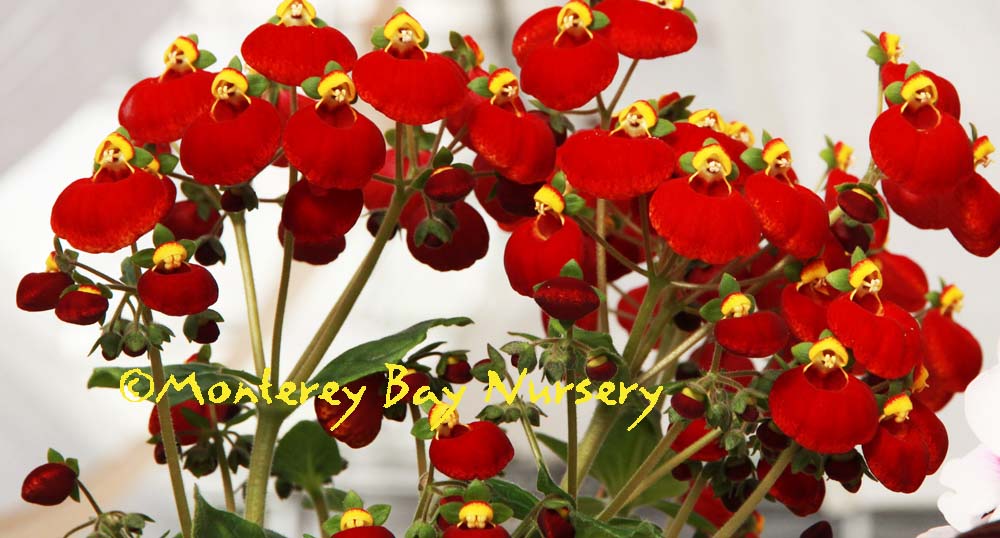
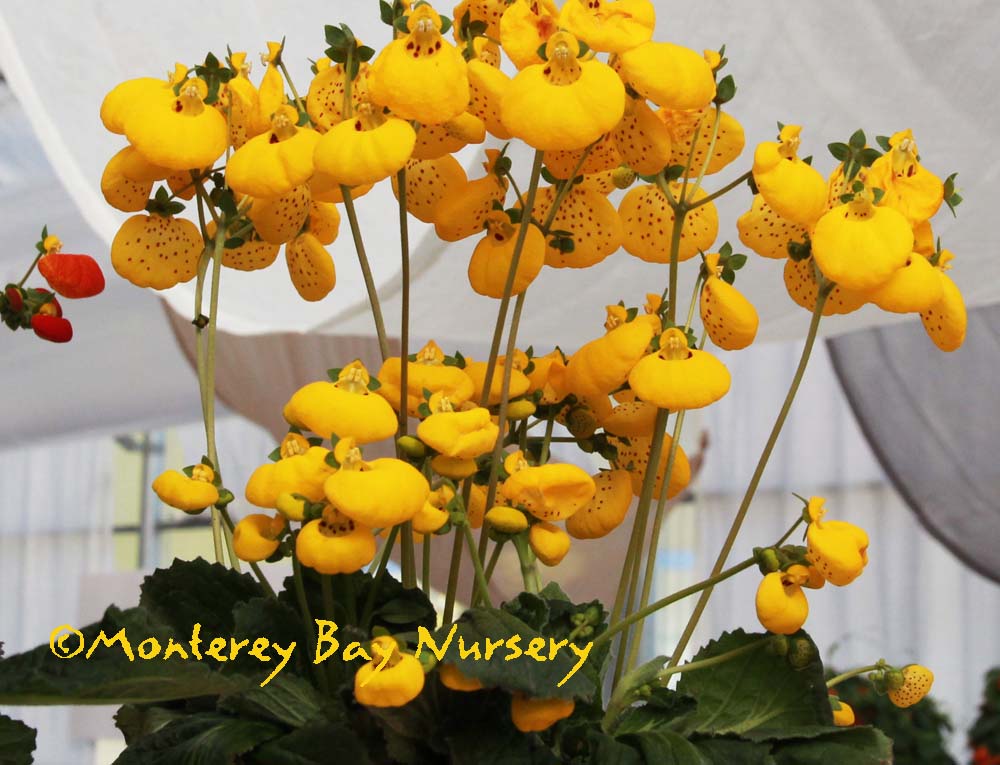
Calceolaria 'Calyopsis Series' SLIPPERWORT, POCKETBOOK PLANT (not currently in production) Red Yellow Red Yellow these new pouch flowers have long stems and look more like orchids than the old-fashioned bedding plant. Irresistible flowers in bright colors, blooming in spring and summer in part shade with regular watering. About 10-12" tall and wide. Dark green crinkly leaves. Hardy to a little below 30F when established, so plant with overhead protection. USDA 9/Sunset zones 16-17, 21-24. rev 3/2015-Suzy Brooks
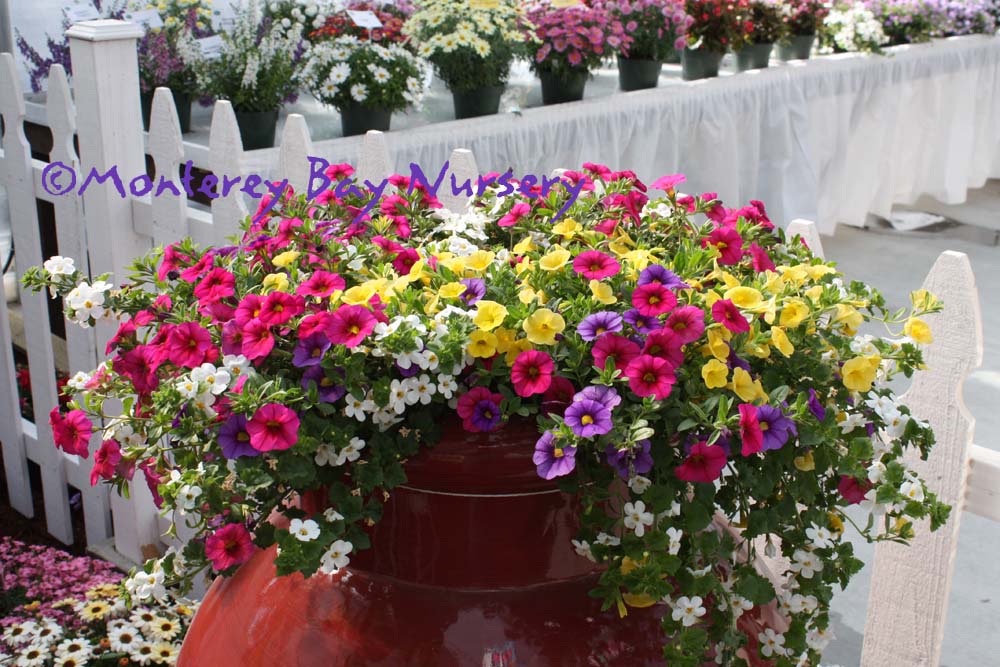
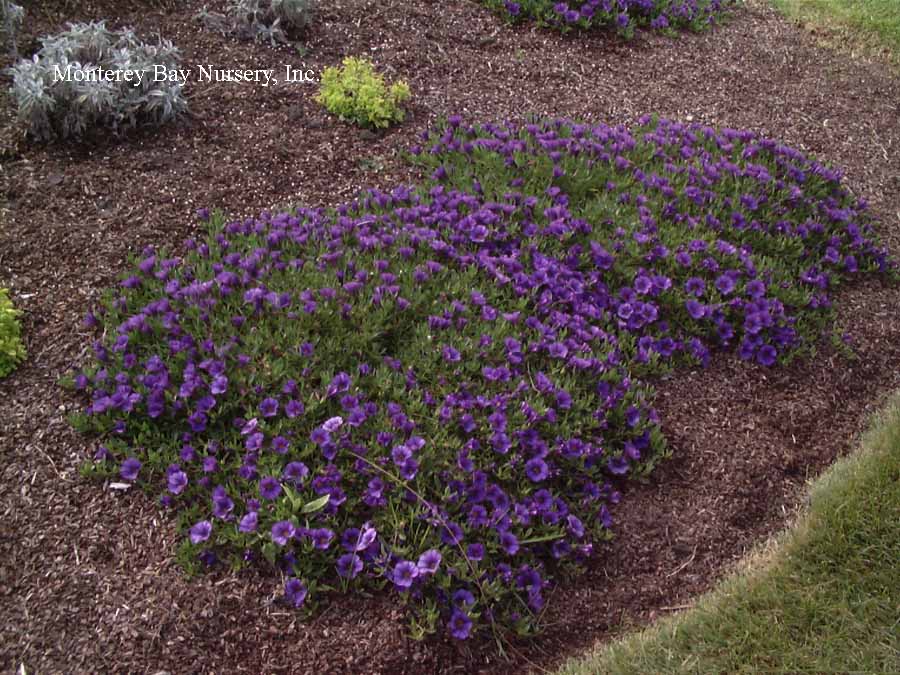
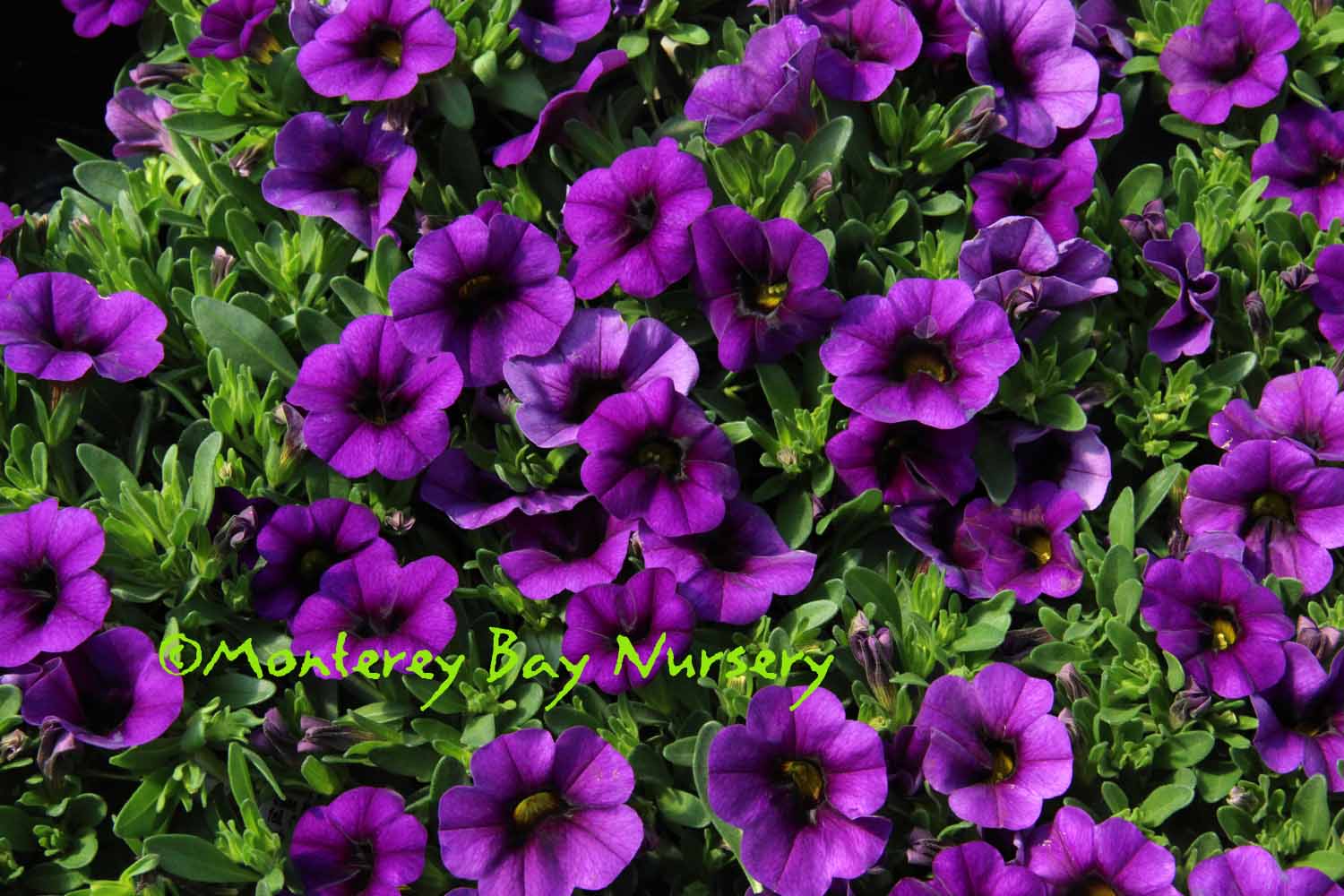
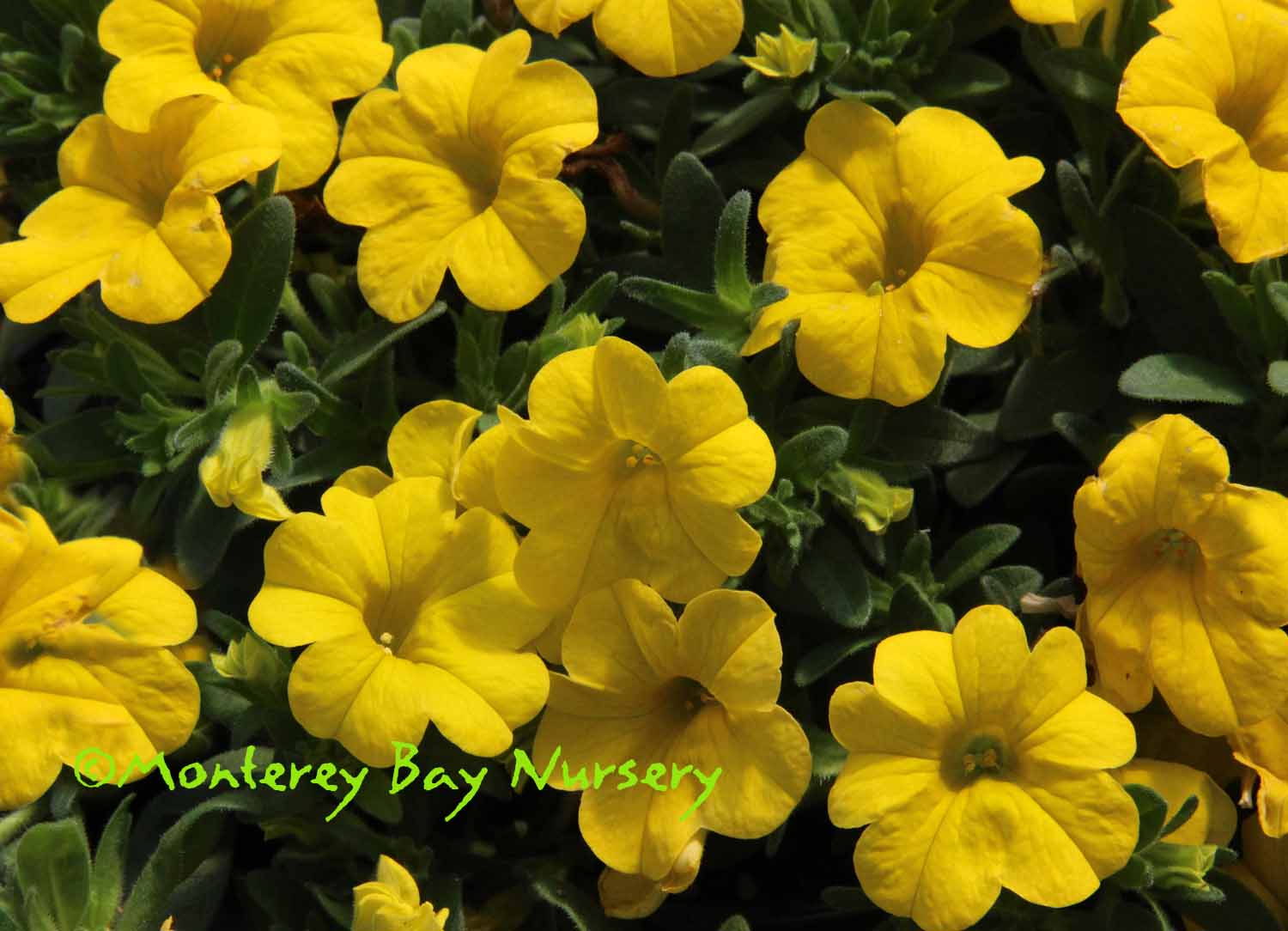
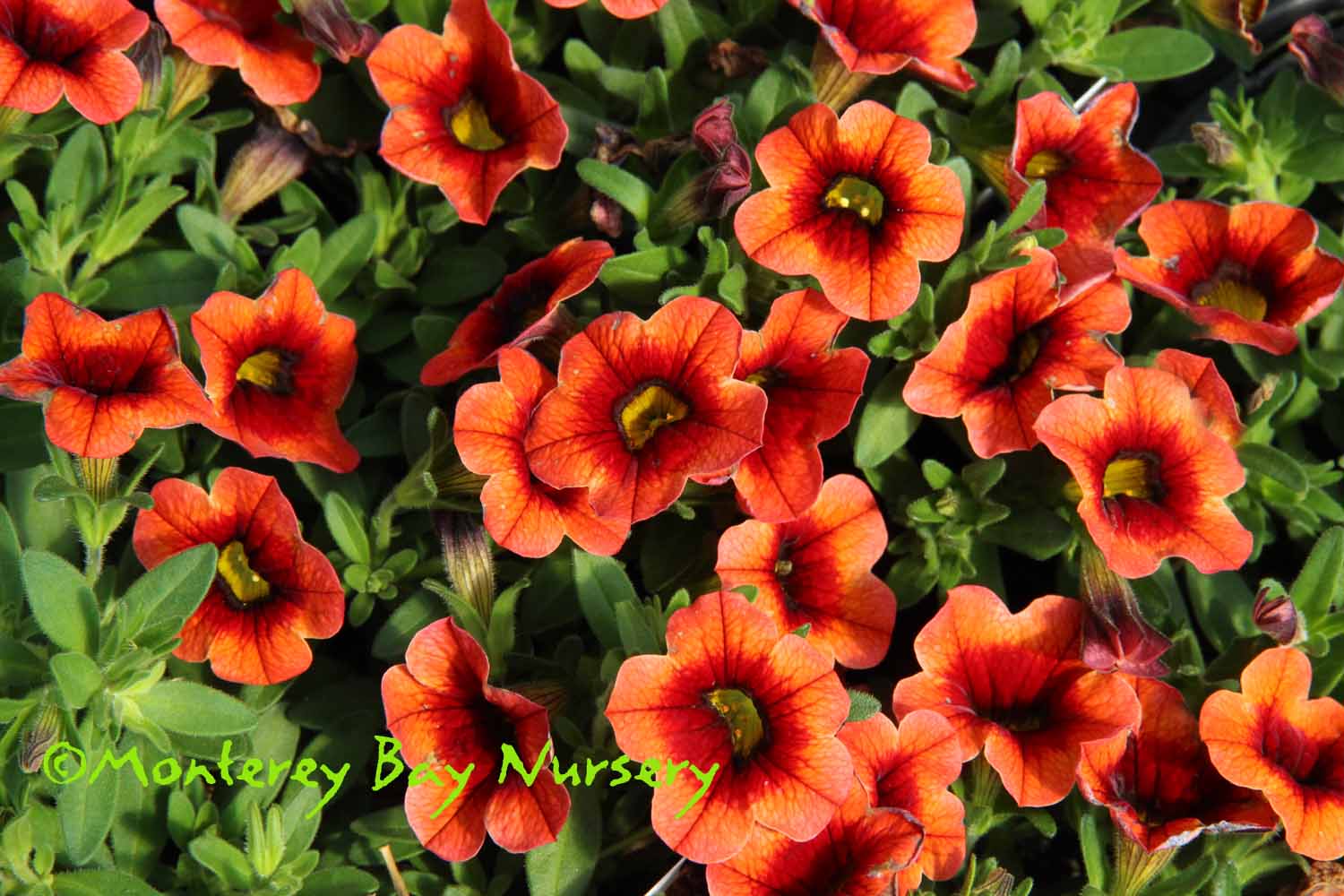
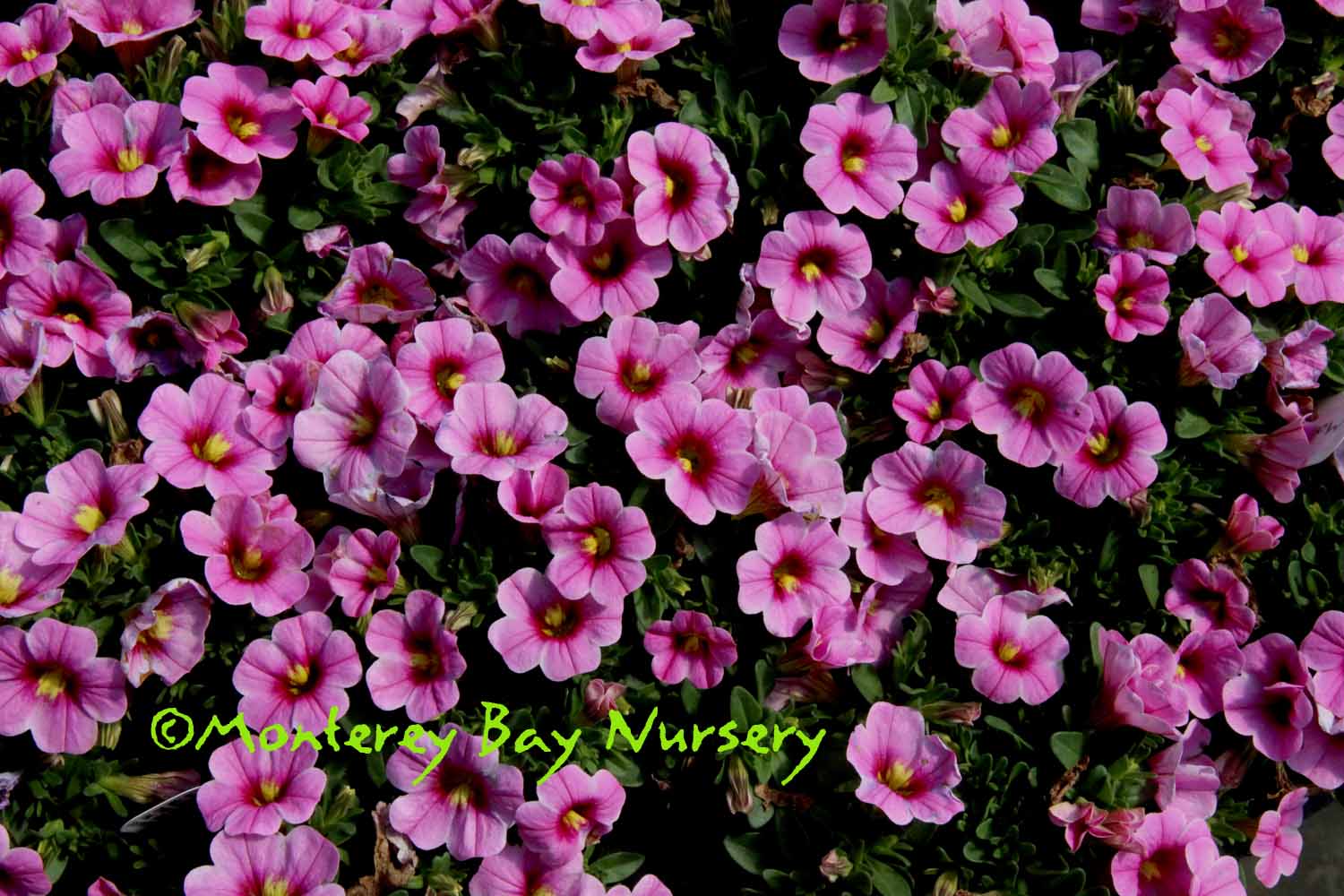
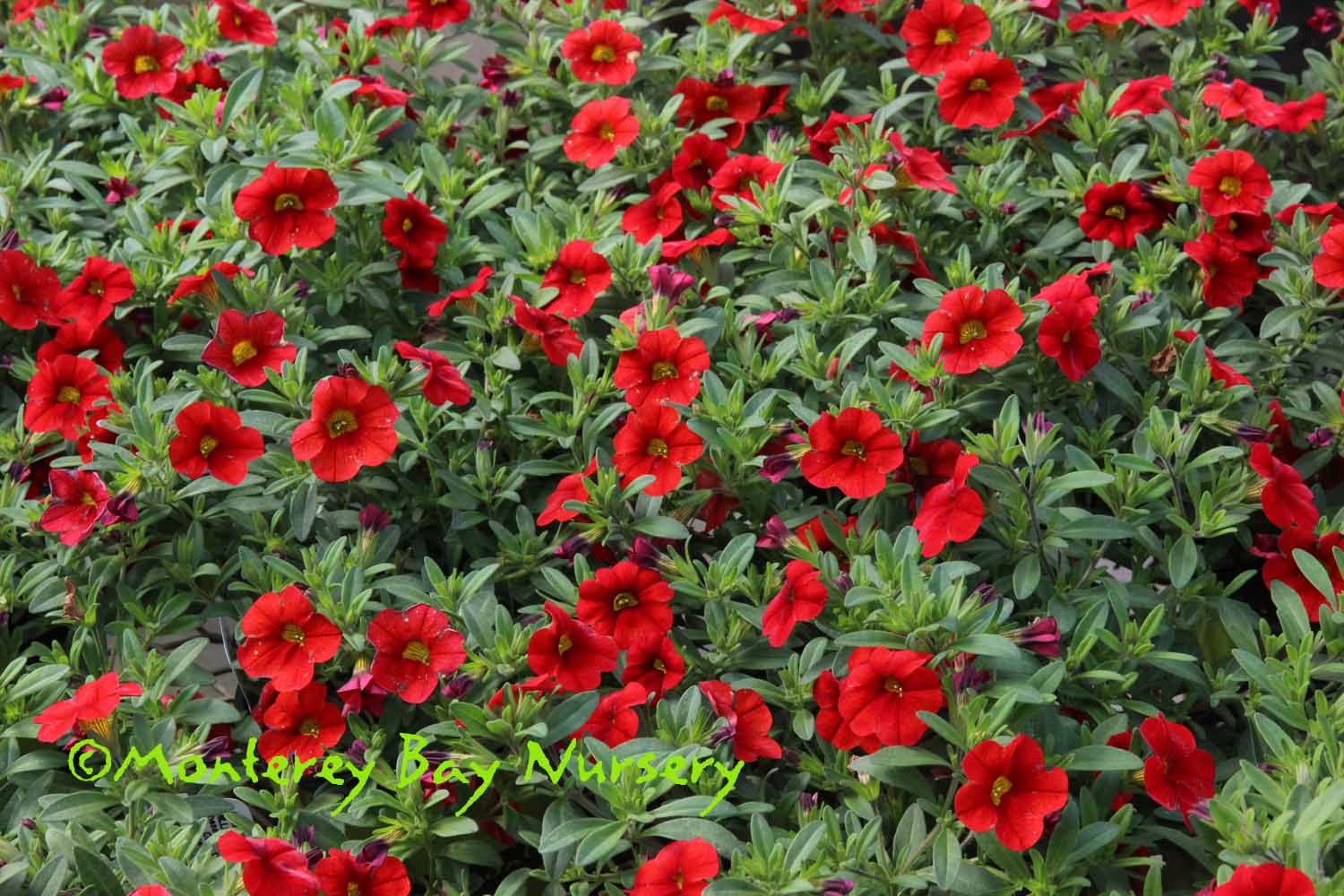
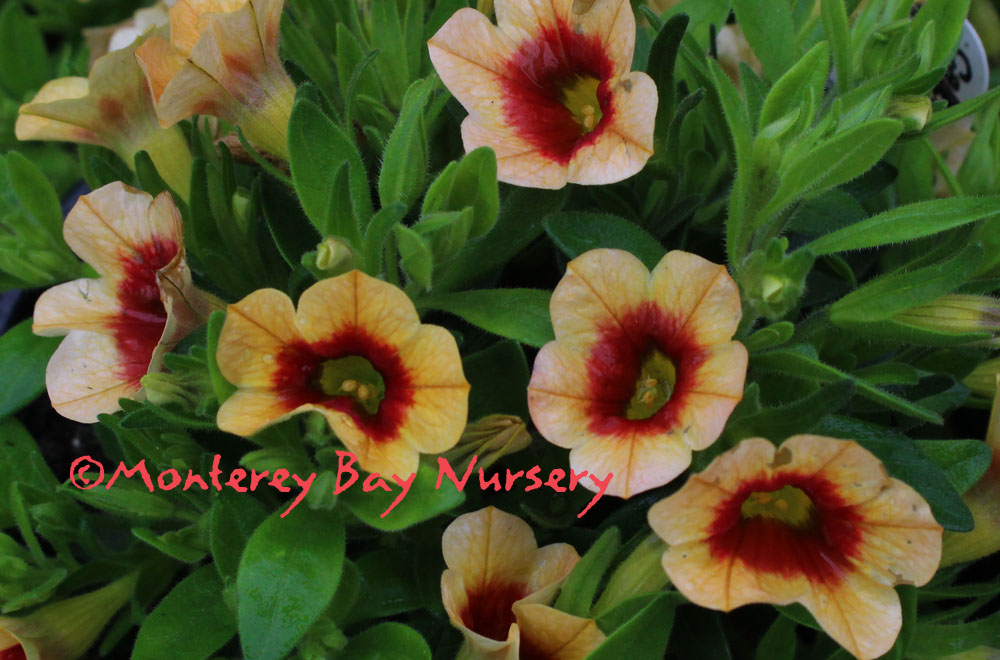
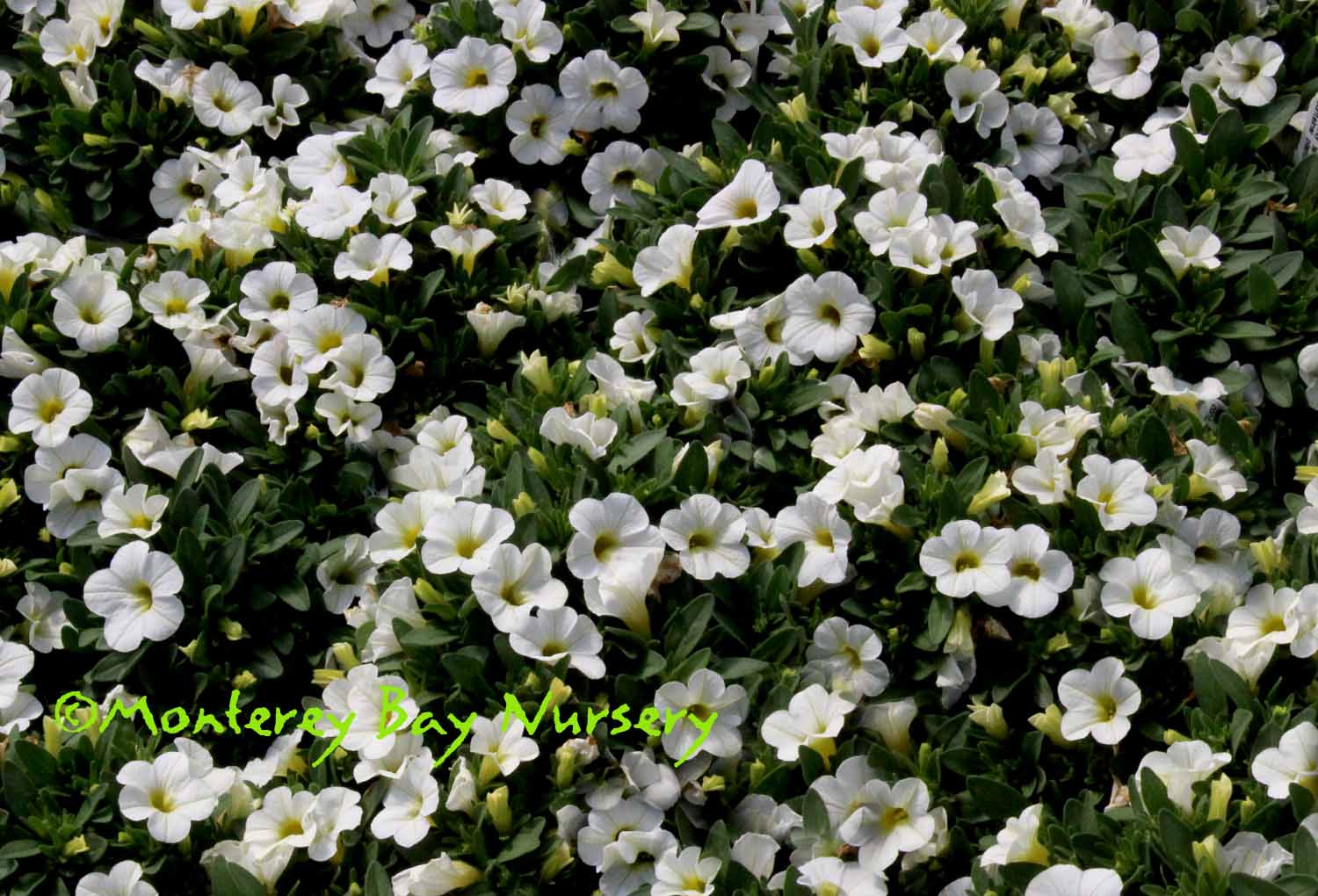
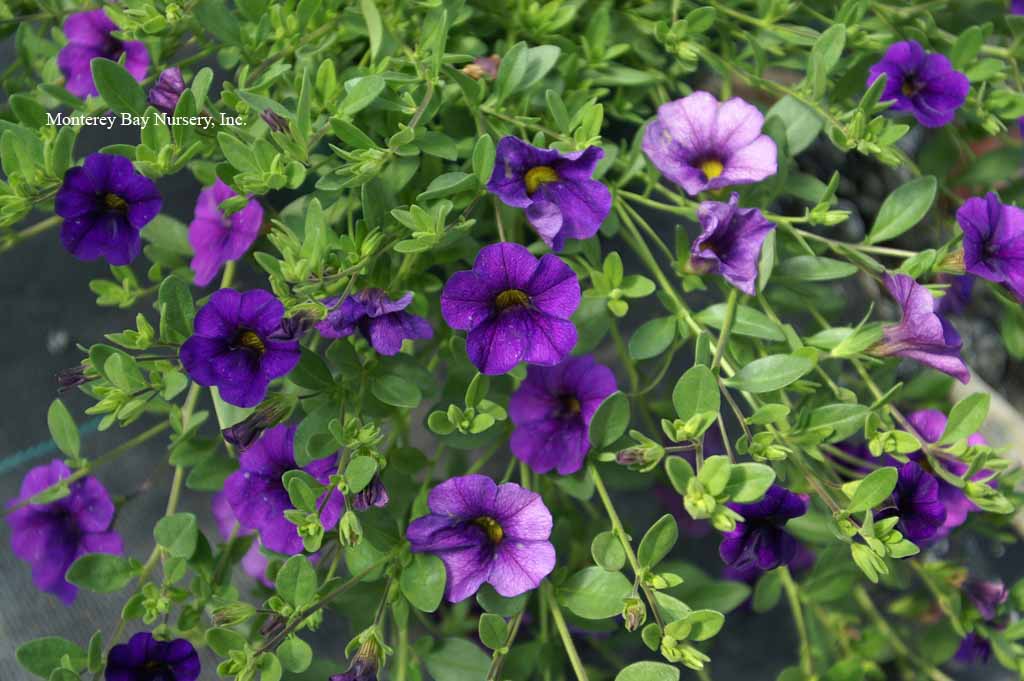
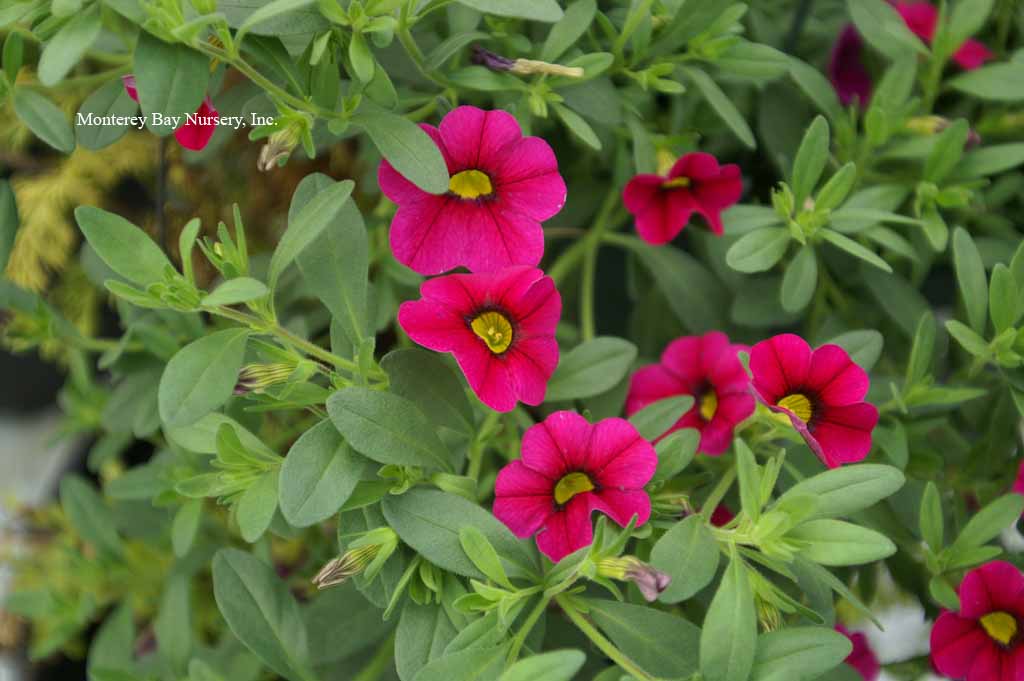
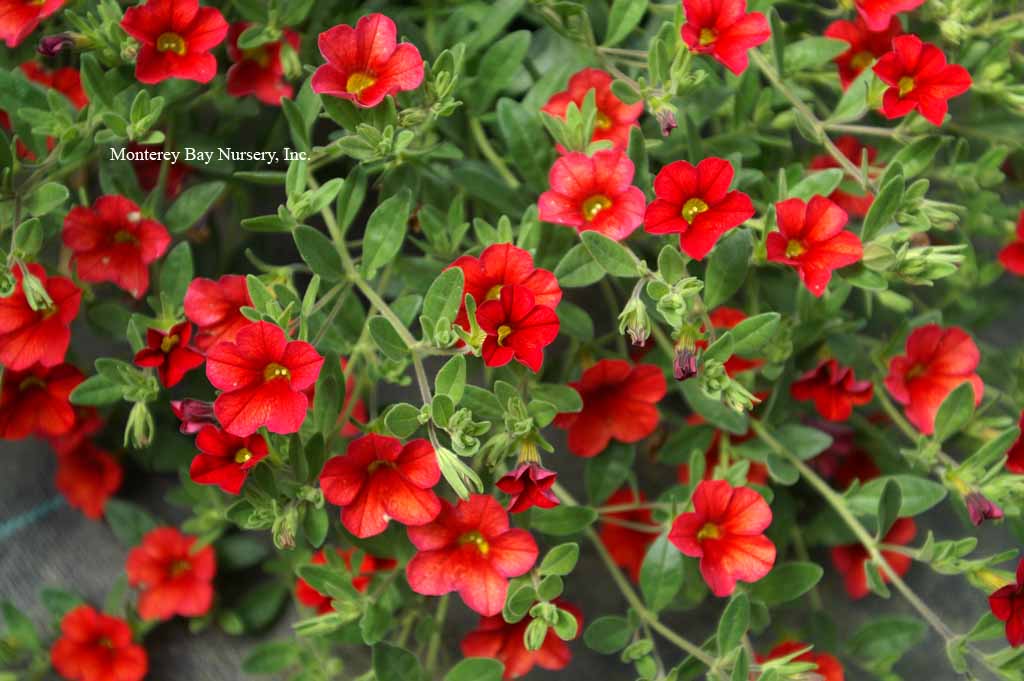
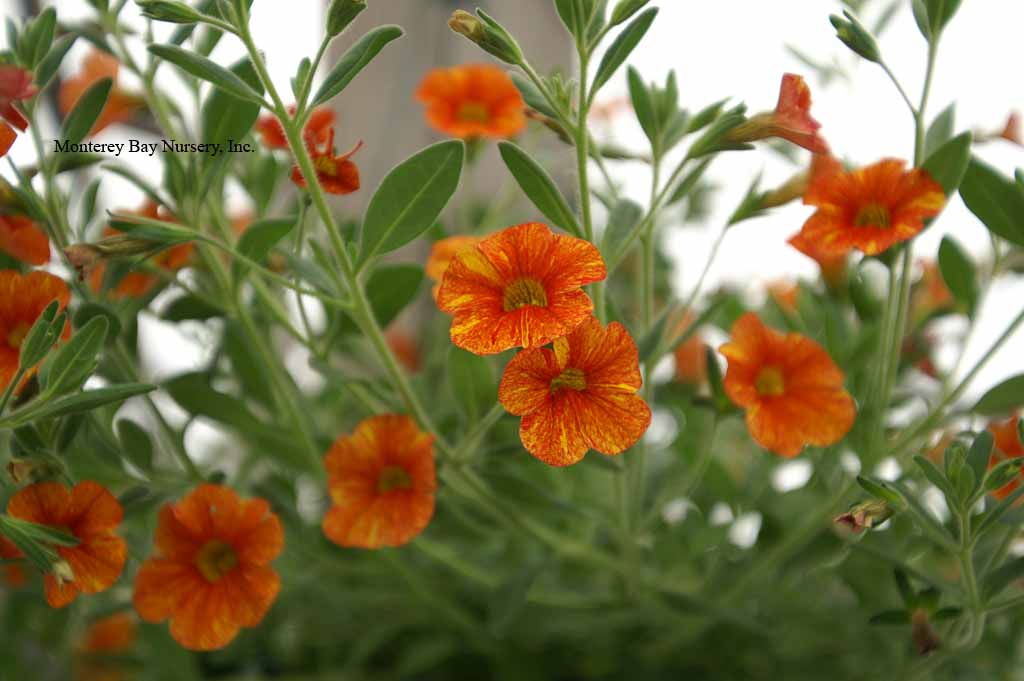
Calibrachoa nice hanging basket as landscape perennial closely related to, and sometimes classified as Petunia, they differ slightly from that genus by chromosome number (18 versus 14), habit (trailing versus upright), and texture (rubbery and durable versus relatively brittle). These prostrate tender perennials or annuals produce carpets of flowers under long day conditions. They are mounding to heavily trailing in habit and make great hanging basket or (with very good drainage) landscape groundcover subjects. They are great for attracting hummingbirds, at least the mounding varieties or any form when used in baskets. They need less fertilizer than the other new amazing “super” trailing petunia strains, which are shameless hogs when it comes to food, but do want consistent regular feeding for best performance. If you feed them and they are still yellow, they probably need more acidic soil and/or iron treatments. Most plants do show yellowing due to iron/soil problems eventually, and the easiest and quickest treatment is using soluble chelated forms. Grow them in full to at least half a day's sun in good, rich, well drained soil with ample watering. South America. Solanaceae. rev 5/201
CURRENT VARIETIES - SINGLES (Conga series) Coral Kiss Deep Blue Deep Yellow Orange Kiss Pink Red Rose Kiss Impr. Sun Kiss White
CURRENT VARIETIES - DOUBLES (Minifamous series) Dbl. Amethyst Dbl. Deep Yellow Dbl. Pink Dbl. Red Dbl. White
NOT CURRENTLY IN PRODUCTION Callie Dark Blue Callie Rose Callie Scarlet Callie Sunrise Callie White Callie Yellow
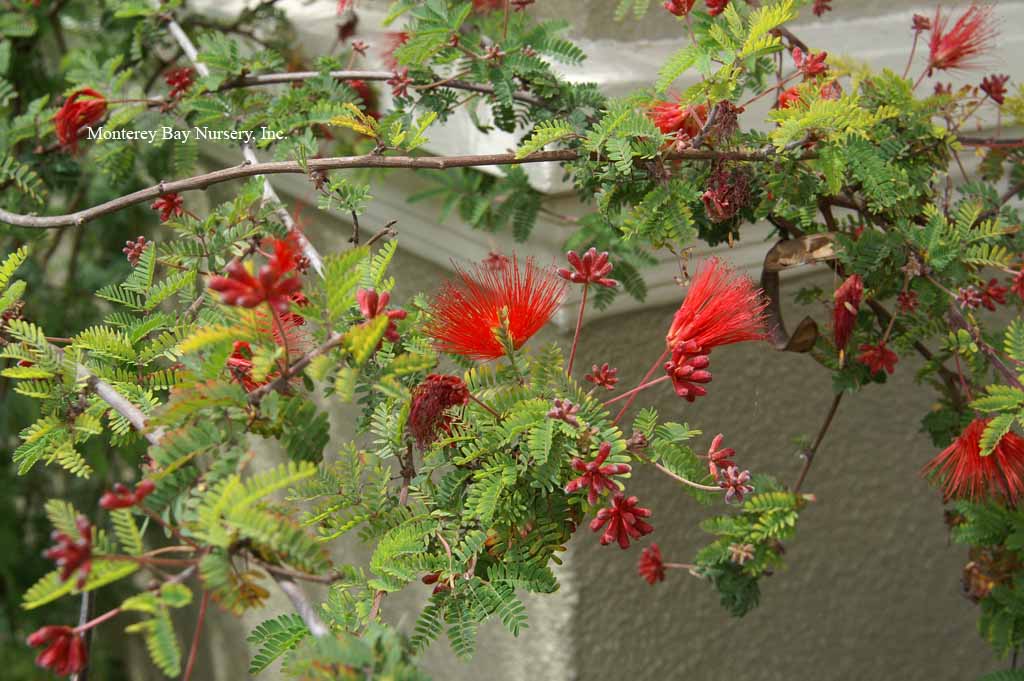
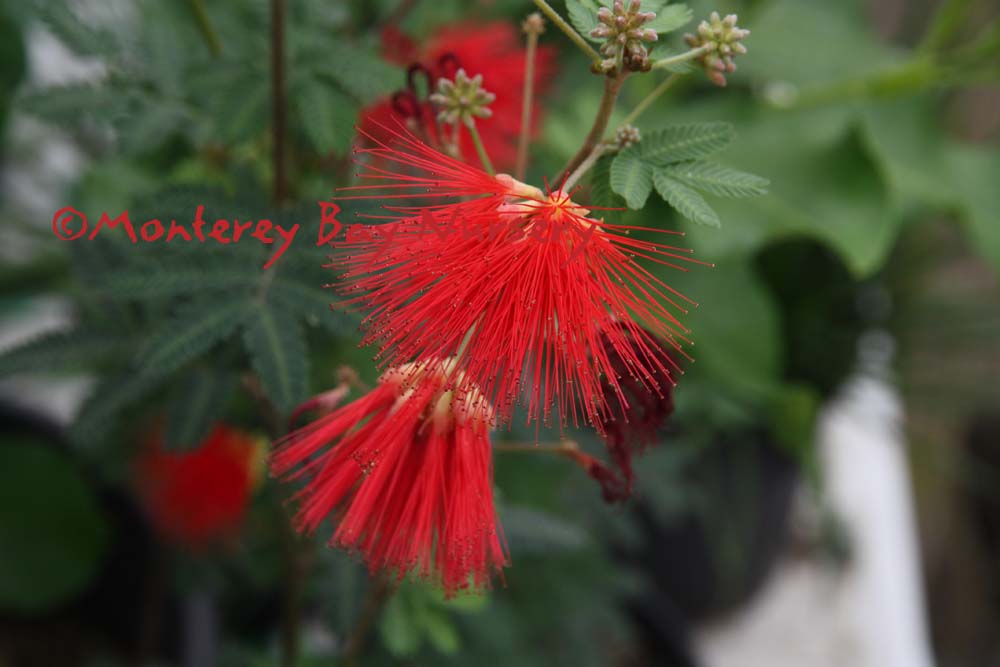
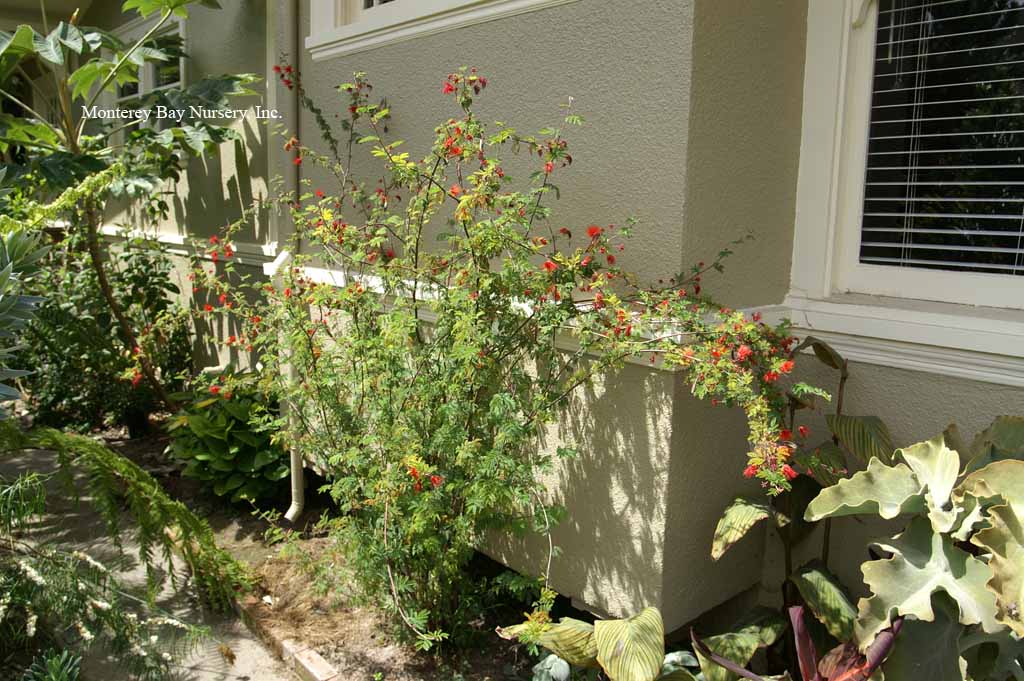
Calliandra californica BAJA FAIRY DUSTER, ZAPATILLO,
CHUPAROSA closeup
very close
natural
espalier in part shade, coastal garden an airy, light
textured, open, rather wispy upright shrub to about 6', with very
delicate and fine-textured grey green to blue grey mimosa-like
leaves to about 1" long and an excellent show of small, brushy
bright red flowers. Besides being really showy the flowers make
this one of the very best plants for attracting hummingbirds and
also bring butterflies and a range of bees and pollinators. This
is yet another interesting plant originating in Baja California,
like my favorite plant, the Mexican Blue Fan Palm (Brahea
armata), and as such is tolerant of a very wide range of
environmental and cultural parameters. In nature it can experience
winters which are long, cold and wet, or warm and wet, or warm and
dry. Summers can be extremely hot and dry, or very cool, foggy and
dry, or warm, humid and rainy. It can experience heavy, warm
monsoon rains when weather systems penetrate from the east in late
summer, or see torrential downpours from hurricanes or their
remnants spinning up from off Mexico's southwest coast in fall.
Plants can display a compact rounded to almost vertical habit due
to the high variation seen in seedlings. (I know of no
cutting-grown forms, or anyone producing them this way at this
point.) Usually it is seen as a mostly rounded shrub in full sun
at 3-4' tall and wide but in bright shade, where it actually grows
just fine, it can become much taller and have a very open shape.
Growing against the east-facing wall of my Santa Cruz home, under
the shade of huge Silver Trees (Leucadendron argentum) and
10' tall Australian Tree Ferns (Cyathea cooperi) it reached
8' tall and was easily kept to less than 2' wide as an
unrestrained, pruning-only natural espalier. It still bloomed
there in the shade but not as heavily as another in full sun, of
course. To a large degree the twigs stayed where I bent them to,
always after 2-3 times. The flowers are small rounded balls to 1"
across consisting of deep red to bright red stamens, with no
readily apparent petals. They can initiate on any new,
seasonally-mature growth that experiences a modest amount of chill
(~55-45F). In most areas this means spring and fall bloom but in
deserts they can flower fall through spring and in cool coastal
areas they can be bloom in waves repeatedly throughout the year.
It does well in containers, achieving great character with age. It
also looks great against any wall because of its zig zag branches,
and the shadows they throw, plus any color background is fine due
to its easy-to-use blue grey to grey green leaf color. It is an
excellent choice for hot areas, even the low desert with
irrigation, tolerating reflected heat while offering more
substance than the even tougher but sparse Desert Fairy Duster (C.
eriophylla), our native California species. It also grows
well in very cool coastal areas, slow until established, always
more compact but usually flowering regularly and heavily. Sun to
part shade, little summer watering except in hot areas, good
drainage, frost hardy to probably around 20°F but can return from
the roots reportedly down to 5F. Baja California.
Leguminosae/Fabaceae. rev 9/2019
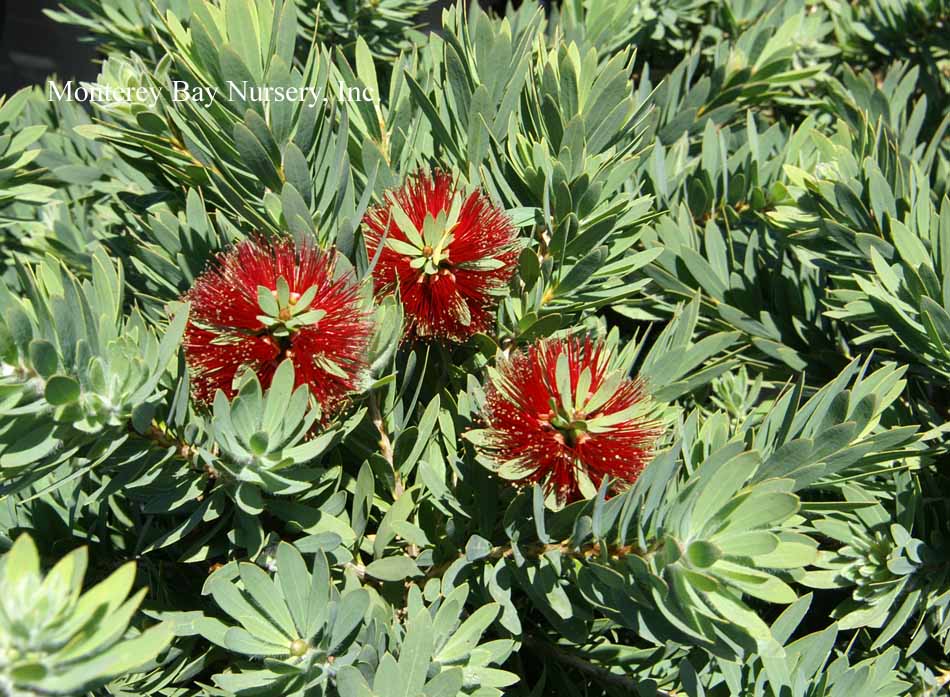
Callistemon viminalis ‘Little John’ BOTTLEBRUSH
flowers &
foliage very dense, compact growth to just 3’
tall and wide. Short clusters of blood red flowers with prominent
golden stamens appear in fall, winter, and spring against blue
grey to grey green foliage. Shows a very neat, regular spiral
pattern of dense, oval, blue green leaves along the stems. Damaged
below 25°F. Myrtaceae. Survives in the warmer desert regions
(Palm Springs, etc.) if watered, even tolerating reflected heat.
Sunset zones 8-9, 14-24/USDA zone 9. rev 4/2012
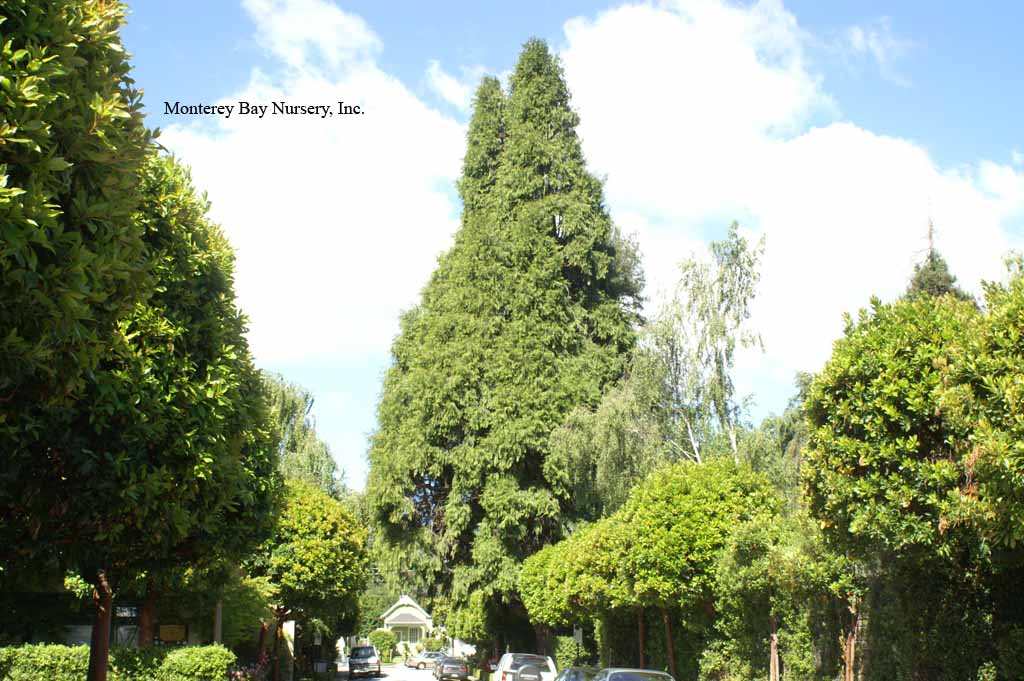
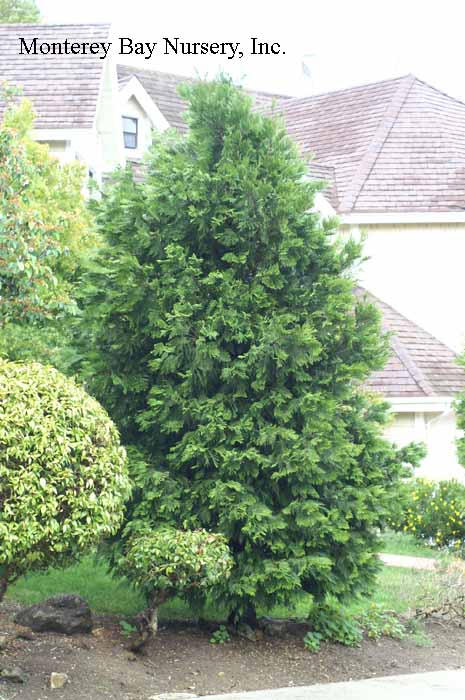
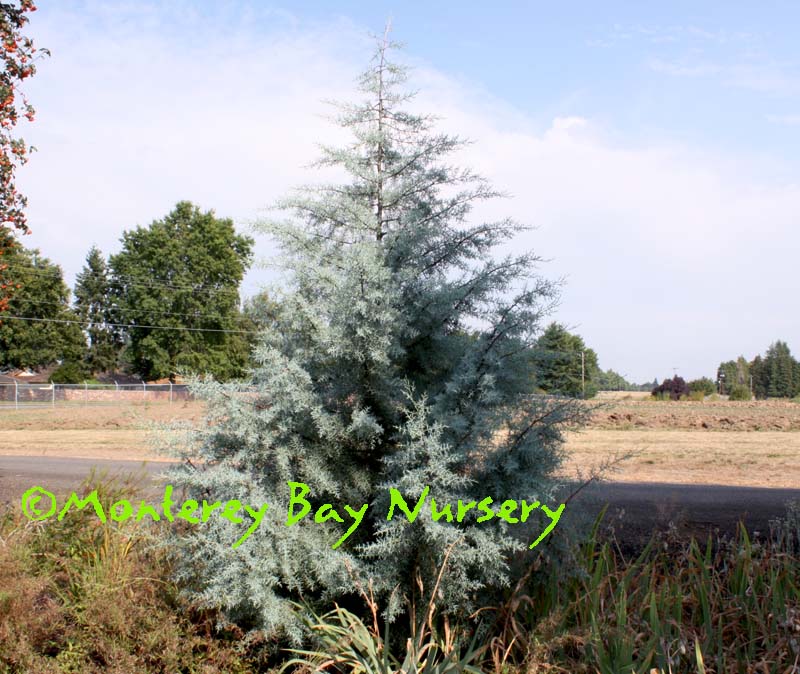
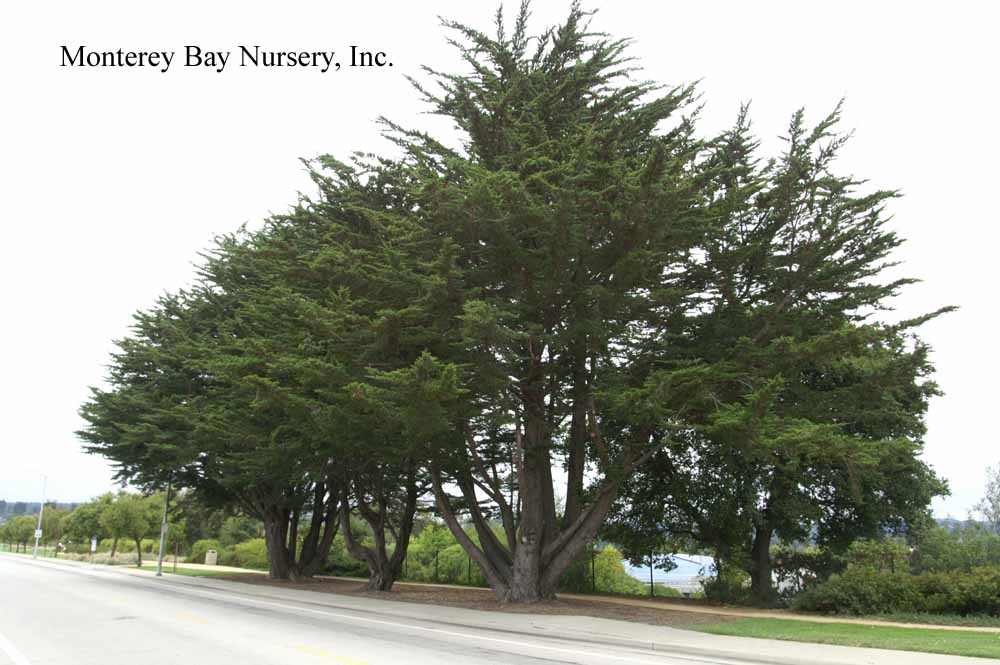
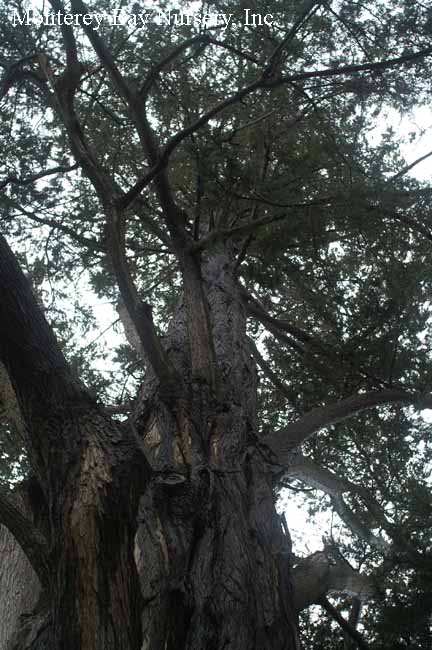
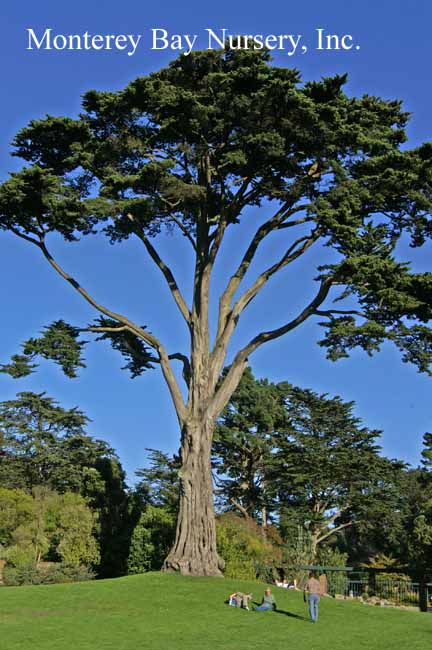
Calocedrus decurrens INCENSE CEDAR Washington Street
fine strapping young
specimen near Spring Street an evergreen tree that is
usually seen in cultivation as a narrow to broadly pyramidal
shaped specimen to 60’ or more, with age. It is almost always
multicrowned, with several to many upright leaders but almost
always retains a narrow top. It has attractive reddish brown,
deeply furrowed bark and the sprays of foliage exude a spicy,
pungent scent that always reminds me of hot summer days camping in
Sequoia National Park. It grows at about 1-2' per year. This tree
is very tough, likes full sun to half sun exposures, needs soil of
average drainage or better and needs little or no summer watering
when established. It is not as bothered at low elevation by
various nefarious twig and needle borers, cankers, and blights as
many other "soft" foliaged conifers (Thuja, Chamaecyparis, etc.) from colder winter
regions. Frost hardy up to the Fir Belt of the Sierras (about
6000'). Coast Ranges, Sierra Nevada. Cupressaceae. rev 3/2009
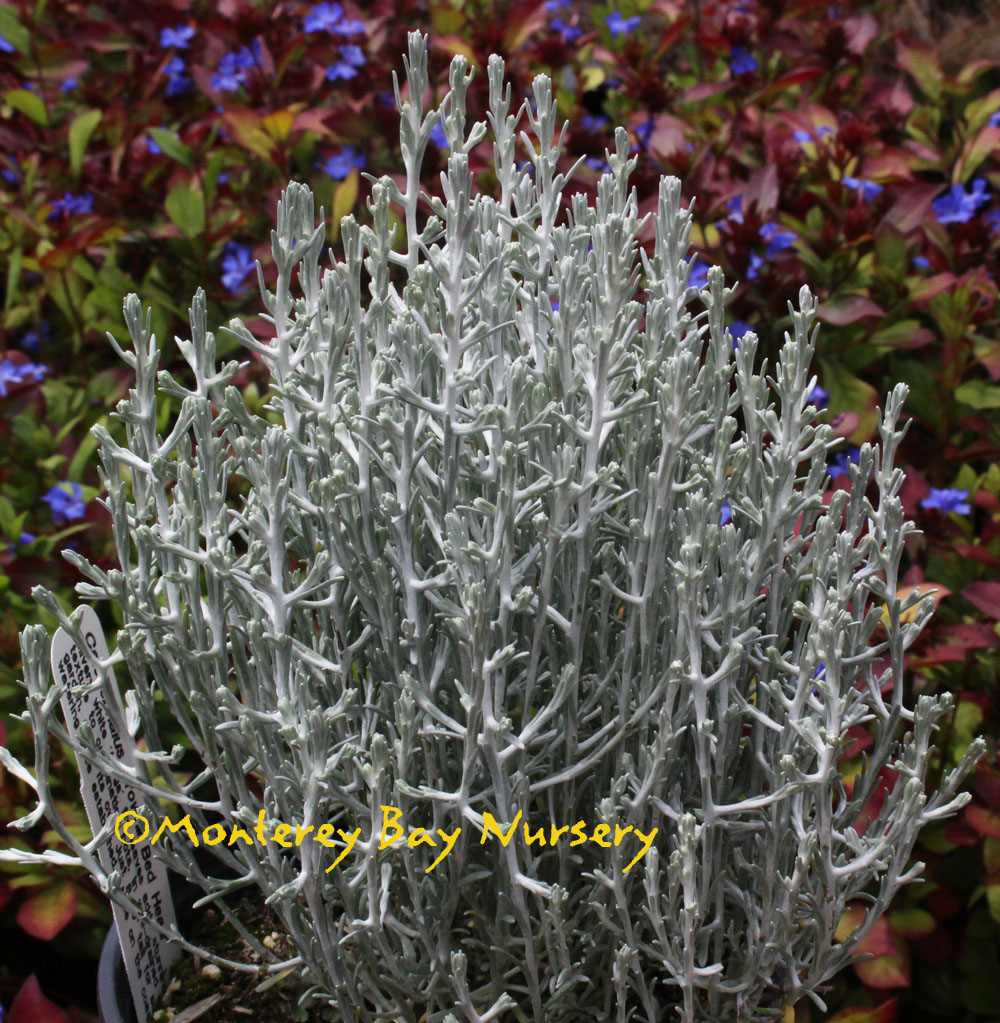
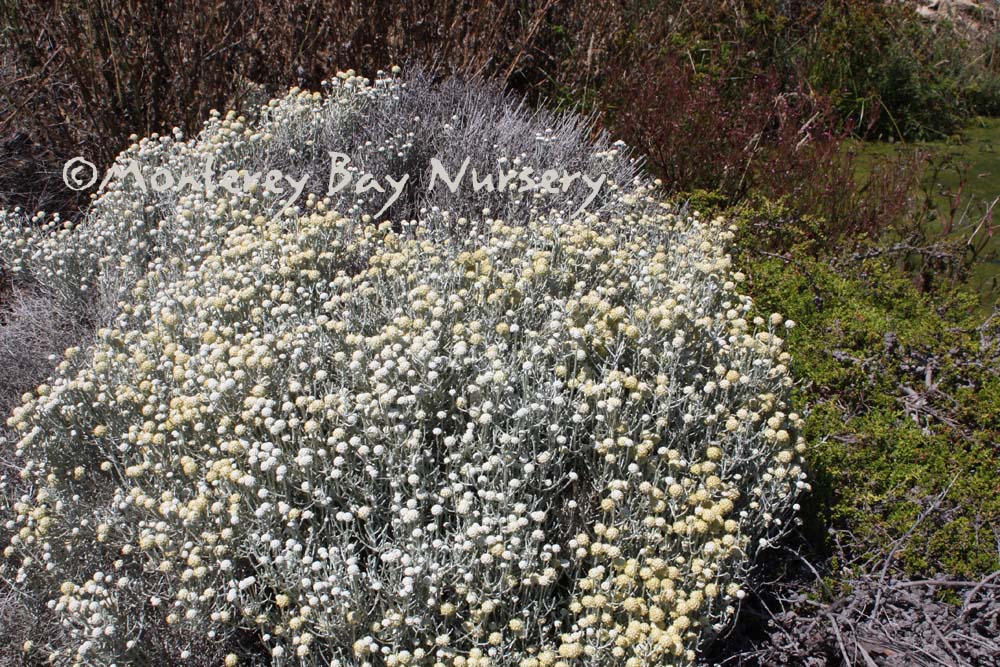
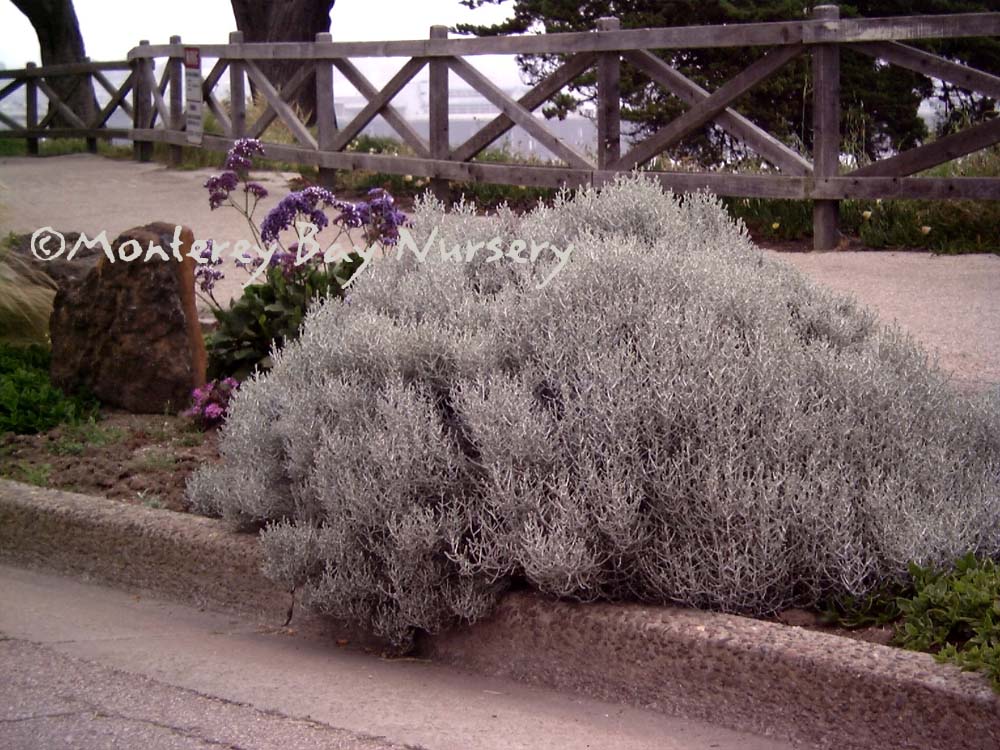
Calocephalus brownii Bed Head CUSHION BUSH twisted branches starting to flower fine plant, West Cliff Drive another fine plant, West Cliff Drive an especially tortured, twisted, curly form of this dense, mounding, very silvery evergreen shrub, which becomes dense, wiry mass of very silvery to silvery white stems. Small silvery flower-bud spheres appear all over the top of the plant in summer and produce a respectable show of tiny, tight, light yellow flowers. This is a great container plant, solitary or combo, but for most of the country that's about all it is because of its Mediterranean-climate requirements and lack of extreme cold-hardiness. Here it is a great garden or landscape addition, and looks particularly good mixed with grasses and other dry or chaparral environment selections. It can take wind, direct salt spray, and extensive drought once established. It looks great contrasted against other plants, mixed with large rocks or even featured just by itself in a container. Sun to a little shade, average drainage or better, tolerates alkaline soils. Sunset zones 8-9, 14-24/USDA zone 9. Australia, with a very broad distribution. Prune it hard if it starts to stretch unattractively, or die out. USDA zone 9/Sunset zones 14-17, 21-24. Australia. Compositae/Asteraceae. rev 7/2017
Calylophus drummondii SUNDROPS deep golden yellow flowers a small perennial, native of the Southwest that provides plenty of bright golden spots of color in any well drained, warm, sunny location. Big bloom in spring and more in fall. Makes a nice groundcover with succulent plants like Agaves, or Aloes, or on a bank, or on a slope, or with rosemary and lavender. About 15" tall and spreading to 2' or more. Average to little watering once established. Sunset zones 1-3, 6-16, 18-24/USDA 5. rev 5/2012-Suzy Brooks
Campanula ‘Blue Gown’ flowers spreading to trailing evergreen or semideciduous perennial is similar to C. poscharskyana but more restrained and neater looking. Dense crowns of foliage break into sprays of bright blue flowers, each with a white eye. Leaves are often very hard, dark green, somewhat hairy, and with a conspicuously frilled margin. Tends to retreat to a relatively tight clump after spring bloom, then flush again in fall. Sun to mostly shade, presumed very frost hardy. USDA zone 7-6? Campanulaceae. rev 8/201
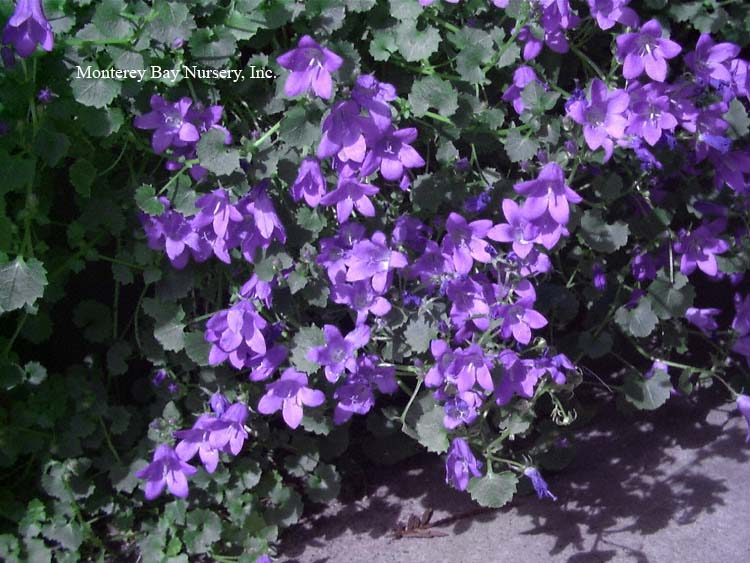
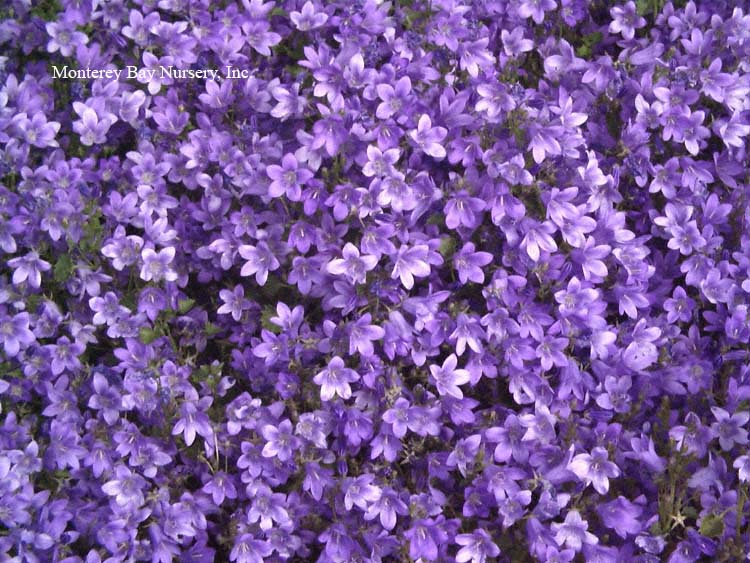
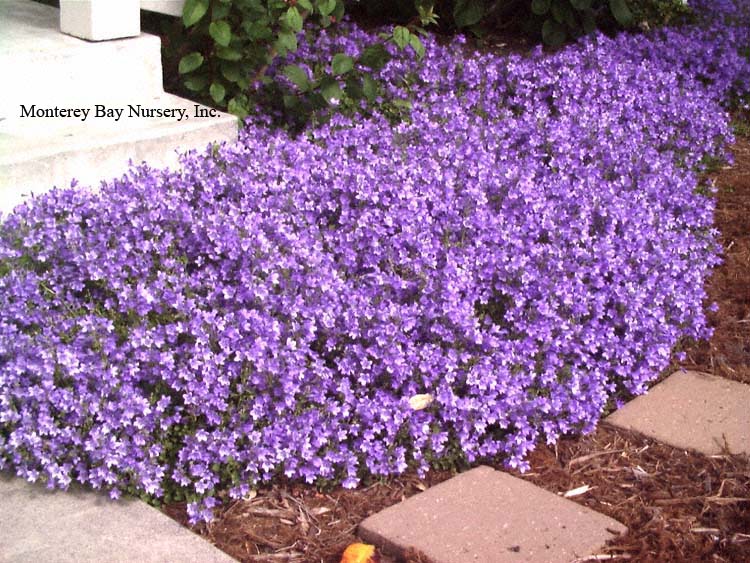
portenschlagiana (muralis) DALMATIAN BELLFLOWER flowers masses of flowers nice planting a mounding to trailing evergreen to deciduous perennial to 6" tall, spreading with age. Dark purple blue, bell shaped flowers to 1" long appear most of the year, heaviest in late spring and summer. Sun to part shade, average watering. Adriatic Mountains. USDA zone 4. rev 8/2014
poscharskyana 'Dickson's Gold' (not currently in production) mostly full sun stone sink, Strybing Arboretum a very slow, tightly clumping, golden-foliaged selection. It is relatively bigger and lusher in shade but I have also seen it used in stone sinks with alpines and other scree plants growing in full sun. The light blue flowers look great against the foliage but it then doesn't bloom much, just briefly in summer. In full sun it grows very slowly and is prone to burning on hot days in clear, dry air (California, etc.). This is much, much different from the regular green-leaved, fast growing species itself, it will never form a large plant. Full sun to mostly shade, average watering, probably not as hardy as the species itself due to lower vigor, guessing USDA zone 6? rev 8/201
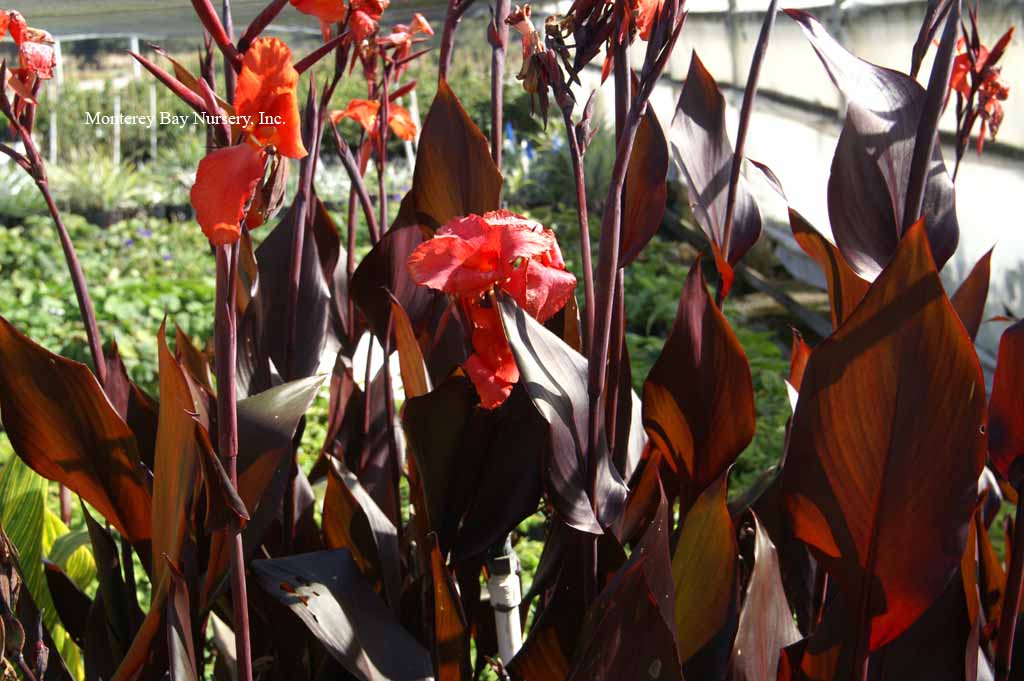
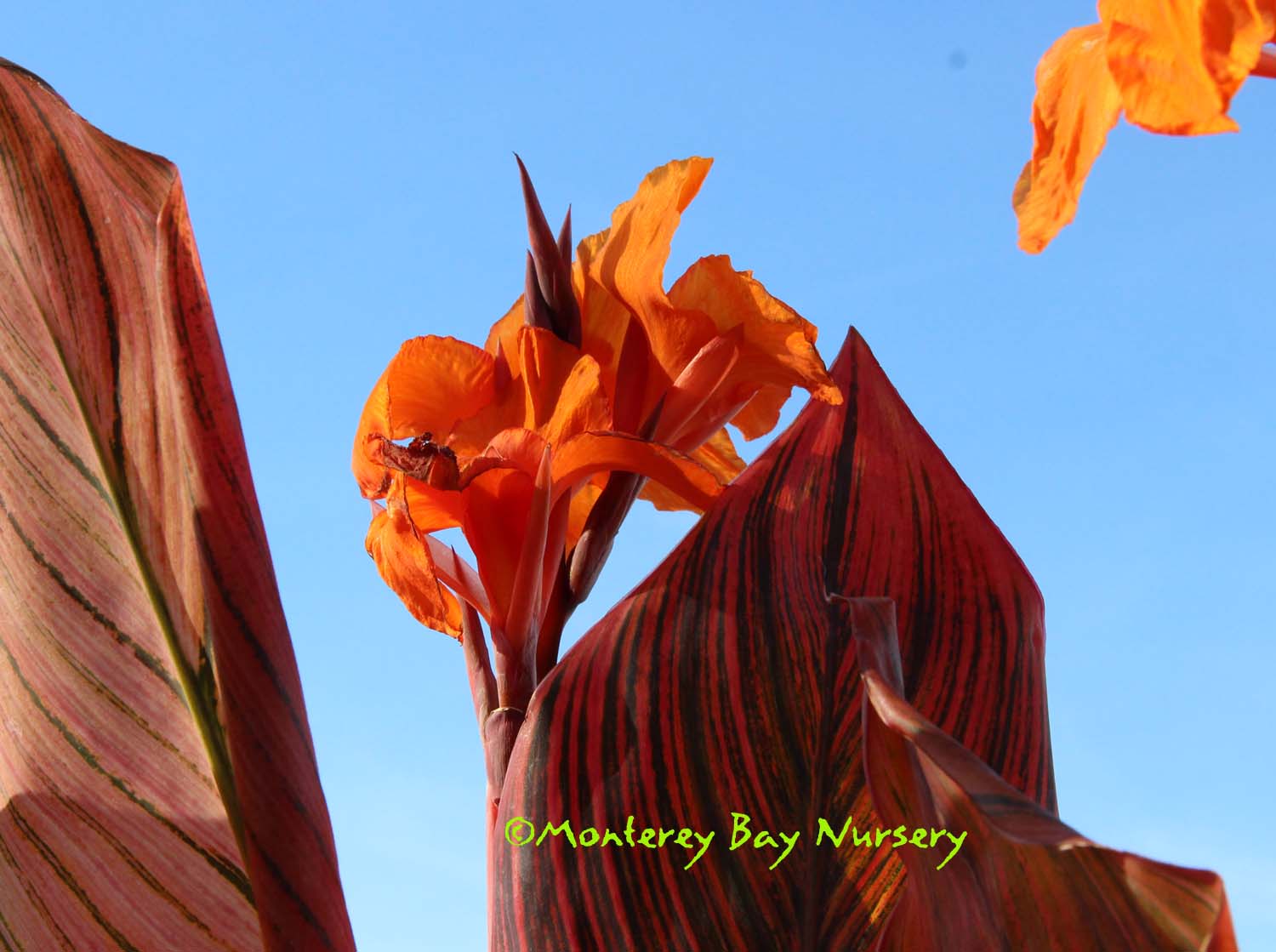
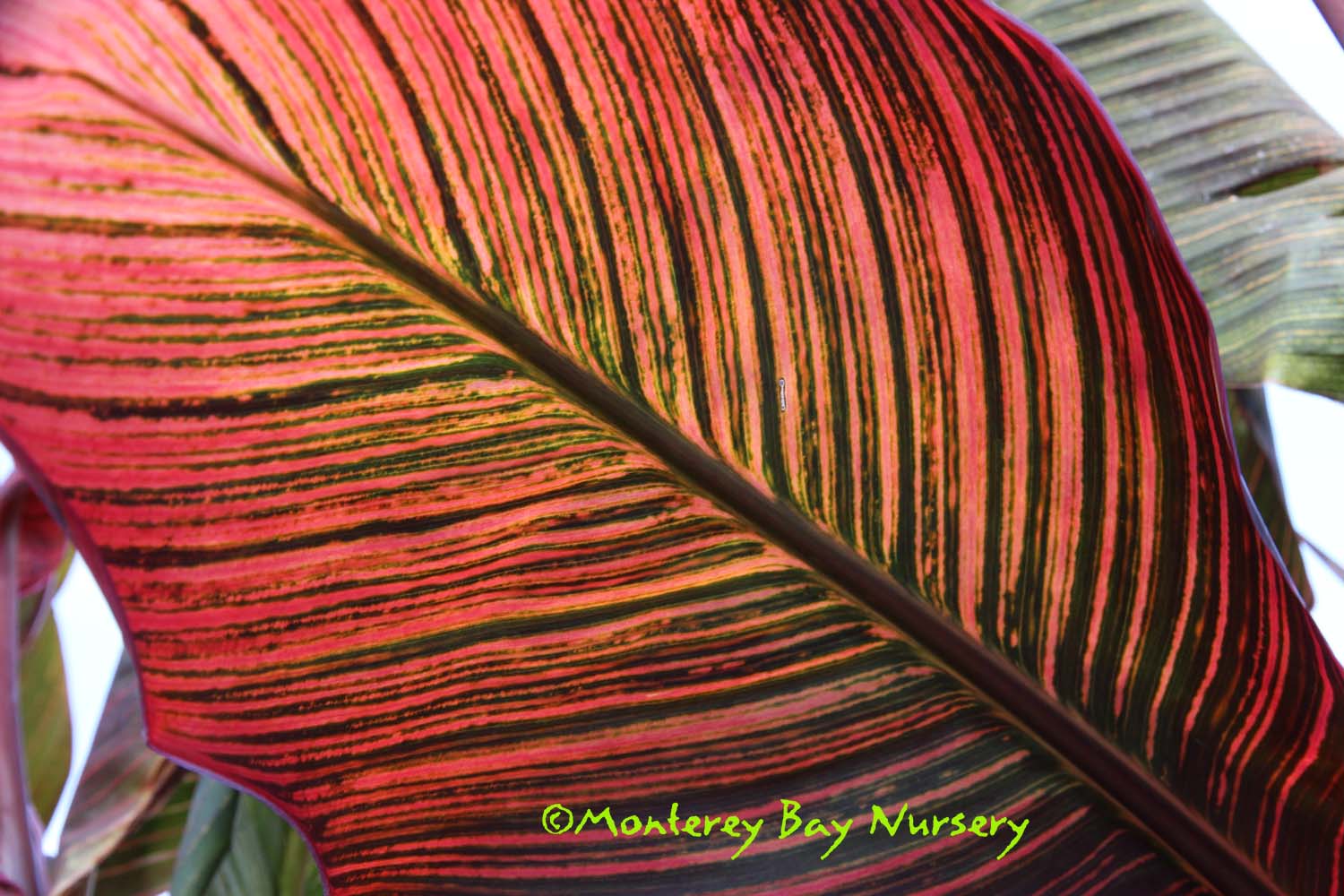
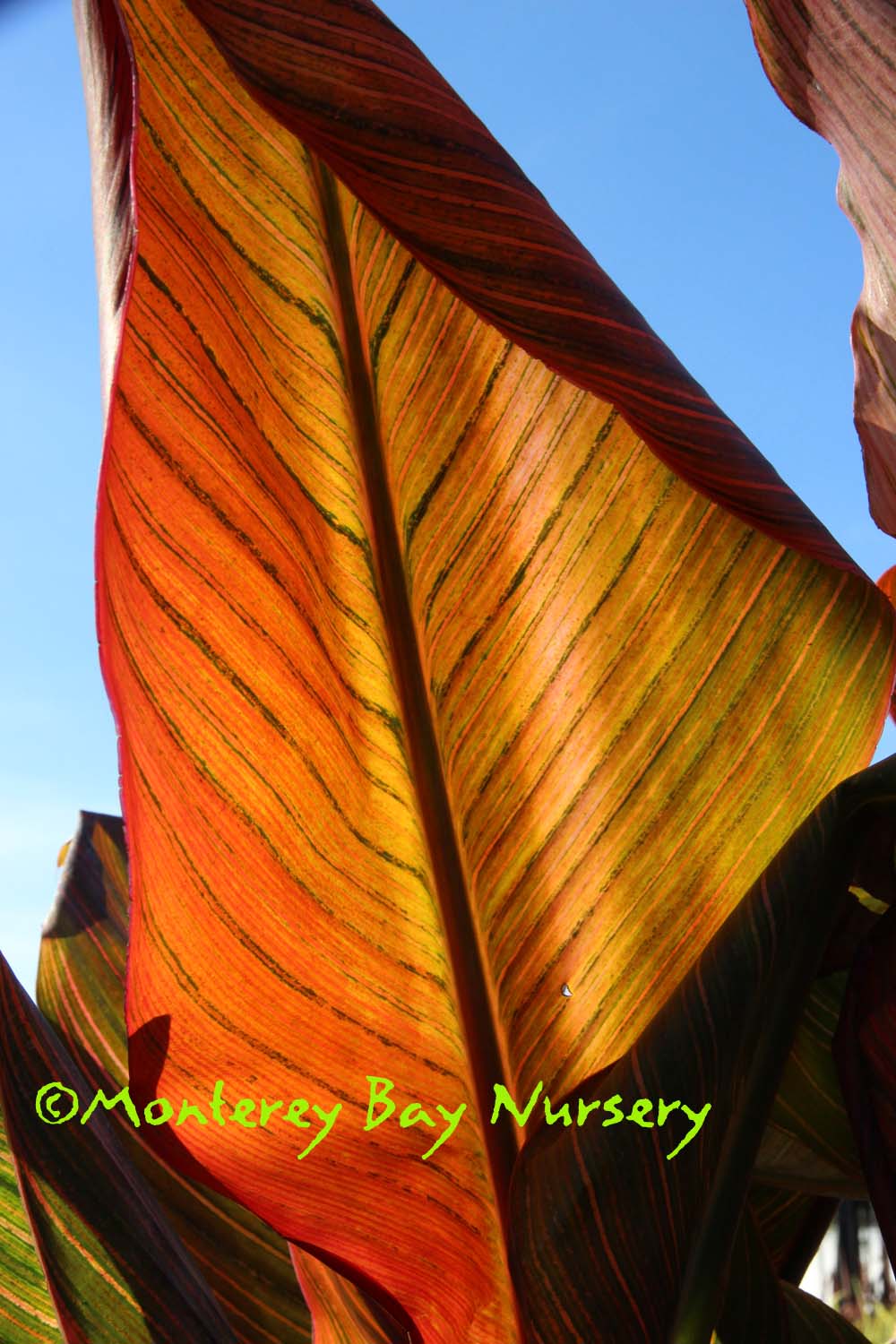
Canna evergreen to deciduous rhizomatous perennials grown for dramatic foliage, flowers, and form. They have really been rediscovered as part of the new appreciation of foliage as a primary design element. Most do best in full to part sun, and in my experience they sulk if they don't get direct sun during cool springs. Dramatic as specimen container plants, especially against a wall. They are tough and will survive on little watering when established but for superior leaf quality, vigor, and bloom irrigate deeply and regularly. USDA zone 7/Sunset zones 4 and higher. rev 4/2008
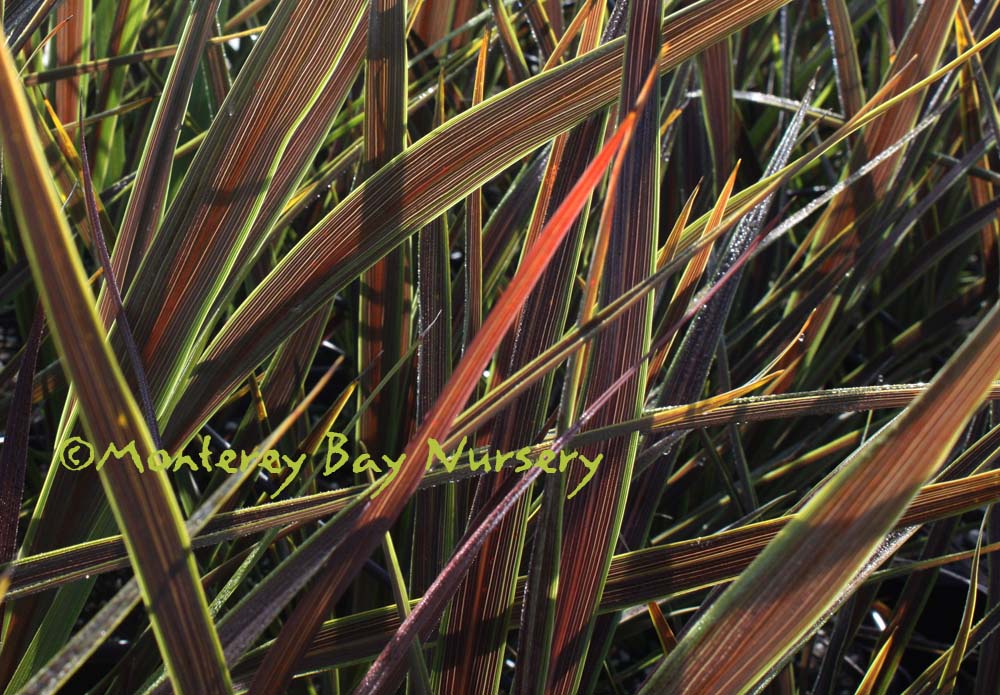
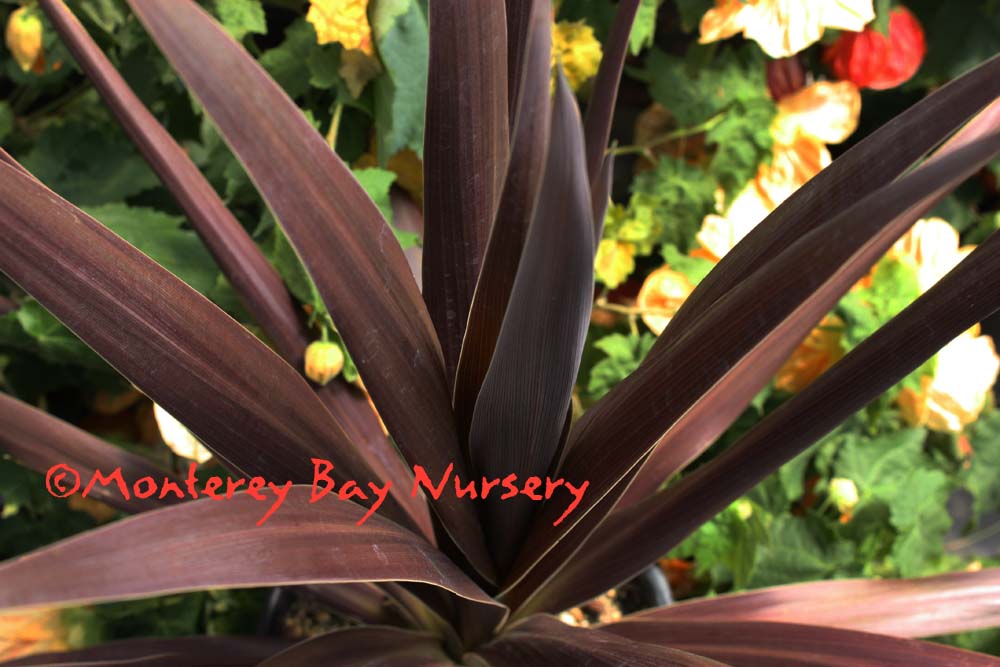
‘Australia’ flowers and foliage luminous burgundy-black leaves in full sun, lighter glowing red color in more shade. Flowers are bright orange. To about 5-6' tall. Very good as a large scale mixed container item. rev 7/2004
'Australia Compact' 3' tall in 1g cans a dwarf foliage-form, to just 3' tall, and all leaf - no flowers seen yet. Color is lighter than regular 'Australia,' mature leaves approach taupe-green. A useful form/foliage plant! rev 5/2019
'Blueberry Sparkler' flowers and leaves pointy, narrow, purple grey leaves with light undersides show off the pink flowers. 5-6' tall. rev 6/2013.
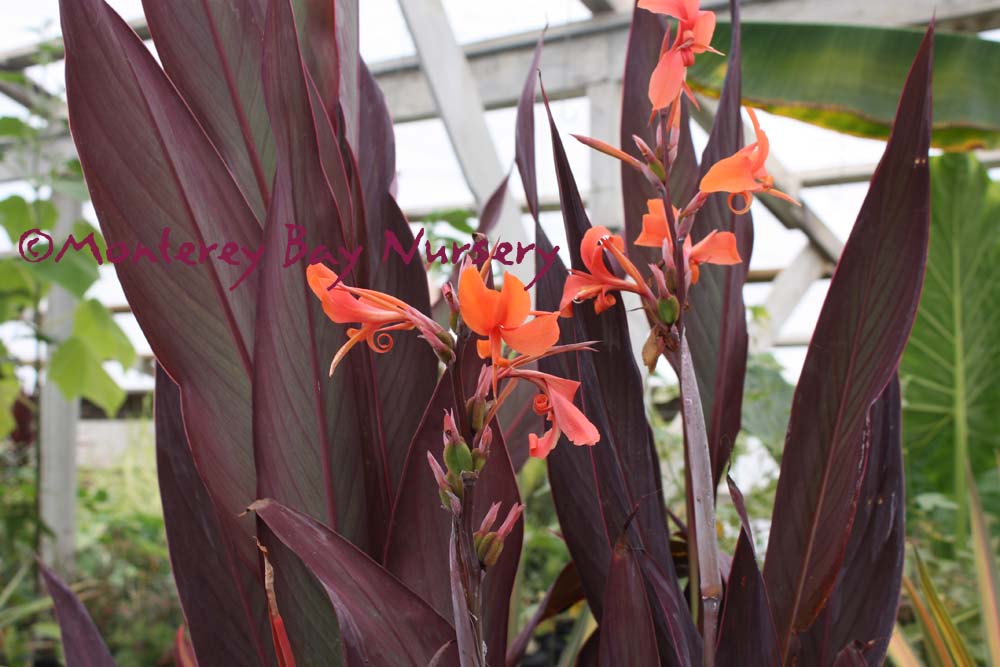
'Intrigue' flowering 7' tall clump at my house the foliage is narrow and an enticing light smoky maroon in color, with a little bit of green showing through. It has a silvery, glaucous character that is difficult to describe but quite noticeable and highly attractive. The coral orange flowers fade to intense salmon pink and are a great combination with the leaf color. To about 6' tall,distinctly narrow, with a strongly vertical leaf presentation as well. rev 4/2021
'Lucifer' flowers compact habit a very compact grower to about 30" tall with bluish leaves and really bright red flowers with petals edged in bright yellow. This is actually a new, reselected seedling of the original, indistinguishable except now virus-free. rev 4/2021
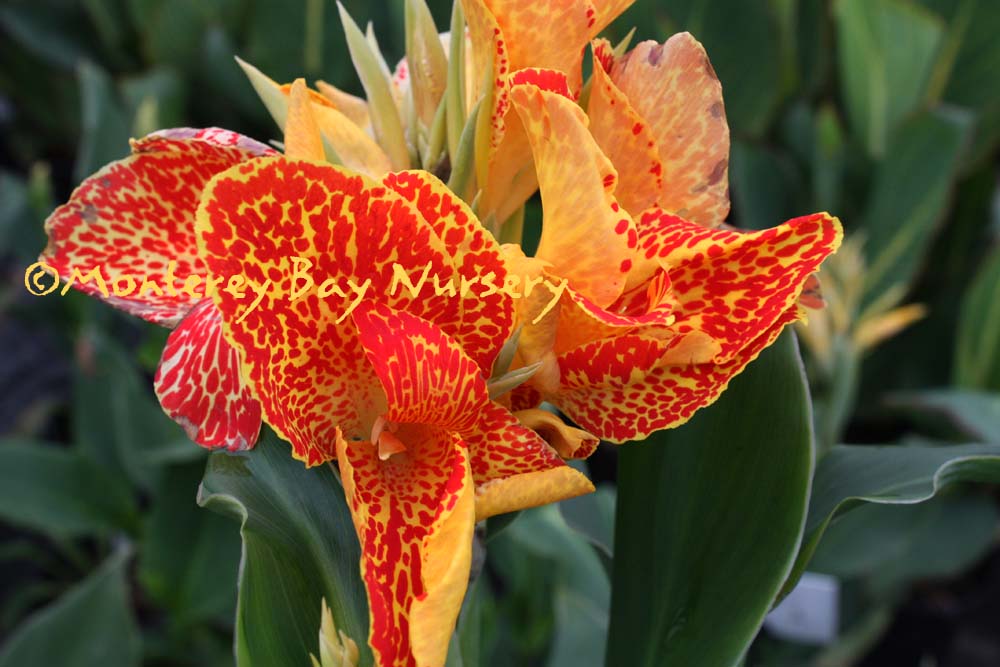
'Maui Punch' spotted detail clusters of yellow flowers densely covered in orange spots and beautiful bue green leaves are quite a show in a large container. Compact, to just 3' tall, blooming into fall. A great tropical accent on the deck or in the garden. rev 7/2013-Suzy Brooks
'Pacific Beauty' hot, glowing golden orange flowers dewy morning, loading dock all ready my favorite Canna, the most striking and eye-catching variety I've see. Something about those hot golden yellow flowers against that exact shade of purple-bronze-olive foliage, with a hazy bluish cast . . . it draws my attention then I keep staring at it. Got this from Paul Bonine at Xera Plants in Portland, who recommended it way back in 1998. We've offered it in small lots ever since, now it's a regular. rev 7/2019
'Pink Sunburst' flowers and leaves this is a hot new introduction that only grows to about 2' tall. It has coral, blonde, and green striped leaves that go great with the light salmon pink flowers. Vigorous, easy. A natural for foliage or tropical landscapes and great is a blooming perennial as well. rev 11/2008
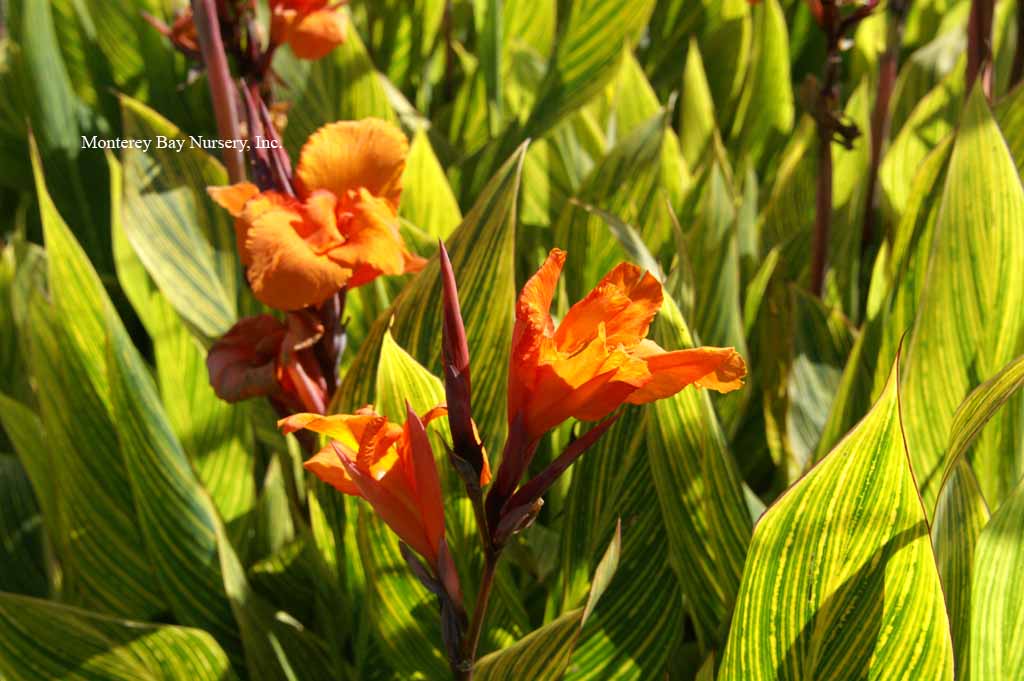
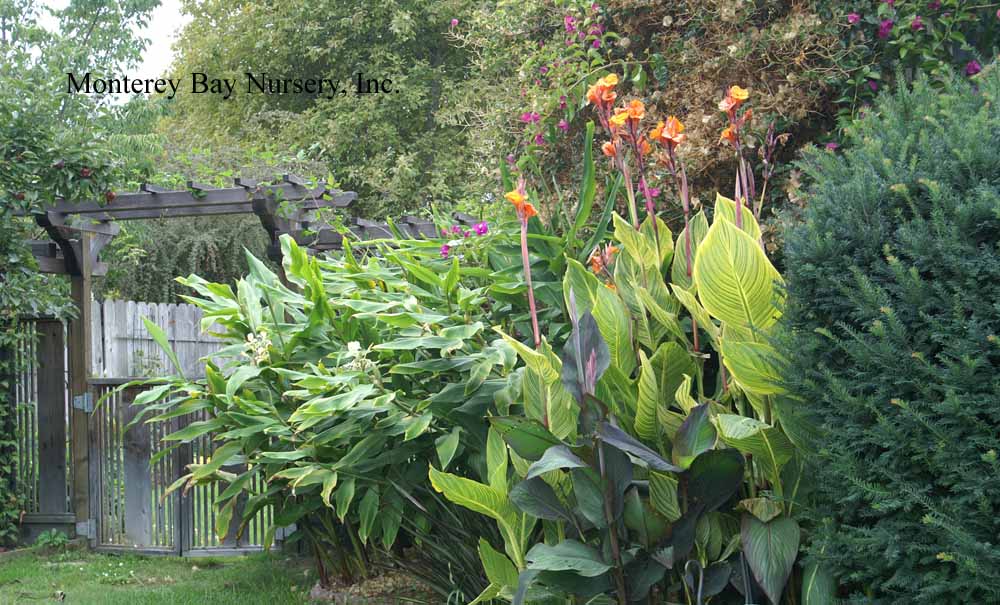
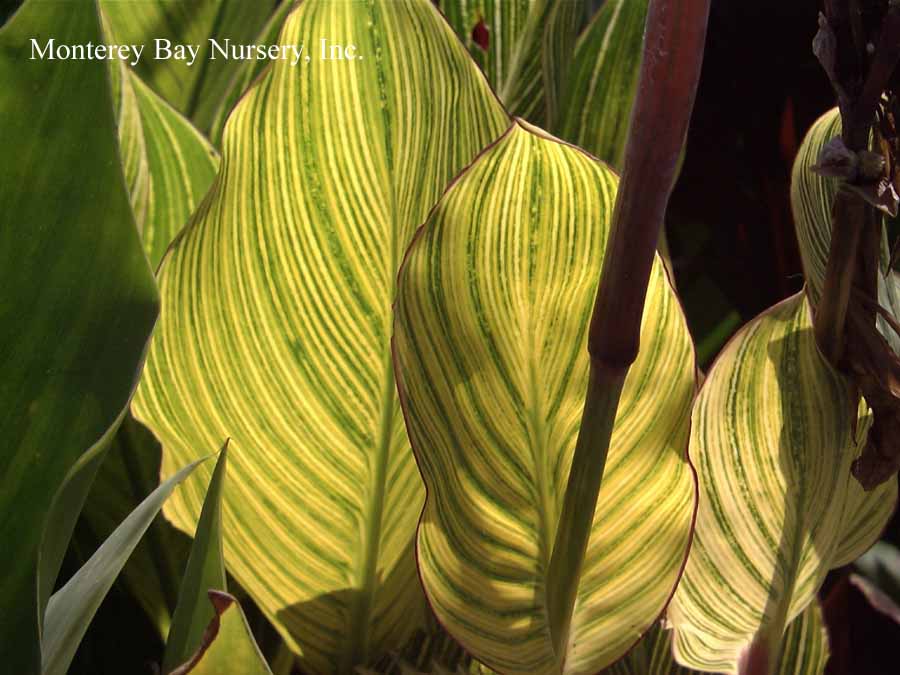
‘Pretoria’ ('Bengal Tiger') flowers and foliage foliage landscape backlit one of the premier variegated clones, with fine green and blond yellow stripes on the leaves. According to Tony Avent of Plant Delights, who certainly knows more about this than me, the original name was 'Bengal Tiger,' and we will formally change to that name this year (2018) at some point. To 4-6', with orange flowers, just stunning against a dark background, even just shadowed landscape. Grows in standing water, looks cool that way. rev 2/2018
South Pacific Scarlet nice and close! a seed-grown 2013 All American Selection winner, due to uniform growth, dark green leaves,and wonderful orange red flowers with yellow markings in the center. Compact, 3-4' in the ground, smaller in containers. Bright, bold flowers initiate under long days, supply months of color, and can be used along with the foliage in bouquets. Likes sun, heat, and regular watering. Freezes to ground with hard frost. USDA 8/Sunset zones 5-7, 8, 9, 14-24. rev 8/2014
Tropical Bronze Scarlet exotic foliage the public clearly demands dark foliage, so here is another variety that meets that deep need. Bold, intense red flowers initiate under long days and provide rich color all summer. A very compact line, to just 18-30" tall, stems clumping from the base after flowering. Full to part shade, modest to inconsistent watering, not picky about drainage. Dig up and store inside in climates colder than USDA zone 8/Sunset zones 8-9, 14-24. rev 6/2015
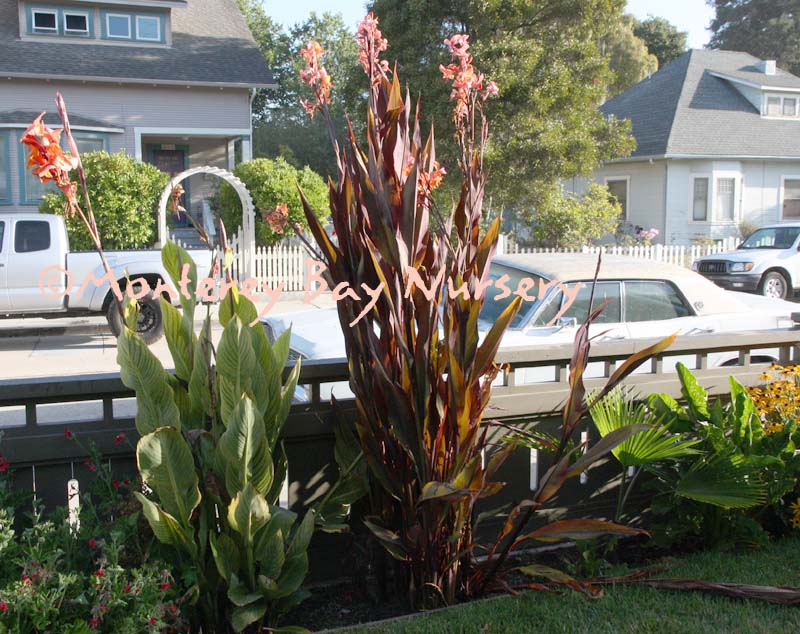
'Volcanna' blue sky background backlit flower more backlight a scintillating fountain of hot, glowing, dangerously hot geothermal delight, with upright plumes of foliage glowing fiery orange, deep molten-lava red and cooler jungle green below, all topped by bright orange flowers from spring through fall. One of the best foliage plants ever released, we are excited to offer this ultimate expression of vibrant color and tropical ambience. Full sun for best color, average to intermittent summer watering, will tolerate wet sites. Maintains colorful foliage through winter in warmer areas with bright, goes deciduous in colder areas, become more green in winter with any shade. USDA zone 7. rev 11/2018
Cardamine trifolia
(not currently in production) shamrocky leaves
here is a woodland treasure! Small, shamrocky, dark green
leaves, creeping slowly and then punctuated by 6" stems of
sprays of pure white flowers in early summer. An easy to grow,
low maintenance perennial for dry shade and only shade, well
drained soil, and average to infrequent watering. To just
about 4" tall by maybe
a foot wide, with time. Great under hellebores, really good
around stepping stones on a cool, shady path. From our
compatriots at Xera Plants in Portland. USDA zone 5/all Sunset
zones. Southern
Europe. Brassicaceae. rev 7/2019
Carex SEDGES evergreen to deciduous grass-like
plants, many native to wet places or able to take seasonal
inundation. Some have quite striking form or coloration, many can
be used en masse. They can make striking container
plants, either as individual focal point specimens or combined
with other colors and textures. Cyperaceae. rev 4/2003
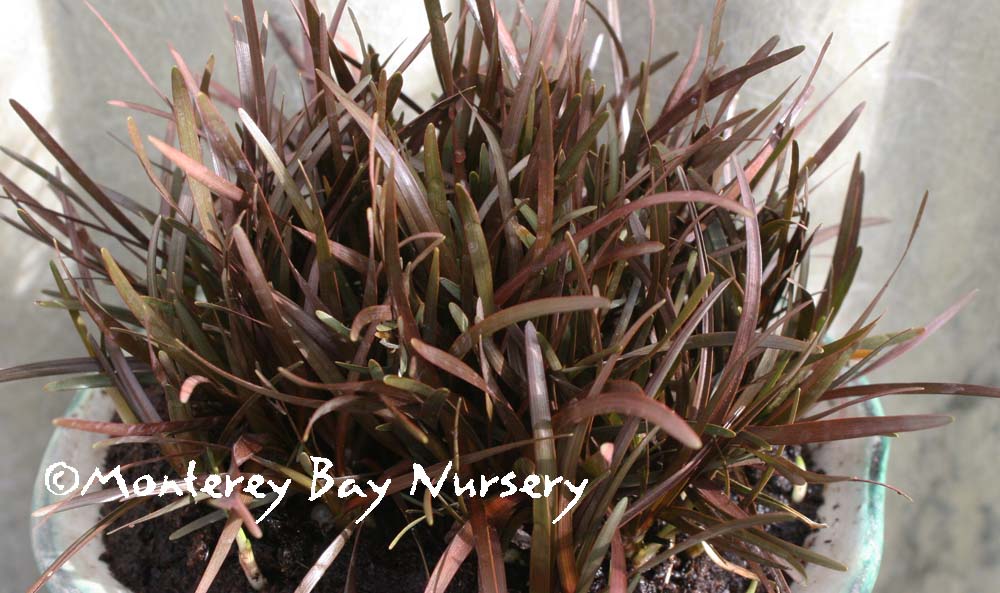
berggrenii cute lil' bronzy thang an alpine-type species, forming a slowly-expanding clump of densely packed, short, stubby, bronzy red blades to just 4" tall. Likes very well-drained-but-at-least-somewhat-moist soil. Think containers, in a gritty mix with some organic material. Or site it in elevated nooks, crannies and pockets in your Zen mound or competition rockery. Looks fabulous with dramatic stones, high quality gravel, by water, in fairy gardens or as a miniature groundcover. Evergreen, USDA zone 6a/Sunset all zones. New Zealand. rev 9/2015
comans 'Olive Oil' (not currently in production) mop head tawny silver, arching blades form a low mophead, about 12" tall and spreading to 3' with age. An interesting color to add to gold or green foliage. Makes a nice groundcover or container subject, and of course looks great with rocks and water. Sun or part shade, average watering. Sunset zones 8, 9, 14-24/USDA 8. rev 11/2010
dipsacea (not currently in production) Mills Garden a very upright green sedge, eventually arching somewhat, with olive tints. Reaches 18-24" tall and has attractive black seed heads. This one tolerates very wet conditions and will like at least regular watering. Winter deciduous, very frost hardy (USDA zone 8/Sunset zone 4 or lower). New Zealand.rev 8/2017
divulsa ("tumulicola") BERKELEY SEDGE mowed lawn unmowed lawn solitary clump, part shade Santa Cruz City Hall shady border everything sold under this name in California is actually C. divulusa, a non-native. The true native C. tumulicola is a smaller species which has a completely different appearance, is apparently not in cultivation, and is probably not nice enough to ever make it into cultivation. This is the best of the grass-like sedges for using to emulate a native meadow. It can be grown in full sun to quite a bit of shade and is quite drought tolerant when established. It is tough, durable, and always seems to find a way to survive. It forms a green groundcover to about knee high when mature, and should be planted 12-18" apart for solid cover on a large scale. It can also be clustered in smaller numbers for use as an accent plant, against rocks, in container, etc. or you can go the other way and plant it as solid cover from small plugs and mow it to form a lawn. You can see a good example of it used as turf at Sierra Azul Nursery in Watsonville. Sunset zones 7-9, 14-17, 21-24/ USDA zone 8? rev 1/2011
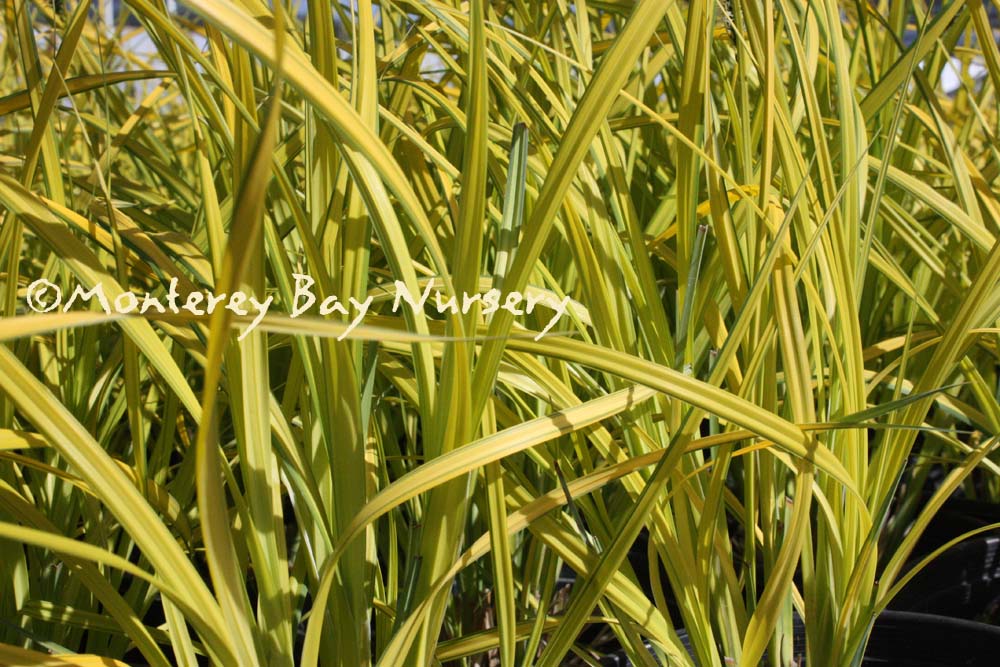
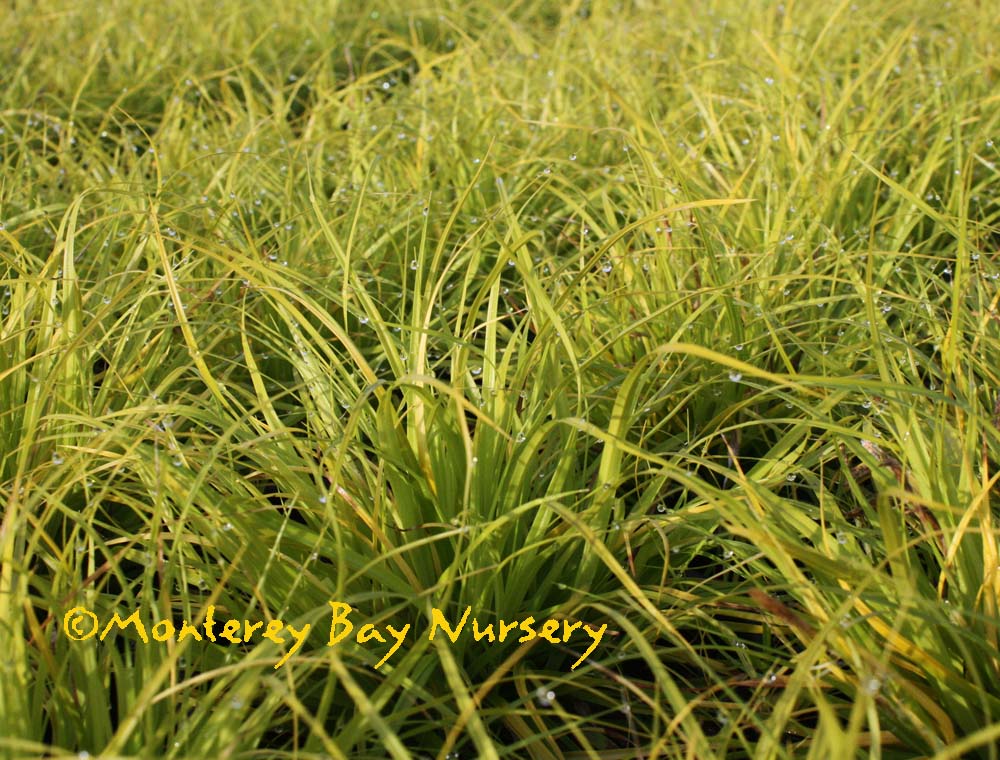
dolichostachya ‘Gold Fountains’ foliage detail, nursery a very fine textured evergreen sedge with bright green leaves that are edged and striped with light yellow. The overall color is a warm golden green. Habit is very relaxed and wispy. To about 12" tall, 2' wide. Sun to mostly shade, average watering. USDA zone 5. rev 8/2015elata ‘Bowle’s Golden’ GOLDEN SEDGE luminous foliage a low evergreen clumper, with moderately thin leaves that are a bright golden yellow with a little chartreuse at the base and along the central vein. To about 2' tall and wide. Minimal bleaching in full sun along the coast, but I haven't heard reports from the Central Valley or Southern California. It likes rich, moist soil and at least half sun to keep its coloration, else it tends to be a deep chartreuse. USDA zone 5/Sunset zones 4-9, 14-17, 21-24. rev 8/2017
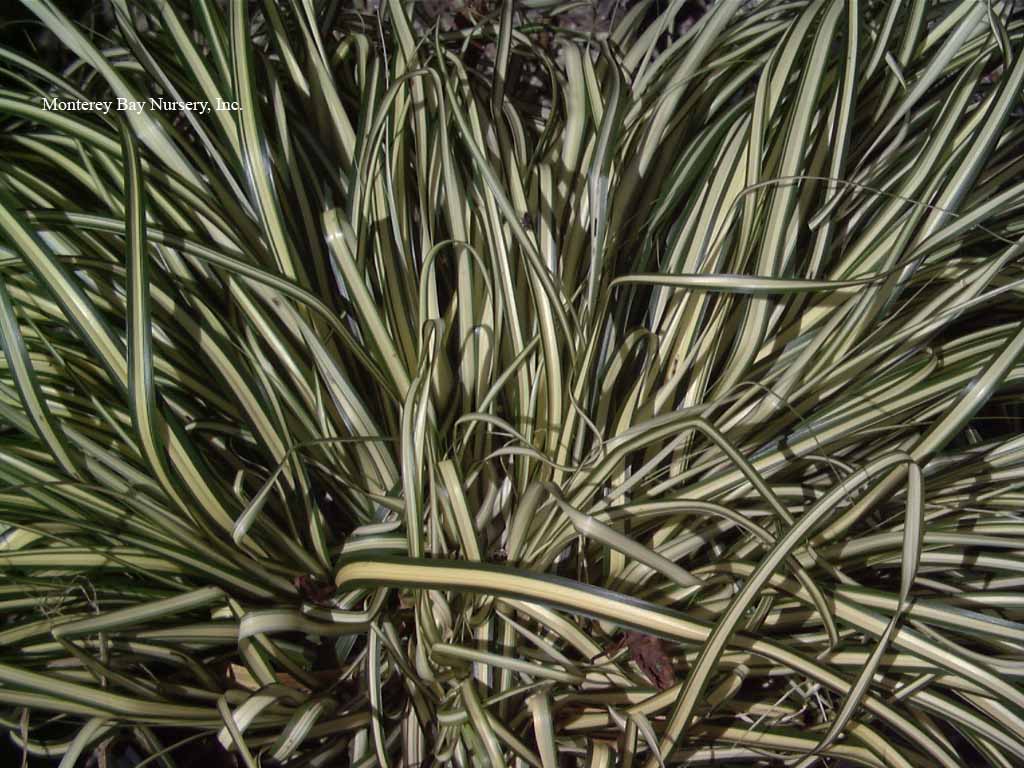
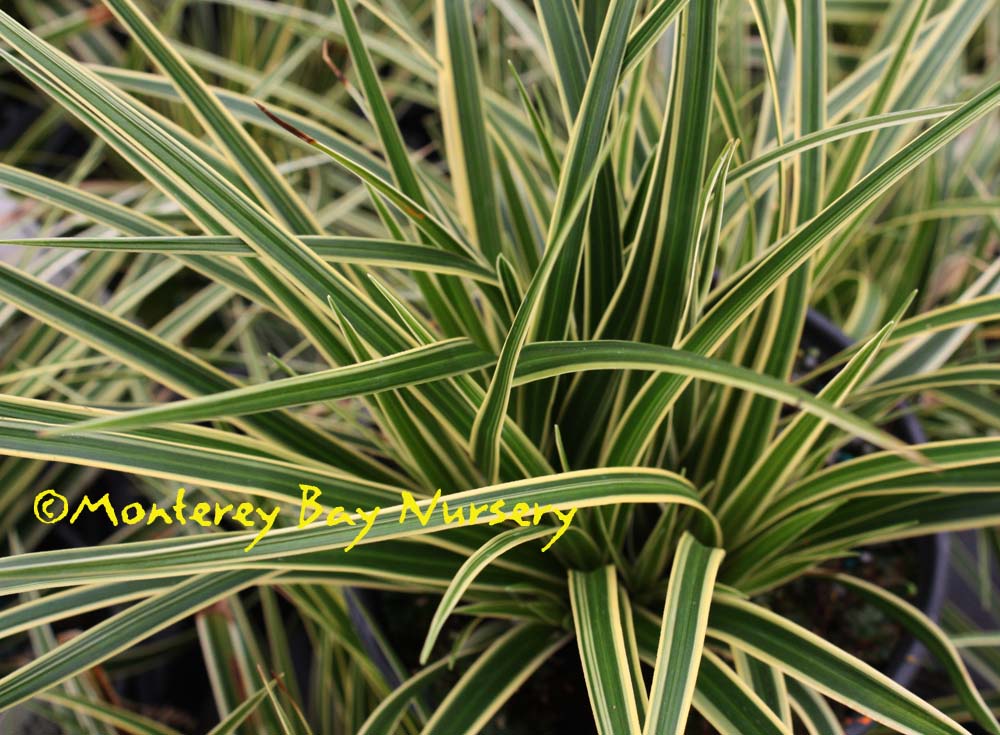
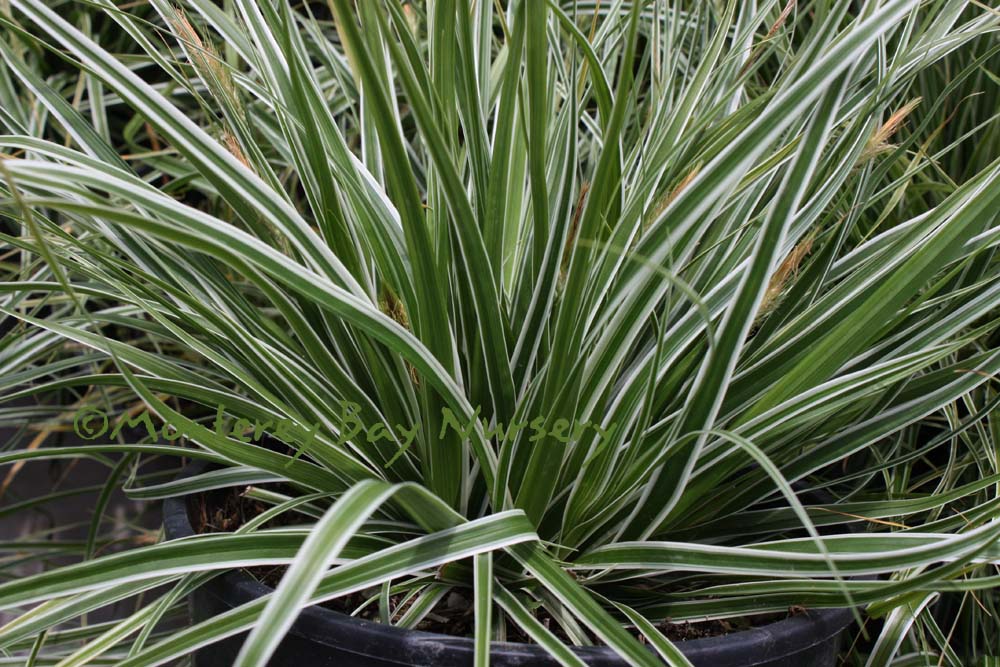
morrowii 'Ice Dance' garden an almost Liriope-like sedge with 1/2" wide, heavy textured, dark green leaves that are cleanly edged in white. It is a strong, dependable grower with ascending to arching leaves that can reach about 12-18" in height. Faint white streaks can be seen in the center of the leaf, but they don't detract from the otherwise clean variegation. Sun to half sun, average watering needs. Frost hardy for all of California, and usually evergreen. Cut back in late winter to renew ragged foliage if necessary. USDA zone 5. rev 8/2017
'Gold Band' bug's eye view tiff, arching blades of green and creamy yellow, this one makes a clump about 12" tall, spreading 18". Likes moist soil and part shade. A real woodland plant, looking great along side ponds, water, rocks, or hostas. Sunset zones 3-9, 14-24/USDA 5. rev 6/2013-Suzy Brooks
'Silver Sceptre' foliage fine textured, white edges, with additional white streaks through the middle of the leaf. This is much like 'Aureovariegata' or 'Evergold' except with clean white variegation as opposed to gold. To 1 1/2' across, about a foot tall. rev 1/2011
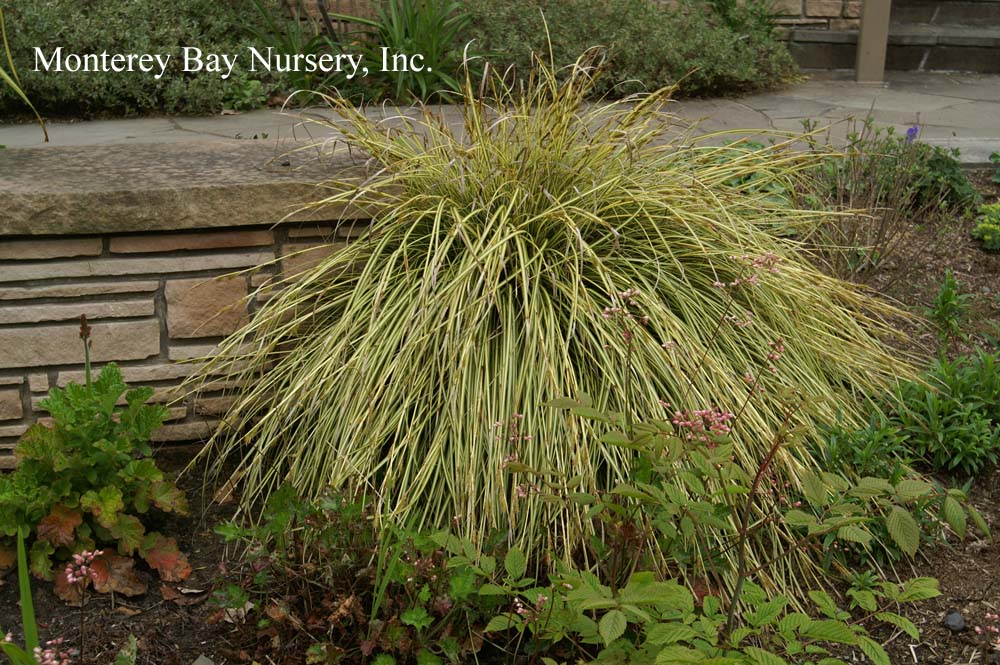
oshimensis a small upland species native to Japan (Honshu), heavily represented in the trade by a range of mostly variegated forms. In cold-winter climates (USDA zone 8 and lower?) it is deciduous or partly so. In most areas of California it is usually quite evergreen. Described as 12-16" tall in the wild many of these cultivated forms are larger and more vigorous. rev 2/2020
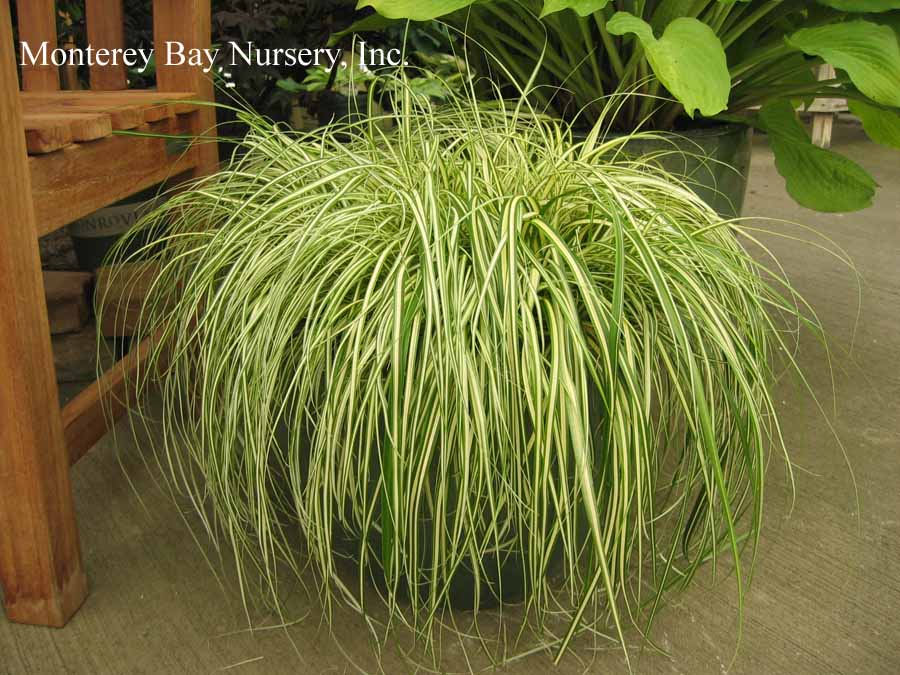
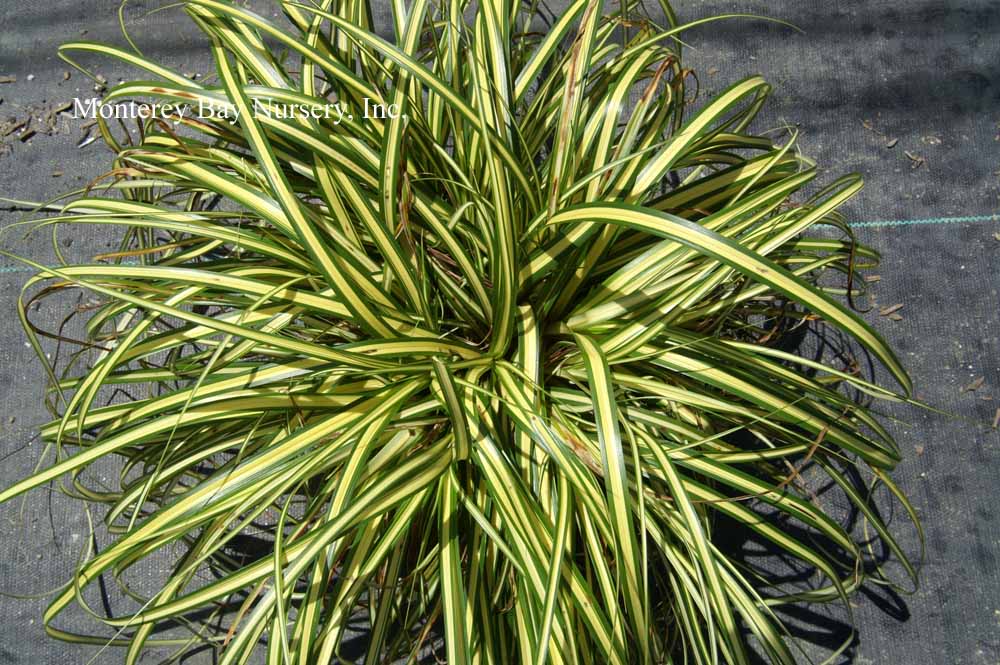
‘Evergold’ Strybing Arboretum garden wonderful container a very nice, neat, lush sedge with fine, glossy leaves with a creamy white central band. The leaves arch all the way over to form a rounded dome of whitish foliage to about 12" tall. This variety is desirable for its superior center variegation and its small habit. It has a formal appearance and its variegation is very stable. Evergreen in our area, frost hardy to USDA zone 5 but deciduous. Likes at least some water all year. USDA 5a/Sunset all zones. rev 5/2016
'Everest' PP20,955 foliage closeup the name is a little confusing, as the very good and closely-named 'Evergold' is a larger grower than most ornamental sedges (about twice normal scale) with a golden center variegation. This is a smaller, more typical-sized selection (10-12") with a clean, white edge variegation, and very nice on its own. Place it to overhang ponds or the edges of pots, or against rocks (of course rocks - do we still need to tell you that?) Morning sun or shade, regular watering. rev 6/2013
'Everillo' PP21,002 filaments lime green leaves, turning to gold, add wonnderful color and texture contrast to larger, bolder green or colored plants for sites with morning sun or mostly shade. Clumping and weeping, takes moist to dry soils, can be used in beds, borders, containers, and mixed plantings. 12-15" tall, twice as wide. In a hanging basket it seems it would be a great nesting site for little birds. rev 2/2015
'Everlime' PP25622 leaves light green edges, ranging from almost chartreues-yellow through bright lime green, highlight the fine leaf blades on this new variety. To 12-18" tall and wide. Grow in sun, shade, almost any soil, with average watering required when established. Makes a nice container plant too! USDA zone 5. rev 7/2017
'Everoro' PP23,406 young plant another variation in the parent EverColor® line, this TC sport of 'Evergold' supposedly has better vigor and "improved habit," though I can't remember disliking the original habit. Like it's parent-source the leaves have a consistent center-variegation pattern, ranging from creamy white to gold depending on light and maturity. Very fine, white-striped leaves seem to be a juvenile characteristic, I expect leaves will broaden up and intensify as the plant matures and clump size increases. To 12-18" tall, 18" across, clumping habit, spreading slowly. Like all of its closely related ilk, this makes one outrageously fine container plant, especially when featured by itself. Part sun to full shade, average to infrequent watering, depending on climate, soil and siting. rev 10/2015
'Eversheen' PP25,938 our fifth, final and (very) fine installment in the "Carex oshimensis that begin with E." Thin blades of lime and dark green, soft and graceful will spill over a pond, pot edge, cover the ground, or line a walkway. To about a foot tall and wide, part sun to shade, moist to drier soils. rev 5/2016-Suzy Brooks
'Feather Falls' why you grow it more Spring Trials and another flower/seed head and leaf detail clean white edges on dark green leaves. A fast, usually moderate-sized grower, to about 1 1/2' tall and wide you can see from the "SpringTrials" images how big they can get here in California under good conditions. Obviously it makes a great container plant, especially in those large-dimension pots. It's claims to fame are it doesn't leaf-scorch in full sun conditions but we haven't confirmed that as being true here in our exceptionally dry, bright, clear West Coast skies. USDA zone 5. rev 2/2020
'Gold Strike' young nursery plants similar to 'Evergold,' with green leaf margins and broad, blond-gold, almost white central banding of the leaf, but about twice the scale in leaf width and length, and habit. A larger scaled version of variegated Carex. One of the very best varieties. rev 2/2009
phyllocephala 'Sparkler' (not currently in production) at Strybing's Entry Garden a striking, cane-stemmed, upright form to a foot or two high, with broad, medium green leaves brightly edged with cream and a spiky habit. A distinctive and different sedge that is great in containers, as part of the perennial garden, or perhaps best as a focal point or accent plant. Sun to mostly shade, average conditions, evergreen. Sunset zones 5-9, 14-24/USDA zone 7. rev 1/201praegracilis ("pansa") CLUSTERED FIELD SEDGE (not currently in production) texture a species that grows wild from the Yukon through California, the Great Plains, Midwest and Atlantic Coast states and only stops at Texas and the Southeast. It has become entrenched in the California landscape trade as C. pansa, another native species of much more restricted distribution (coastal strand dunes only) and little garden adaptability. This will grow as a low (under 1'), matting to spreading clump that will take some foot traffic but not mowing. It has a meadowy look and can serve as a lawn substitute unless you have pets or kids that want to play on it. It can be used over large areas and is aggressive enough to exclude most weeds, needs little (but some!) watering when established, and is frost hardy enough to be grown in, well, the Yukon. It is salt and alkaline tolerant if those are issues. rev 1/2010
secta NEW ZEALAND ORANGE SEDGE (not currently in production) plant nursery foliage to 30", evergreen, frost hardy, olive green in the center and orange on the outer, weather exposed portions of the leaves, especially in cool weather. A more upright variety, like C. buchananii but with a wider leaf and not looking so dead. Sun to half sun. One of the very nice things about this species is that it is very persistent from one season to the next, unlike some of the other, short lived species. Evergreen, frost hardy to 10°F. New Zealand. rev 3/2003
siderosticha 'Banana Boat' Suzy's nice picture almost like a miniature Phormium, the low, broad blades are golden to chartreuse, with darker green bands along the edges. This is the hot sedge, but is a little more difficult for us to produce commercially. Once planted it is easy enough, as long as it has about half a day of direct sun (for proper bright color) and regular watering. It is a clumper, spreads slowly, and is usually seen 6-12" high and about twice as wide. Really appreciates at least 50% peat moss in its planting soil, either in containers or in the ground. Winter deciduous. A real nice choice for woodland, ferny areas or in mixed containers. All Sunset zones/USDA 5. rev 8/2016tenuiculmus 'Cappucino' coppery, threadlike leaves an arching clump of many colors, red, copper, orange and olive, provide color and interest, softening the edges of a walk, offering contrast to perennials, or enhancing or implying water features. A dramatic solitary evergreen subject for containers. To about 12-16" tall, and twice as wide. Sun or part shade, regular watering. Sunset zones 8, 9, 14-24/USDA 6. rev 11/2011-Suzy Brooks
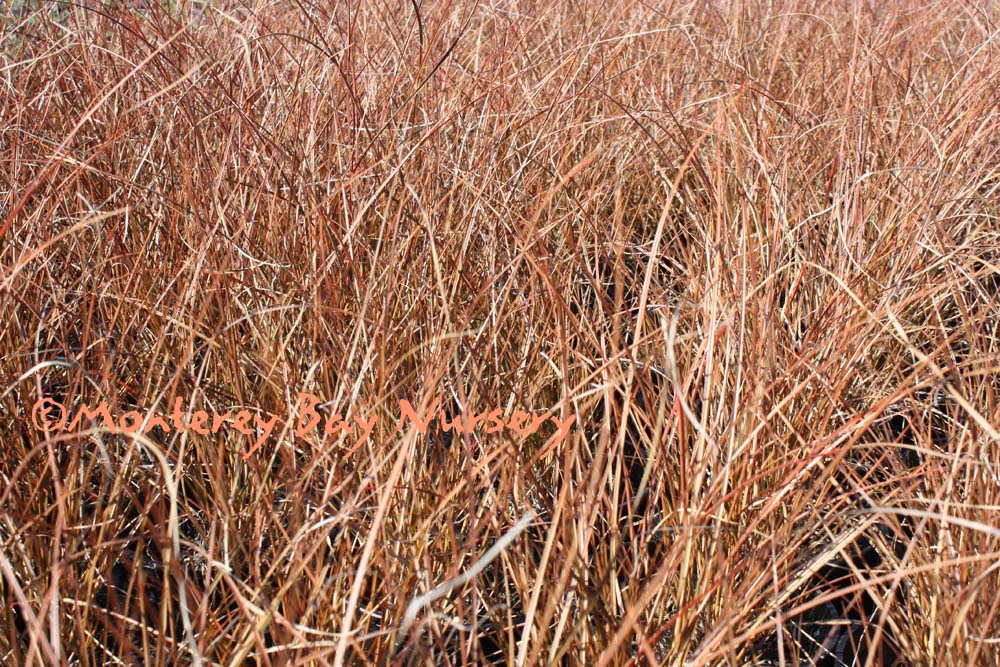
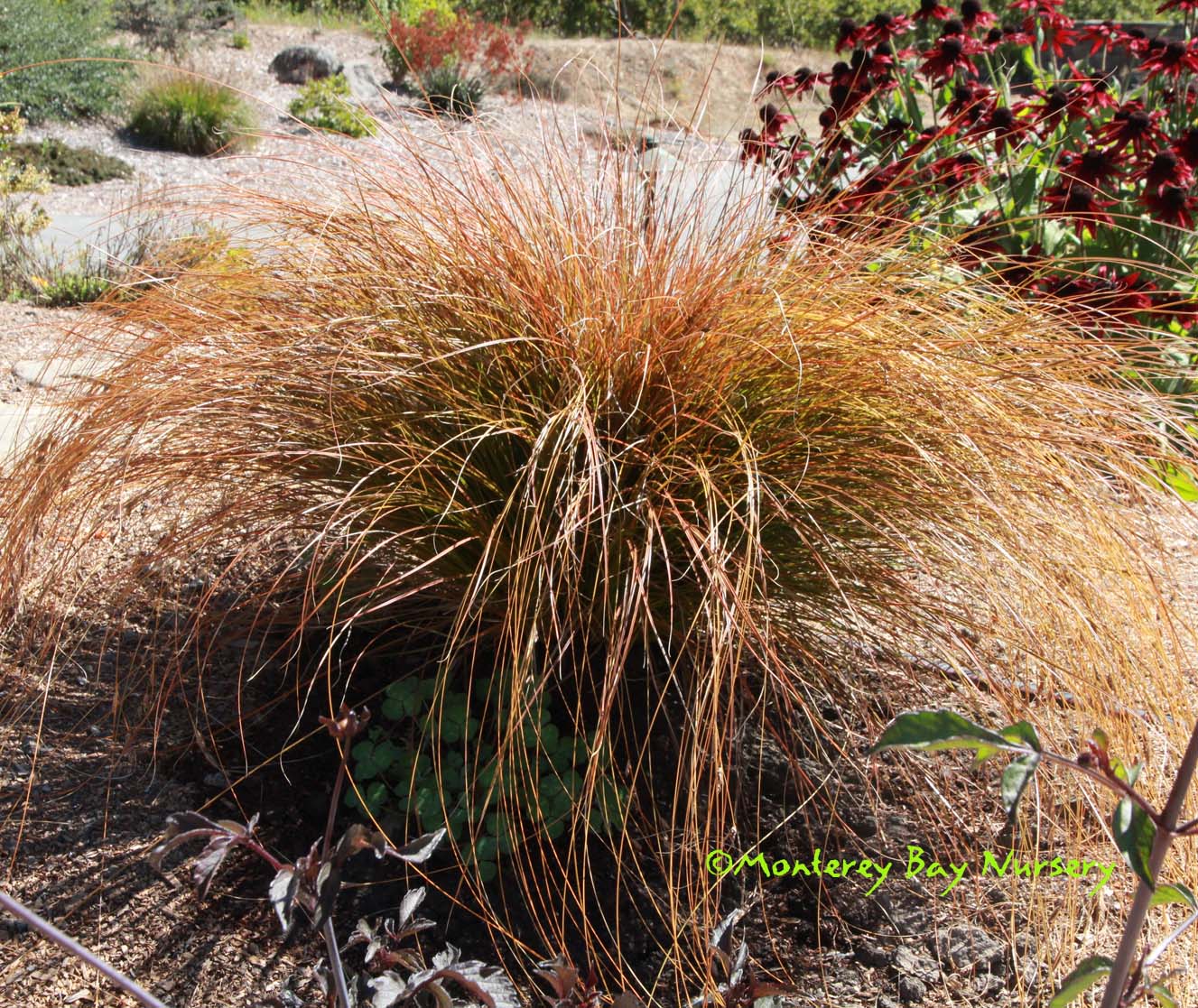
testacea UCSC Edward D. Landels New Zealand Garden Cabrillo College entry landscape Stephanie Mills' garden Eastside Santa Cruz yardscape one of the most reliable NZ types, and probably the most commonly used in California. Shiny dark or bronzy green foliage becomes bright, striking coppery-orange to orange-red in sun under cool conditions. Seed heads are produced in summer, they are mostly inconspicuous. Drought tolerant, needing just intermittent summer watering. It definitely needs drier conditions and better drainage than many sedges, which generally are found in wetter sites. It makes a good container plant. Extremely tough cold hardy for a NZ native, doing well in locales as dry and cold as Denver for example (USDA zone 6). To about 18" tall by 2-3' wide, evergreen. For best orange leaf color site in as much light as possible. resistant to deer and rodent damage (except for gophers!). rev 11/2019
trifida 'Rekohu Sunrise' PP20512 (not currently in production) display container selected for its wide, green blades, with a curl and a weep, and variegated margins of creamy white to light gold. Grows to about 24-30" tall and 24" wide. It's evergreen, and a good choice for group or combination plantings or even just in a container on its own. Likes sun or part shade, well-drained soil, and regular watering. USDA zone 7/Sunset 8, 9, 12-24. rev 2/2020
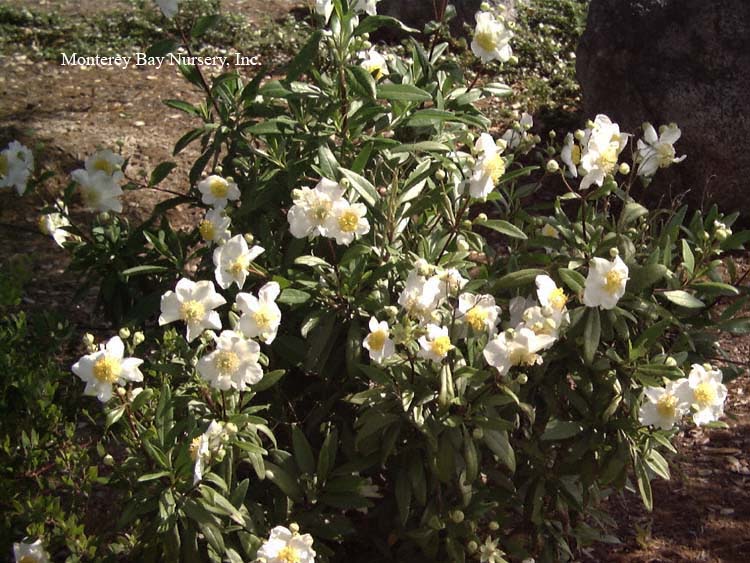
Carpenteria californica ‘Elizabeth’ BUSH
ANEMONE closeup
young plant
an
evergreen shrub to 8’ tall, 15’ wide. Relatively formal, dark
green leaves form a nice backdrop for the profuse terminal
clusters of white flowers, to 2" wide, with showy yellow stamens,
that are produced in late spring. This is an improved form, with
noticeably larger flowers and many more flowers per cluster than
the average seedling. Named for Elizabeth McClintock, of the
California Academy of Sciences. They look somewhat like small,
single camellia blossoms. Sun to part shade, little or no summer
watering when established. Needs good drainage, and likes mineral
soils best. Native to the Sierra Foothills. Introduced by Saratoga
Horticultural Research Foundation. Saxifragaceae. rev 8/2010
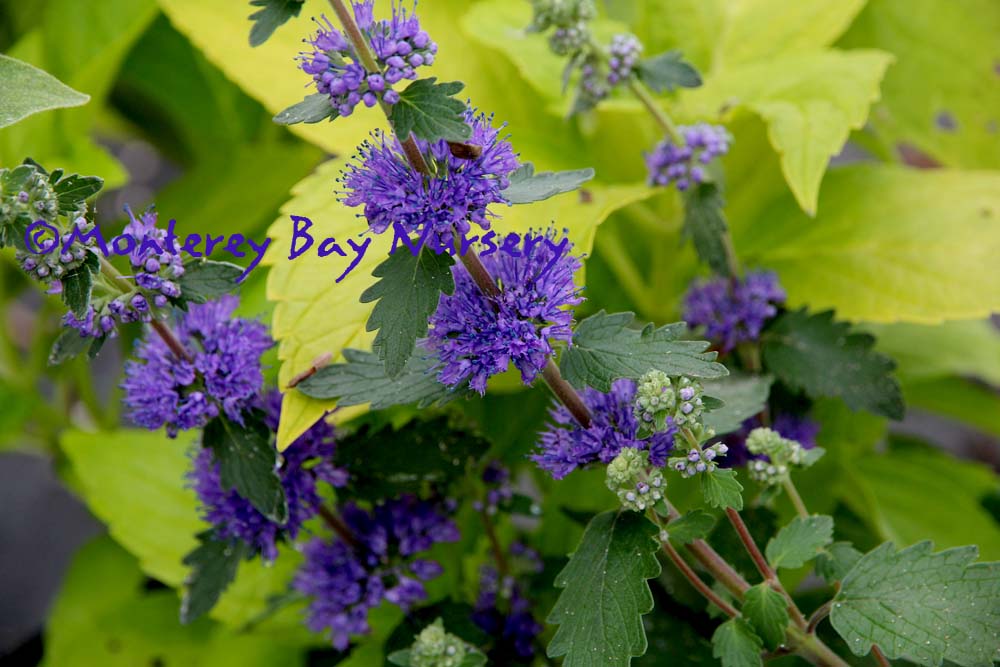
Caryopteris BLUEBEARD (not currently in production) deciduous shrubs grown for their blue (usually) flowers and the fact that they attract butterflies, bees, humminbirds, and beneficial insects. They are low growers and bloom during long days. Very frost hardy, need average to minimal summer watering, and need at least average drainage. Cut back in winter. Full to half sun. Labiatae/Lamiaceae. rev 8/201
'Dark Knight' (not currently in production) to 2-3' tall, deep purple flowers against deep green leaves. rev 8/2010
incana (not currently in production) flowering a great source of mid-summer through mid-fall deep blue purple color, against slightly felty, pleasingly toothed green leaves. One of the parents of the C. x clandonensis hybrids ('Dark Knight' and its ilk), I think this is actually more desireable than those more common hybrid progeny. Grows as a.deciduous shrub to completely deciduous perennial (in very hard winter areas), reaching about 3-4' tall and wide. It is even relatively drought tolerant when established. Sunset zone 5-9, 14-24/USDA zone 7. Eastern Asia. rev 8/2012
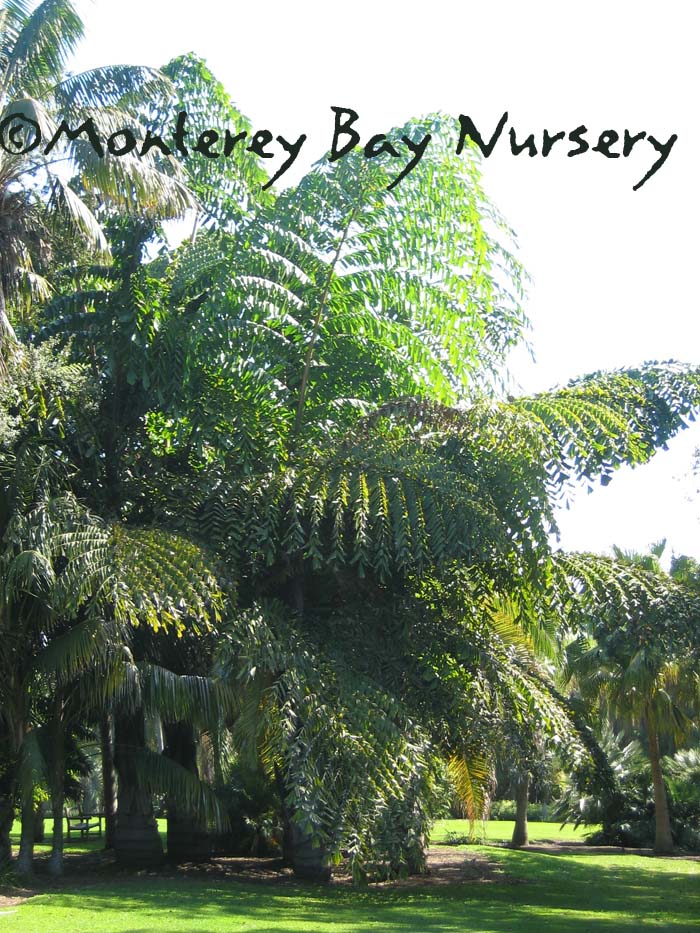
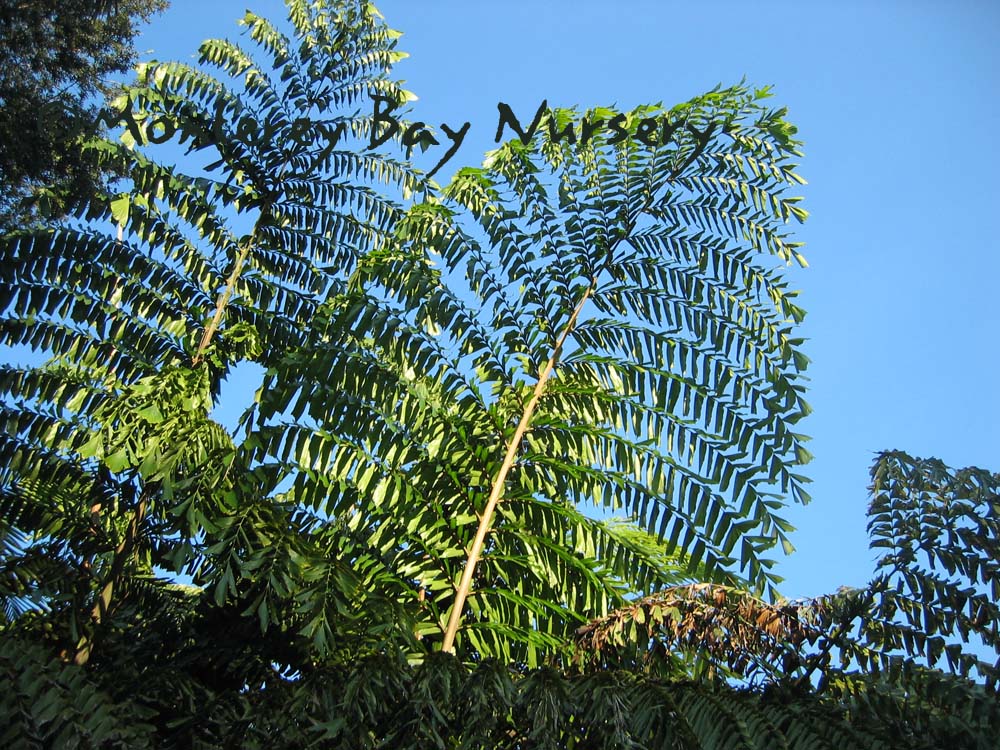
Caryota FISHTAIL
PALMS striking, large scale palms from the tropics and
subtropics, with large feather fronds that have fan-like leaflets
shaped something like a fish's tail. My favorite palms,
including what is possibly my favorite plant of all plants, C. gigas or its hardy
equivalent, known as "King Kong," "hardy Thai mountain giant,"
"black stemmed form," or any combination of the preceding terms.
Mostly known as clustering tender house plants that are prone to
mites, the outdoor versions are generally tall trunked, majestic
species with striking outlines and exotic foliage. Several are
hardy enough to be used in California, and a select few can be
tried in Northern and Central California. But don't have
unreasonable expectations; the cold hardy strains and species are
still being tested and it would be rash to suggest they will be
truly dependable in most areas or situations north of Santa
Barbara. These are definitely plants for the connoisseur's
connoisseur, the elite of the discriminating elite, the wheat and
not the chaff. You have to be enthralled enough with their amazing
foliage to put up with their primary fault, that is that they are
monocarpic. This means that your huge, house-dwarfing foliage
plant, with herringbone-patterned leaves 20 feet long, is going to
flower then die and eventually fall over on you or your house if
you don't cut it down. Nevertheless, nothing does what a Fishtail
Palm does except a Fishtail Palm, and you will be the talk of your
neighborhood if you have one as well as the being envy of all the
local members of the Palm Society. All like rich soil and at least
average watering, but when mature they will withstand drought at
the expense of fast growth. Most are understory plants when young
and are substantially faster and greener if given shade the first
few years. Good mature examples of several species can be seen at
the San Diego Zoo as well as Huntington Botanic Gardens.
Palmae/Arecaceae. rev 3/2005
Ceanothus WILD LILAC, BUCKBRUSH California
native shrubs loved for their fragrant deep blue flowers and
drought tolerance. They grow as low spreading groundcovers to tall
shrubs or small trees. All Ceanothus varieties need
average to good drainage, sun to part shade, and little or no
summer watering when established. When evaluating varieties for
deer resistance, remember that certain smooth leafed species of Ceanothus
are critical survival items for deer in many California habitats
in winter and early spring. The closer the foliage is to ‘Ray
Hartman’ or ‘Sierra Blue’ the greater the chances of being
browsed. Rhamnaceae. rev 2/2003
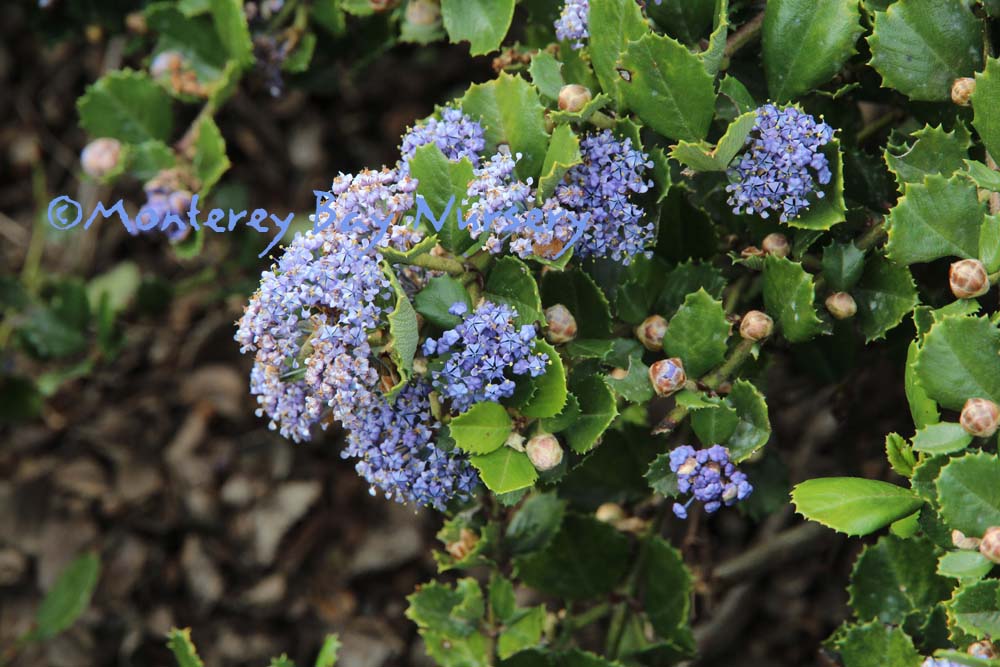
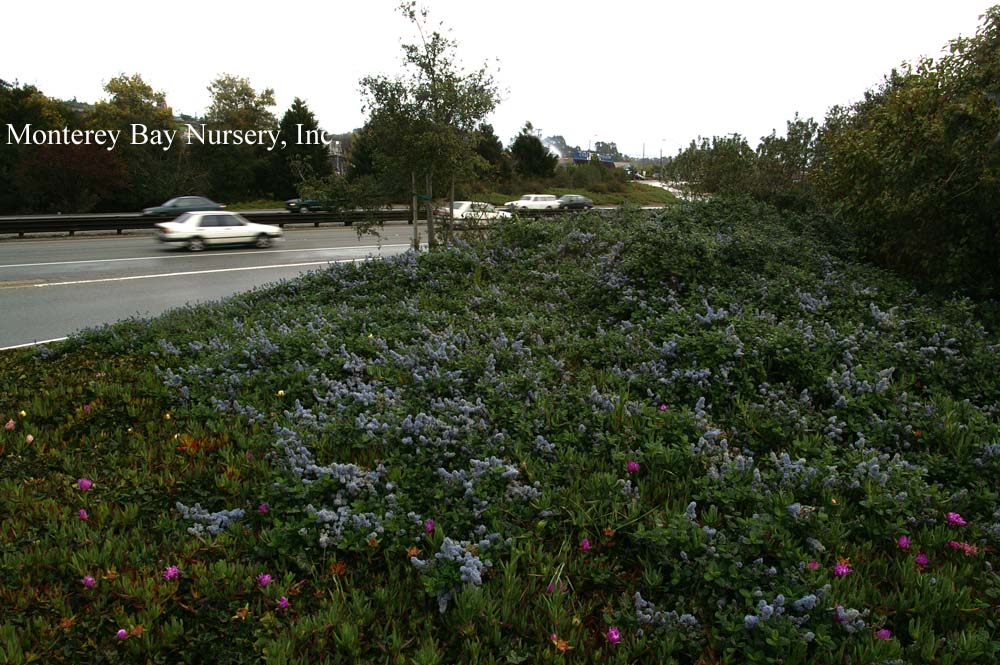
'Centennial' (not currently in production) tiny treasure back again, after more than a decade off our list. Small, dark green, shiny leaves and little, round, deep blue flowers in spring. Low grower, under a foot tall and spreading 6-8'. Makes a great groundcover, spilling over walls, or on banks and slopes. Sun or some shade. Little watering once established. USDA 7. rev 5/2015
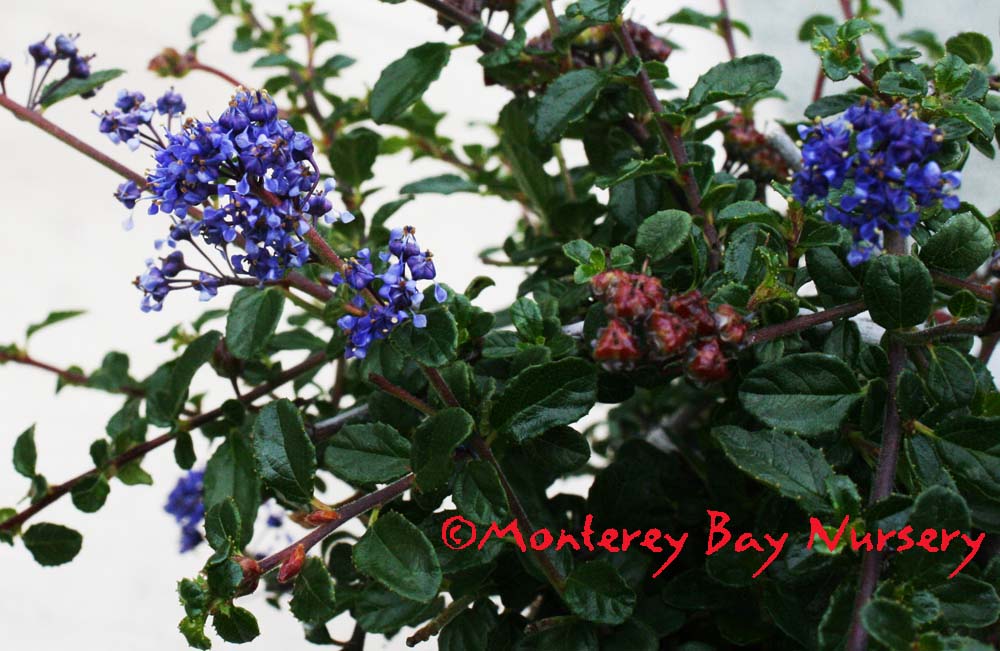
‘Dark Star’ blooming plant to 4-6’ tall, 6-8’ wide. Small, rounded clusters of dark blue flowers appear in spring from light burgundy buds. Almost identical to C. ‘Julia Phelps,’ but apparently somewhat more compact, with darker foliage. Small, warty leaves grow to only 1/2" long. Moderately deer resistant. rev 2/2010
gloriosus (not currently in production) PT. REYES CREEPER, GLORY MAT flowers and leaves, closeup UCSC Arboretum groundcover (now have you ever, ever heard anyone refer to this plant as "Glory Mat"?) this species has an interesting distribution, growing from near Shelter Cove (just south of the Lost Coast) to the Golden Gate Bridge, then occurring in just three small populations each near Monterey, SLO Town and Pismo, "The Clam Capital of the World,' or as they are using now, "Pismo - More Than Just Clams!" (Did you know they have beavers at Pismo?). Actually, in order to head off calls from The Pismo Beach Tourist and Visitors Council, I made that last part up. (The slogan, not the beavers.) Strong and resilient branches arch horizontally, bear glossy, dark green, toothed leaves that are mostly left alone by deer except in dire circumstances, and provides a nice and nicely fragrant show of light blue flowers in spring. Sun to part shade, average to good drainage, very drought tolerant when established, not as Central Valley-tolerant as other species and forms. USDA zone 8. rev 1/2018
‘Anchor Bay’ blue flowers like the regular form of C. gloriosus, but with denser growth, larger, coarser leaves and slightly darker flowers. A groundcover to 18" tall, 6-8’ or more wide. Very lavender blue flowers fade to pale pink. Glossy, dark green, toothed leaves tough, hard, deer resistant. Best in moderate summer climates. rev 3/2012
griseus v. horizontalis CARMEL CREEPER flowers some habit commercial very fast growth to 1-3’ tall, 12-15’ wide, with large, rounded, glossy green leaves. Flowers are light blue, moderately showy, lightly fragrant, and appear in late winter and early spring. Best used in mild summer areas. Needs summer watering inland. If not planted with sufficient elbow room, this plant can mound quickly to 4’ or more. Deer love all varieties of this species. This and the following varieties would be grouped under C. thyrsiflorus v. griseus under the current CNPS classification. rev 3/2021
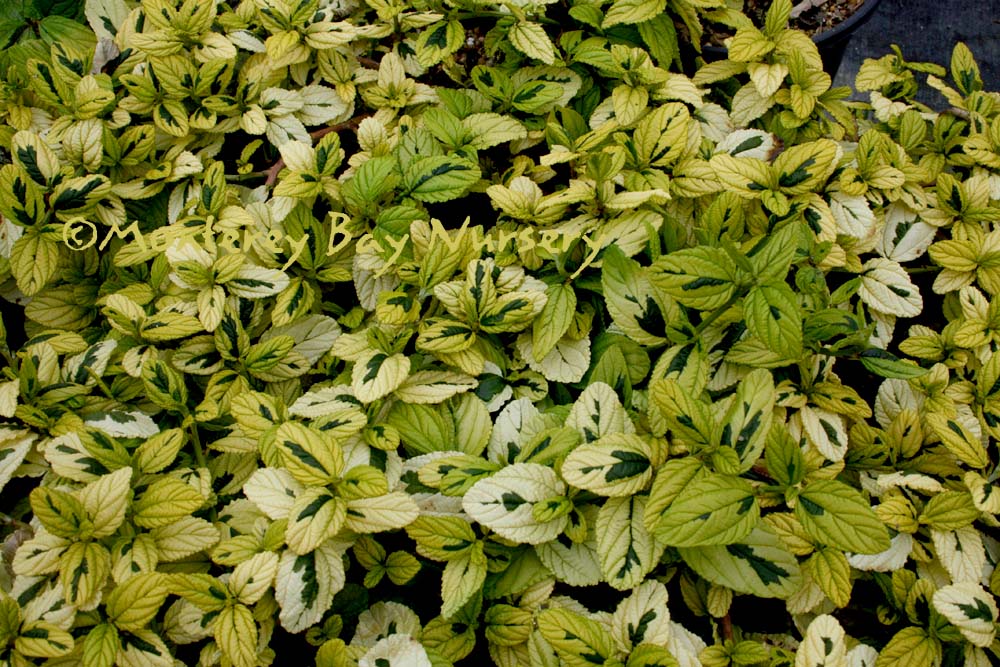
'Diamond Heights' foliage this is the second plant we ever introduced (the first was Syzygium 'Monterey Bay'). We received this from the discoverer, the epic plantsman Barry Lehrman. Barry was an "heirloom" employee of our predecessor entity, S&S Nursery. Barry's only request was that in return for introducing it, we had to it use the name he chose, 'Diamond Heights.' Don't bother looking for Diamond Heights on a map of California, because it was actually the name of Barry's apartment complex in San Francisco, where he found it. This is a broadly variegated branch sport of Carmel Creeper, and has wide golden green to blond white edges with just a small hash of green in the middle. Very low (under 12"), very slow, and very pretty after it has filled in completely. Same conditions as for CC. rev 8/2010 MBN INTRODUCTION-1989
'Holy Guacamole' flowers and foliage that hypnotizing leaf color! the wholly pale chartreuse sport of the above, no green patch in the middle of the leaf. Slow, more shade. Hypnotizing! We used to find this sport regularly occurring in blocks of 'Diamond Heights' along with the all-green version. But I never had the sense to isolate it and see if it grew on its own, figuring it would just die from lack of chlorophyll. But it doesn't! rev 4/2021‘Yankee Point’ flowers typical use like C. griseus horizontalis, but taller (to 3-5’), and showier, with richer, darker blue flowers. Leaves are slightly narrower, more triangular, slightly more deeply veined, and darker green. A little more adaptable. rev 2/2010
hearstiorum HEARST RANCH WILD LILAC think of this as a fast, ultra-flat interpretation of 'Julia Phelps.' It grows with a strongly prostrate, ultra-radial growth habit, with long, very thin branches headed out on a straight line away from the center of the plant. Under its favored conditions of good drainage, full or almost full sun, dry-summer conditions and without too many mountain ranges between it and the ocean it can form a dense carpet of small, long, warty dark green leaves that is simply covered in spring by a wonderful show of medium purple flowers in dense, tight, rounded clusters. Give it a little help with weed suppression in wet, close soils, shear it back to thicken it up towards the middle, and you can watch it thrive even in commercial or public landscape situations. USDA zone 8? rev 1/2018
'Joyce Coulter' wonderful flowers old specimen refusing to die in the wino park along the Pajaro River levee this popular trade variety is a fast growing mounding shrub to 3-4' tall by 5-10' wide or even more. Produces a very heavy show of medium blue flowers in 3-5" long spikes in spring against dense, glossy dark green leaves. Apparently this is a hybrid involving C. papillosus and originates from the Santa Lucia Mountains, above the Big Sur coastline. rev 4/1994
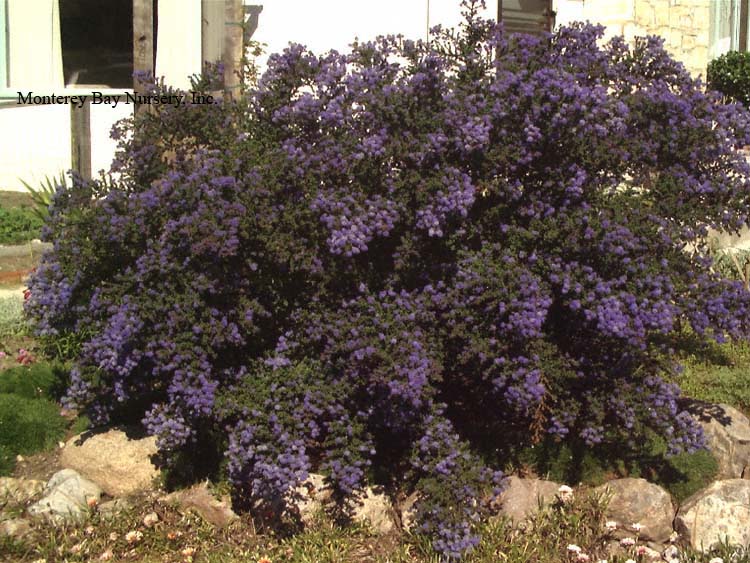
‘Julia Phelps’ closeup another closeup typical habit medium to dark blue flowers in short, rounded clusters. To 4-6’ tall, 6-8’ wide. Forms a solid mass of flowers when in bloom. Often starts to bloom as ‘Ray Hartman’ finishes. Deer resistant. rev 2/2010
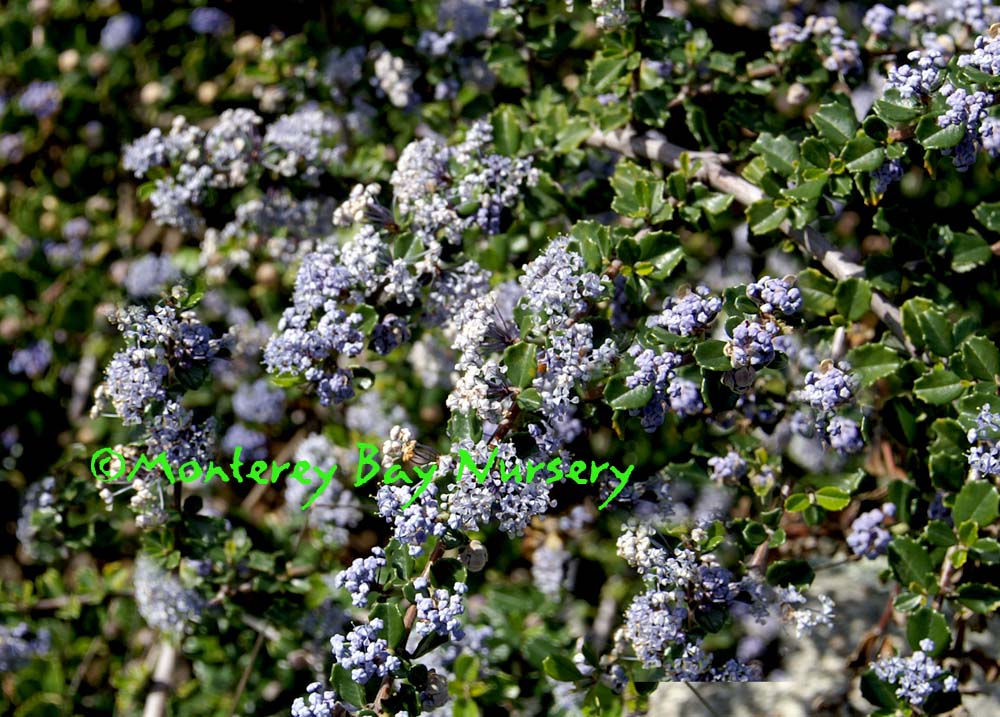
maritimus 'Valley Violet' (not currently in production) closeup of a few flowers from the Arboretum at UC Davis comes this fine little native groundcover with strong, siff, horizontally spreading branches and dense, small, dark green, holly-like leaves. Small in stature, to about 2' tall and spreading to 4-6' wide, it loads up with a quite nice show of medium violet purple flowers in spring. Requires no pruning unless you want to shape it up a bit after flowering. This is a wonderful selection, part of their All-Stars program, that seeks to identify and popularize "truly drought tolerant" plants. This makes a shiny, dense, weed-smothering groundcover, or even a low, bordering hedge. Growing requirements are soil of at least average (but not necessarily perfect) drainage, at least half a day of sun, and little to no watering once established. This is tough and resilient enough to do well through Central Valley summers even when planted out in the denser soils and extreme heat of the UC Davis test garden plots, where many of the fussier native Wild Lilacs fail. Sunset zones 5-9, 14-24/USDA 8. rev 1/2018
‘Ray Hartman’ glorious spring day originally called 'Blue Skies' the most commonly grown tree or large shrub variety in California. Rarely grows to less than 15’ tall in part shade, but often makes a broad shrub to 10’ tall, 15’ wide in full, open sun with restricted watering. Light burgundy buds appear in late winter and early spring, turning to spikes of medium blue flowers with a slight dusty or greyish cast. They are lightly but quite pleasantly fragrant. Smooth, rounded leaves form excellent browse for deer. Formerly known as ‘Blue Skies’ before being renamed by SHF for their founding patron. rev 1/2018
thyrsiflorus BLUE BLOSSOM a near-coastal variety, ranging from prostrate coastal forms through more usual chaparral-habitat large shrubs and small trees. Noted for its very deep green, lustrous foliage and excellent flower fragrance. rev 5/2020
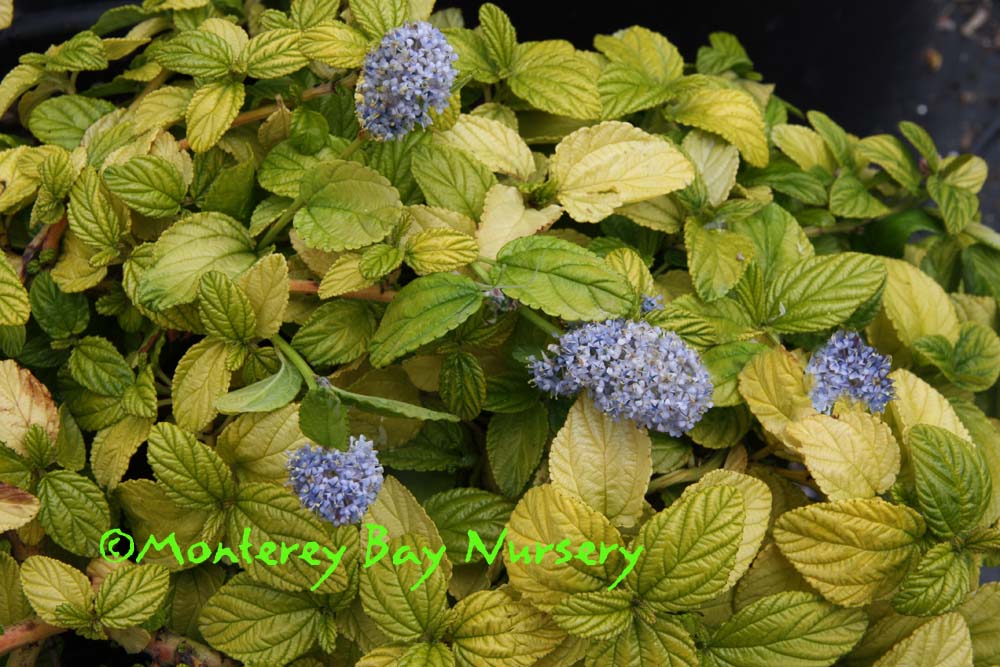
'Born Again' leaves a low, relatively slow, dazzling foliage-effects variety we picked up on one of our Oregon trips. Apparently this passed through Rancho Santa Ana at some point though I'm not sure it originated there. It is the most highly variegated form of this species we've seen, captivating once it has filled in. Flowers are in short spikes, medium blue, and look really nice against that gold and green backdrop, but then it doesn't bloom heavily, that's not its main job. Part sun is best, will tolerate moderate summer watering and should be hardy to at least 15F or lower. rev 8/2018
v. griseus CARMEL CREEPER we still list (and describe) this standby under its old moniker, C. griseus v. horizontalis, or no one would be able to find it.
'Zanzibar' leaf variegation pattern a nicely edge-variegated shrub form, probably C. thyrsiflorus, that bears light to medium blue flowers in short spikes against its lighter colored, very glossy foliage in spring. Moderately fast to 6-8' tall and wide in sun to part shade, average drainage or better, little or no summer watering when established. USDA zone 8. rev 1/2018
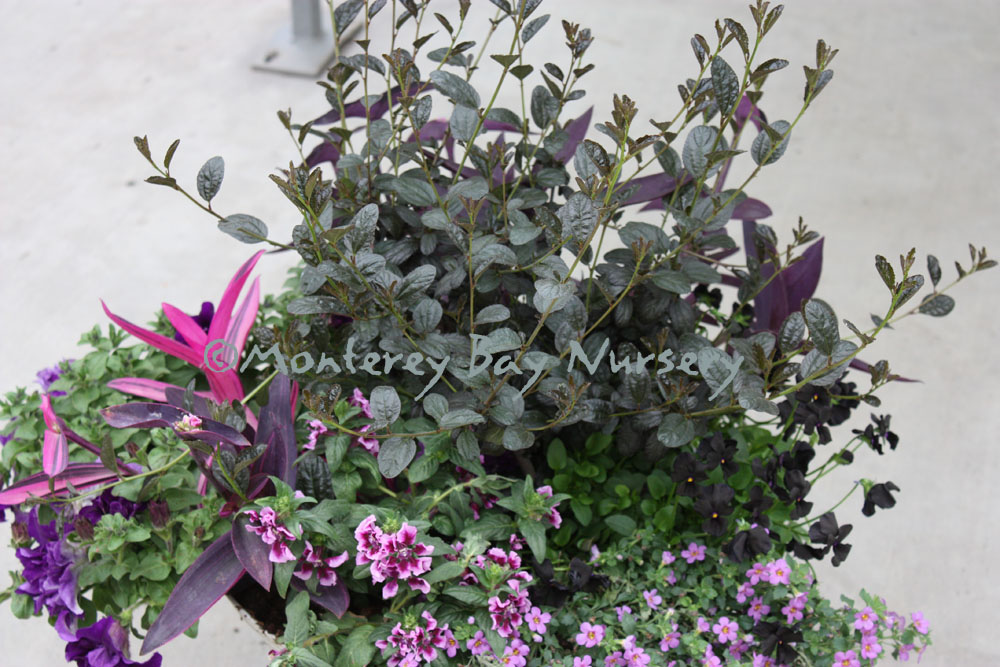
'Tuxedo' PP20754 (not currently in production) potted shiny, dark purple brown, almost black leaves host spikes of light lavender blue flowers in late summer and fall. Grows with an open habit, about 8' tall and wide, though it easily pruned for shape and size. A great color to use with silver foliage. A branch sport of C. 'Autumnal Blue' (C. thyrsiflorus x (americana x caeruleus)) found in Ireland. Sunset zones 5-9, 14-24/USDA zone 8. rev 1/2018
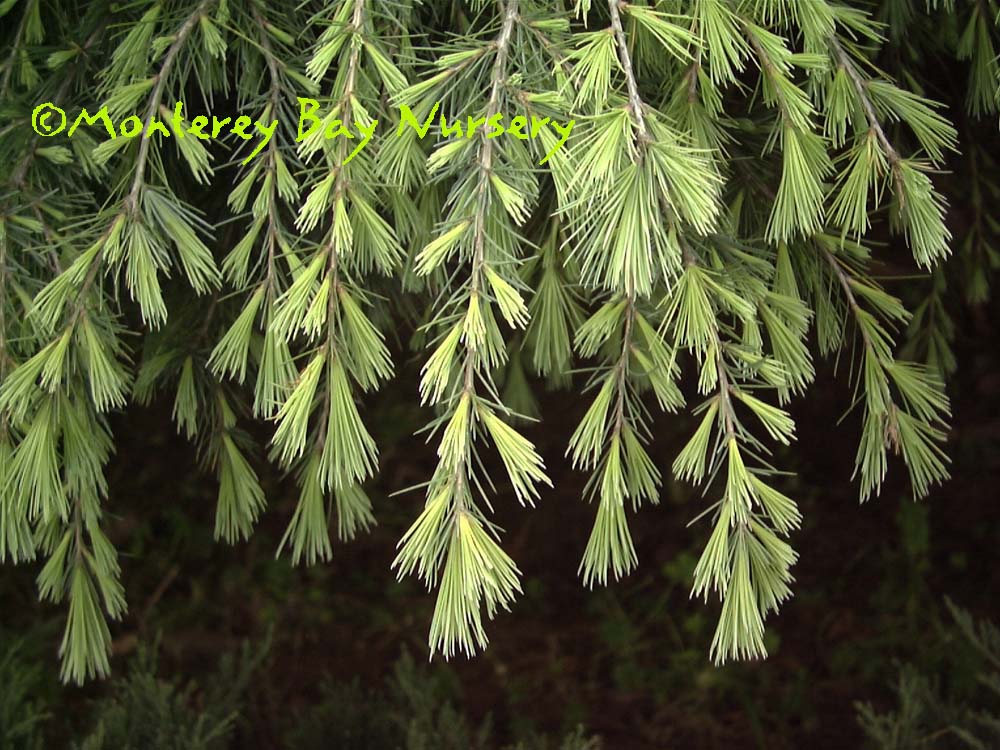
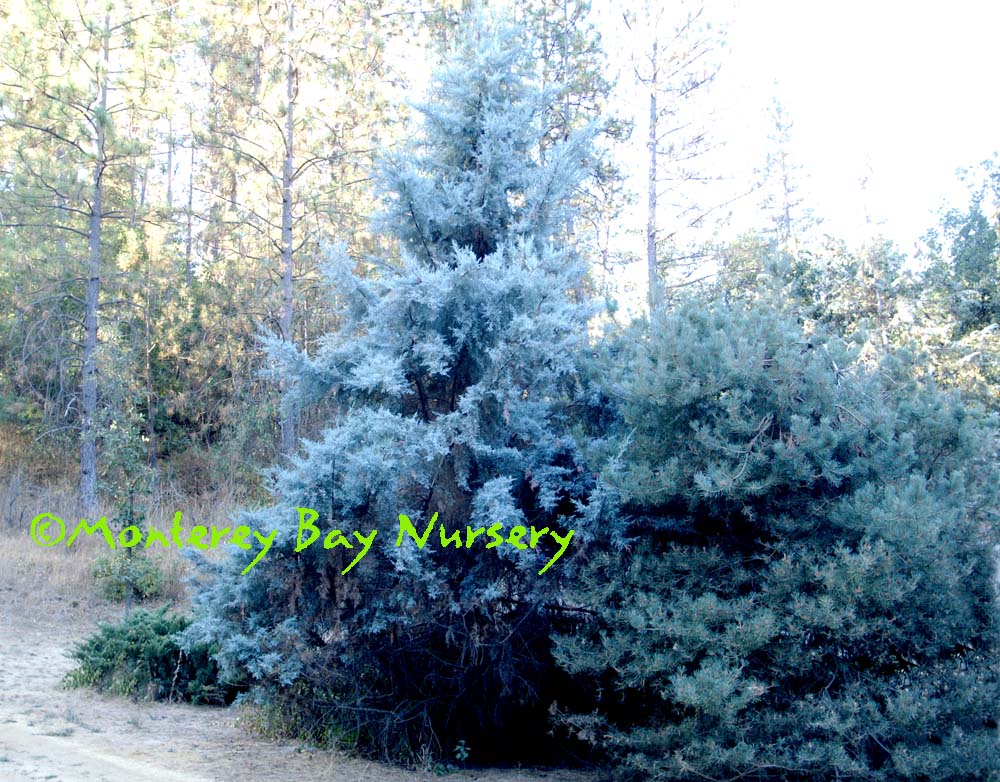
Cedrus deodara DEODAR CEDAR new growth mature stand an evergreen
tree to 60’ or more, reaching ~200' in its native range where it
greatly resembles our native Sitka Spruce (Picea sitchensis),
according to David Arora. Slow when young, it usually displays
deep green to blue grey needles with weeping branch tips. Crops
grown from domestic seed sources show considerable variation
however, ranging from gaunt, open, fast, pale grey individuals
through slow, compact, dark green variants. Dense, strongly blue
grey colored trees and dark blue green, weeping forms are
especially attractive. Performs quite well as a clipped hedge,
also heavily used for bonsai and other container applications.
Grows best in sun to part shade, with average to no summer
watering when established. Mature trees can provide excellent
quality wood, fragrant, attractively grained and highly rot
resistant though not particularly strong. It is also burned for
incense. Grows well in USDA 6-7(depending on seed source) through
cool areas of zone 11. Western Himalayas. Pinaceae. rev
8/2018
Centaurea ragusina DUSTY MILLER,
DUBROVNIK young one
gallons one of the wide-leaved-yet-cut-edges
forms of the shrubby white-leaved accent plants sold under this
common name. This here is "the original." Found only in a few
places along the Dalmation coast it is now rare in the wild and
listed as threatened or endangered. To about 18" tall by ~2' wide,
forms a nice tidy ball of silvery white leaves with mostly
spherical, yellow (vs. purple in C. gymnocarpa)
thistle-type flower clusters (constricted into a ball at the base
= Centaurea, vs. simple narrow clusters = Senecio)
held on short stalks Fast, easy, bold, satisfying, great as
an edging plant, accent or in containers, especially in
combination. Relatively short-lived for a perennial, but it
sometimes responds to a real hard cutting-back. Eastern Europe
(Dalmatia). Compositae/Asteraceae. rev 4/2020
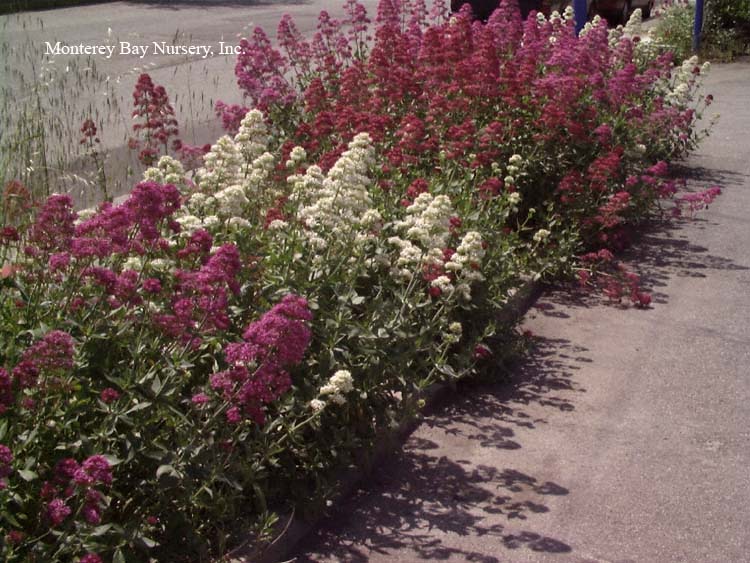
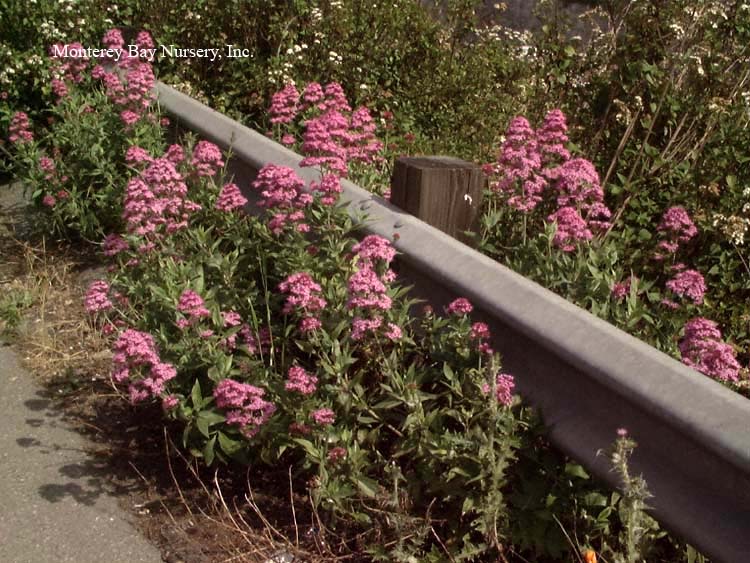
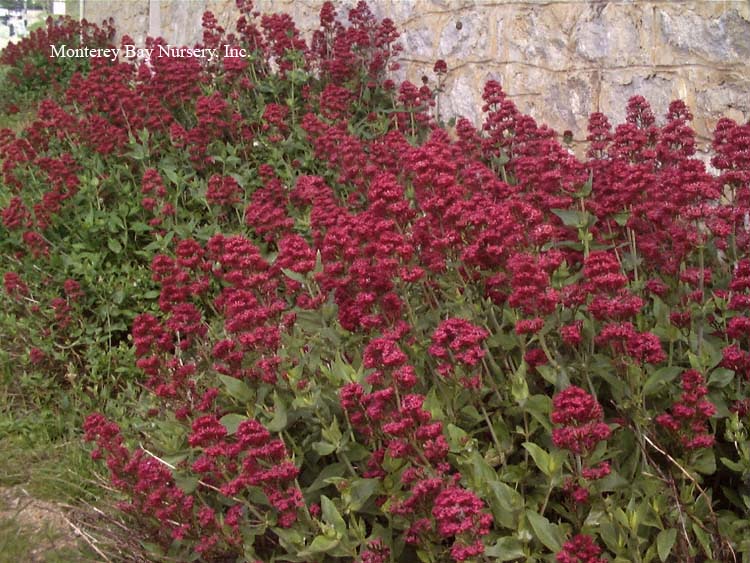
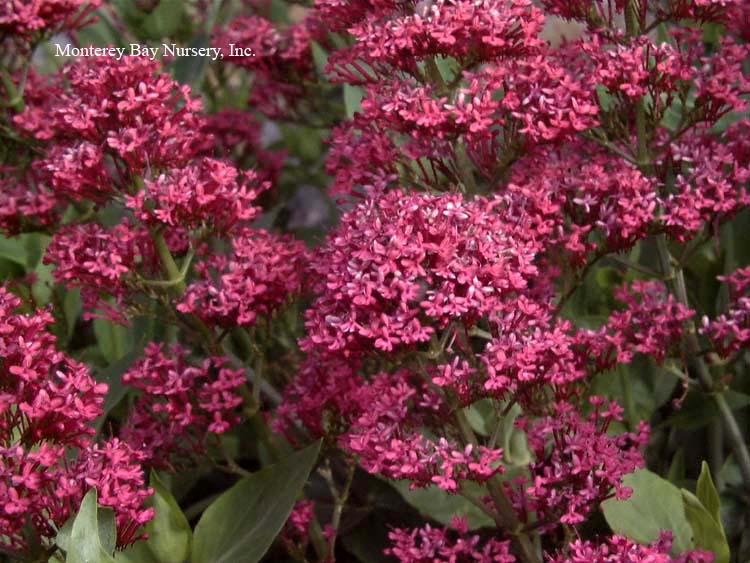
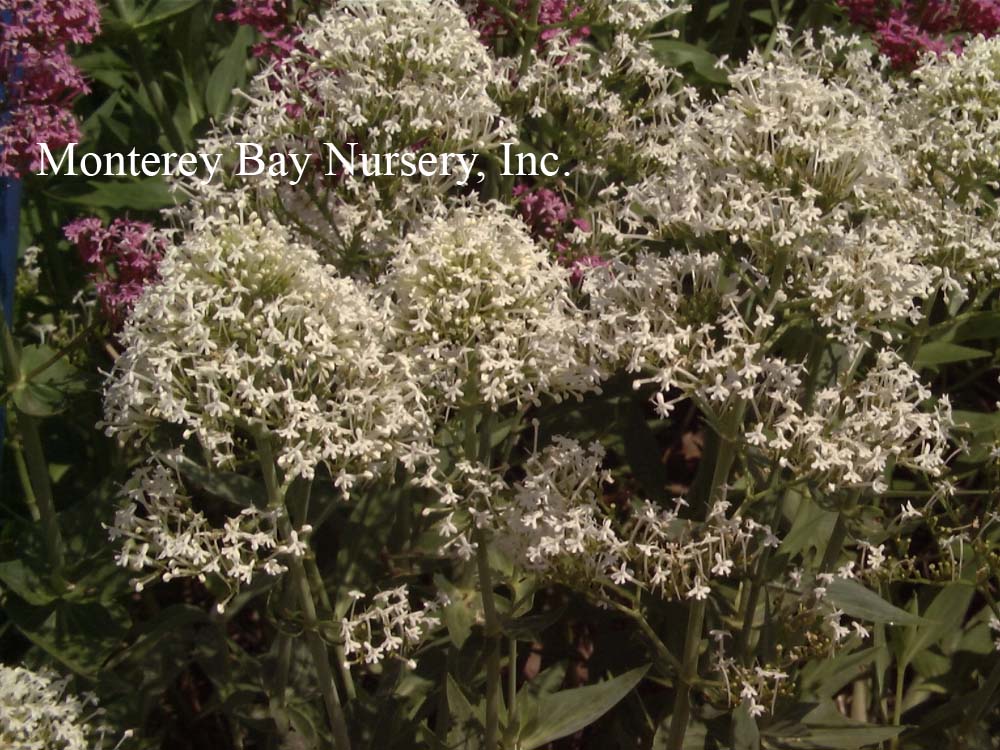
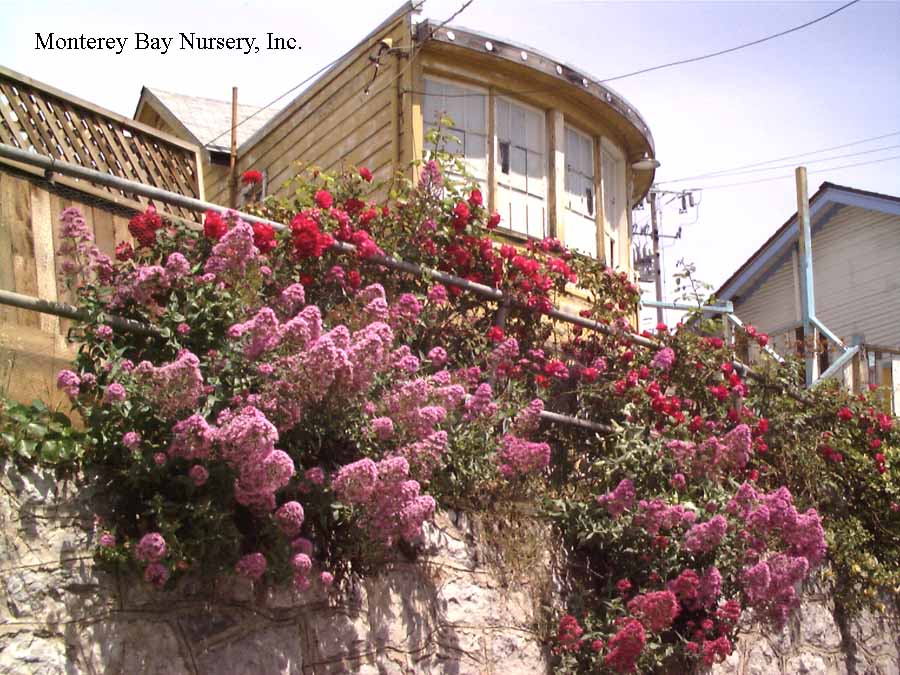
Centranthus ruber VALERIAN mixed roadside light coral red rose pink that ages to lavender pink pure white Front Street a tough evergreen perennial to 30" tall bears rounded spikes of tiny flowers in dense clusters in spring and summer. Naturalizes readily, and can reseed itself happily in gardens, along old fences, against buildings, in rock walls, or in cracks in the sidewalk. Commonly seen in untended situations. Sun to part shade, little or no summer watering, hardy to around 15-20°F. Mediterranean. Valerianaceae. rev 5/2018
Cerastium (not currently in production) herbaceous perennials, mostly known in horticulture from creeping, low forms used variously as rock garden subjects or small scale groundcovers. Caryophyllaceae. rev 5/2018
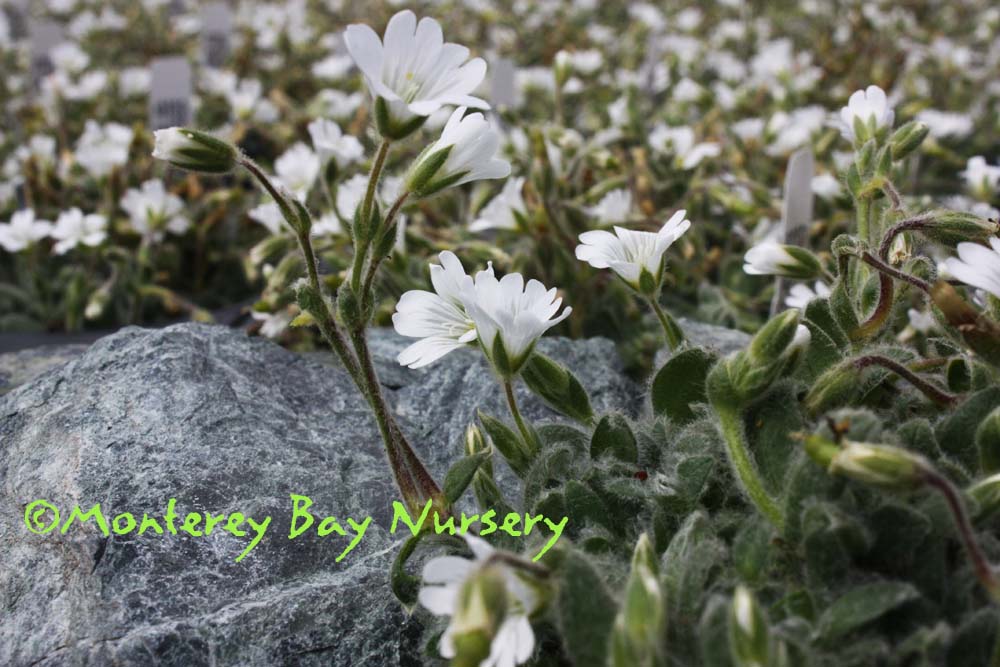
alpina lanatum (not currently in production) WOOLY MOUSE EARS (not currently in production) beautiful on serpentine a slow growing alpine for hot, dry, areas with good drainage. Silvery, fuzzy leaves, to about 2-3" tall and spreading, White flowers in early summer. A good choice for rock gardens, troughs, between stepping stones or with succulents. Little watering once established.USDA 3/Sunset all zones. rev 5/2012-Suzy Brooks
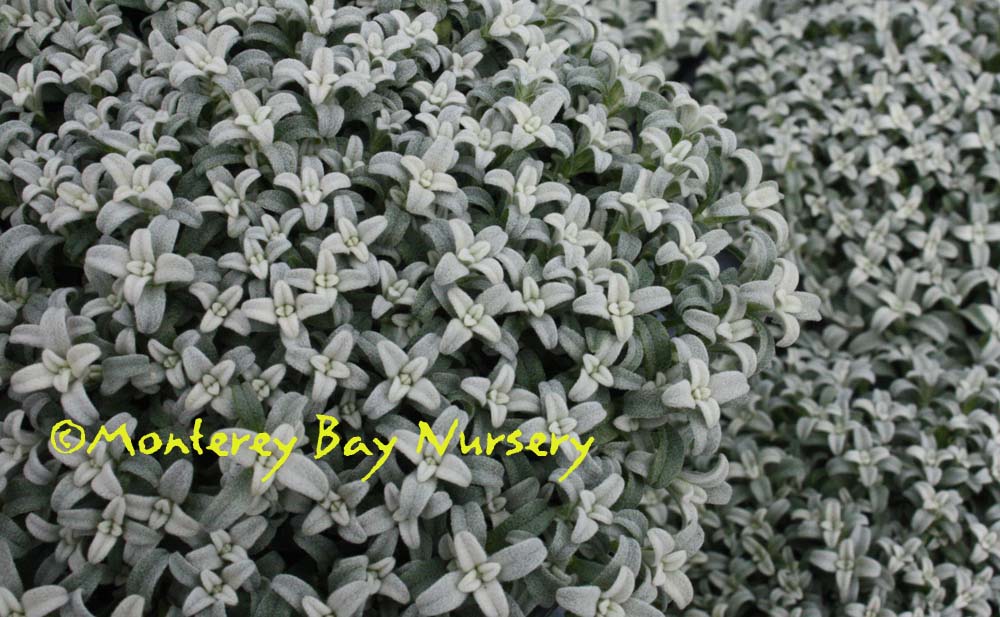
candidissimum (not currently in production) tight white leaves very compact, very low, very grey white, but with an olive green cast. Intriguing! Much better for not dying out in the center and traveling away from its original spot. USDA 4-9/Sunset all zones/. rev 1/2018
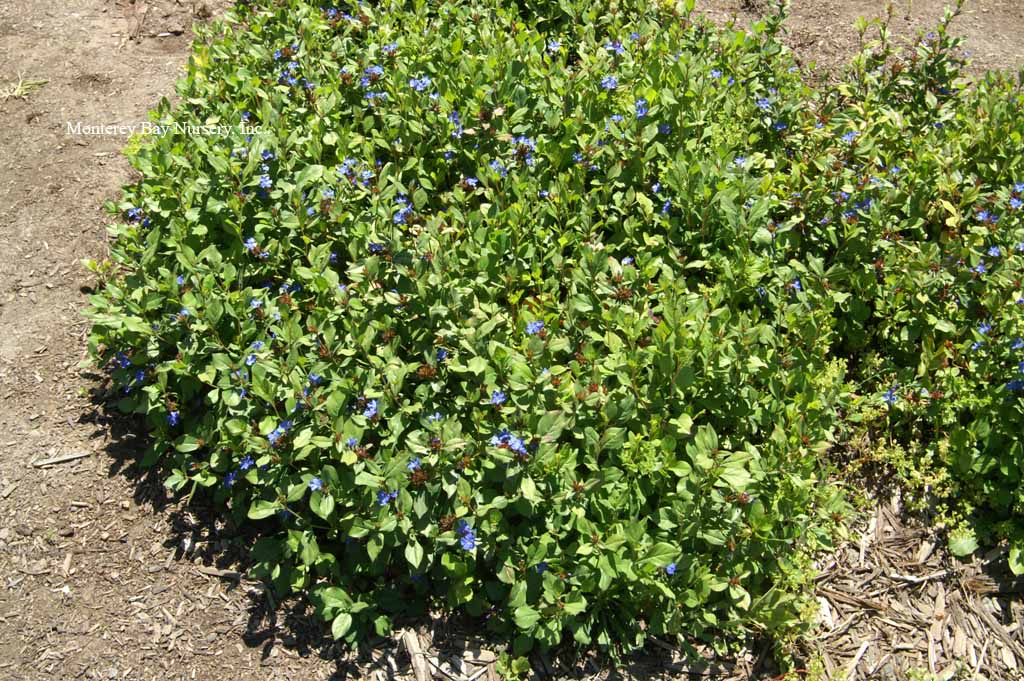
Ceratostigma plumbaginoides DWARF PLUMBAGO closeup park planting winter color deciduous perennial to 18" tall, spreading by underground rhizomes. Dark blue flowers cover the plants in summer and fall. Plants are briefly deciduous, with dark burgundy maroon fall color. An excellent medium size ground cover. Sun to part shade, average watering, frost hardy. Initiates most heavily at 13 hours daylight. Western China. Plumbaginaceae.rev 1/2018
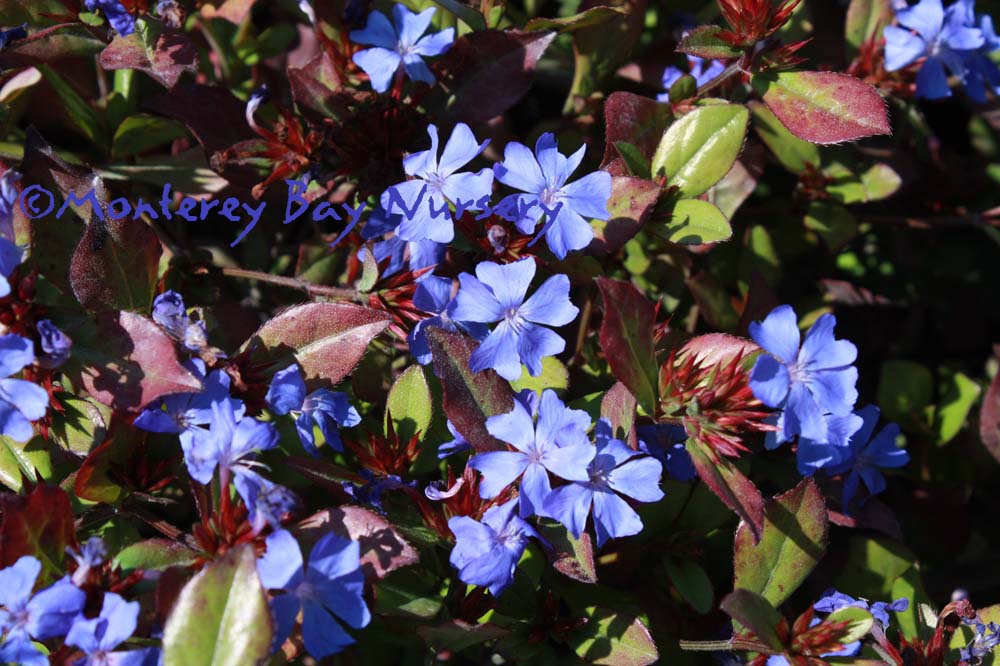
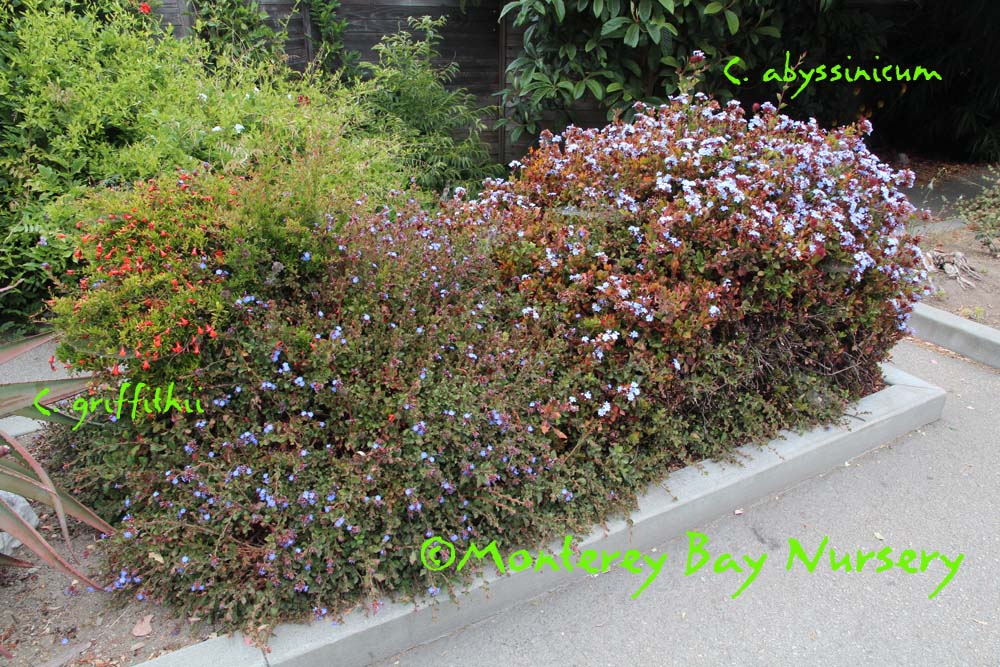
Cereus about 30 species of shrubby to large (45'!) ribbed columnar cacti, many with large, showy flowers and edible fruit. South America. rev 4/2021abyssinicum (not currently in production) EAST AFRICAN PLUMBAGO why you grow it closeup with C. griffithii, Shadowbrook Restaurant, Capitola Shadowbrook, reverse angle succulent garden, Branciforte St., Santa Cruz one of my favorite plants, used repeatedly in my own yard. You grow it for the almost constant show of sky blue flowers, those deep burgundy buds in starburst clusters and the wonderfully colorful foliage. There's something ethereal and intriguing about that flower color, or maybe it's the combination with the foliage. The waxy leaves turn orange, red and burgundy in dry, sunny conditions, more so in cool weather. It can flower and grow right through a mild winter but usually stops in late fall. It doesn't seem to care about soils and can survive in cool-summer areas with no irrigation at all when established. Mine lost a little top canopy at 25F, but I've seen it come back fast from the roots after an honest-thermometer reading (protected!) of 20F, so it seems to be hardier than referenced elsewhere. To 2-3' tall by 3-4' across, spreading slowly but dependably like its kin by short underground stems. Eastern Africa. rev 2/2018
grandicostatus (not currently in production) stuck in the sand! at this size, it is made for desert dioramas! In it's native habitat, it grows to tree size. Beautiful green, stout, symmetrical ribs and when mature, enormous salmon pink flowers that bloom at night. Provides an excellent vertical specimen in the succulent collection, nice contrast to the fuzzy white columns. Sun, good drainage. Shelter from cold outside Sunset zones 16-24/USDA 9. rev 9/2013-Suzy BrooksChamaecereus sylvestrii PEANUT CACTUS cute little things I like these, but never wanted to grow them commerciallty. But when one of my greenhouse workers saw us starting to grow succulents, he up and planted a few tables of this without asking. I was sure we would throw them away. Of course they sold like hotcakes once the came into bloom, because this is one of the best loved cacti of all, easy to grow, easy to bloom, hard to kill, and increases happily for little input. Sun to part sun, lives happily on a windowsill with little care, just makes a great plant pet. Grows to about 6" high and can form large clumps with age. Argentina/ Cactaceae. rev 3/2009
repandus (peruvianus) PERUVIAN APPLE CACTUS, PITAYA, KADUSHI Santa Cruz almost-spineless stems nice flower old, split fruit a large, fast growing (2-4' per year) columnar cactus with almost spineless grey green stems of 8-13 ribs and 5-7" across. Very large, showy nocturnal white flowers, backed by coppery red sepals, can reach over 8" across and appear spring through fall. They open for just one night in most areas, often very many at once, but sometimes last for 2-3 nights in very cool, moist conditions, such as along the coast during foggy periods. Though used here almost exclusively as an ornamental it produces spineless, edible red orange fruit with a very good flavor. I have seen forms with clusters of intimidating 3" long spines but our current form produces only tiny spines and so is much safer to use in commercial landscapes and home gardens. This an easy variety to grow, tolerant of a wide range of soil types, climates and watering regimens. The biggest issue limiting use is its ultimate size, as it reaches 20' tall by 10' across unless cut back occasionally, even more with age, enough room and a permissive environment. Hardy to around 20 °F, USDA zone 9/Sunset zones 16-17, 21-24. South America. rev 4/2021
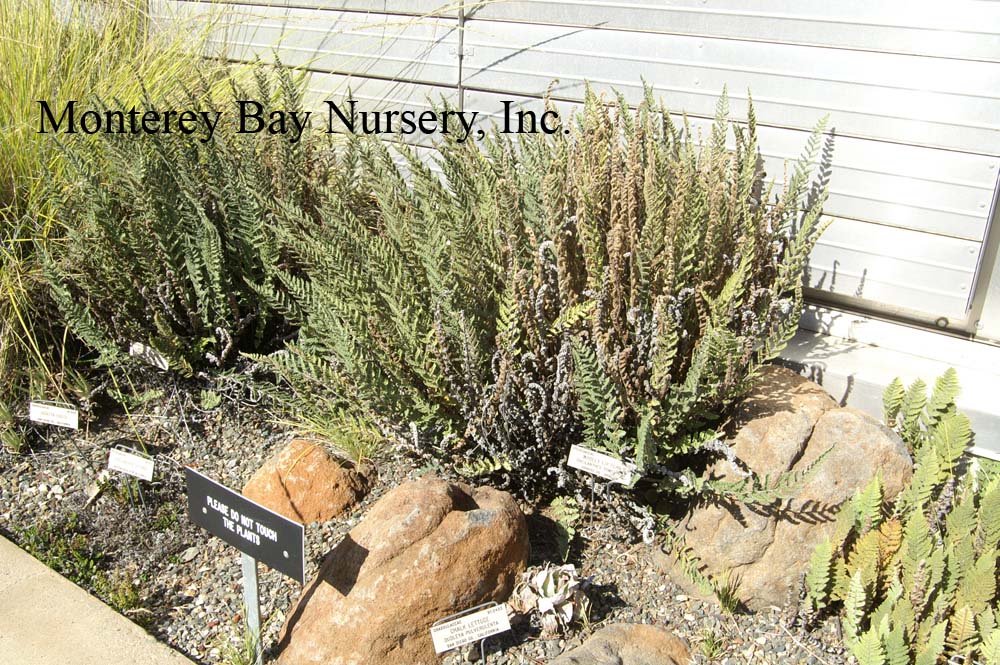
Cheilanthes LIP FERNS small evergreen ferns, deciduous with drought. Spores are produced close to the frond margins and become protected as fronds dry and curl up. With about 180 species as formerly described this group is considered paraphyletic and many species are now classified under separate genera by most authorities Polypodiaceae. rev 5/2020
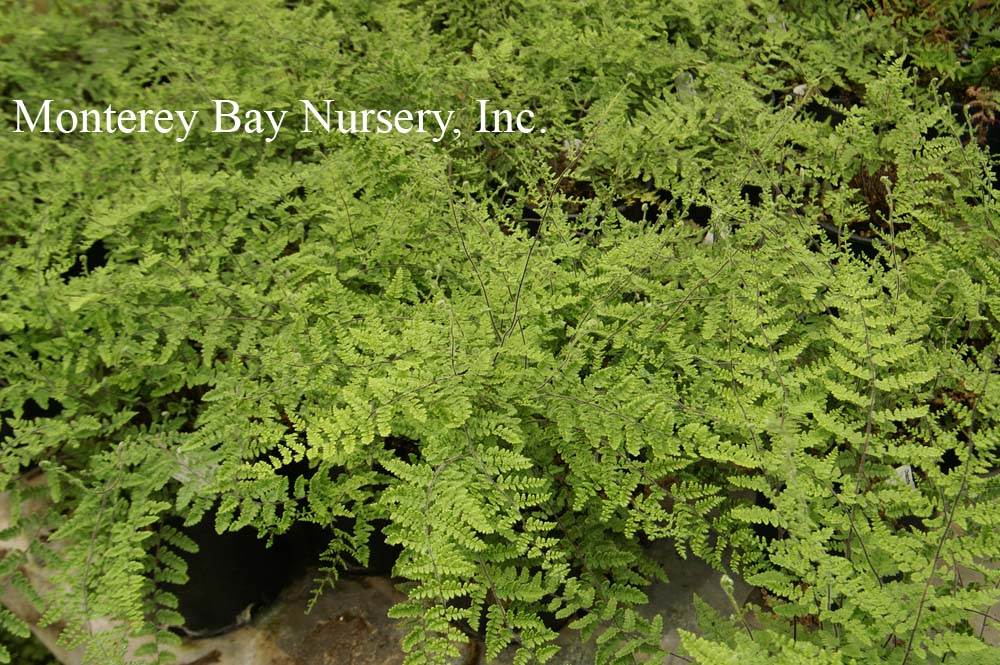
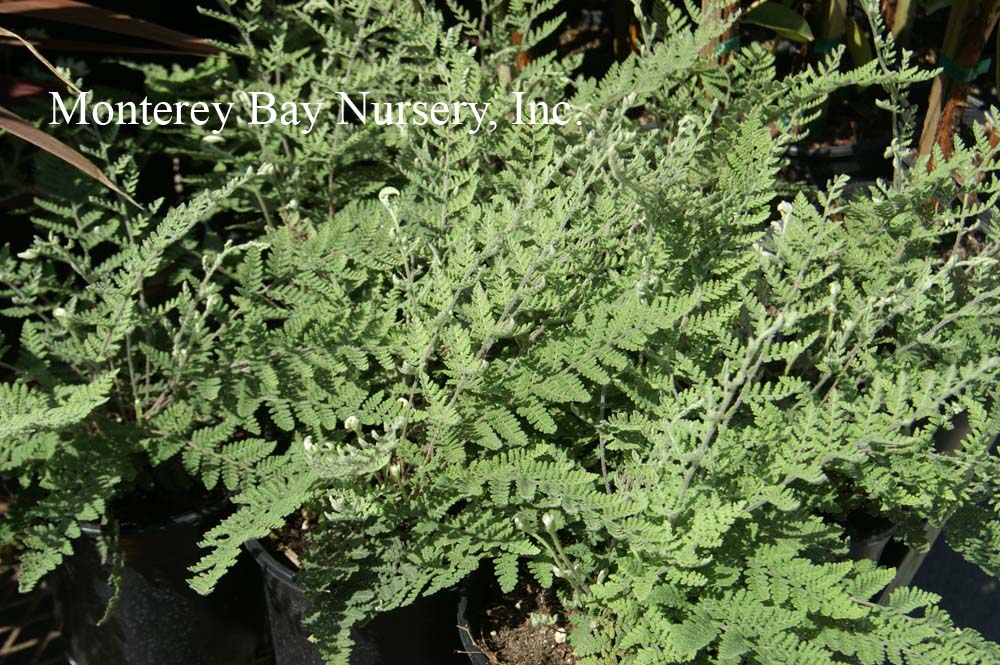
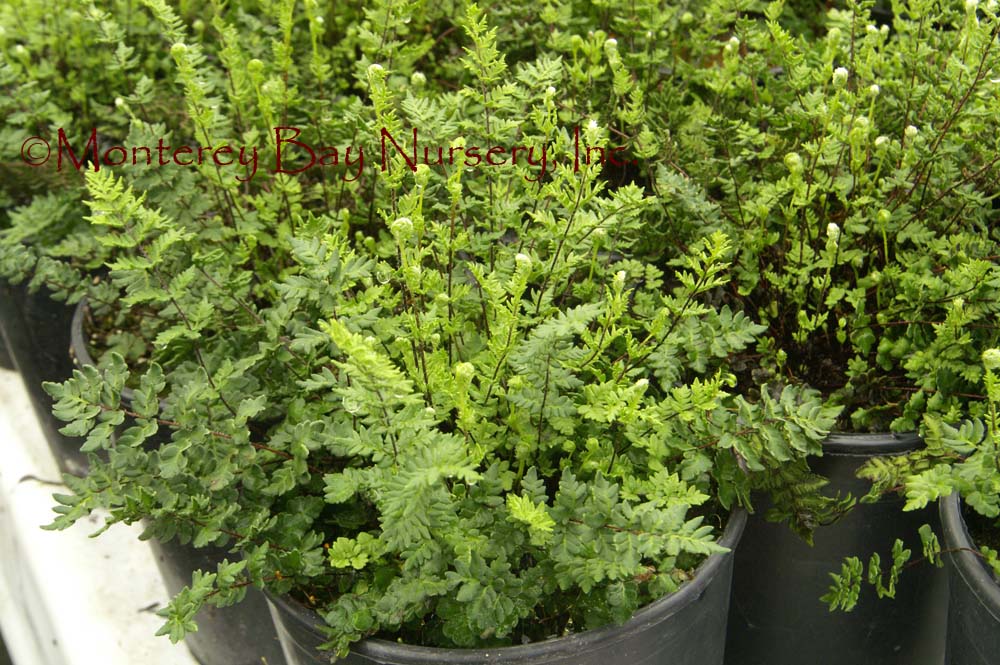
argentea SILVER CLOAK FERN nursery plants a small, charming, tough, clumping fern with dark green fronds that have silvery undersides. You can stamp your hand with the white spores on the undersides for a free wonderful temporary tatoo just like you do with our native Gold Back Fern (Pityrogramma). For high light areas, but will tolerate mostly shade. Likes average watering, good drainage, high light. It can go completely dormant under very dry conditions. Easy, good in containers. Northern and Eastern Asia. USDA zone 5. rev 4/2007
lanosa
HAIRY LIP FERN nursery
plants now there's a strange thought. But the
fern itself is nice, a rather more open and airy form than
some of the other in its genera, that is slightly golden
grey green and minutely tomentose. It is another East of
the Rockies form, to about 12" tall, and tolerating either
regular watering or deep drought. This species probably likes warmer
temperatures and is a little tougher to grow. rev
1/2010
sinuata nursery plant
a
robust, drought tolerant species with soft textured, and
soft looking, furry, grey green fronds with whitish
undersides, growing as a mostly erect rosette to 8-10"
high in a short amount of time, but vigorous 2' tall
eventually. With age it can get to be rather plump
and spread to form nice colonies. It can even grow in full
sunlight with reflected heat. If it goes drought-dormant
it will revive with rainfall, but it can also tolerate
regular garden watering. This is a nice small to medium
sized subject to tuck into a rock wall or even a succulent
garden, or enjoy as a small container specimen, or grow in
the shade. The leaves can be used like Gold Back Ferns to
make spore imprints on your hand. Native
to dry shrublands at mid elevations in the Rocky Mountains of
Mexico and the adjacent US. rev 12/2011
tomentosa (not currently in production) nursery plants UCB plants, full sun, rockery another of the extraordinarily tough species for the hot, dry rockery. In shade the leaves are lusher and softer but still quite nice. It can dry down considerably in summer. Evergreen in mild winters. Relatively easy and tough. Eastern and Southern US, northern Mexico. rev 1/2010
wrightii (not currently in production) nursery plants a small species native to rock ledges of the Southwest and adjacent northern Mexico, growing in chaparral. To about 10" high, vertical and compact in habit, with dark green fronds bearing short pinnae. May be short lived. This is probably best used in smaller containers or combo'd up. Sunset zones 5-24/USDA zone 8. rev 1/201
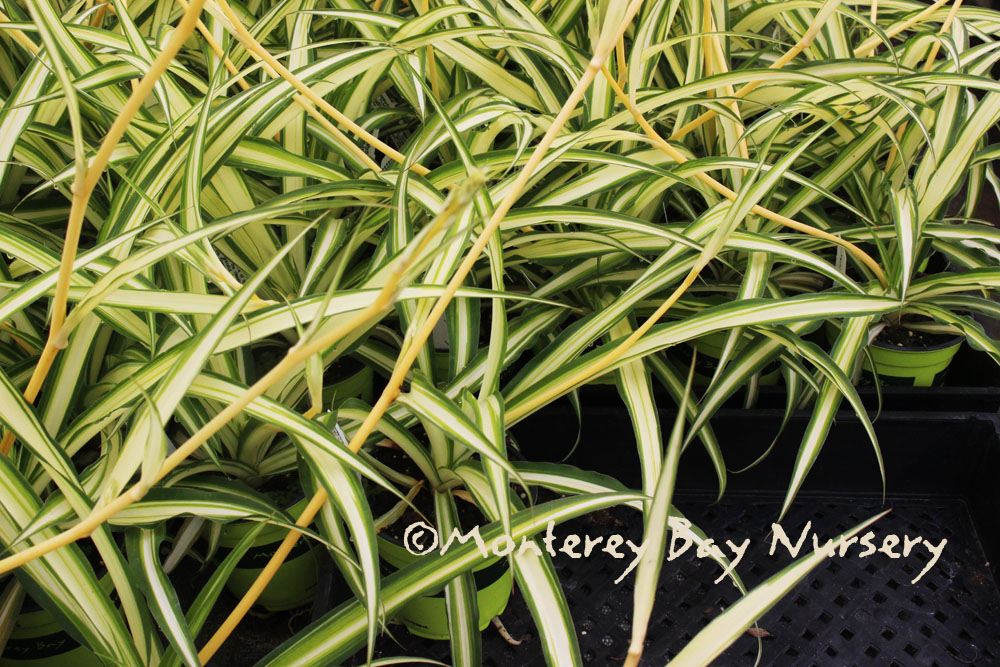
Chlorophytum comosum SPIDER PLANT Green Edge
White Edge Airplane
easy house or patio/porch container plant, can even
grow outdoors but watchout - it can move fast! rev 6/2017
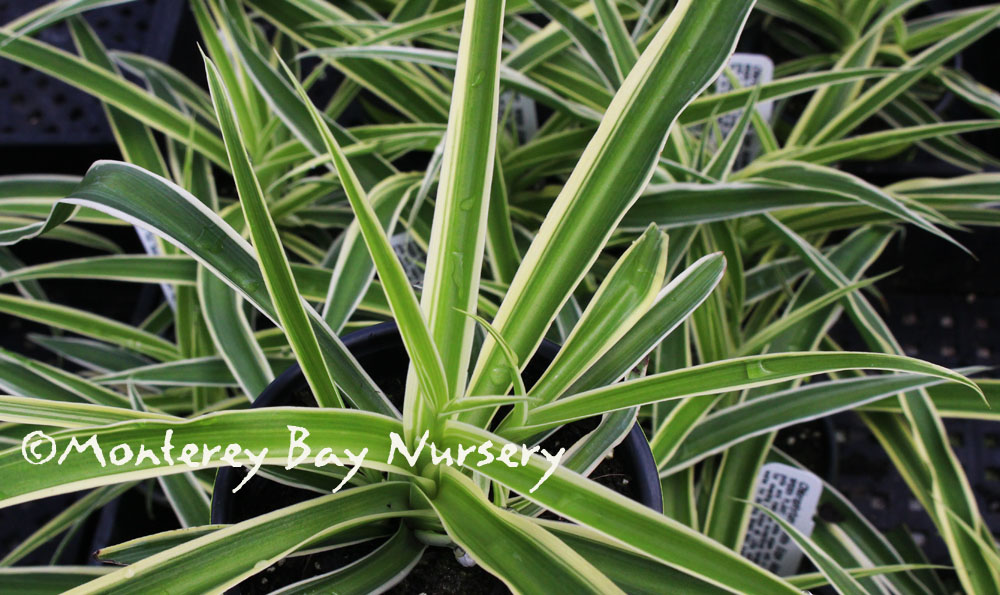
'Ocean' young plant leaves are cleanly margined with white. Same size and growth requirements. rev 4/2021
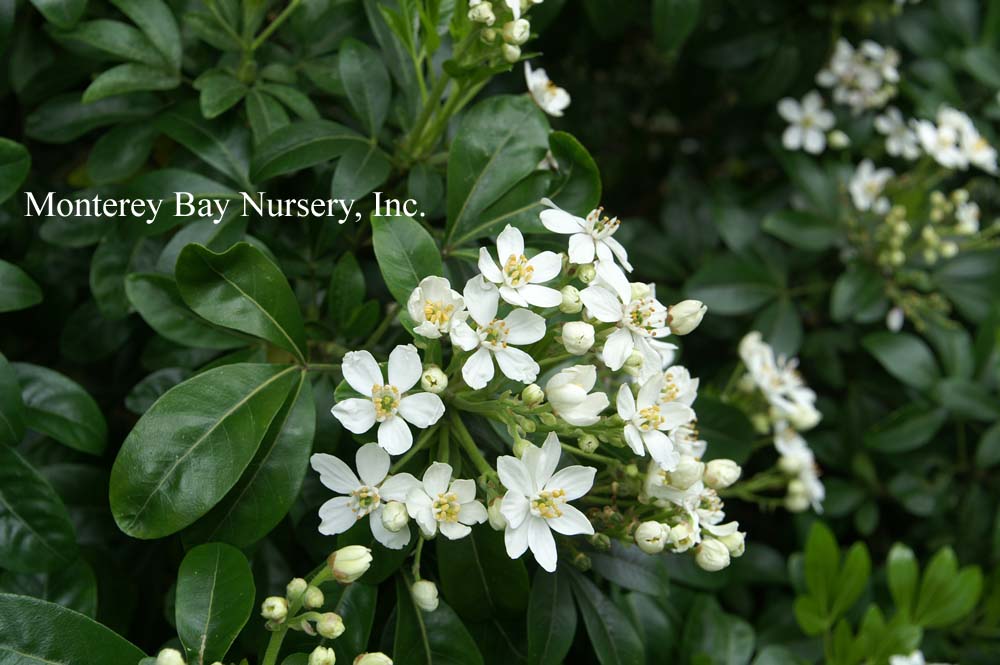
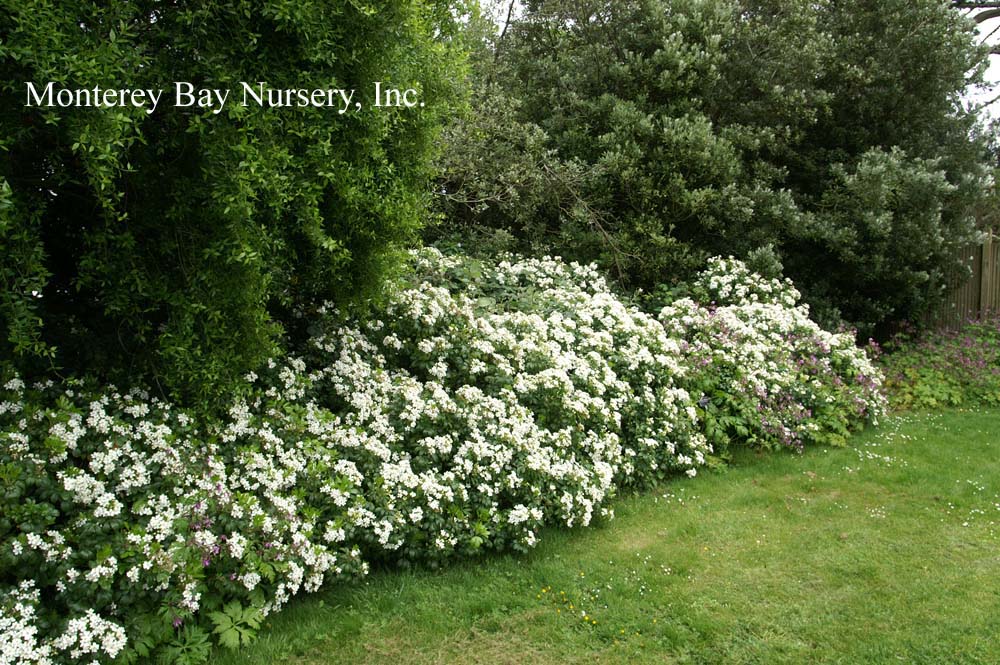
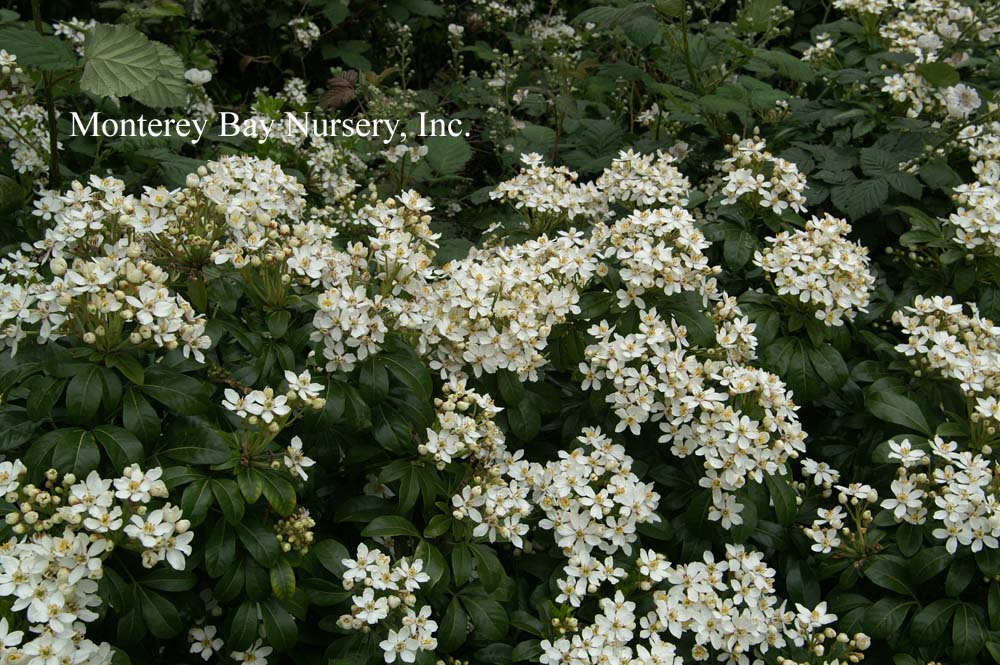
Choisya ternata (not currently in production)
MEXICAN MOCK ORANGE flowers
closeup nice
planting, Strybing Arboretum mass bloom an evergreen
shrub to 6’ tall, 8’ wide bearing clusters of fragrant white
flowers in winter and spring, sometimes again in summer. Sun to
part shade, average to little summer watering, damaged below 20°F.
Mexico. Rutaceae. rev 1/2006
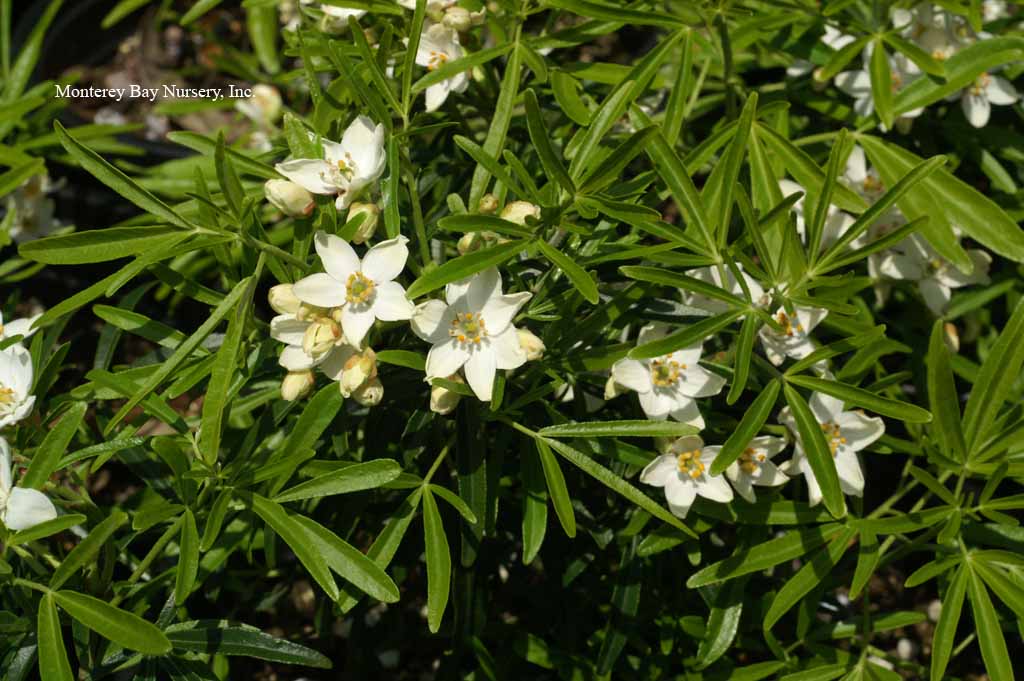
‘Aztec Pearl’ (not currently in production) flowers and leaves has very narrow leaflets, a strongly vertical, rather open habit to over 6' unpruned, and a heavy show of fragrant flowers. The hardiest strain, easily surviving in Portland (zone 8b). Its open growth can be effectively used against walls. rev 2/2003
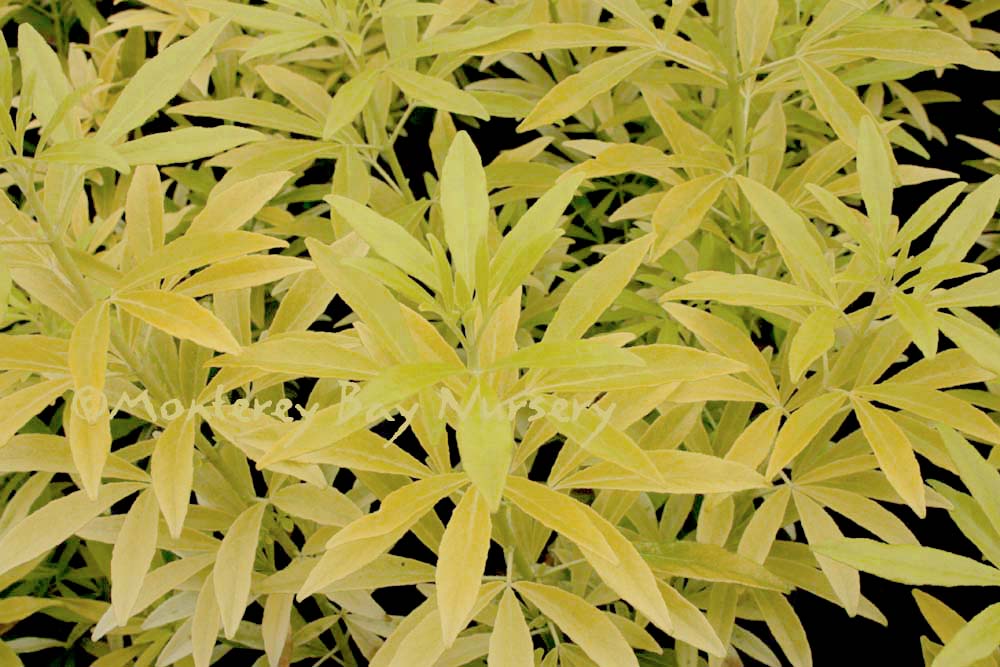
'Goldfingers' (not currently in production) narrow and yellow shrubby evergreen with narrow, golden leaves and white flowers in spring with orange blossom fragrance. About 3-4' tall and wide. Best color comes in sun, though it can take part shade. Regular watering. Sunset zones 6-9, 14-24/USDA 7. rev 8/2013-Suzy Brooks
Chondropetalum tectorum CAPE RUSH
sheathed, jointed
culms this was the very
first member of this first-rate family, the highly ornamental,
grassy, bamboo-like Restionaceae,
to appear here in the US in any quantity. The culm-stems of
this family are jointed stems, just like bamboo, and some retain a
similar ornamental joint-sheath as well. All Restio Family plants
have separate male and female plants, often with quite different
and very showy flower spikes. In this form the flowers of both
sexes appear superficially identical, and it usually takes a hand
lens to separate them by finding their tiny stamens or stigmas. If
you want to sex your plants know that ours usually bloom in early
February. There are subtle differences between the two in the
overall appearance of the male and female flower spikes, and also
variation within each species within each sex.
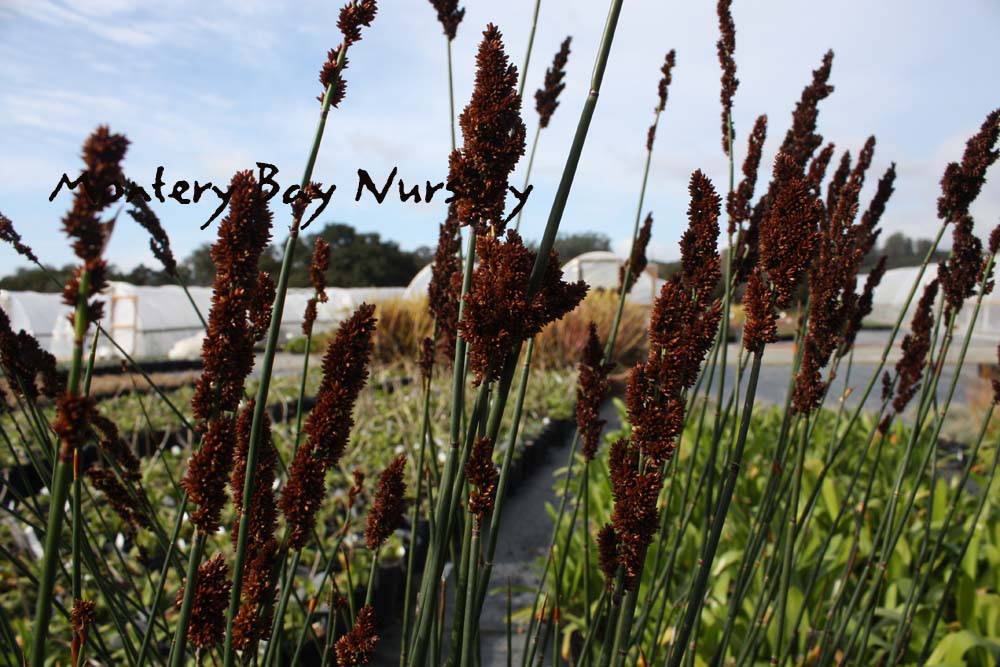
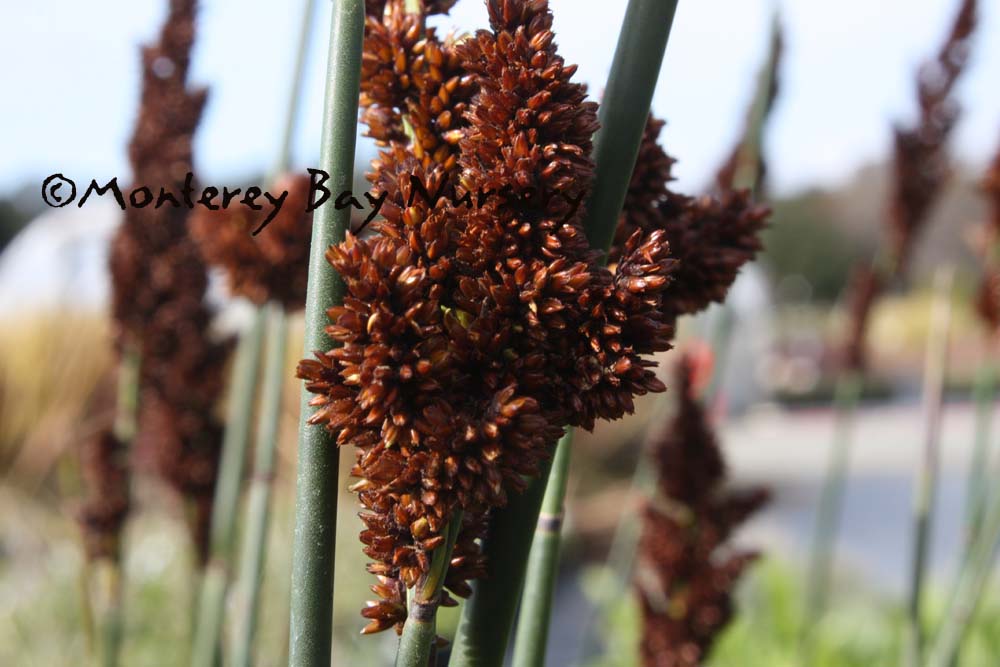
Use either or both of the following two sub-forms as dramatic, large scale grass or bamboo-equivalents, sited in the back of a border, as a focal point planting or as a very dramatic and forgiving container plant. The signature brown-black flower/seed heads appear at the tip of each stem in summer on both varieties, lasting often for two or more years. A very nice feature is that the stem-joint sheaths pop free with a clear "snap" when they shed as the culm is maturing. Both make outstanding cut flowers or filler, and are used for thatching or even hut construction once the culms are about a year old and have stronger sidewalls (just in case you were ready to put up that garden yurt tea house you've always wanted). In nature plants usually live about 10 years but in cultivation they can go much longer, possibly indefinitely with thinning/rejuvenation of the clumps. Figure after 7-10 years your plants will be taking up too much room, plus you'll be ready to try something new in that spot by then anyway. Sun to part shade, average watering, barely frost hardy below 20°F. Our grower Jeff Brooks says his came back from 18F, but slowly. South Africa. Restionaceae. rev 4/2021
Two physically different biogeographical forms are currently sold under this name in the US, separated by how thick their culms are. The larger/thicker-stemmed form was the first form available here of this species and is now also sometimes sold as Chondropetalum elephantinum. (The correct name for this reclassified form would have to be Elegia elephantinum, Chondropetaloum elephantinum has never been published.) The smaller/thinner-stemmed and more recently available form continues to be sold by many as C. tectorum separately and alongside the preceding. Which causes confusion. Therefore . . . we continue to sell both under the original name and classification of Chondropetalum tectorum but separated and distinguished as large-stem and small-stem forms respectively. Both forms have their charms and can be used in different situations. As they source from two different geographic areas their appearance and culture differ slightly. rev 4/2021
large-stem form David LeRoy's large-stem form, quite beautiful across the street, before he so callously ripped it out and ruined my view nice old/new stems effect, large-stem form, Aptos large-stem form, UCSC, 2009 commercial, Marina, large-stems with root barriers large-stem, commercial, full shade, Soquel Creek female large-stem blooming female large-stem very close male large-stem flowers male large-stem very close found in hotter/colder summer rainfall interior regions, more uniform and generally taller (5-7'). It eventually spreads quite wide due to older culms reflexing outwards and downwards quite dramatically and attractively, from the weight of the seed/flower heads, providing room for new culms pushing up from the center of the clumps. It can easily arch/spread to over 8-10' with age - site carefully! This is one of the most adaptable of the whole Restio Family, and is more tolerant of heat, frost, dense soils, and summer watering than its finer-stemmed sister, below. rev 4/2021
small-stem form dwarf small-stem, left, average large-stem right, Westside Santa Cruz young large-stem, Eastside Santa Cruz mature small-stem, UCSC Arboretum 2005 female flowers very close male flowers very close from the cooler winter-rainfall Cape Region's Mediterranean-climate coastal areas. Finer in appearance, more vertical and generally shorter but also much more variable in height and appearance than the larger form. Some seedlings are as short as 12-18" high, some reach over 7'. It can also vary in color from light green, almost chartreuse, to very dark green, grey green or quite blue. It is a little touchier in cultivation, preferring cooler summers with less dry season irrigation and definitely needs at least average drainage even though it is found in rather wet coastal prairies in nature. rev 4/2021
'Monterey Bay Midsize' this is our own selection of a single very dark green seedling individual (female) chosen from a large block of thin-stem (culm) 5g plants grown from seed. It should fit the need for a reliably compact, mid-sized plant for gardens and landscapes. Trade seedlings of both thin and thick-culm populations consist mostly of plants which will usually exceed 4' in height, with many producing stems that are over 6' long, usually arching over even before weighted by seed heads to occupy a circle of space 10' across or more. There are dwarf forms offered that don't exceed 18-24" in height ('El Campo'), usually reaching to about your knee. Those forms almost serve as small-scale grass clumps, and don't have the vertical presence and mass required or desired for many situations. This form, produced by division, has consistently maintained a very useful 3-3 height, with a few stems reaching 4' height, and should be a predictable asset for gardeners and designers to use. Help reinforce its good behavior by planting in full or mostly full sun and using moderate watering when possible. In moist, shaded conditions expect it to reach higher, and accept that you acted as an enabler by needlessly providing an opportunity to fail. This can serve as a container plant for several years but as with all Cape Rush forms will eventually rather quickly expand to the limits of its available space, pushing itself up and out of the pot by massing roots below and even sometimes fracturing ceramic containers. An even more desired and pending form would be an intermediate size selection of the large stem form. rev 4/2021 MBN INTRODUCTION-2020
Chrysanthemum a genus of perennial herbaceous to soft-wooded shrubs. In some classification systems certain species have been moved to various other genera such as Argyranthemum, Leucanthemum, Rhodanthemum etc. However some of these are being returned by many botanists, and we mostly treat those emigrants as never having left this genus. Compositae/Asteraceae. rev 6/2017
catananche
a compact mounding perennial with silvery leaves, very close to C.
hosmariense but little smaller scale over all, being a lower
grower with smaller leaves and smaller flowers. To 6-8" tall,
12-16" across, likes sun/part shade, average to gritty, lean
soils, good drainage, intermittent to infrequent watering.
Initiates flowers with cool weather and/or short days. An upland
species from the hills and mountains of Morocco, can take some
dryness but shrivels with extreme drought. A good but somewhat
short-lived container plant, cut it back hard to renew and replace
if it doesn't come back after that. USDA zone 8. rev 4/2021
'Casa Rosa' perky flowers
dark pink buds open to white daisies and a dark rosy
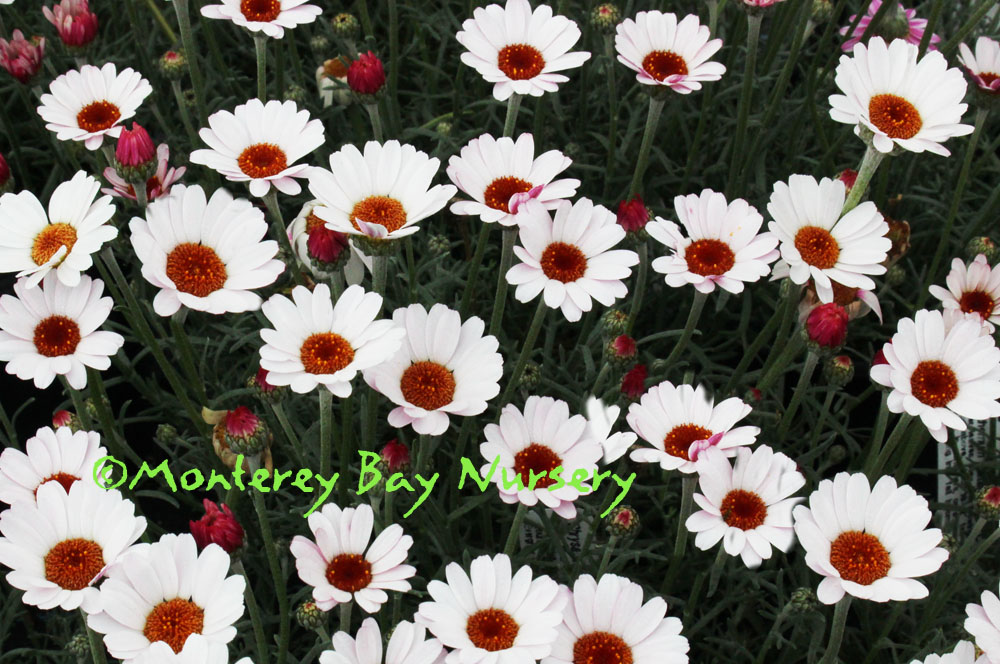
middle. Grey, ferny foliage stays low, 10-12" tall. rev 5/2016-Suzy Brooks
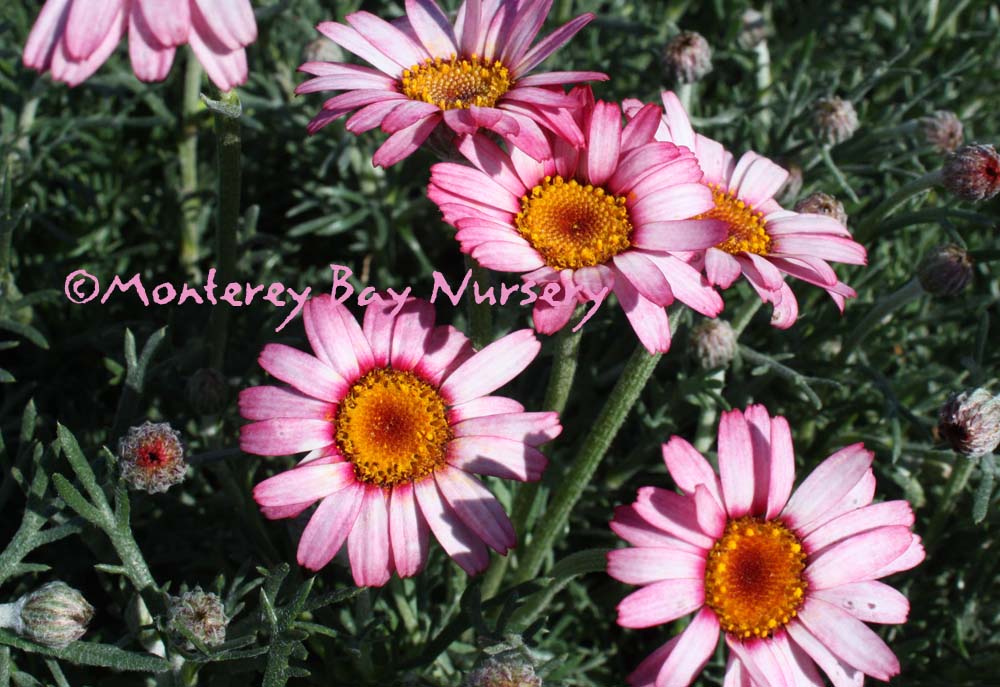
'Marrakech' (not currently in production) pink flowers a tidy, compact, evergreen perennial with silvery foliage and little daisy flowers with many shades of pink from summer into fall. Just the thing for pathways, spilling over the sides of a pot, or as a groundcover. About 10-12" tall and wide for sun or part shade. Sun, average to good drainage, little to average summer watering. Sunset zones 14-24/USDA 8. rev 5/2016-Suzy Brooks
'Tizi-n-Tichka' (not currently in production) flowers from Morocco, this little daisy is named after a pass going from Marrakech up to the Atlas mountains. It has grey ferny foliage and white flowers with a red base at the bottom of each petal. Growing 6-8" tall and twice as wide, it blooms early in spring not bothered by the cold. Likes good drainage in a sunny, warm spot with average watering. rev 2/2013-Suzy Brooks
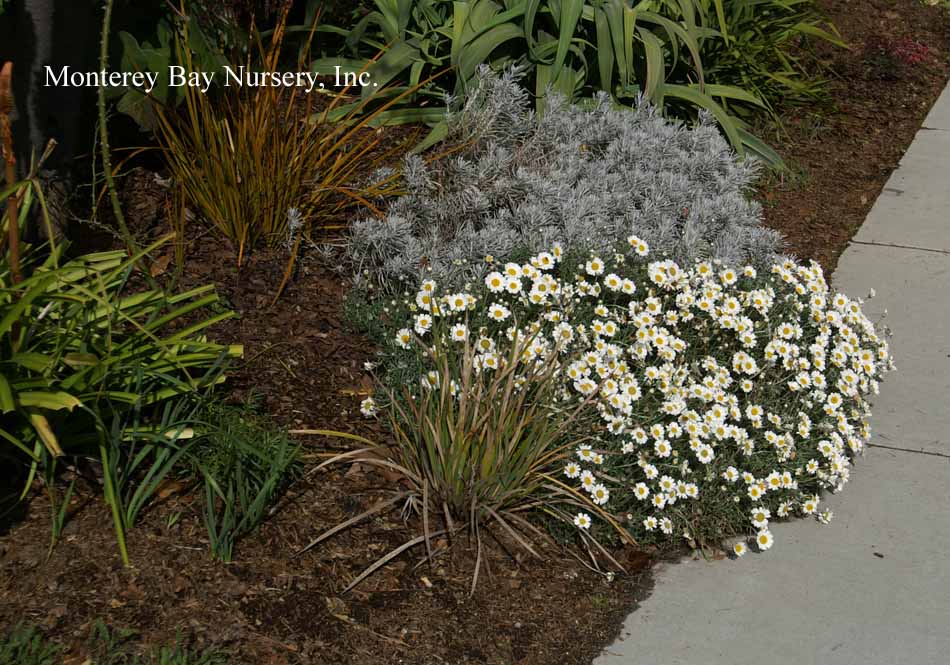
hosmariense flowers landscape evergreen perennial forms a dense, compact mound of silvery foliage, to 8" tall by 2’ across, topped with large white daisy-like flowers with wide yellow centers. Blooms heaviest in winter, with some flowers almost all year. Sun, average to little summer watering. Survived 20°F in containers without damage, and reportedly hardy enough to be used on the East Coast. Morocco. rev 4/2011
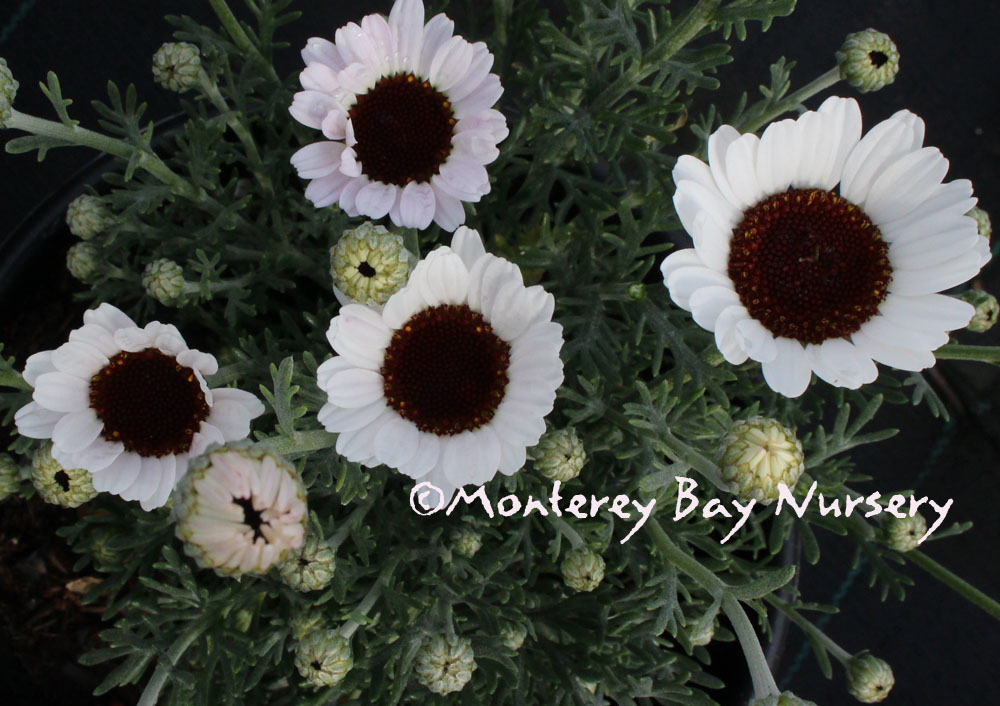
'Casa Blanca' right in the eye! more compact, more silvery foliage, larger flowers with dark central discs (vs. yellow) and over a longer period. Flower petals are faintly blushed pink, especially with cool conditions. rev 4/2021
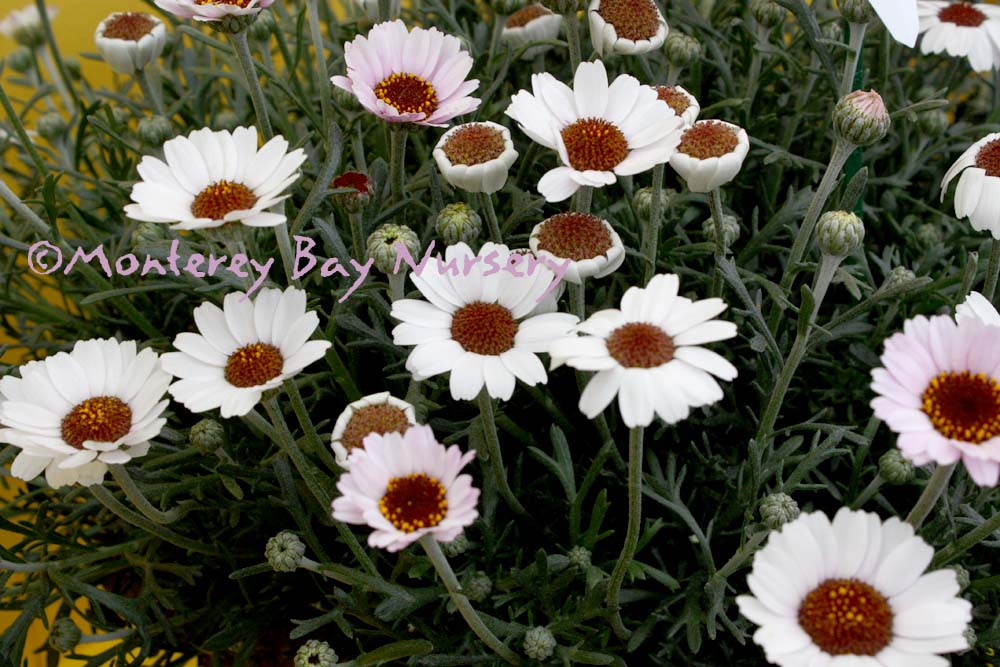
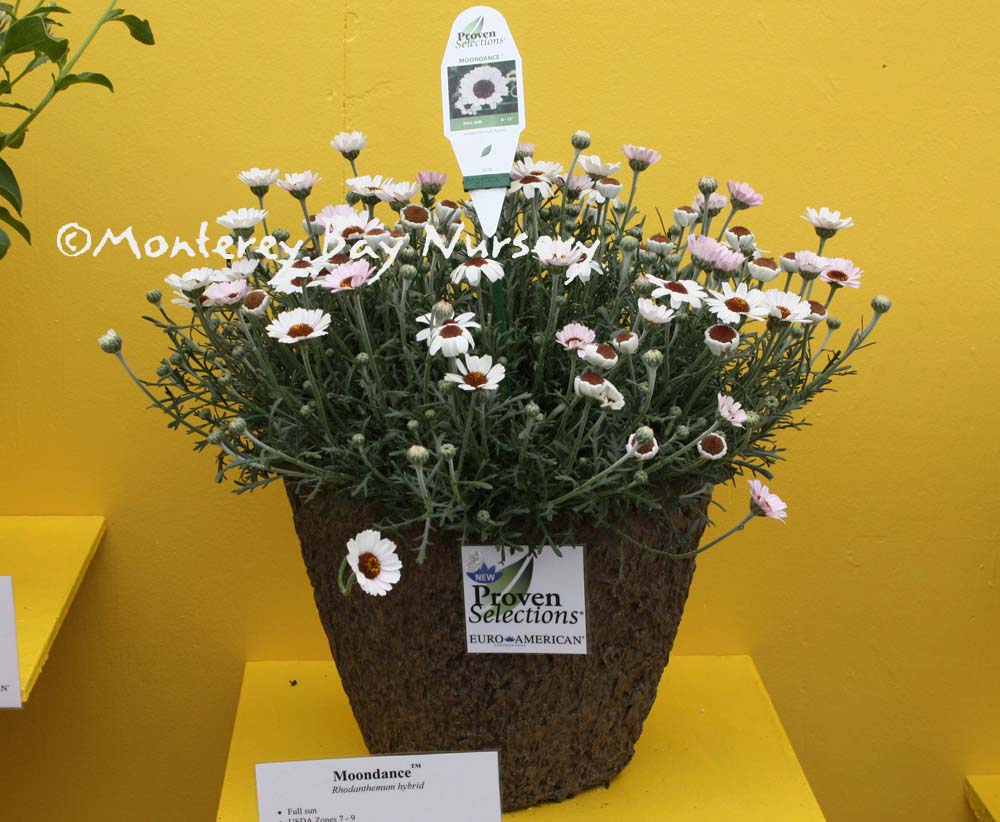
'Moondance' (not currently in production) flowers container just like the regular form of C. hosmariense, but with a faint pink blush to the petals as well as a distinctive rosy ring around the dark center. Same silvery foliage, same low, compact habit, same frost hardiness, same late winter through spring bloom. But that soft pink against silver is very nice. My wife Molly will really likes it. rev 4/2011
parthenium 'Aureum' GOLDEN FEVERFEW garden with lavender used for its soft billows of gentle golden yellow to lime green foliage, it also displays small white daisy flowers with yellow centers under long days. Very frost hardy, but deciduous with cold. To about 18"' tall and 2' wide. Sun to part shade, average watering. Sunset zones 1-9, 14-17, 21-24/USDA zone 5. rev 4/2011
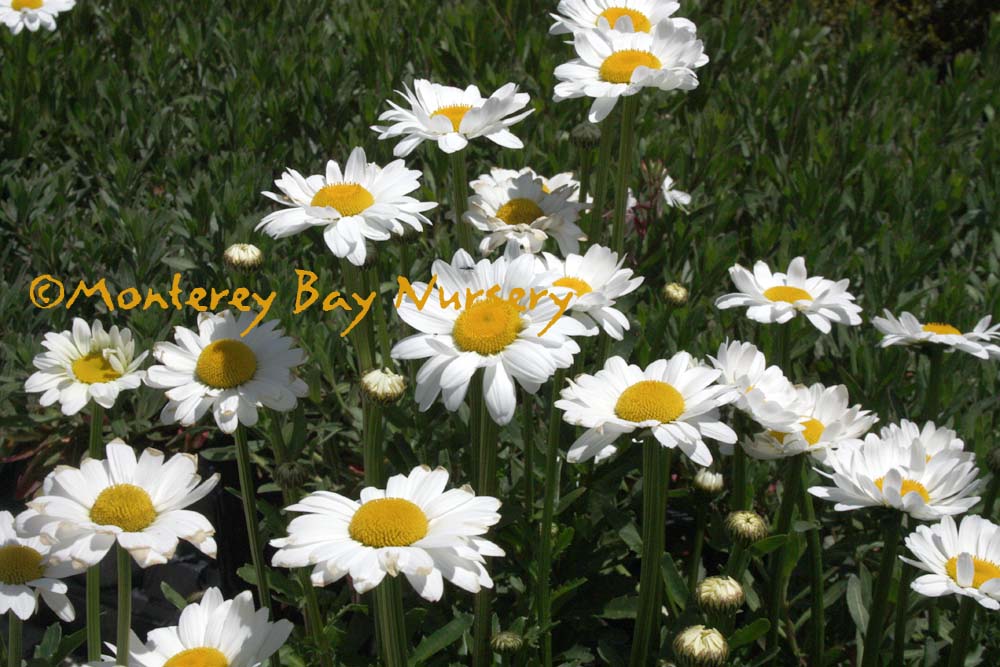
superbum (not currently in production) SHASTA DAISY semievergreen, facultative or obligate long day bloomers. Some have fabulous petals and flowers. An easy to grow perennial for sun, part shade, average watering. USDA zone 5/Sunset all zones. rev 8/2014
'Darling Daisy' (not currently in production) COMPACT SHASTA DAISY flowers this is an improved strain with higher uniformity, earlier bloom, and just better overall performance. To just about 12-16" tall, flowers from spring through late summer. Sunset zones 1-9, 14-24/USDA zone 4. rev 5/2011
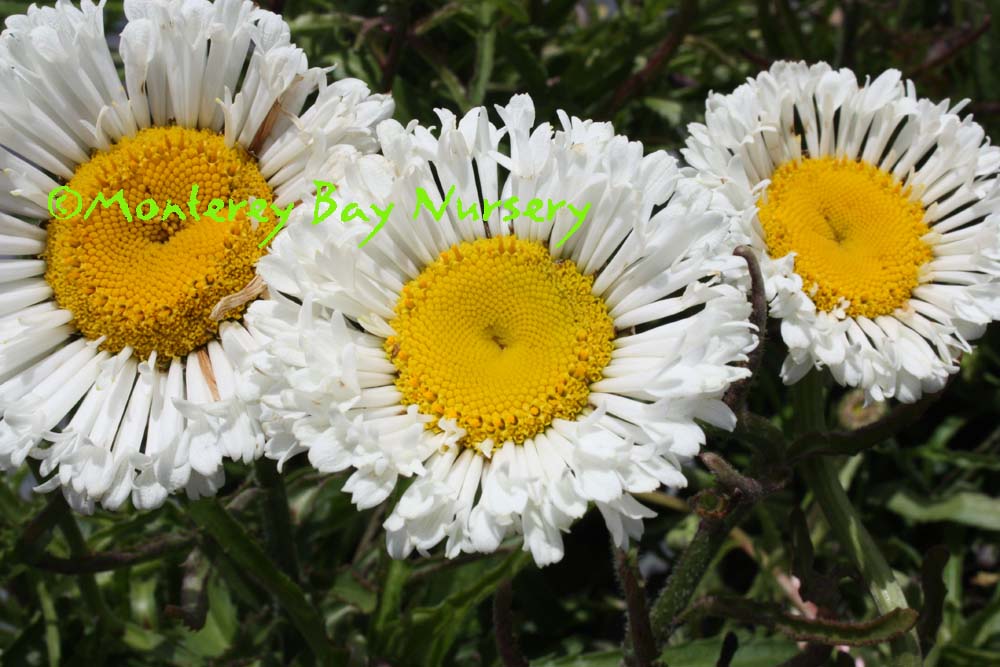
'Freak' (not currently in production) stare into their hopeful young faces not as bad as the name sounds, this is a beautiful Shasta daisy! Big, yellow button center and lots of fluffy white petals surrounding it. A few go this way and that but not enough to put a crazy streak in its cheerfullness. About 12" tall, for sun or part shade, average watering. Wonderful in a flower bed, along a walkway, or in containers. Deadhead for continued blooms. rev 6/2013-Suzy Brooks
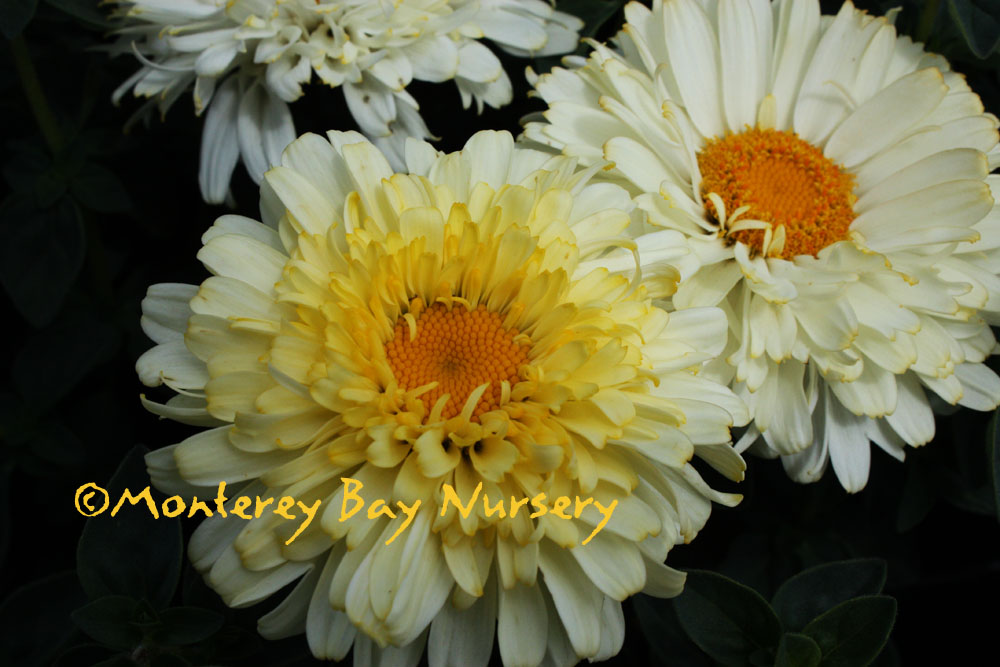
'Real Dream' (not currently in production) SHASTA DAISY a really nice shot by Suzy! the last of the 'Dream' series and a really pretty one, with frilly petals that start off limey yellow and turn to white, all set around a gold-button center. Strong stems for cutting up to 16" tall. Tuck this cheerful daisy in the flower or vegetable bed to attract pollinators and add sparkle! rev 8/2014-Suzy Brooks
'Real Galaxy' (not currently in production) flowers these frilly white petals and yellow centers stand on strong, sturdy stems and grow to 36" tall. Dark green foliage clumps and gets bigger and better each year. A cheerful presence in the garden and pots and for bouquets. rev 8/2014-Suzy Brooks
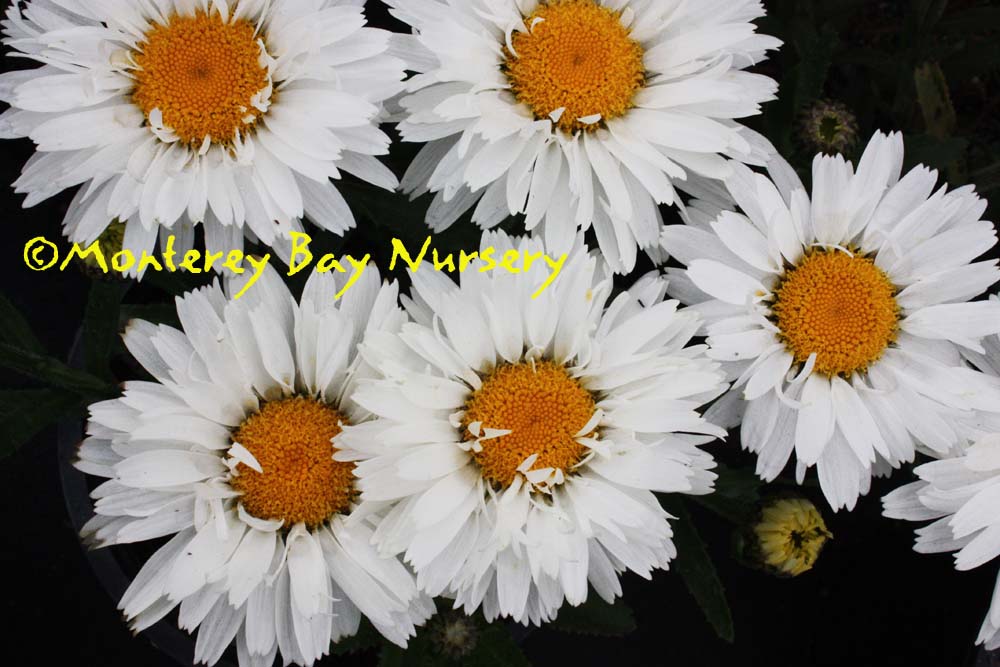
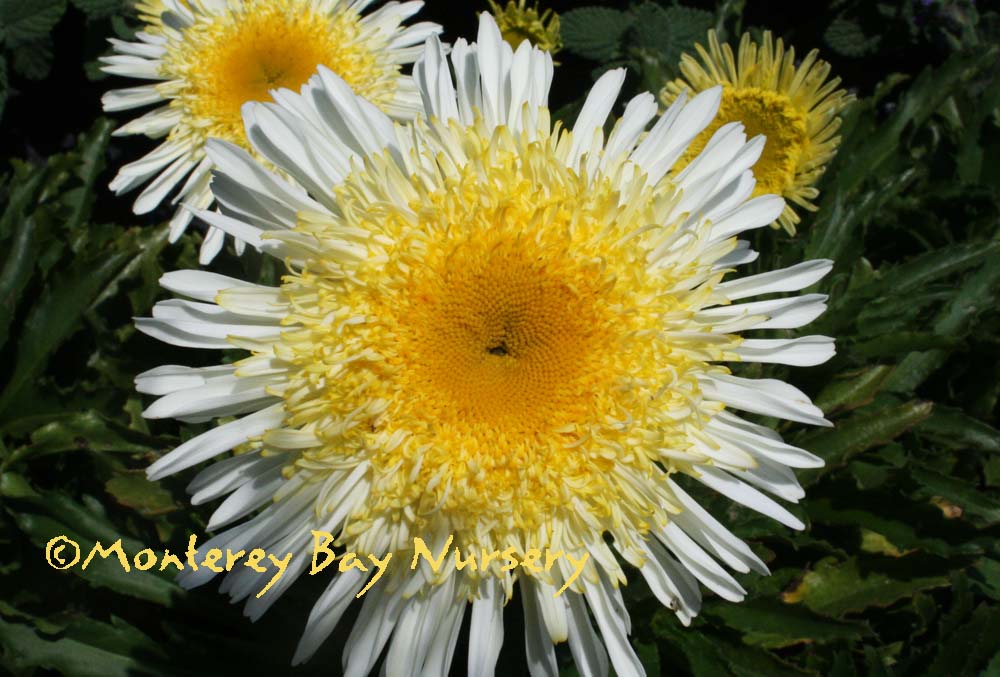
'Real Glory' (not currently in production) wow. strong stems to 24"-30" tall bear flowers whose white petals reflexed, showing off the anemone-like center of yellow filaments. For containers, cutting gardens, or mixed borders. Attracts butterflies. Sun or part shade, average to very modest summer watering, frost hardy. USDA zone 5/Sunset all zones. rev 6/2015
'Real Neat' (not currently in production) SHASTA DAISY trio the classic white with yellow eye only the petals are fluted. Such simple beauty is a beacon of cheerfullness in the garden, attracting butterflies and making wonderful cut flowers. About 16" tall and 14" wide. rev 8/2014
'Snow Lady' (not currently in production) DWARF SHASTA DAISY happy flowers a classic white Shasta daisy with a yellow center, only it grows under a foot tall. Elegant and simple, it mixes well with annuals, perennials, in gardens and containers. This easy-to-grow perennial is still tall enough to cut for long lasting bouquets and is a good one for attracting butterflies. rev 8/2011-Suzy Brooks
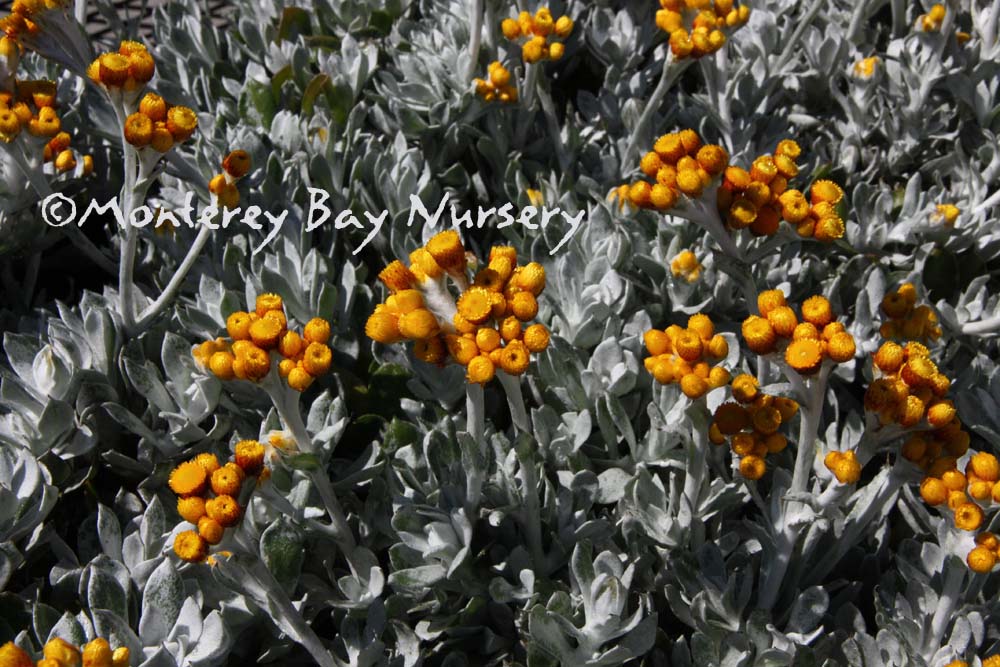
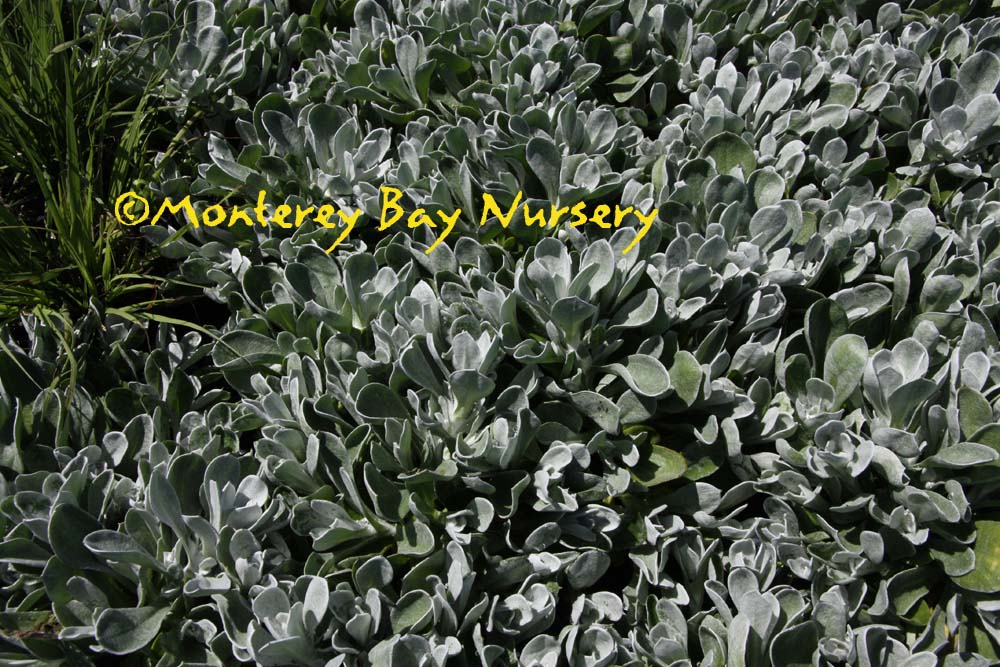
Chrysocephalum apiculatum 'Silver
Sunburst' flowers
against foliage also classified as
Helichrysum, and formerly grown and sold under that name,
but all modern breeders appear to be listing it here. This species
ranges all the way across the entire southern half of Australia,
with climatically-appropriate regional variations in flower,
foliage and form. This particular form is a usually very tight,
very white-foliaged selection, quite low, and makes a really nice
package when the deep golden flowers start appearing in early
summer. Needs at least half a day of direct sun, good drainage,
and moderate to very infrequent summer watering. This should take
frost to around 20F but will probably start to top-defoliate below
about 25F. Sunset zones 8-9, 13-24/USDA zone 9.
Compositae/Helianthaceae. rev 7/2017
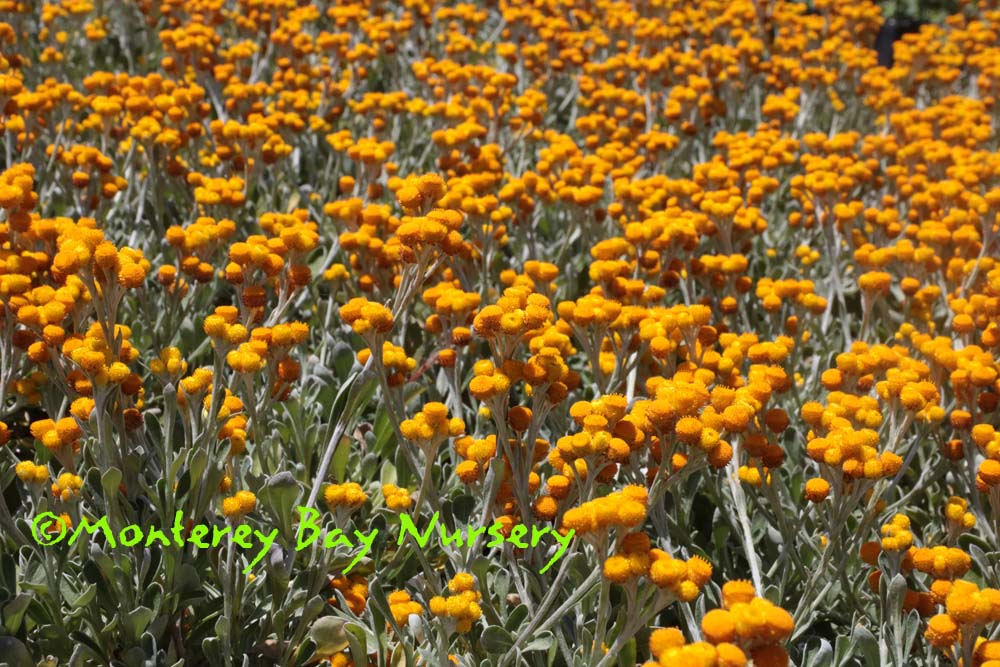
'Desert Flame' (not currently in production) new flowers another superb, very tough groundcover, with very deep golden yellow, almost orange yellow button flowers appearing against very silver leaves in spring, summer and fall. Spectacular once established, very tough and drought tolerant, even relatively soon after planting. To some degree (some!) I found in my own trial landscape that it can (luckily!) just shrivel up and rehydrate later, whenever it is I remember to water it. Then again other times it just dies. To 6" tall, 18" across. Sun to part shade, average to good drainage, infrequent to almost no summer watering required in most areas when established. Cut it back hard at any time of year if it starts to look stretched, ragged or tired. rev 7/2017
Chusquea coronalis foliage closeup
why you grow it (Richard
Josephson's yard) nice container an
elegant, graceful, gracile, tightly clumping bamboo to 12’ that
bears tight, dense whorls of small, oval, light green leaves along
arching golden culms. It has an attractive, distinctive habit and
is one of the most highly sought-after bamboos. The culms often
arch over all the way to the ground and overall it has a very fine
texture. It is highly desirable but has faults: it tends to be
slow, appreciates heat, likes food, and takes a long time to
recover from a hard freeze, sometimes years. It is also at least
partially winter deciduous with any amount of sustained cold, even
if it doesn't go below freezing. This is one bamboo that is
definitely better in Southern California unless it has a
well-sheltered position. Otherwise you must be willing to put up
with the lengthy damage rehabilitation from the 10 or 25 year
freezes that occur in Northern California. Sun to part shade, but
best in warm semi-shade. In cool foggy areas give it full sun.
Responds to average to generous watering and regular liquid
feeding. Likes rich, humusy soils. Flowered but did not die, or
even die back much, in Richard Josephson's Santa Cruz garden
several years ago, but others weren't so lucky. Damaged below
28°F, especially when young. Zones 9, 16-17, 21-24 or with good
protection up against a house elsewhere/USDA 9. Find more info on bamboo in general here.
Central America. Graminae/Poaceae. rev 2/2010
culeou
(not currently in production) at Cistus Nursery, Portland
at UCSC Arboretum
stem sheaths bluish leaf undersides
a clone of uncertain exact identity, close to the "true" C. culeou, but differing in
having darker culms and spreading a little faster. This form is
usually found as a shade plant in the Southern Beech forests of
the Andes. It is a relatively loose clumper, with very long leaves
that form a dense mass of deep green foliage against dark green
culms shaded maroon, and with contrasting light sheaths and
bluish leaf undersides. The culms persist for years. Flowering is
estimated as occurring at 45 year intervals. This species does not
do well planted in hot, dry sites, as its native habitat would
suggest, looking quite wretched in fact. It really starts to smile
in shady spots, especially those with acid soil and at least
average watering. It makes a very good container plant, much
better than C. pittieri,
which tends to shed its older culms quickly. This species is very
cold hardy, to 0 deg F, and should survive in all but the very
highest and coldest regions of the Sierra Nevada and Modoc
Plateau. The shoots are edible and considered choice. Sunset zones
5-9, 14-17, 21-24/USDA zone 8. rev 11/2010
pittieri (not currently in production) foliage closeup cool stems large clump at Blue Bamboo Nursery smaller clump, more restrictive conditions arching growth this is a medium to large scale clumping bamboo, to 50-60' in nature though I have only seen it to about 20'. It's culms can reach 2" in diameter. It features dense plumes of very long, narrow dark green to blue green leaves in lush clusters and wants to be somewhat scandent if there is anything close by to lean on. It tends to droop over, even to the ground if there is room. It is somewhat like Otatea acuminatum aztecorum but on a larger scale. One peculiarity is that in production the old culms tend to die out as fast as it makes new ones, making division problematic. This doesn't seem to happen when planted out, though it does cycle culms faster than many other bamboos. It is a wonderful, dramatic subject, like many species being introduced in this genus. The sheaths of the new culms are burgundy colored and covered with coarse, intimidating, dark hairs. Give this one room to spread, or crowd it and make it go vertically, it doesn't matter which. Size varies depending on soil quality, nutrients, and watering. In full sun, poor soil, and with restricted irrigation, this is a medium size bamboo. On river bottom soils with full sun, watering, and feeding it can be quite large. Damaged at 26°F, probably can be grown well in Sunset zones 8-9, 15-17, 21-24/USDA zone 9. rev 6/2006
sulcata (not currently in production) at Richard Josefson's house originally described in 1940, this native of Chiapas has recently been introduced to this country and we received our plants from Don Mahoney of Strybing Arboretum. It grows as an exceptionally dense, lush, bright deep green fountain of luxuriant, soft, long leaved foliage to 6-10' high by about 10' wide under cool, part sun conditions. When young it has a tight, dense shaving brush habit but it leans over and become softer in presentation with age. It makes a great container plant. Our plants are seedlings or divisions of seedlings. Given its native origin I wouldn't expect it to tolerate temperatures below 25F. Sunset zones 8-9, 14-24/USDA zone 9. 7/2014
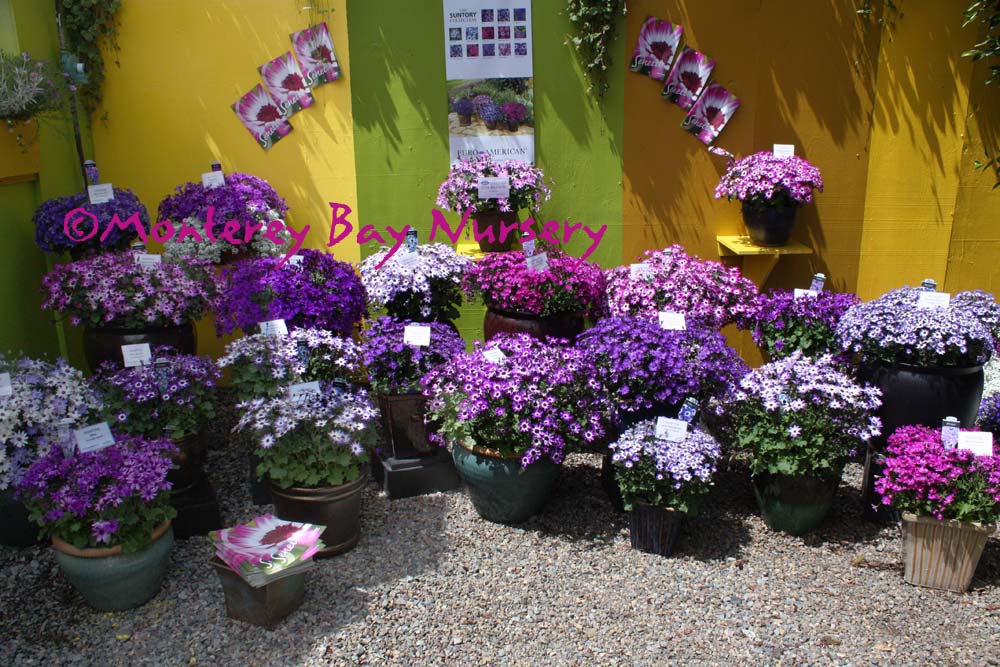
Cineraria Senetti hybrids
(not currently in production) the series these beauties are an improvement on the
old fashioned tall cinerarias with compact, sturdy foliage
and larger, sterile flowers that bring reblooming
performance. They give you much of that heirloom plant ambience
but for better or worse depending on your sentiment, they
don't reseed all over your garden. The vibrant colors on bigger
flowers add some spark to winter landscapes, and they are superb
for containers on the deck or in the front entry. To about
18" tall and wide. Part shade, regular water. If you protect them
from frost they can be planted in fall and overwintered in Sunset zones 9, 16-17, 22-24/USDA 9, or can be
used as spring annuals in colder climates. rev 2/2011
Cistus ROCKROSE evergreen shrubs, mounding or upright to prostrate and spreading groundcovers. All have single flowers, often with contrasting centers or petals marked at the base. They are found across the Mediterranean region. All Cistuscan be raised in full to part sun, need average to good drainage, and need little or no summer watering when established. Most grow quite quickly to near their ultimate size. Cut them back, if needed, in late fall or early winter before they begun to push. Flowers are formed on mature wood that experiences chill and short days. All are frost hardy for almost all of California. Cistaceae. rev 11/201
Many species have resinous foliage, pleasantly
fragrant on warm days, and they are worth planting for this
feature alone. One of my earliest memories is the smell of C.
purpureus foliage outside of The Green Frog, a small
neighborhood grocery store in San Francisco back in the 1950's.
The foliage smelled just like the Rainbow Popsicles that I loved.
Whenever we went in I would smell them on the way by, and ask
my mommy if I could please, please have a popsicle today.
Occasionally the answer was yes! To this day, when I walk by Cistus and smell that
fragrance I am immediately transported back to when I was three
years old and had to stand as high as I could on my tiptoes, and
struggle to pull myself up to see over the top of the
freezer case, with its chrome trim and glass top frosted with ice,
to see those wonderful pink, white, and blue twin-stick popsicles
neatly lined up inside just waiting to be eaten! rev 7/2024
'Grayswood Pink' ROCKROSE flowers pretty, soft clear pink to salmon pink flowers with pale, contrasting centers and the signature bright yellow stamens are produced in spring, and sometimes sporadically in fall, against a really good grey green foliage background. Got an Award of Garden Merit from the RHS in 2002, that means something. This is a relatively wide leaved, horizontal grower of only moderate size, so it can be used in smaller sites than more robust types such as C. skanbergii or C. purpureus. Easy to grow, to just about 2' tall by 5-6' wide unpruned. It looks really good alongside rosemaries, lavenders, manzanitas, and Ceanothus. Sunset zones 6-9, 14-24/USDA 8. rev 11/2011
hybridus (not currently in production) flowers more flowers! habit nice small plant mounding growth to about 2-3' tall, spreading to 10' or more with room and a few years of growth. This is a good, relatively low, medium-size ground cover that will take full to part sun and require little summer watering in most situations. Flowers are white with yellow centers, about 2" across, and are produced from quite attractive, dark burgundy red buds in a mass display in early to mid spring. Good to average drainage. USDA zone 8/Sunset 6-9, 14-24. rev 11/2018
'Gold Prize' (not currently in production) dense foliage leaves are broadly margined deep golden yellow, but on new growth leaves are often completely yellow. Flowers are white, petals unmarked, with yellow centers, and are seen in late spring, but more sparsely than on the regular green form. To a couple of feet high by a few feet across, very dense. Reversions aren't that common, and are easily recognized and removed.. In full sun this has really nice foliage color and can't be missed! rev 11/2019rev 6/2018
'Little Miss Sunshine' PP22364 typical stunning landscape specimen flower colors, very close an ultra compact habit, dazzling foliage very close or afar, glossy deep burgundy stems and flower buds and pure white flowers scattered across the top. Grows into an extremely dense, compact dome-shaped plant to about 24-30" tall by 4-6' across or more, slowly. The reds go so well against that strong, deep yellow. A Sunset Program variety. rev 11/2019
ladanifer (maculatus) LAUDANUM closeup at Chabot Museum another mature plant upright shrub to 4-6’ tall and wide, with dark green, somewhat glossy foliage. Large white flowers to 3" wide. Petals have large crimson spot at base, showy stamens are bright yellow. A resin is extracted for use in perfumery. rev 6/2018
x purpureus ORCHID ROCK ROSE flowers very close typical plant spreading shrub to 4-5’ tall, 8’ wide. Bears deep pink flowers to 3" across, with a crimson spot at each petal base. Can be used as a tall ground cover. rev 6/2018
'Pink Satin' PPAF PINK SATIN ROCK ROSE flowers a blush pink, almost white flowering branch sport found here at our nursery, this is a close replacement for C. ladanifer in many situations, offering longer life, a lower, more spreading habit, denser foliage and larger flowers. The only drawback is that it isn't a perfect white, but it approaches that standard under warm conditions when flowers have fully matured. rev 8/2024 MBN INTRODUCTION-2024salviifolius (not currently in production) flowers habit low, spreading shrub to 2’ tall, 6-8’ wide. Bears white flowers, 1" wide, with yellow centers. Another good groundcover with a very dense habit. rev 6/2018
x skanbergii (not currently in production) closeup flowers mature plant mounding growth to 3’ tall, 8’ wide with narrow, silky grey green foliage and small clear pink flowers to 1" wide. Another RHS Award of Garden Merit winner. rev 6/2018
‘Sunset’ flower habit dense, compact mounding growth to 3’ tall, 8’ across. Bears wide, soft grey green leaves with a little bit of a point at the tip. The dark magenta pink flowers make a heavy show in spring, then appear intermittently over an extended blooming period. Probably another product of a C. albidus cross or selection. rev 6/2018
‘Victor Reiter’ closeup another Mills Garden compact upright growth to 3’. Bright salmon pink flowers. Faster than ‘Doris Hibberson.’ Blooms about three weeks later than most other Cistus varieties. rev 6/2018
Citrus species and hybrids - info here
As of April, 2015 we no longer offer citrus for sale.
While we feel citrus will always be part of the California home
landscape, we are holding off until we see the the impact on our
retail customers of pending state and federal regulations
regarding Yellow Dragon Disease (Huang Long Bing, "citrus
greening"). The information at the link above is provided as a
free resource for professionals and home gardeners. rev 4/2015
Clematis pruning is usually presented in an unnecessarily complicated fashion, most often using groupings of hybrids/species, with instructions for each group. The simpler method is simply to observe how and when your plant blooms, and use the environmental parameters that preceded bloom, along with noting the type of wood the flowers occur on, to dictate how and when your plants should be cut back. In all cases you will need to know something about flower initiation, or the sets of conditions needed to form flower buds. Once you have practice sorting out Clematis, you can apply these same techniques to plants throughout your garden, and stop cutting back plants at exactly the wrong point in their annual cycle.
For example, some varieties are described as needing mature wood plus a cold period. The flowers don't form on the mature wood until a cold period, they swell as winter ends, and they burst into bloom as the shoots emerge. A good example of this would be C. montana, which blooms only once, on mature wood formed during the preceding year. Another example would be a lilac, or flowering plum. You wouldn't want to cut such a plant back in winter, or even fall, because you would be pruning off all the mature wood that would then vernalize (initiate flower buds) over winter. Such varieties should be pruned immediately following bloom until no later than mid-summer. By recognizing that C. montana only blooms one time in early spring, you can deduce that it certainly needs a cold period. Experience tells you that immature wood will not form flower buds. So it must be cut far enough in advance of dormancy for the new growth to mature and harden.
Some varieties will only flower under long-day conditions once the branches are old enough to flower. Such varieties are often casually described as blooming "spring, summer, and fall," which isn't really accurate. What really happens is that as soon as the days have enough hours of sunlight (usually more than 12, around March 21st), and the wood is mature enough, the branches will form buds. The actual appearance of flowers will depend on temperatures, size of flowers, actual number of hours required for initiation, and other factors. The result is that flowers appear from four to eight weeks after initiation. If buds initiate, but the plant then goes dormant for winter, those buds will flower as soon as the plant breaks dormancy. Thus, the plant appears to flower, then "rebloom" as the new wood matures under the long day conditions. Such plants should be cut immediately after spring bloom, or in winter if you don't mind losing the first flush of old initiated buds.
A few, especially older varieties, require mature wood, AND very-long-day conditions (usually 14 hours or more of daylight). In addition, they appear to need a long time for flower buds to form after initiation, or perhaps very mature (lots of leaves) wood. In our latitude, this means one late spring/early summer blooming period followed by a second lighter bloom in late summer or early fall. Such varieties are ‘Ernest Markham,’ ‘Niobe,’ ‘Henryi,’ ‘Hagley Hybrid’ and ‘Ville de Lyon.’ Usually these varieties have newer counterparts that offer similar features but have more generous initiation requirements, and we have tried to drop the old varieties in favor of the new ones. If you are looking for an old favorite and we don't have it, try asking for a similar replacement. You will probably be pleasantly surprised.
The last type of Clematis flowering requirement is also very-long-day but with a faster/easier development period. Such plants need no chilling, but will instead flower on any wood mature enough as soon as days are long enough, and will continue flowering essentially unabated until late fall. Such varieties would be C. viticella strains and C. ‘Jackmanii.’ You have to wait, but you are well rewarded.
In the next rewrite of this section, I will
begin adding the flower initiation requirements for each variety.
rev 6/2015
hybrids (none currently in production) deciduous vines, ranging from 6-20’ tall, bear large flowers in a range of colors. Sun to part shade, average watering for most, all prefer shaded, cool roots. Many make excellent container plants.rev 6/2019
'Anna Louise' flowers violet red flowers to 6" across have a contrasting red bar and bright yellow anthers. Reblooms, compact grower, excellent in containers. rev 3/2014
'Barbara Jackman' intense flower here is an early and repeat bloomer in dark lavender with a magenta bar. A great one for an obelisk in a container or growing through a climbing rose. About 6-8'. rev 5/2012-Suzy Brooks
'Candy Stripe' pink with magenta rose bars lilac pink flowers display a strong rose pink bar. Reaches 6-8' tall but easily contained in small spaces, such as pots with support. Can also be grown through climbing roses. An early bloomer! rev 6/2015
‘Comtessa de Bouchard’ flowers mauve pink, 5", summer to fall. A heavy bloomer. rev 9/2003
‘Elsa Spath’ flower mid blue, to 6-7" across. Long and free flowering, good as cut flower. Award of Garden Merit.
‘Ernest Markham’ flower magenta red, to 7". Summer. Old, reliable variety.
‘General Sikorsky’ flowers dark lavender blue, to 6". Strong grower, good bloomer. Good as a cut flower. Award of Garden Merit.
'Hagley Hybrid' flower single light plum pink, darker stamens, with variably darker pink bars. To about 5" across, in clusters. rev 10/2009
'Hyde Hall' magnificent flowers this 'Queen of the Vines' is a beauty! Large, bright white flowers, 6-7" across, have a pink blush. Blooms in early summer for weeks and then continues as wood matures until it goes dormant in fall. Of medium height, 6-8', just right for small gardens or containers. Introduced in 2004, and named after the gardens of the Royal Horticulture Society. rev 6/2011-Suzy Brooks
'Liberation' radiant pink stars striking and sizable, these deep pink flowers have a darker pink center bar and white stamens. The buds by themselves are also big and beautiful. An early bloomer, 8-9' tall, just right to wind through a climbing rose, shrub, or kept containerized with support. Sun or part shade, average watering. Sunset zones 2-11, 14-24/USDA 5. rev 4/2014-Suzy Brooks
‘Miss Bateman’ flower white flowers to 8-10", with attractive, black stamens. Good for cutting. Very compact, free flowering plant, good in containers. Attractive seed heads. Late spring through fall.
'Multi Blue' flower older rich, deep blue to lavender blue. Younger, earlier flowers are single, on older plants and later in the season they become considerably more doubled in the center. To 5-6". Early, plus reblooms in summer. rev 8/2010
'Natascha' flowers here is an early bloomer with an intense rose violet color, shaded slightly ligher on the bar, and with intense maroon and red stamens surrounding a stark white stigma. Small in stature, to just 6-8' tall, a good choice for a container and a great reason to buy another obelisk! You do have at least one obelisk already, don't you? No, not a monolith, those don't count. Will climb through a rose just beautifully if your obelisk hasn't arrived yet. rev 5/2013-Suzy Brooks
'Niobe' flower a dark, velvety red, to 6" across, blooming heavily from late spring till fall. Good as cut flower and container plant. rev 5/2013
'Perrin's Pride' flower this Queen of the Vines has deep purple flowers on a vine about 6-8' tall. Facultative long day. rev 4/2013-Suzy Brooks
‘Rouge Cardinal’ flower free flowering velvety crimson, to 7". Late summer.
'Scartho Gem' nice flower light pink flowers with a raspberry bar, and darker anthers. The petal edges are elegantly wavy, flowers get to about 7" across and appear early, so don't prune back much in winter. This is another very good variety for filling your garden with color from early until late, since it will initiate flowers on any mature wood under long day conditions. rev 7/2011
‘The President’ flower dark purple blue, to 12" when really happy (hot, full sun, cool, moist roots). Relatively compact growth. Blooms freely from late spring until fall. Makes a good cut flower, also has seed heads. rev 8/2010
'Vivienne Beth Currie' early pink and purple gorgeous flowers of plum purple with a crimson bar appear very early and late in the season. Just 6-8' tall, perfect for a container with an obelisk (you're still looking for the perfect obelisk?!?) or scrambling through a climbing rose. rev 2/2014-Suzy Brooks
‘Warsaw Nike’ flower more flowers rich purple, described as “needing a light background to show off flower colour.” Late, initiates under long days. Disease resistant, heat tolerant, and very purple. rev 8/2010
viticella ‘Polish Spirit’ flowers a new, very free flowering dark purple form. This species grows as a vigorous small deciduous vine, and is very effective scrambling over and through shrubs as well as on trellises. All forms are resistant to Clematis Wilt. This variety bears rich dark purple flowers, with yellow anthers, in summer, and is a good bloomer. It resembles C. ‘Jackmanii’ (which was hybridized from C. viticella), but has smaller, more profuse flowers and is even tougher. This species begs to be used with mixed beds of perennials. Eurasia. rev 6/2005
Cleistocactus about 50 species of columnar
cacti native to higher elevations of South America. Most have
erect habits but others are semiupright, sprawling/recumbent or
even downright prostrate. All have tubular red flowers to one
degree or another, as well as fine, dense spines. rev 6/2019
strausii WOOLY TORCH CACTUS, SILVER TORCH CACTUS mostly shade but with rain protection, Santa Cruz City Hall one of the most popular species, fast, easy to grow, forgiving and an easy, showy bloomer. Grown outside in England, even, and durable enough there to have received an RHS Award of Garden Merit. Flowers are tubular, intense, bright red and clustered near the tops of the columns. Clustering growth, with many stems on old specimens. Spines are very fine, very dense and very white, making it somewhat like the Old Man Cactus, Espostoa, but without the flowing, pendant fibers. Cold hardy to around 20F, its weakest point for Californians, or Britishers, is if it's going to fail it will be during one of our long, cold, wet winters. There are amazing specimens at the Huntington, just giant clumps, worth the trip for seeing those alone. Individual columns are about 2" across by 4-8' tall, clumps spread slowly by sending out new columns from the base. rev 6/2019
Clerodendrum quadroliculare (not currently in production) leaf undersides starburst flowers a "tropical" foliage plant, except that it grows fine under cold, wet, miserable conditions and doesn't seem to die back until it gets hard, direct frost. It does need gobs of heat to develop the wonderfully fragrant pink flowers in rounded terminal heads, but that should be no problem in zones 9 and 21-24, or even 8 and 14-16 where it has overhead protection. I have never seen the flowers in real life, being that we are so cool and constantly cut our plants for propagation, but from pictures they are like Gilia blossoms; long, narrow tubes with narrow, flared, star-like petals at the ends, and rosy pink towards the base. The flowers attract butterflies. For me the real value is in the wonderfully dark, rich maroon purple leaf undersides and dark olive green foliage, which displays well against that wall under that protective overhang. This is a very good color/texture item that does very well in a container as well. Grows to 1-5' for us but listed to 15' in the tropics, where it can be dangerously invasive in hot, humid, frost free climates. Part sun to mostly shade, average watering. Sunset zones 15-17 (overhead protection), 21-24/USDA zone 9. My two plants were killed completely in Santa Cruz, on a north facing wall with overhead protection in the 25F degree freeze of 2007. Verbenaceae. Phillippines. rev 8/2008
'Brandonii'
PPAF (not currently in production) foliage
the
same black green leaves backed with maroon, but this time broadly
and irregularly edged with light golden yellow above, and apricot
tones below. Slower and more compact. 11/2007
Clivia hybrids LADY CLIVE LILY flower cluster more flowers beautiful seeds more flowers nice container plant large planting at Strybing Arboretum a series of hybrids mostly involving C. miniata. Also commonly sold as “Belgian Hybrids” or “French Hybrids,” these broad-leaved strains were developed in Europe near the turn of the previous century. The mix is now so varied that the original meaning of those more exact terms is lost and in reality everything in the trade is all mixed up. In addition, other species have recently been added to the mix, such as C. nobilis, C. gardenii and C. caulescens, so the situation is getting even more complicated.
These are wonderful clumping evergreen bulbs in the Amaryllidaceae, with luxuriant leaves to 3’ long. Stalks up to 3’ tall bearing round clusters of large flowers are produced from late winter through early summer. Color ranges from pale yellow to pale pink and salmon orange through deep orange and dark red orange. The flower stalks can last weeks when cut. Clivia can repeat bloom in cool summer areas since most plants can produce a flower stalk about every four or five leaves and bloom initiates when the plants experience about 55°F, which happens regularly throughout the year at night near the coast. Seeds are quite colorful, ranging from yellow (in the yellows and pinks) to dark red. Variegated plants have circus-like green, red, and yellow striped fruits.
Plants are found across wide areas of South Africa, but this species is from the summer rainfall areas as opposed to the Mediterranean-climate winter rainfall areas, which are the source of many other familiar South African plants such as Agapanthus. Hence it does not like our cold winter rains, though it will tolerate them. It naturally experiences a dry winter, flowers in late winter or early spring, then puts on considerable growth during the warm season when it encounters regular moisture. Following these clues, Clivia will be most happy where they have some protection from fall/winter rains, which tend to arrive on southerly, southwesterly, or southeasterly winds. These can produce orange-spotted foliage and ruin or rot flowers, especially when the stalks are still trapped down in the foliage, just starting to emerge. They don't want very much frost though they will survive a hard freeze. Below about 25°F expect them to lose their current season's growth and flowers but come back from below. And give them plenty of warm shade and water from spring through fall. They like good drainage, will tolerate extended drought, and generally make very tough, durable landscape subjects, even in commercial situations.
Clivia often prompt comments from garden visitors. They have a bold presence with luxuriant foliage and luminous flowers. They are effective by themselves or planted in masses (nice large scale plantings can be seen in Golden Gate Park). They are used as houseplants in colder climates and do very well in the dry interior air and reduced light. Clivia will actually tolerate very dark conditions, probably as well as the famous Apsidistra elatior, the Cast Iron Plant. It looks especially good when underplanted with Baby's Tears, which provides a wonderful contrast of color and texture. They make outstanding container plants, and should be tried as subjects in more complicated mixed foliage plantings too. In fact, since they only bloom for 3-6 weeks (unless they repeat), I would argue that leaf quality and presentation is more important than flowers, and they should be sited primarily for their striking form and dramatic foliage.
Clivia is perhaps the most variable plant I have ever worked with. Every observable characteristic that can be described will vary noticeably. Leaf length, width, thickness, texture, ribbing, cross-checking, and color all vary. There are tall plants, there are miniature plants. Flower size, flower color and combination (solid, bicolor, etc.), petal size and shape and conformation, number of flowers per head, conformation of the flower head, bloom vigor, all vary. Even the stamen shape and brittleness varies from plant to plant. And on top of every class is the additional potential for variegation, and then again even type of variegation.
There are flowers with wide, blunt petals and flowers with long, elegant, lily-like petals. There are reds, bricks, “Hawaiian Punches,” soft pinks, and clear oranges. There are plants with leaves over three feet tall, very narrow, and robust. There are plants with incredible stiff, hard, almost plastic-like leaves, very short but incredibly wide, dark green, and glossy. Some have leaves that bleach to blond or almost white and make a striking background for the flowers (especially reds) but are fantastic just grown for their foliage alone. Some plants are quick to increase and divide, others maintain a mostly solitary habit.
They can be selected for almost infinite combination of characteristics, which leads to problems if you are breeding or selecting. Once you have selected your ultra compact, wide petaled, early blooming, corrugated-veined, hard-leaf-textured red bicolor, you will notice some have green throats, so you select those out for yet another class, and the breaking-out of new categories never ends. In the end I think Clivia enthusiasts, both commercial and hobbyist, will need to choose to pursue only certain directions in breeding and selecting, much as orchid growers have had to specialize in the face of diversity in their class of plants. The alternative is to suffer madness as the result of trying to pursue everything. Keeping track of all the data regarding possible permutations and combinations becomes a crushing job in itself.
Our selection of plants is quite
diverse and our seedlings can be expected to show a wide range of
variation. In the future we will be offering named varieties from
division but will have only limited numbers at any one time. rev
3/2006
Little Charm blooming orange, smaller flowers, thinner leaves. rev 3/2006
orange as shade garden foliage blooming dark shade commercial setting container open garden situation light to medium orange. rev 3/2006
orange variegated blooming another even the seeds are nice with leaves striped yellow to creamy white. A handful of yellow variegated are available, inquire. rev 3/2006
salmon nice individual light salmon orange flowers. rev 3/2006
Solomone hybrids flowers some more a strain with flowers ranging from deep to pale yellow. rev 3/2006
Yellow Charm blooming small yellow flowers, thinner leaves. rev 3/2006
Codaeium variegata CROTON a familiar
houseplant grown for its wildly colorful leaves, variegated green
and gold then turning hot coppery red, orange and burgundy. As a
houseplant or indoor/outdoor specimen it likes bright light to
maintain brilliant color, a well-drained container mix, average
watering but a little drying between waterings, humidity (also
helps keep high color) and no cold temperatures (leads to
leaf-drop).. Large specimens can make spectacular display
subjects. This plant will not reliably persist outdoors where soil
temperatures fall below ~50F, especially under continuously wet
conditions, which effectively rules out most of California except
for very protected spots in the warmer areas of Southern
California. Cultivated selections are more compact and more highly
colored than the wild forms, which are native to hot, relatively
open, sunny habitats in Malaysia, Indonesia, Australia and South
Pacific Islands. Narrow spikes of small, white, spiky flowers are
rarely seen, they are not showy. They set seeds rarely, but these
are highly toxic and especially dangerous for children.
Euphorbiaceae. rev 8/2019
'Nervia' leaves a whole flat lance-shaped leaves, sually with slight twist, becoming more horizontal with age. Broad variegated centers, foliage colors quickly as leaves mature. rev 8/2019
'Petra' leaves broad lance-shaped leaves, color quickly. rev 8/2019
'Red Banana' leaves very thin, upright foliage with distinctive, rounded tips. rev 8/2019
'Zanzibar' leaves very narrow, spidery leaves. rev 8/2019
Coleonema pulchrum PINK DIOSMA closeup of flowers short hedge upright
to spreading shrub, 6-10’ tall and wide, with soft, fragrant,
bright green foliage and heavy show of pink flowers in spring and
fall. Sun to part shade, little or no summer watering when
established. This plant is probably misnamed, and the proper
species name is probably “pulchellum.” As originally described, C.
pulchrum has leaves 1-2 cm long, whereas all material we
have seen in the trade is more like .8-1 cm. A South African
botanist described and named the garden material C.
pulchellum in 1881. If this analysis proves correct and is
accepted, we will change the name in the future. South Africa.
Rutaceae. rev 8/2005
‘Compact Form’ closeup habit with mixed perennials compact growth to 3’ tall, 6’ wide, somewhat more open than the upright form. Much like C. album in habit. Showy flowers are lighter pink than regular species, and tend to be clustered at the branch tips across the top of the plant. rev 6/2012 MBN INTRODUCTION-1996
'Compact Gold' closeup on left, original green 'Compact Form' right a sport found within one of our blocks of 'Compact Form,' it is essentially in specs and growth habit but halfway towards 'Sunset Gold' in color. Light pink flowers. rev 2/2021
‘Sunset Gold’ habit peak bloom, closeup at Sierra Azul Nursery as groundcover unpruned shrub a spreading shrub or groundcover to 2’ tall, 6’ wide. Golden yellow foliage greens somewhat in winter but generally holds color well and can be quite bright in summer sun. Needs at least a half a day’s sun for good foliage color but it can take considerable shade if it has to. Flowers are pale pink, darker in cool weather but still lighter than the standard form of Pink Diosma. I have seen this used with Verbena tenuisecta 'Tapien Purple' and the effect is hypnotic and blinding at the same time. rev 8/2005
Coleus
annuals, perennials and shrubs from the Old World tropics
and subtropics. Some species produce edible tubers and are
cultivated as crops. Closely related to and currently suffering
multiple revisions with sister genera Plectranthus, Pycnostachys
and Anisochilus. Stay tuned. Labatae/Lamiaceae. rev 7/2021
scutellarioides COLEUS tropical perennials treated as warm season annuals in cold climates. rev 7/2021
Argentine Hybrids (not currently in production) eight inch pots - yes, eight inch! a reintro for us, last having been offered about ten years ago, before we ran out of seed. This is a Monterey Bay exclusive, grown from seed sent by a former intern of ours. This is what happens when bored growers get an idea and there is no one around to keep them under control. Our Southern Hemisphere nursery friends years ago started selecting out the largest leaved, best colored seedlings from the standard Wizard or Rainbow seed mixes then available. They certainly succeeded in their goal. I suspect one of these lines is the actual starting point for the 'Kong' series from Ball. These seedlings flower more than Kongs, but can be even large and also feature a wider range of variable and highly colorful leaf forms. The prefer to flower under shorter days, so pinch off those spikes as they start to form late in the year. Humid sun to part shade, regular watering. Summer annual or housplant. Believe it or not they do well in 4" pots also! rev 2/2021 MBN INTRODUCTION-2004
Party Time Macaw Pink Fizz Smokey Rose a Sakata line of small, dense, well branched varieties with trailing to semitrailing habits. Plants naturally form even-shaped domes in full sun or shade. rev 7/2021
Colocasia TARO, ELEPHANT EAR evergreen to facultatively deciduous tropical and subtropical foliage plants used for their usually huge, lush leaves. The leaves tend to be held vertically hanging down so they show the entire, gigantic leaf face from the sides. The roots are edible after preparation and form a staple starch in some tropical countries. They spread slowly by either clumping from their bases or by short snaky surface stolons. The clumping varieties need wetter conditions than the much more adaptable stoloniferous types. Colocasias in general are better adapted to less than tropical climates than their close cousins the Alocasias. Flowers are small, Spathiphyllum-like things, usually interesting but not showy. Plant in full sun to part shade with average drainage and water as needed. They can usually tolerate very wet soils but don't require them. Tropical Asia. Araceae. rev 2/200
esculenta TARO streamside, Escalona St. in Santa Cruz the roots of this species are edible after preparation and form a staple starch in some tropical countries. The normal green agricultural form of this species has been mostly replaced in the ornamental market by more colorful forms. Contains both clumping and stoloniferous species. Frost hardy to USDA zone 6-8/Sunset zone 8. rev 6/200
'Black Beauty' leaves a darker mutation of 'Illustris.' rev 7/2006
'Black Magic Mini' (not currently in production) young and mature leaves an inspiring little fella that only grows 1-2' tall! Think of the combinations you can make with these dark leaves, mixing it with lime, gold, or multicolored foliage for interest all summer. And it's a good one for small water gardens or ponds. Sun to shade, likes rich, moist soil. Sunset zones 7-9, 14-24/USDA 8. rev 4/2013-Suzy Brooks
'Blue Hawaii' PP 20003 (not currently in production) young leaves mature leaves one of the new 'Royal Hawaiian' series, this is one of the best. Originally bred for taro production, these were cross-purposed as ornamentals due to the new and beautiful color variants that popped up in the seedlings. This one is distinguished by light green leaves contrasted by deep blue violet veins, midribs, and stalks. The color pattern diminshes to intriguing swirls between the veins, especially on more mature plants. Like all the others in this series it is a clumping (as opposed to stoloniferous) grower. To 24-30", sun to full shade, at least average watering and of course it will grow perfectly happily when completely inundated. rev 8/2012
'Coal Miner' leaves very similar to 'Illustris' and 'Black Beauty,' with a flat black finish and coarse green veins, but a much more vigorous grower. This was selected by Tony Avent (Plant Delights) for its much earlier emergence and is reliably more permanent in less-than-tropical climates than the original 'Illustris.' rev 5/2020
'Electric Blue Gecko' Raku leaves one of the darkest leaved ornamental taros yet, not blue but iridescent Raku-black, or dark purple, depending on the light. Dwarf size (but pretty big leaves!), clumping versus running habit, to 3' tall. Adds some big color to the shade garden. Wonderful featured in a pot. rev 4/2015-Suzy Brooks
'Elena' (not currently in production) foliage this is a compact, clumping form that has a glowing lime green leaf shading to golden in bright light. In shadier conditions it looks like a regular light green taro but it really shines in full light, where it becomes a study in gold with contrasting green. The red stems and veins add definition. It clearly likes heat. rev 8/2008
‘Fontanesii’ BLACK STEM TARO blue sheen flowers Quail BG water garden deep shade deep olive green leaves against purple black stems. The upper leaf surfaces have a shiny, bluish, coppery turquoise metallic sheen almost like Raku pottery. This one will darken in full sunlight to become almost black at times. It also does well in almost full, bright shade. Striking, easy, to 6' tall or more with heat and water. Small, narrow, hooded creamy yellow flower spikes are produced in winter, under the leaves and close to the base. I have heard reports from growers who have seen them over 9' tall in the Pacific Northwest! It has proven to be one of the best growers in my garden, needing only average watering and showing enough vigor to break out above the dense billows of foliage on the shady north wall where it was planted. This will be one of the most reliable performers. Extremely frost hardy, and tends to stay evergreen until leaves are frosted back. Easily our most evergreen variety. A vigorous stoloniferous grower. rev 5/2005
'Illustris' (not currently in production) dark blackish markings with green peeking through. Short, to just 24-30", vigorous for a black-leaf type. USDA zone 8. rev 4/2018
'Lime Fizzy' glowing colors Rod Whitlow's Sacramento Valley garden a sport we sorted out from a block of C. esculenta 'Red Stem,' this is a pale lime green form with tiny speckles of dark green scattered over the leaf, the number and intensity varying with leaf maturity, growing conditions and fertilizer. This is a short grower, about one third the height of its parent (18-24" vs. 3-5') and will be most useful for providing light chartreusy color in a container venue. USDA zone 8/Sunset zones 7-9, 14-24. MBN INTRODUCTION-2014 rev 5/2014
'Madeira' (not currently in production) nice color effect green leaves with blue veins turn to velvety black as they grow, contrasting with the pink stems. Not a giant, only 2-3' tall, nice for the pond, the garden, and pots. This is similar to 'Black Magic' but is not as dark, and has nicer color nuances. Easily blends with many colors and textures. Good in sun, or part shade if you have warmth. rev 9/2011
‘Midnight’ BLACK TARO (not currently in production) 41st Avenue, Capitola at Quail Botanic Gardens, Encinatas Richard Josephson's water garden a sport of ‘Black Magic,’ smaller and much darker black. Also a slow grower, and slow to propagate, and therefore available in limited quantities only. Clumping growth. rev 2/2005
'Mojito' (not currently in production) spotted leaf a new and exciting elephant ear! These big, soft, heart shaped leaves are riddled with dark purple spots, blotches, and smudges. Something to liven up the garden in sun or part shade. Wonderful in a container. Clumping habit, about 3' tall, more with regular water and rich soil. Sunset zones 8,9,14-24/USDA 8. rev 10/2010
'Red Eyed Gecko' (not currently in production) looking at you lime green leaves with a little maroon spot in the center of each one, like the eye of a gecko! About 3-4' tall, for moist soil, in morning sun or bright shade. Nice one for pots on the deck or by the water feature. Sunset zones 8, 9, 12-24/USDA 8. rev 7/2013-Suzy Brooks
‘Red Stem’ (not currently in production) nursery plants striking rhubarb-red stems contrast with medium green leaves. Fast, tall, vigorous, easy to grow, highly sought after, and in short supply. Clumping growth habit. rev 2/2005
Coniogramme japonica BAMBOO FERN stock plant, 10" deco pot a genus of fern resembling the larger varieties of Pteris cretica. This and its sister species (or variety, gracilis, below) are robust, striking and easy plants to grow, though slow to divide. This species forms dense clumps of very large, long, narrow, semiweeping strikingly dramatic glossy fronds. Those are presented on vertical to arching petioles (leaf-stems). This is fully evergreen (in very warm winter climates) to deciduous or semideciduous (everywhere else), reaching 24-30" tall to 1-3 feet across, more with age I am sure. The fronds will age to purple black, or even drop at very low temperature, then fresh green fronds push out from below the ground in late winter or early spring. Resist cuttng back old fronds until those new croziers begin to push from the base else it can be very slow to resume growth. I really like this one and if you have a spot in part or full shade with at least moderate watering I think it will do well. This is a durable landscape and container subject that is tolerant of intermittent watering, is large enough to shoulder aside small weeds and clean enough to be used in entryways, commercial settings or even indoors. USDA zone 7/Sunset 5-9, 14-24. Japan, China, Taiwan, Korea. Pteridiaceae. rev 10/2024
emeiensis 'Golden Zebra' GOLDEN ZEBRA BAMBOO
FERN a wild variegated form, broad gold strokes across
the bold-scale fronds. A slow grower, reaching 2' tall by almost
that wide, with fronds angling to the sides as they mature. Highly
desirable! rev 4/2019
gracilis SLENDER
BAMBOO FERN tropical
foliage on a hardy plant! often considered a
variety of C. japonica,
above. It is just as wonderful, glossy and tropical
tropical-looking but is finer-textured, spreads more horizontally
and is about half-scale in size. Reaching about 18-24" tall
by 3-4' across (at the leaf tips, and not right away!), it
will slowly spread to fill a partly sunny to deeply shady,
moderately moist garden spot. It makes a great, dramatic, low-care/low-pest, medium-size
focal-point container plant for your porch, entry or patio. For
best appearance, groom the easy way, just as you should Woodwardia or P. munitum: and cut off
all old fronds once a year, right as new fronds begin to swell,
usually sometime if February or early March. Tolerates dry
conditions well for a fern when well established by virtue of a
deep, tough root system. Hardy to USDA zone 7-8 (deciduous)/Sunset
zone 5-9, 12-24. Japan, China, Taiwan, Korea.
Pteridiaceae. rev 10/2024
Convolvulus
MORNING GLORY, BINDWEED about 250 species of annual and
perennials, mostly herbaceous herbs and vines but a few forming
low shrubs or becoming almost treelike to about 10' tall.
Distributed worldwide. Convolvulaceae.rev 7/2021
cneorum SILVER MORNING GLORY, SILVERBUSH flowers groundcover at Strybing Arboretum shrubby perennial to 2’ tall, 4’ wide grown for its beautiful silvery foliage and small single white morning glory flowers produced in summer. This is a good low, mounding groundcover for full or mostly full sun situations with little summer watering. Drainage must be good and irrigation should be at least intermittent or plants can begin dropping out of the landscape planting. Almost all situations will require at least some summer watering but many sites will need very little. Prefers alkaline soils. Hardy to around 20°F, USDA zone 9. Northern Mediterranean regions. rev 3/2019
sabatius v. mauritanicus CREEPING BLUE MORNING GLORY closeup habit clouds of flowers in a rockery a quite worthy recipient of the RHS's coveted Award of Garden Merit, this creeping perennial, usually evergreen in California, bears cute light lavender blue morning glory flowers to about 1" across on new stems, usually spring through fall. It can bloom right through some mild winters. Most stems are biennial, dying back after their second year and sprouting from closer to the crown. This species is best cut back at some point in winter to stimulate fresh blooming branches. Sun to part shade, little or no summer watering when established, but best with at least some, especially in full sun/hot areas. Good accent clump or groundcover for small areas, risky and more maintenance-heavy over large areas except for well-drained slopes under light shade (i.e. high-canopy trees, etc.) where I have seen many excellent examples. Italy, Atlas Mountains (northern Africa). rev 3/2019
'Compacta' typical summer display on the dock real close, with beneficoid tighter growth habit, somewhat denser display of somewhat darker blue young flowers. Mature color is closer to the original, that alluring light periwinkle blue. This is really showy when it goes off, as you can see from the images. It starts blowing you away in late spring and is full blast by early summer. rev 7/2021
Coprosma MIRROR BUSHES evergreen shrubs native to New Zealand and a range of widely separated Pacific Islands, from Juan Fernandez Island off South America to Hawaii, and Borneo. Many have highly dimorphic foliage, with very small juvenile leaves but changing to larger leaves at maturity, often at around 10'. Related to coffee (Rubiaceae). rev 10/2005
'Evening Glow' foliage color Rogers Gardens landscape interemdiate leaf size, coral, yellow and green colors. Medium size growth. Another one that really glows as cool weather intensifies color. rev 8/2007
'Scarlet
O'Hara' (not currently in production) shiny
super shiny, wavy leaves are orange red in summer and darken
with cooler weather. Evergreen, easy to grow shrub with
wind and salt tolerance, about 2-3' tall and wide. It
deserves a container right in the way so everyone can be
awestruck. Sun or part shade, average watering. Sunset
zones 8, 9, 14-24/USDA 8. rev 8/2014-Suzy Brooks
'Taiko' (not currently in
production)
a dense, mounding, trailing evergreen groundcover for banks or
slopes that has very tiny, shiny, dark green foliage. Excels at
spilling over walls. To 8-12" tall, and spreading. This is
a great substitute for Cotoneaster
where fireblight is a problem, and it looks a lot like C. microphylla thymifolia.
Sun, little to average watering once established. Sunset zones
8, 9, 14-24/USDA 8. rev
5/2011
Cordyline a genus of monocots (parallel-veined plants such as grasses, orchids, lilies, palms, etc.) growing with grassy, shrubby, often yucca-like shapes, very occasionally quite tall, branching and of fully tree-shaped form and girth. Many species have ornamental value. Eastern Australia, New Zealand, Polynesia, western South America (one species). Agavaceae, or more recently section Lomandroideae of the Asparagaceae. rev 5/2018
australis the proper incorrect common name for this plant is “Yucca Palm,” doubly attractive because it is doubly incorrect, being not a yucca and not a palm, but yet perfectly descriptive since it looks and acts like both. And everyone knows exactly what plant you mean. This species is a tough, adaptable plant, readily growing into full yucca-palm tree form, to about 15' tall with an 8' spread at the crown at maturity. Mature trees tend to have a greatly enlarged, buttressed base and a narrowed waist, then spread branches and foliage widely above. Whitish flowers are tiny, and borne in large terminal sprays in late spring and summer, smell much like privet flowers and are modestly showy. The clusters hang on after they die and should be groomed off if possible. Trunks and branches fork after flowering, just like in Joshua Trees (Yucca brevifolia). Old leaves hang on for a while then eventuallyl shed to form a thatch below the plant unless they are raked or picked up. The new brightly colored forms make a dramatic statement when used as focal point plants or massed. They also look great against pale pink/buff or creamy white adobe walls or red tile roofs. If cut back regularly to sprout from the base it can even be used as a Phormium substitute, and you won't have to worry about the Phormium reversion problem. It also makes a tough, trouble free, long-term container plant. Sun to part shade, watering can be intermittent and very infrequent in almost all our climates, not fussy about soil or drainage as long as it isn't boggy. Fastest in full or mostly full sun in rich soil and regular but intermittent watering, but you may not want it to be fast - the leaves may not feature as well against the sky. Listed as frost hardy to USDA zone 8/Sunset zone 5, 8-14. I have seen them take 20°F without damage. New Zealand. rev 5/201
In remodeling our 1915 Craftsman home I came across many original photographs of early Pasadena Craftsman style homes which were built 1905-1930. The green seedling form of this plant was commonly used in landscapes, often seen as scrawny, sparse, single young specimens randomly dropped around almost bare yards, like they fell out of the sky. They look like exotic exclamation marks, attractive and effective because of the minimalist landscapes. One way to use them similarly would be to stump mature plants off if they started to get too big and regrow them as a narrow, single-trunked specimens. The new variegated or brightly colored forms should grow about half as fast as those regular green seedlings, and maintain that alien look longer. rev 5/2018
'Cappucino' (not currently in production) coffee lightened with a bit of cream, our name for reversions of several varieties, but still a nice color in its own right. This could be considered as a standardized, clonal form of the seedling bronze strain of the species, not as dark and intensely colored as selections like 'Dark Star,' 'Red Star,' or 'Red Sensation.' rev 6/2007
'Cherry Sensation' bright rose red leaves light and dark pink colors to jazz up containers or gardens, like a firework going off! This seems to be an analog of the very popular and ever-in-short-supply 'Sunrise,' the most intensely colored of the C. australis types. See our catalog for more information on using these low maintenance, dramatic plants. rev 5/2012-Suzy Brooks
'Coral' PP19964 (not currently in production) dark coral red center striping against copper brown edges, luminous and striking as it sizes up. The best variety available in the orange-red column division, being stronger and more noticeable than the older, more faded 'Paradise.' Use in containers, borders, or dry gardens, in sun or shade. rev 6/2012-Suzy Brooks
'Paso Doble' brilliant foliage yet another blindingly, brilliantly electrified pink, with dazzling leaf edges and broad, striped, bronzy centers. This is wider, bolder, and definitely more vertical variety, resembling 'Cherry Stripe' in color but less glossy, and leaves not arching over as they extend. Except for its stiffer habit I would have taken it for a variegated form of 'Sensation.' Mature foliage is considerably greener but retains narrower, light-variegated edges and a few inner stripes. USDA zone 9. rev 7/2017
'Paradise' (not currently in production) our first crop somewhat shiny leaves striped coral salmon red. High tendency to revert, unfortunately. rev 11/2018
'Pink Champagne' light green leaves are streaked and margined with white. Leaf bases are light coral pink against the trunk. Faster than 'Torbay Dazzler.' rev 2/2021
'Pink Passion' side view top view subterranean view another really excellent brilliant flamingo pink columnar form, it is brighter and more color-saturated than 'Southern Splendor' but lighter and more broadly marked than 'Cherry Sensation.' With age the leaves mature and the pink becomes lighter not as shiny, but it is still very noticeable in the landscape. Along with 'Cherry Sensation,' it is the best of the colored columnar forms and is arguably as good the one everyone is mad for these days, the chunkier and more robust 'Electric Pink.' It sloooooooowwwly puts on height, to perhaps 10', maybe even more, with great age. When it evennnnnnnntually gets too tall, just cut it right off close to the base, or higher if desired, to reset the size. rev 7/2014‘Red Star’ glossy nursery foliage deep burgundy red leaves. This is a much grassier, more gracile, slightly lighter colored variety than ‘Red Sensation,’ and the leaves are glossy as opposed to being dull. rev 9/2003
'Salsa' hot foliage another Dance, but this time a trunked selection of C. australis and not a clumping hybrid like the others in the series. It is SHOCKING MAGENTA PINK, with some red and bronzy green on the beautiful arching leaves. A first-rate focal point plant for containers, near entryways, mounds, against wall and fences, etc. This is an upright form, slowly becoming trunked, eventually to 8' or more. Cut it back to the base whenever it gets too tall, it will resprout happily. Full sun to part shade, at least average drainage and happiest in looser, mineral soils, little summer watering required once established. 8/2015'Sensation’ (not currently in production) young plants, Mills Garden mature, Opal Cliffs usually 'Red Sensation' (incorrectly), this is a larger-scale variety with very wide, dark coppery bronze foliage that holds it color very well as it matures. The new leaves have a noticeably glaucous cast. Dramatic! rev 7/2017 (not currently in production)
'Southern Splendor' (not currently in production) Opal Cliffs landscape hot pink to dusty salmon pink against bronzy grey green, a great combination. Luminous. rev 2/2011
'Sunrise' (not currently in production) first gallons sold hot, dark pink. Leaves are margined deep magenta pink. This is a slow columnar type that can be cut back to come from the base if you want the color down low. It would be a good thing to try in hot areas as a Phormium sub or alternate. Of course it will be superb as a container combo element if you want to use it like that. rev 11/2008
'Torbay Dazzler' foliage young trade show plant leaves striped with white and at maturity featuring a reddish stripe along the midrib, in contrast to 'Sparkler,' which has thinner white edge stripes and lacks the red coloring. We will be the only ones to have this in any quantity for a while, as usual. rev 10/2007
hybrids cross one of the bronzy C. australis types (columnar) with a C. pumilo (green, clumping, and stemless) and you get these. Hardy to around 15-20F, better in the heat than Phormiums. They can be used en masse as groundcovers or even lawn substitutes, and make completely stunning container specimens, especially mixed with contrasting foliage. Average watering. Sunset zones 7-9, 12-24/USDA 8. rev 3/201
'Can Can'
very young
plants! another in the Dance series, this is
a strikingly colored, bright pink on red foliaged clumper,
grassy and thin textured, like 'Festival Grass' or the
'Design-a-Lines.' As they mature, the eaves turn to
green and cream, for a tricolor effect. This is our first
crop, but we are told they mature to 3' tall by 3' across
in part sun with average watering and good drainage. This
is an excellent choice for
containers, or hanging baskets, or even spilling
over a wall. A good one to mix with blue Echeverias or Agaves. Sunset
zones 8, 9, 14-24/USDA 8. rev 9/2013
'Cardinal' (not currently in production) New Zealand commercial landscape flowers dark bronzy red, shiny, broad leaves on a branching, low, Yucca Palm-type plant to perhaps 3-5' tall. rev 1/2010
'Cha
Cha'
colors
some new colors to play with in the very compact,
clumping line! Here you are offered apricot, peach, brown,
and yellow. The leaves arch and weep over the sides of
containers, walls, or rocks. Full sun near the coast, some
shade inland. rev 6/2012-Suzy Brooks
'Crimson Star' (not currently in production) almost indistinguishable from 'Cardinal,' perhaps a bit darker in color. rev 1/2010
'Design-a-Line Burgundy' wonderful container a grassy, compact clumping hybrid variety, much like other festive forms, but with very slightly darker hued, slightly wider leaves. To about 3' x 3', frost hardy to Sunset zone 6-9, 12-24/USDA zone 8. rev 6/2011
'Electric Flash'
Siamese Cat colors
clumping, arching leaves form a mezmerizing display
of ivory and chocolate, or ebony and ivory, or yin and yang (you
get the idea). As the plant begins to size up the side shoots fill
in to make a dense clumping specimen, to 3-4' tall. Excellent
as a focal point specimen, in containers of striking or
contrasting color, or against a painted wall or fence. Needs
little watering on the coast in mostly full sun, more shade and
moisture inland. USDA zone 8/Sunset 8-9, 12-24. rev 7/2015
'Electric
Pink' check
it out name says it all. A shocking pink pink
variegated form, slowly forming a trunk with age but responds well
to being cut off close to the ground. One of the hottest plants in
the country, still, many years after introduction. Customers just
love this color, can't stay away. rev 7/2017
'Electric Star' closeup
a variegated clumping form, upright and
arching, these maroon brown leaves striped green form an
extra thick clump due to the many basal side shoots it
produces. Use this as a large scale grass or phormium
alternate. The presentation is more yucca-like than a
grass but grassier than a phormium. Grows 4-6' tall.
Sunset zones 8, 9, 12-24/USDA 9. rev 2/2013
'Falcon'
PP18931
(not currently in production) (C.
obtecta var.) close in
broad, large-textured, bronzy maroon foliage and a compact habit (to just 4-5' tall) makes for a
handsome specimen in the garden or containers. The foliage
scale provides visual weight to hold things down. Eventually
multitrunked, cut it to the ground once it starts to get too
high, it will resprout and start all over. Rather large and
impressive branched stalks of white flowers make a respectable
show in spring. Sun, part shade, soil with good drainage,
average to little watering once established. Sunset zones 8,
9, 14-24/USDA 8. rev
5/2014
'Jive' (not currently in
production)
stripey
stripes another one of the Dance
series, this one is a semi-tree type, 6-7' tall,
meaning it has a little more vigor and rodent
resistance and sun tolerance and stem-strength vigor
than the strictly clumping hybrids. Young leaves
start out creamy yellow on lime green, then age
to bright yellow on dark green. Nice in grasses, or
as an accent or focal point. Sun or part shade.
Average watering. Sunset zones 8, 9, 14-24/USDA 8. rev
7/2013
'Polka'
(not currently in production)
new leaves, young plant
peachy-orange
new growth ages to olive green, To 5' tall and
wide. Part of the 'Dance' series. rev 2/2017
'Renegade' PP 18,605
easy to use
broad, shiny dark leaves, almost black, grow in a clump,
but to only 2' tall! This is a really stunning, dramatic
plant, because of its large scale and intense, dark color. It is
an excellent feature or focal point plant, and also combines
particularly well with white or silvery leaves, like Brahea or Astelia or Echeveria or Blue Fescues, or with chartreuse
foliage, like that of Ipomoea
'Goldfinger,' or with golds, or oranges, or anything! And
there are wonderful, scented flowers in the summer, so it's
something you'll want to have close. Morning sun or bright shade,
well drained soil, average waterings. Sunset zones 8, 9,
14-24/USDA 8. rev 9/2011
'Zumba' leaves really
nice, intense, deep ruby-coral color and shiny luster, perhaps the
very best of a series of hybrids and a plant that really draws
attention to itself. It is a natural focal-point or can supply a
fountain-like effect in a garden since its leaves often move even
in slight breezes. This is a slowly trunking variety, taking a
while to form a 5' tall specimen while holding most of its
brilliant color, unlike some other varieties which age duller or
less shiny. If you'd like you can just cut it right ack to the
ground to keep those wonderful leaves down where they show their
wonderful color and shine better. Sun to part shade, average soils
and drainage, average to very infrequent watering when
established. Our rep Mike Baker reports the large container plant
he has on his deck at his house in the Sierra foothills (2400')
was completely unfazed or affected at 24F. From that I'd estimate
it can easily take around 20F. It should be able to survive much
lower as well by resprouting from its large, fibrous, woody root
system. rev 2/2019
fruticosa (not currently in production) TI PLANT formerly C. terminalis. House/patio or indoor/outdoor plants, also used as outdoor landscape ornamentals in subtropical climates and other situations with no frost. They can be used in well frost protected areas of Northern California if you can keep the snails at bay, which dearly love them. Their third Achilles' Heel is lack of tolerance to high salts, which can doom them in certain areas with bad city water but is also something to remember when fertilizing. Keep them in high acidity soils and soil mixes and feed at the half or three quarters rate. Full sun to full shade, though speed of growth and color will vary accordingly. Some are wide leaved, and slower to add height, others are narrower and quicker. The most important thing is that UV is what burns leaves UV is filtered out by humidity. So in our our dry California conditions many varieties will need at least some of shade. Others with testing may be tolerant of more direct light and respond with better colors. Only time and testing will tell. We do know that for the most part the darker reds tend to be more salt tolerant. For another variety of Ti Plant see C. 'Glauca.' rev 7/2017
'Chocolate' (not currently in production) rich color
milk chocolate leaves, upright growth, this
tropical perennial likes sun to part shade and regular
watering. Makes a good houseplant with good light, looking
great in with light colored walls. Good choice for
pots, keep it away from snails, and provide some rich,
moist soil. To 3-4' tall. rev 5/2015-Suzy Brooks (not
currently in production) rev 7/2017
'Fairchild
Red' (not
currently in production)
hot
red narrow leaves, bronze with
hot pink edges, grow up and out like a fountain on this
colorful Ti Plant. this subtropical foliage
plant is grown for its luxuriant, hot pink and green
foliage and compact habit (just 1-3' tall). Shade in hot
interior climates, can take some sun in cooler, humid
coastal sites. Use as a house plant, in outdoor patio
containers, or in the garden in frost-protected outdoor
sites in USDA zone 9/Sunet 9, 16-17, 21-24. (not
currently in production) rev 7/2017
'Luchia' (not currently in production) just turning more colorful tropical foliage for frost-protected sites and climates, patio and porch containers, greenhouse windowboxes or houseplants. The narrow, compact green leaves sport orange margins on mature foliage. The brighter, hotter, and drier your climate, the more shade and watering it will need. Best in morning sun or all-day bright shade, in rich, peat-moss ammended soils or soils mixes, with regular, periodic watering. USDA zone 9/Sunset 9, 14-17, 21-24. (not currently in production) rev 7/2017
'New Guinea Black' foliage this may be an interspecific hybrid based on leaf texture and growth characteristics. Also known as 'Black Ribbons.' This is a robust, tough, old landscape form, one of the original hybrids, that of course also makes a great container or house plant. It is easily recognized by its long, rather narrow, glossy purple black leaves that have nicely wavy edges. It grows relatively quickly and is one of the best for trying outdoors in California, subject to the usual limitations. This is probably my favorite Ti plant variety, being fast, vigorous, black, shiny, tall, SNAIL RESISTANT, and completely tolerant of cold, wet soils (I have one planted under a drain spout at my house, no problems.) It even tolerates frost pretty well, though it will burn with direct freezing temperatures if exposed. Like all the old-generation hybrids it is quite resistant to tip burn with low humidity and high light, unlike the fancy, softer newer hybrids. I like it so much I have used it throughout my very crowded yard. This is a real winner in all departments. (not currently in production) rev 7/2017
'Red Sister' (not currently in production) new foliage, mature plants broad coppery red leaves, with occasional pinkish stripes on the new growth. One to use if you want a fast, upright, copper colored variety. This is one red-leaved variety that is highly intolerant of high salts, either from fertilizer or irrigation water, unlike most others. rev 5/2018
'Ruby' (not currently in production) nice plant a compact, broad-leaved variety, new growth rich burgundy, mature leaves black red. (not currently in production) rev 7/2017
sellowiana
BRAZILIAN TI PLANT, BRAZILIAN PALM LILY the only species
not native to the southwest Pacific, occurring in cooler,
temperate climates and elevations from southern Brazil through
Argentina. Two forms seem to be in the trade, both are tougher,
more durable plants than any of the C. fruticosa/terminalis
types, both as houseplants and garden/landscape choices.
Previously known as C. brasiliensis, changed due to
naming-priority rules. rev 3/2019
'Glauca' mature plant at Quail Botanic Gardens new growth flowers this is a relatively tough garden, landscape and container variety, much more tolerant of dry air and/or soil conditions in either sun or shade than any true Ti Plant. It is a compact, vertical grower to 6-10' by half that wide or less, blue green in color with purplish tips and new growth. Grow it for its foliage color, tropical appearance and even the rather showy flower clusters. It will take full sun to full shade, tolerates surprisingly situations, is highly snail and slug resistant and has survived a freeze to 25F here (completely exposed, weather box reading!) with leaf-tip damage only. Should resprout vigorously from the roots at much lower temps. Full sun coast-side, part shade anywhere else, tolerates deep shade but loses all purplish tints. It makes a great porch/patio container specimen, or indoor houseplant anywhere. USDA zone 9/Sunset Zones 9, 13, 15-17, 19-24. rev 3/2019
'Pink Joy' PP19959 very close, juvenile foliage hypnotizing! tricolor-variegated leaves are short, stiff, rather hard (snail resistant!!! snail resistant!!! snail resistant!!!), grey green in color streaked white and pink. In cool weather it becomes tinted deep violet around the leaf edges. New growth is most intensely colored, and at its best in at least part sun - colors fade in deep shade though the plant still performs well. Winter flowers are palest lilac, displayed in short, branched spikes near the tips of the narrow, vertical stems. To 3' or more in height in full to part sun, spreading to just 2'. It's tough enough for commercial landscapes, beautiful and intriguing enough for home gardens. It's also a natural, compact container plant for home, porch or patio. In all applications it stands out best against a darker background. This has survived 28F at my own house with minimal damage, and sprouts vigorously from the roots whenever cut back close to the crown. It should be able to survive much colder but not on a regular basis. USDA zone 9/Sunset zones 9, 16-24. rev 2/2020
Coreopsis
TICKSEED annual and perennial solitary or clumping
plants, usually with small yellow daisy flowers. Many species are
very showy, almost all are valuable for pollinators and beneficial
insects such as predatory or parasitoid wasps. North, Central and
South America. Compositae/Asteraceae. rev 5/2018
'Big Bang Cosmic Eye' (not currently in production) Sheldon's
fav? no connection to the TV show,
but one of the members of the 'Big Bang' series of
hardier Coreopsis.
Maroon red petals, tipped in yellow, blooms all summer and
fall. Compact growth, 12-15" tall and wide. Nice in
groups, containers, or around the garden for color and
butterflies. Sun, average watering. Sunset zones 2-24/USDA
6. rev 7/2017-Suzy
Brooks
'Big Bang Full Moon'
PP19364 (not
currently in production) flowers
what a great plant. Huge, light to pale yellow
flowers over two inches across (and with a perfectly
colored golden orange center!) simply cover the plant
from late spring into fall, and it grows just as well in
the ground as in a container. This is a great garden
plant, dense, even, a really nice performer and
extremely showy. Highly recommended! About 24-30" tall,
full to almost full sun, average soils and watering,
Sunset zones 2-9, 12-24/USDA zone 5. (not
currently in production) rev 7/2017
'Big Bang Mercury Rising'
(not currently in production)
red,
red flowers nice, big, single, red
flowers with a bright yellow center can keep going into
fall with deadheading. About 15-18" tall, 20-24" wide.
Tuck this one into beds, borders, or containers. Sun or
part shade, average watering. Sunset zones 1-24/USDA 5.-Suzy Brooks (not
currently in production) rev 7/2017
'Corey' (not
currently in production)
daisies this
easy-to-grow coreopsis has large, golden yellow flowers
with the base of the petals marked with red. Strong,
upright growth, 18-24" tall and almost as wide. It will
grow easily in sun with average watering and if
deadheaded, bloom through the fall, providing color,
nectar for bees, and cut flowers for the vase. Sunset
zones 2-24/USDA 6.-Suzy Brooks (not
currently in production) rev 7/2017
'Lemon Lime' (not currently in production) swirled colors the leaves are so shiny and limey it looks wet and good enough to drink, just like kool-aid! This delightful little evergreen shrub would be a treasure in containers, even as a bonsai subject, groundcover, or just in groups. About 3' tall and wide, it likes sun or part shade, average watering. Sunset zones 8, 9, 14-24/USDA 8.-Suzy Brooks (not currently in production) rev 7/2017
'Li'l Bang Daybreak' (not currently in production) bright, two-toned flowers large, bicolor flowers, red with yellow tips, and crinkled edges that bloom from mid-spring into fall. Attracts the butterflies too! A compact grower to only 6-10" tall, spreading to 18" wide. Groundcover, hanging baskets, any where you need some pizzazz. Appreciates good drainage. Sun, average watering. All Sunset zones/USDA 5. (not currently in production) rev 7/2017
'Little Penny' (not currently in production) coppery red penny sized, copper colored, little daisies will spill over in pots, soften the edges of walkways, and look great in masses all season. Only 8" tall and twice as wide, give them sun or part shade, and average watering. A worthwhile annual outside Sunset zones 16-22/USDA 9.-Suzy Brooks (not currently in production) rev 7/2017
'Solanna' (not currently in production) bright and sunny! bright golden pompons of petals that go so well with blue, orange, or red in festive borders, beds, or containers. This mound of cheerfullness grows about 14-18" tall. Easy to grow in sun or part shade with average watering. Nice cut flower too. Deadhead for continued bloom into fall. Sunset zones 5-9, 12-24/USDA 7.-Suzy Brooks (not currently in production) rev 7/2017
'Tequila Sunrise'
(not currently in
production) blooming
single deep golden yellow flowers, with a maroon eye in
the center of these golden daisies, that bloom all summer and
until frost. The creamy white variegation has pink which turns
to red in the fall. Looks great against something dark like
green leaves or a mulch. About 18" tall and wide. Nice in
groups or as an accent plant. Sun, little watering when
established. Attracts butterflies. Sunset zones 2-24/USDA 5.Compositae/Asteraceae.rev 7/2017-Suzy Brooks
'Uptick' series
Yellow and Gold
Gold
and Bronze clouds of
flowers planted 10/5/17, first
bloom 1/10/18 a recent Darwin Perennials/Ball
Seed Co. offering, being an ultra-compact dome of flower color
(about 12-14" tall and wide), extremely early to initiate (color
in the bud here January 10th, if you can believe it) with vigorous
green foliage, high mildew resistance and thus superior landscape
and garden performance. We have three colors: Yellow and Red,
Cream and Gold & BronZe. Count on 3 seasons-plus here as far
as flower production. But that's not all! It's also heat
resistant, and great at attracting bees and butterflies. Foliage
goes to 25F before going dormant, and it's hardy to USDA zone 5.
rev 5/2018
Corokia cotoneaster 'Little Prince' structure plant another returning item, this one deserves another look. Put a solar light in front so you can see the shadow of the zigzag pattern that the branches will leave on the wall behind it. Little, thick, dark green leaves on dark bark. Slow growing to 4' tall, it's a great choice for containers in sun or part shade. Average watering. Sunset zones 4-24/USDA 6. rev 9/2013-Suzy Brooks
Correa AUSTRALIAN FUCHSIA tough, adaptable plants, and are usually immune to grazing damage by insects, rabbits, deer, gophers, and ground squirrels unless they are recently planted. They will tolerate most soils if they have good drainage. All grow best in sun to part shade, but will tolerate pretty dense shade if kept on the dry side. Many will take frost until about 20°F, below which they are severely damaged. All are native to southern or southeastern Australia, except for C. reflexa, which can be found across Australia. Rutaceae. rev 3/2011
‘Ivory Bells’ closeup habit rounded shrub to 4’ tall, 8’ wide. Rounded green leaves have light undersides. Pendant, tubular, ivory white flowers to 1" long, with light tan flocking on the back of the petals, appear in winter and spring, occasionally throughout the year. Taller and more upright than ‘Dusky Bells,’ relatively open when young, eventually moderately dense. rev 3/2011
pulchella closeup habit another plant mounding shrub to 3’ tall, 6-8’ wide. Typical dark green foliage, with a heavy show of pendant light pink flowers, with a hint of salmon, in winter and spring. Very showy when in bloom. This species is native to areas of alkaline soil in South Australia, and may need applications of lime in acid soils. rev 3/2011
'Wyn's Wonder' nice plant flowers a variegated sport of 'Dusky Bells,' with leaves broadly margined with pale yellow to yellow green. Only grows about half as quickly and to about half as large as its parent. Same red flowers are showier against the lighter foliage. rev 3/2011
Corydalis flexuous 'Porcelain Blue' why you grow it yes it really is this color blue green + purplish our full-sun crop a great plant. This Hillier Nursery introduction (England) features intense, ultra-clear, single-wavelength-ethereal-blue flowers above ferny, purply blue green leaves. Blooms heavily in spring, continues right through fall on new growth in cooler-summer areas. This is greatly improved form - it doesn't go summer dormant (biggest problem), doesn't die out in warmer winters (second biggest) and it's a bigger, tougher plant with more durable foliage. To about 12" tall and wide. Full sun coastal (check it out, above) to full shade in the Interior. Give it regular to intermittent watering, depending. Cold hardy to USDA zone 5/Sunset all zones. Himilayas, other high-elevation sites in Eastern Asia. Papaveraceae. rev 3/2019
Cosmos atrosanguineus CHOCOLATE COSMOS closeup deciduous perennial to 2’ tall bears small, single maroon brown flowers to 1" across most of the year. Flowers smell like chocolate. Sun, average watering. Hardiness not completely known, but our plants took 20°F in containers without damage, resprouting vigorously from the roots. The real problem with longevity seems to occur in soils that remain overly wet in winter. Mexico. Compositae/Asteraceae. rev 5/2019
'Chocamocha' flowers bigger flowers, longer bloom period, better vigor. Better all around. rev 5/2019
Cotinus coggygria purpureus PURPLE SMOKE TREE foliage flowers small tree, smoking somewhat fall color a medium size deciduous shrub to small tree to about 8-10’ tall and wide. It is grown for its deep reddish purple foliage and strange, attractive flower clusters, which are wispy, thread like, and suspended above the foliage like puffs of smoke. The leaves usually lighten in color somewhat in summer, though this varies from plant to plant. Our strain has proven to be mostly colorfast, with a minimum of greening. Fall color is outstanding - somewhat stronger than the regular green variety, but also not as noticeable when it turns. The green form quite noticeably changes from green to red orange, instead of green to red orange. Still it is one of the best plants for fall color, even in cool areas, though color is much stronger where summer heat ripens the wood. Sun gives the best leaf color, both during the growing season and during the fall, but it will take part shade and fall color can still be quite nice there. It needs regular to almost no summer watering when established and is very frost hardy. Europe, Asia. Anacardiaceae, which makes it a relative of the Cashew and Pistachio. rev 2/2003
'Royal Purple' reflected light sunlight well used at Jody and Terri's tissue culture propagated for clonal consistency, featuring uniformly dark, black purple foliage. Typical intense fall color and puffs of flower smoke. rev 8/2005
Cotoneaster integrifolius ultratight, shiny growth, with flowers a newer, more accurate name, or synonym, of C. microphyllus, this has hair like Sideshow Bob (Crusty's sidekick!), these branches are stick out firmly all over. Tiny leaves, dark and shiny, white flowers in spring followed by red berries make an attractive groundcover. About 2-3' tall and spreading 5-6' wide, it is evergreen and takes little watering once established. Sun or part shade. USDA 5/Sunset 3-24. India. Rosaceae. rev 3/2015-Suzy Brookshispida SILVER BUTTONFLOWER forms a low, spreading cushion of small-textured, very silvery foliage, and looks a lot like Artemisia schmidtiana. Until it flowers that is, when it sends those curious, wonderful, dramatic, yellow button-like flowers high above the matting foliage on wire-thin stalks. Deciduous or mostly so, sun, good drainage, average watering, very frost hardy. USDA zone 7/Sunset zones 5-9,14-24. rev 4/2017
'Tiffendell Gold' GREEN MOONDROPS golden discs here is Martian Moondrops in green, instead of grey! Ferny soft foliage and the bright yellow buttons on wiry stems that add dots of sunshine to gardens, pots, or between stepping stones. Sun, average watering. All Sunset zones/USDA 5. Compositae/Asteraceae. rev 3/2015-Suzy BrooksCotyledon a genus of plants resembling and related to Kalanchoe and Crassula, with succulent leaves and usually showy, pendant, bell-shaped flowers produced from spikes held vertically over the foliage. Until the '60s about 150 species lived here but now the Kirstenbosch-affiliated South African Native Biodiversity Institute (SANBI) lists just 10 species as currently recognized, some only recently described, with most endemic to South Africa itself. They range in size from a couple of inches (C. elisae, C. papillaris) to tall and sometimes scandent shrubs, including one that can reach 9' (C. velutina). Mostly tender there are a many which will take a few degrees of frost but only a couple to a few from the winter-rainfall areas which will also tolerate our wet winter soils. rev 11/2021
green form(s) why you grow it, commercialscape another why, Delaware St. commercial landscape flower spike trimmed up, real nice, Santa Cruz reverse angle closeup wiggly-red-edge form compact broad leaf smooth-red-edge form another commercial there is a series of green leaved forms, from finger-like through spatulate to broadly rounded, almost circular in shape, some with that red edge and some without. Juvenile forms don't look like their mature iterations, you just have to wait. Flowers are bright, intense orange red, often shiny, and from my image library appear to be produced only in winter, even in our very cool-summer climate. Currently we offer a form received as unrooted cuttings that shows spatulate green leaves, probably maturing to a moderate-height, broad-leaved form without red edges. Time will tell and we'll re-describe if appropriate. Probably not very frost hardy. rev 11/2021
v. flanaganii wonderful flowers nice succulent combo container a tight clump of upright finger-like grey leaves that show some nice banding. The leaf tip is cut into an oval shape, with a reddish margin. Flowers are stunning, deep coral red orange tubes, slightly pendant, on moderately tall stalks that rise above the foliage in late winter or early spring. According to South Africans, this is good for warts. Will take a moderate freeze (25F?) at the cost of any open flowers. USDA zone 9/Sunset zones 8-9, 14-24. Cape Province, South Africa. rev 5/2020papillaris 'Choco Line' 4" plant forms a 2" tall mat of low, basally spreading, plump, upright greyish finger leaves with brown fingernails and a tiny distal point. Juvenile foliage on this form is broader and shows wavy edges. Forms vary, with some populations and selections showing wider, greener, flatter leaves ranging through very short, grey-white and very round forms. Produces just a very few pendant bell-shaped flowers per short spike, held just over the tips of the leaves, they're bright red with brilliant yellow stamens and are quite showy despite being small scale. Sun/part shade, good drainage, little winter watering, keep it free of frost in winter. This is a valid name but appears to have been prioritized or classified away as currently considered, I'm still trying to figure out where it went. Until I do this will live here. rev 6/2021
tomentosa
BEAR'S PAW a very cute, slow growing succulent with
little soft 'claws' on the top of each leaf. Makes a clump about
12" tall and wide. Nice in it's own container or mixed with
other low water users. Part shade. Houseplant anywhere. Sunset
zones 15-17, 20-24/USDA 10. rev 11/2021
'Variegatum' (not currently in production) BEAR'S PAW potted creamy edges. Cute as a button! rev 4/2011
Craspedia globosa (not currently in production) BILLY BALLS, BILLY BUTTONS, DRUMSTICKS nice garden plant the Billy Balls not new, just re-added to our line, last being sold here so far back (early 1990's) its code was wiped from our system. A fun plant, just flower clusters the shape and almost the size of a golf ball, except golden yellow, held well above the silvery clumping foliage, swaying in the wind on very wiry 30" stalks. Sun, low watering requirements, a famously outstanding cut flower and great addition to drier gardens. USDA zone 9. Eastern Australia. rev 6/2018
'Blue Bird' hard, thick blue grey leaves supposedly a selection or variant of ssp. undulatifolia, this has noticeably longer, thinner, bluer leaves with a maroon outline. A slow grower to 2' or more, it makes a wonderful container plant, especially for close-up viewing because of those wonderful leaves!. Sun or part shade, water when soil surface feels dry. USDA 8. rev 2/2016
'Campfire' cool season color long, narrow green leaves become reddish with age, then bright, striking orange red with cool weather. Short day bloom, but tender to a hard freeze. This usually stays under a foot high and spreads or sprawls slowly. Use in protected locations, as an annual, or in mixed plantings. Small flowers are red and fragrant, fall through late winter. Sun to half shade, usual succulent conditions and care. Also classified as C. coccinea by some authors. All zones (annual), perennial Sunset zones 21-24/USDA zone 10. South Africa. rev 4/2021cephalophora young plants an ultra-mini Propeller Plant. Juvenile foliage is green and slightly fuzzy, mature leaves become grey, thick, densely and minutely fuzzy, and with neatly stacked opposite leaves. Very small flowers are light pink to white and are produced in very tight, arching terminal clusters in winter. Variable in shape and size but almost always forms a beautiful mound of compact, silvery green foliage. A cool season grower, needs less watering in summer. To 6-8" tall. Also sold as C. nudicaulis. USDA zone 9. South Africa. rev 2/2017
'Devil's Horns' threatening foliage leaves are longitudinally flattened, snaky, pointed at the tips and dipped in blood red on the outer third or so. Dramatic, striking, really cool. rev 4/2021
ssp. thyrsiflora crazy tight foliage dramatically unlike its sister selections, this one is a miniature study in dark burgundy red leaves densely stacked into a four point star. Breaks new stems from between each leaf, forming larger clumps with age. rev 4/2021
corymbulosa young greenhouse plants, juvenile foliage older, outdoors, mature foliage, sun, cool closeup very similar to 'Campfire,' and a rather strongly dimorphic species, emerging from the greenhouse with soft, green, juvenile foliage then maturing to a very compact, tightly stacked, small-leaved, mature plant that often turns red under cool conditions and strong light. Very small spikes of very tiny flowers appear in winter. Inches tall, and wide, keep it in a small container, a succulent combination dish garden, or in crevices, rocky soil, etc. Sun to half shade, will tolerate a little frost, not much. USDA zone 9. South Africa. rev 2/2017
falcata the best plant I've ever seen or its real name, Crassula perfoliat var. minor. This is "the propeller one," with thick, flat leaves alternately slapped together up the stem., structurally intriguing by themselves. Then when you add the flat, broad, clusters of tiny scarlet red flowers it's just stunning! To about 2' tall as a monopodal stem, then clumping. Average watering in summer, likes well drained soil, best in containers in our winter-rainfall climate. Starts to burn below about 25F. USDA zone 9/Sunset zones 9, 15-17, 21-24. rev 9/2014'Dwarf' BABY JADE PLANT tight foliage a compact form, with smaller leaves. This is a great container plant, with a little more coppery color than its full-sized cousin and a very tight habit that leads to an even, dome-shaped plant. Someday we'll get a better, more definitive name. rev 8/2010
augustum 'Queen Emma' florida landscape flowers QUEEN EMMA LILY the Unholy (Yet Righteous!) Mother of all Bulbs, a mind-boggling, Century Plant-sized evergreen subtropical bulb, with leaves standing over 6' high at maturity, deep olive green above and reddish beneath. When the proper time for its Blessed Event occurs massive flower stalks, as thick as your thigh, will emerge from the massive, banana-like trunk-column. The awe-inspiring, dark burgundy red stalks can reach over 6', and bear clusters of large, spidery light pink flowers with darker red reverses. Seems to initiate when it has accumulated enough food reserves then experiences either short days, facultative ("almost") short days or FSD with modest chill modification. The ne plus ultra of any collector's display garden, it can be grown into botanic garden-sized specimens here in California but only in warm, mostly frost-free areas or microsites with good overhead protection. It also needs enough room for its leaves to spread and enough light + warmth energy inputs to reach maximum size, or even adequate size, in order to eventually flower. Best here in full sun to partly shaded wind-protected sites with good drainage and deep regular to intermittent watering. Do a good job on this one and you will achieve quite satisfying levels of envy, jealousy and respect from your nosy, ever-watchful neighbor-competitors. And they'll have a very hard time truly getting even. Not new, but since we're only letting go of a few mature 7g and 15g stock plants they deserved to be be featured. This is also seen listed under several other species' names, and the green form is probably what you'd find in the wild. You'll occasionally see it, especially in truly tropical climates. I'm not sure 'Queen Emma' is really a true official varietal name for this red form, might just be a common name misapplied. USDA zone 9/Sunset Zones 16-17, 21-24. Southeast Asia. rev 5/2018
procerum ‘Splendens’ (not currently in production) at the Huntington almost certainly the same as C. augustum. A large, robust, coarse textured grower to 5' tall with 3-4" wide leaves that are flushed dark maroon. Narrow petaled pink flowers are produced in fall to complement the striking foliage. A dramatic focal point subject, use it like an Agave or Phormium. Rare. Semievergreen to deciduous, hardy to 20°F (USDA zone 9, Sunset probably 8-9, 14-24). rev 5/2018
'Sangria' (not currently in production) young crop much like C. procerum 'Splendens,' but this variety has deeper pink flowers. Also smaller? rev 5/2018
'Shreck' (not currently in production) pretty nice flowers! a large but still reasonably small garden and landscape form, reaching 1-2' tall when in bloom. Basally rosetting foliage seems to be either evergreen (trop-subtrop), seasonally deciduous (cold climate or dry summer) or semideciduous (sorta cold or sorta dry). You'll have a pleasant surprise when the red and white flowers appear on those 2' stalks, facing upwards, looking a lot like a cluster of amaryllis. Dark green, upright, arching leaves are always nice to have in a mixed planting for sun or part shade. Regular watering. rev 5/2018
Crocosmia (not currently in production) South
African iris relatives that provide long wands of colorful
flowers, season depending on species. rev 8/2014
'Lucifer' (not currently in production) intense! intense, deep red flowers, with a hint of orange, have broad petals. Leaves are moderately broad, rich green and slightly pleated. Spikes extend to top of foliage (30") then turn horizontally once flowers begin to open. Summer bloom. rev 8/2014
'Lucifer
Yellow' (not currently in production) ultra-cheery!
golden yellow flowers slightly edged and speckled with
deeper orange. Same growth characteristics as above. rev 6/2010
Croton see Codiaeum variegatum
Cryptanthus EARTH STARS a genus of
terrestrial, occasionally trunked Bromeliads, all native to
Brazil. Almost always grown as container plants. Colors seem best
under bright diffuse light, warm temperatures and some humidity.
Grown dry in full sunlight they will fade, grown too dark they
turn greener. Tiny flowers develop at the center and afterwards
new plants break from the base of each leaf. Bromeliaceae. rev
5/2020
'Pink' small plant light salmon pink edges, bronzy green central stripe, tiny white flowers. rev 5/2020
'Pink Starlight' new plantlets starting deep salmon pink edges, bronzy green central stripe, tiny white flowers. Very close to what we've received as '"Pink" but grown side by side this has somewhat stronger color. rev 5/2020
'Ruby Star' flat in transit light to medium fluorescent magenta pink leaves, with wavy edges and darker centers. This is one of the brightest Earth Stars available, and really lights up a porch, patio or indoor table or windowsill. It will take some direct light but is at its best in strong diffuse light with warm (50-90F) daytime temps. Night temps can approach freezing but active growth is directly tied to average temperature. To 6-7" tall and wide, offsets with age. Give it an adequately large pot, a light, open houseplant potting mix, water intermittently but don't let it go completely dry, likes humidity. Feed lightly but regularly for best color and growth. Probably a variety of C. bivittatus. rev 11/2018
Cuphea CIGAR PLANTS, FALSE HEATHERS
soft-wooded, fine-textured shrubs, herbaceous perennials and
annuals, about 250 species, native to tropical, subtropical and
temperate regions of North and South America. Many have showy or
very interesting flowers, some have interesting seed fats and oils
with healthy qualities and commercial potential. Aside from
juvenility considerations all species and varieties we grow are
daylength-neutral for initiation but flower development is
noticeably energy-input dependent. Brighter and/or warmer will
flower faster than shadier and/or cooler. Lythraceae. rev 3/2021
'Honeybells' first flowers coral red and light yellow tubular flowers. A better hot-climate grower that also does well under cool temperatures. To about 1-2' tall, 2-3' wide at maturity if not cut back by a hard freeze. USDA zone 9. rev 4/2021
hyssopifolia FALSE HEATHER, MEXICAN HEATHER closeup typical plant shrubby evergreen perennial to 2’ tall, 4’ wide bears small, closely set leaves and tiny rose red flowers. Heaviest bloom in summer, with some flowers almost all year. Full sun in cool-summer areas, partial to full shade elsewhere. Can run and be quite persistent in heavy clay soils, including surviving hard freezes by resprouting from the roots. Great in containers. Damaged by frost below 25°F but can survive anywhere soils do not freeze much below the surface. USDA zone 9/Sunset zones 8-9, 14-24. Central America. Lythraceae. rev 3/2019
FloriGlory Series A Westhoff line introduced in 2016, bringing (they say) improved flower size, better bloom vigor, and some new colors. rev 3/2019
'Diana' larger, more intense rose pink flowers heavily produced in an upward-facing display against dark green, compact foliage. The AAS Winner in 2017, replaces 'Allyson' and 'Lavender Lace.' rev 3/2019
'Maria' larger, more profuse white flowers, heavy display, dark green, compact foliage. rev 3/2019
'Selena' deep lavender pink, larger/more etc. rev 3/2019
'Sofia' rose pink flowers. -rev 2/2021
'La
Chiquita'
(not currently in production) miniature
a small, cute plant now even smaller and cuter! A
micro plant only 6-8" tall, just right for fairy gardens
or very small containers. Pink micro flowers most of the
time. Sun or part shade, average watering.- Suzy Brooks rev
2/2019
'David Verity' brilliant tubular function on the dock juvenile/adult phases an improved form, bigger orange-red flowers putting on a bigger display on a bigger, more vigorous plant is what this one is all about. Long, dark green leaves flushed with purple, especially under cool conditions, form a backdrop for the continuous show of long, bright orange flowers that delight your hummingbirds. Can bloom all year, if cut back in fall/winter figure on spring through fall bloom. To about 4-5' tall and wide unrestrained. rev 3/2019micropetala CANDY CORN SHRUB, CIGARETTE FLOWER Cabrillo College, shady bench shade flowers sun flowers a low, spreading, fast, soft-wooded shrub with relatively large leaves and correspondingly large "cigarette" flowers of hard yellow and red. Will take full sunlight with enough water, better in at least half shade where it is easier, softer-textured and the flowers can really light up against a darker background. In sun it will be more compact, perhaps 3' tall by 4-5' across, in shade expect larger without pruning, to 4-5' tall by 5-6' across before too long if irrigated. Mexico. rev 3/2021
'Kristin's Delight' closeup commercial landscape, full sun, Santa Cruz shade, Cabrillo College like a school of purple minnows a faster, taller, shrubbier species with fuchsia pink tubes, lavender at the mouth. To about 3' tall. Kristin Yanker-Hansen got this from Gary Hammer years ago. She reports it goes to the ground hard with a freeze but comes back as a true perennial in her Danville garden, which can experience temps in the teens. rev 3/2019
'Minnie Mouse' cute little ears close to 'Strybing Sunset' but with bigger, blacker ears and orange stamens vs. white. Sweet little bat-faced, red-orange flowers with almost black ears. The flowers just cover this shrub, especially in warm weather. Growing 2-3' tall and wide, it makes a nice filler in a border or provides some very interesting flowers in a pot. rev 3/2019
'Strybing Sunset' blooming orange against purple tubular, dark fiery orange flowers shading to golden orange at the mouth plus those dark maroon red ears sticking up. Flowers extend before the leaves and provide display above the mass of foliage, they also hang in chains down the branches. Grows to 2-3' high and spreads cheerfully and in an uncomplaining manner. Flowers over a very long period once in mature phase. Shear back as needed. Great as container, combo item or garden shrub. Much more frost hardy than it looks, just like C. cyanea. It should take 10-15F or lower, USDA zone 8/Sunset zones 5-9, 14-24. rev 3/2019
Cupressus CYPRESS evergreen conifers native mostly to drier regions throughout the world. Cupresssaceae. rev 3/2019
arizonica 'Blue Ice' BLUE ICE ARIZONA CYPRESS who-knows-how-old, Sonora 2 years from 5g, Los Gatos North Willamette (Oregon) Research and Extension Center this is one spectacular conifer, the best of the blue C. arizonica selections according to those who have also grown its closest competitor, 'Blue Sapphire. It offers all the toughness and character of your standard-issue Arizona Cypress seedling, but with foliage color close to a good Colorado Blue Spruce at maturity but brighter and more silvery. Foliage on plants that haven't reached full, cone-producing maturity can vary based on growth rate, media and irrigation among other factors. I've seen whole blocks in our nursery so uniformly green I was sure the propagators cut the wrong plant, only to watch them transform to shimmering silver blue a few months later. The biggest mature trees I've seen can reach 15' tall by 10' across in cultivated situations in a reasonable amount of time, but the species reaches over 50' in nature. It can be tolerate somewhat shaded conditions in hot climates, and have a rather loose, reaching habit, or it can be shorter, narrower, denser, gnarlier and more compact when planted in harsh, dry, mineral soils, full sun, and with restricted watering. In spite of its dry montane origin I have seen it doing well in climates as wet as Portland, as summer-dry as Sonora (California foothills), and as cool, foggy and mild as coastal Central California. Of course it will do quite happily in almost-true-desert situations with a little watering, and shrugs off Southern California conditions without blinking. It will even stand duty as a container plant if pruned, and tolerates very well the demanding full drought/high saturation cycles common with that situation. A slow to moderate grower in Mediterranean climates, it supposedly needs 10-12" of rainfall to grow well. I know for a fact it doesn't get that in several situations where I know it does well, so fog and/or cool conditions, night or day, was certainly mitigating water stress. At maturity it develops beautiful purplish trunks with peeling, curling bark. USDA zone 7/Sunset zones 5-24. rev 7/2015
macrocarpa MONTEREY
CYPRESS typical
middle aged specimens nice view clipped on N. Branciforte
Strybing patriarch
a
fast
evergreen tree to 40’ or more, picturesque and
individualistic with age under the right conditions. It can be
sheared as hedge quite successfully in climates where it is well
adapted. It tends to be very short-lived away from the immediate
coast. Its main nemesis these days is Cypress Canker, a highly
contagious fungal bark disease that causes open cankers on the
branches that weep sap, causing limb loss, eventual decline, and
eventually death. Keep this one in fog and wind and overall cool,
humid conditions and it will generally do fine. The farther away
from those conditions they are, the poorer they do. Sun to part
shade, little or no summer watering, average to good drainage,
probably begins to suffer below 15°F. Central California.
Cupressaceae. rev 3/2019
'Wilma Goldcrest' pale golden chartreuse to deep gold, depending on intensity of sunlight. Naturally compact and thus serves very well as a container plant. The soft, very fine-textured nature is due to its retaining the softer juvenile-phase foliage longer, though it can eventually break to harder, glossier and tighter mature-phase branches. This selection has found a happy home in the holiday-crop sector, as well as in my wife's holiday decorating. It does well as an indoor plant, surprisingly well, and not just for a short period. If given adequate light and allowed to dry between waterings it can live quite a while as an excellent houseplant subject. The main problem is it grows rootbound - deal with an occasional top-prune-wait-repot-and-root-prune schedule and see how long you can go. My wife Molly (my "focus group of one") loves this plant in all its iterations. Outdoors give anything from full medium shade to full sunlight except I'm not familiar enough with it yet to talk about scorching in really hot-summer climates. rev 6/2021
sempervirens 'Totem' nursery crop a slower growing Italian Cypress, perhaps 10-15' tall in ten years in California gardens, faster and ultimately taller if pushed.It's easy to top and keep down though, unlike the full-sized version (C. sempervirens 'Glauca'). Eventually it can get to 20' or more, but you will have many years before then of fine-textured, dark green, columnar-shaped foliage topiary specimens hedges. Dare we call it "dwarf"?? Could be just the thing for along your entryway or driveway, or in large patio containers. Sun to quite a bit of shade, infrequent to almost no summer watering in the ground once established, regular watering in containers but tougher and more forgiving than most other container subjects. USDA zone 8/Sunset zones 5-9, 12-24. Southern Europe, eastern Mediterranean, Asia Minor, northern Africa. rev 3/2019
Cussonia spicata
CABBAGE TREE (not currently in
production) snowflake leaf
Huntington
Botanic Gardens closer
a wonderfully dramatic foliage plant
that just makes it into our zones, growing for
years as a shrub in our climate. In warmer, more
humid and tropical areas it becomes a tree to over
30' but I've never seen it over about 15' in
Northern California. Probably it is cut back by
cold during our epic freezes. This needs a warm
wall, overhead protection of an eve, or some other
kind of frost protection unless it is being
planted south of the Transverse Ranges. The
wonderfully cut leaves are green and glossy when
young but become harder and tougher with age. Need
a fast growing, upright, evergreen tree for sun,
part shade, or a container? Need some interesting,
deeply cut, shiny green leaves that grow at the
ends of the branches like a pompom? Here it is!
Tropical looking, from South Africa, this uncommon
tree can grow to 25' or more, likes sun or part
shade, and regular watering. Sunset zones
16-24/USDA 9. rev 10/2013
Cyanotis somaliensis PUSSY EARS fuzzy leaves a cute little houseplant or porch/patio container subject, with wonderfully fuzzy, somewhat succulent green leaves closely set on short internodes. Under cool conditions foliage picks up purplish/taupe hues, leaf undersides especially. Shade to part-sun, rich, moist, open potting soils, cut back if it starts to show too much stem, average watering. rev 1/2019
Cyathea TREE FERN tree ferns seem to need a couple of years to get established before they start forming a trunk. Often the fronds will increase in size dramatically for a year or two while the crowns enlarge. Once it has reached its mature trunk size, it will start to put on vertical growth. The best overall site for tree fern information is Ian Barclay's excellent The Cold Hardy Tree Fern Web Page.(link is here) I recommend anyone interested in tree ferns check it out as their first stop. Tree fern lovers of the world unite!!
Want to grow your tree ferns faster? I know a little trick. Heap freshly chipped tree clippings or other coarse mulch on the ground all around them as thick and as far as you can stand it and sprinkle or soaker-hose them like crazy. I have seen established C. ‘Brentwood’ and cooperi plants in a grove put on THREE FEET of trunk growth in one year following this formula. If I hadn't seen it myself, I wouldn't a believed it! You could probably speed them up even more if you used a high nitrogen analysis liquid fertilizers monthly. NOTE: do not use pure chipped wood, your mulch should be litter composed of leaf, twig, branch, and stem material. The best stuff comes when the power line trimming crews are working in spring, when the trees have all their nutrient resources committed to the new growth. Such a mix will have most of the elements needed for complete decomposition. The idea is to create a thick, nutrient-rich, water-holding sponge above the roots.
A distinctive look found in the wild with some tree ferns, including Cyatheas, is that of a skirted trunk, formed when the dead fronds from the previous year fold down against the trunk with the emergence of the new fronds. These old fronds are retained either not at all, briefly, or for a long period depending on the species and exposure. Some species or forms maintain a permanent skirt with at least the previous year's fronds as ornamentation. This look is never found in ornamental plantings in my experience because everyone cuts the old fronds off as soon as they start to yellow. But it is easy to emulate this natural skirting by simply bending and/or cracking the yellowed or dead fronds down against the trunk. This works best when they are relatively moist, which prevents them from cracking off completely.
Don't site tree ferns immediately
adjacent to traffic areas because the scales can be quite
irritating to sensitive skin and even dangerous if they get into
your eyes. rev 3/2004
‘Brentwood’ distinctive brown fur on croziers my house distinctive robust trunk formerly just considered a strain of C. cooperi, I am separating this one on out on its own until we or anyone else can figure out just exactly what this is. Ours form, which come from one commercial source and from tissue culture, is distinctly different from C. cooperi. It is a much larger, more vigorous, more robust variety. It may be a selection or a hybrid, or even a form of some other species. My personal suspicion and theory is that it is actually C. kermadecensis, but that is just from picture-booking it, I haven't examined the fine characteristics to pursue that lead. It is larger than anything else in the trade. Compared to the familiar C. cooperi its trunks are about twice as thick and only have dark brown fur, not the blond to whitish fur typically found on the former. The frond stipes (leaf-stems) are conspicuously rough, almost spiny, and dark, shading quickly away from the trunk to light green. There are subtle differences in the tiny leaflets as well, the frond color is darker green, and the fronds themselves show a much more pronounced arch than the usually almost flat crown found on C. cooperi. It is a good substitute for the hard to find (in California, anyway) Cyathea medullaris, plus an incomparably better cool grower. Growing conditions are as per C. cooperi, but it is slightly more frost tender. I lost my two more exposed specimen in 1998 when the crowns froze, and the other, more protected specimen resprouted with two crowns. Older plants, or plants with a little more winter sun, would probably not have been as damaged. rev 1/2008
cooperi (Sphaeropteris cooperi, Alsophila cooperi) LACY TREE FERN, ROUGH TREE FERN, AUSTRALIAN TREE FERN Union Street, 1998 Union Street, 2005 blue Victorian the importance of background color and companion plants happy plant, Paradise Park characteristic trunk from above at Strybing Arboretum evergreen (usually), to 10’ tall (to 30' in nature!) with a maximum trunk diameter of 8". This is easily the most common tree fern found in California, for a variety of reasons. It is fast, easy to propagate, reasonably hardy, tolerant of dry summer air, and survives commercial culture well. It can be transplanted and moved very easily as long as some root ball is taken with it and it is well watered afterwards until established. Its fronds are light to medium green, tripinnate (divided many times) and spreading to 15’ wide on more robust specimens. Fronds are wider and usually held more horizontally than those of the “Tasmanian” Tree Fern (Dicksonia antarctica), and the bases eventually dehisce cleanly to leave an oval scar (D. antarctica retains the stubs). It is also distinguished by relatively large, blond (usually) scale-like filaments on the stipes (frond stems), as opposed to the very fine brown fur found on D. antarctica. It is very tolerant of growing under Eucalyptus globulus, and is often found growing beneath it in nature, along with Acacia melanoxylon. Grows best in part shade to shade but is often seen in full or almost full sun conditions, usually bleached and scorched to some degree. It will tolerate very frequent watering, with an attendant fast growth rate, but can survive in a semidormant state with little summer watering. It is a good container plant as long as you don't plant it where its fronds will be across a pathway. This species is more tender than the one found more commonly in Australia, C. australis, a much taller and much slower growing species, which is hardier even than D. antarctica. This species is damaged by frost below 25°F, usually going deciduous, but it needs around 20°F to kill it. Eastern and southeastern Australia. Cyatheaceae. rev 9/2004
Cycas revoluta SAGO PALM starting to cone at the Huntington - dream on!
a cycad, which is a palm-like gymnosperm, and a cone bearing
plant, but not considered a true conifer. Grown for its exotic
foliage and striking form. From Southern Japan, it is one of the
hardiest cycads and is frost hardy enough to be used throughout
California except the Sierras and points east and the Northeastern
high desert plateau. Its fine textured, glossy green leaves are
hard, durable, and mostly free from pests. With age the crown will
enlarge and a trunk will form, and remarkable giant cones will
form within the leaves. With great age it can reach 10-15', though
such specimens are rare in California, and so slow that it is
pointless to attempt to grow one to that size unless you start
when you are in first grade. And if you do get one that big, it
will be prone to theft anyway and so probably disappear. This
plant is quite effective used by itself in a container or as a
focal point in the landscape. It is also quite dramatic used in
massed in the garden, which used to be prohibitively expensive but
is a more achievable look nowadays. It brings much of the perfect,
uniform, clean look of a palm but stays nice and small. Likes sun
to part shade, average to good drainage, and average to infrequent
watering. It responds well to moderate fertilizing. Use iron
treatments and/or acidify the soil if chlorotic. Cycadaceae. rev
5/2006
panzhihuaensis (not currently in production) HARDY SAGO, DOUKOU SAGO the hardiest species of all cycads, native to Szechuan and Yunnan provinces at 3000-6000' elevation. It is physically very similar to C. revoluta but features slightly longer leaves and longer, thinner leaflets. Our seedlings all displayed a definitely bluer color compared to the more olive green of C. revoluta. It is definitely tolerant of colder, wetter conditions. Canopy spread is 6-7', ultimate trunk height (slowly!) is 6-8'. Our remaining few plants were started from seed around 2006. Originally easily available these plants are now in much shorter supply and very expensive. Sun to part shade, moderate to low water use, outstanding in containers. Tony Avent at Plant Delights reports leaves burning off at 12°F but plants returning strongly in spring. USDA zone 7-8. rev 11/2020
Cymbopogon see Lemon Grass
Cyperus SEDGES grass-like plants that like
moist soil. Some can be oppressively invasive, many are compact
clumping growers. Cyperaceae. rev 9/2003
papyrus PAPYRUS mature garden clump another garden at the Huntington tall subtropical perennial bears clusters of filmy, narrow, thread-like leaflets on stalks to 6-8’ tall. Needs average to heavy watering. Must be protected from hard frost. Outstanding container plant, striking when used with cut flowers. Sun to part shade, will tolerate standing water. Northern and central Africa. rev 10/2019
'Little Tut' DWARF PAPYRUS Pack Trials planting this is a truly dwarf form of the real Papyrus, not the chunky little species C. isocladus, that only vaguely resembles it. Just cut the size of genuine Papyrus by half to two thirds and that is what you get. A much better form for medium to small containers. rev 5/2008
Cyrtomium falcatum ‘Rochfordianum’ HOLLY FERN
Great America Strybing Arboretum
this upright evergreen fern to 30" tall (to over 5' if you live
along the Gulf Coast!) bears large, coarsely pinnate, glossy,
sword-like fronds, with large, dark green pinnae (leaflets), in
circular rosettes. Needs mostly shade, average watering, and no
frost below 25°F. IT does well in containers and can form large
specimens Asia, South Africa, Polynesia. Polypodiaceae. rev
11/2008
fortunei HARDY HOLLY FERN this species is a little different from the more commonly encountered C. falcatum, being generally lighter green, sometimes almost grey green in color, dull as opposed to glossy, and mostly lacking the marginal hairs and indumentum. It often has attractive and noticeable vein patterns pressed into the leaf's upper surface as well. It is usually lower, rarely over 2' tall, and goes a full USDA zone colder (5 as opposed to 6). It also is not plagued by thrips like C. falcatum and seems more tolerant of garden conditions on the West Coast. Japan. rev 3/2012
v. clivicola first crop more leaflets, undulate leaflet margins, denser, lower, finer textured, slightly grey green in color, and with dark central midribs. Choice, an excellent garden fern. To about 12" tall. rev 3/2012
hybrid
(falcatum
x caryotideum) first
plants this is one of several new forms we have that I
think are all more interesting than the standard trade species, C. falcatum, and its forms.
This is a lower growing, flatter form with many fewer but much
larger leaflets that are more cut, a light, almost-but-not-quite
greyish green in color, with a flat finish as opposed to a glossy
sheen, and with interesting, fine, impressed veins. It is grown
outside in the Pacific Northwest so should be fine for most of
California as far as hardiness. It looks like a smaller grower,
probably to under 2' tall. Typical fern conditions. rev 11/2008
note: all above text and images ©Luen Miller and Monterey Bay Nursery, Inc. except as otherwise noted