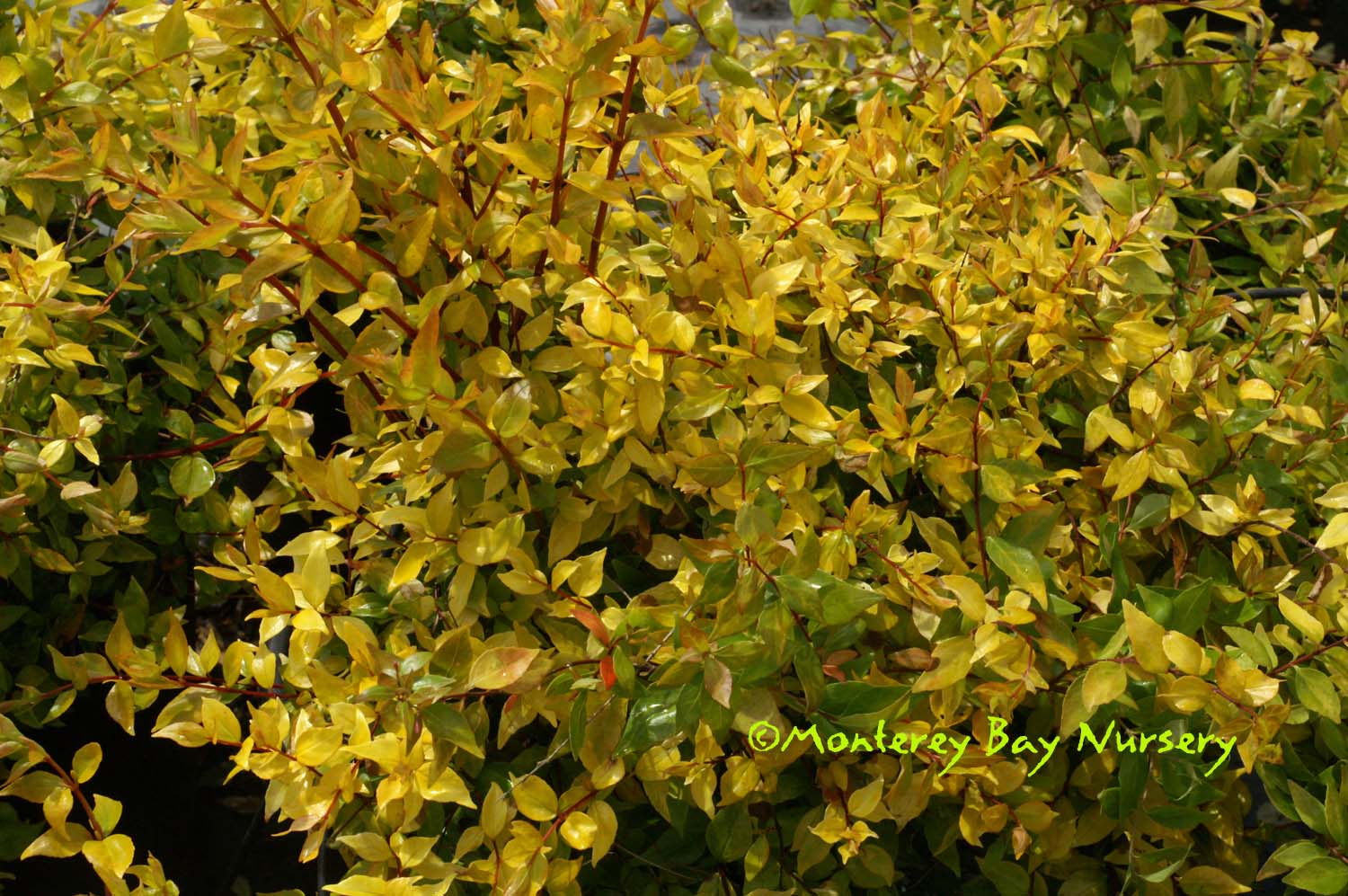
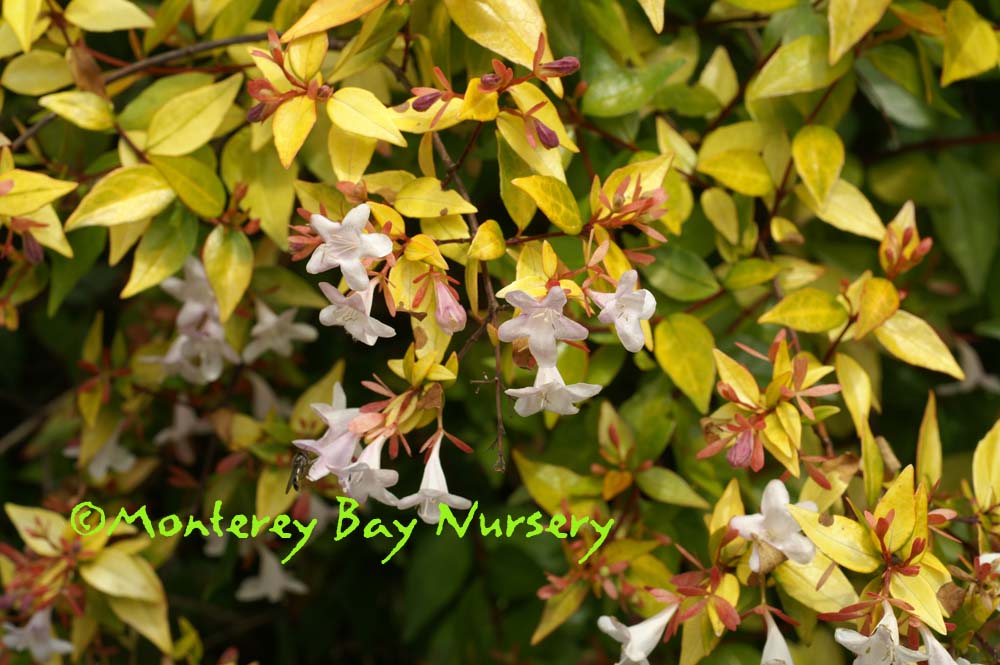
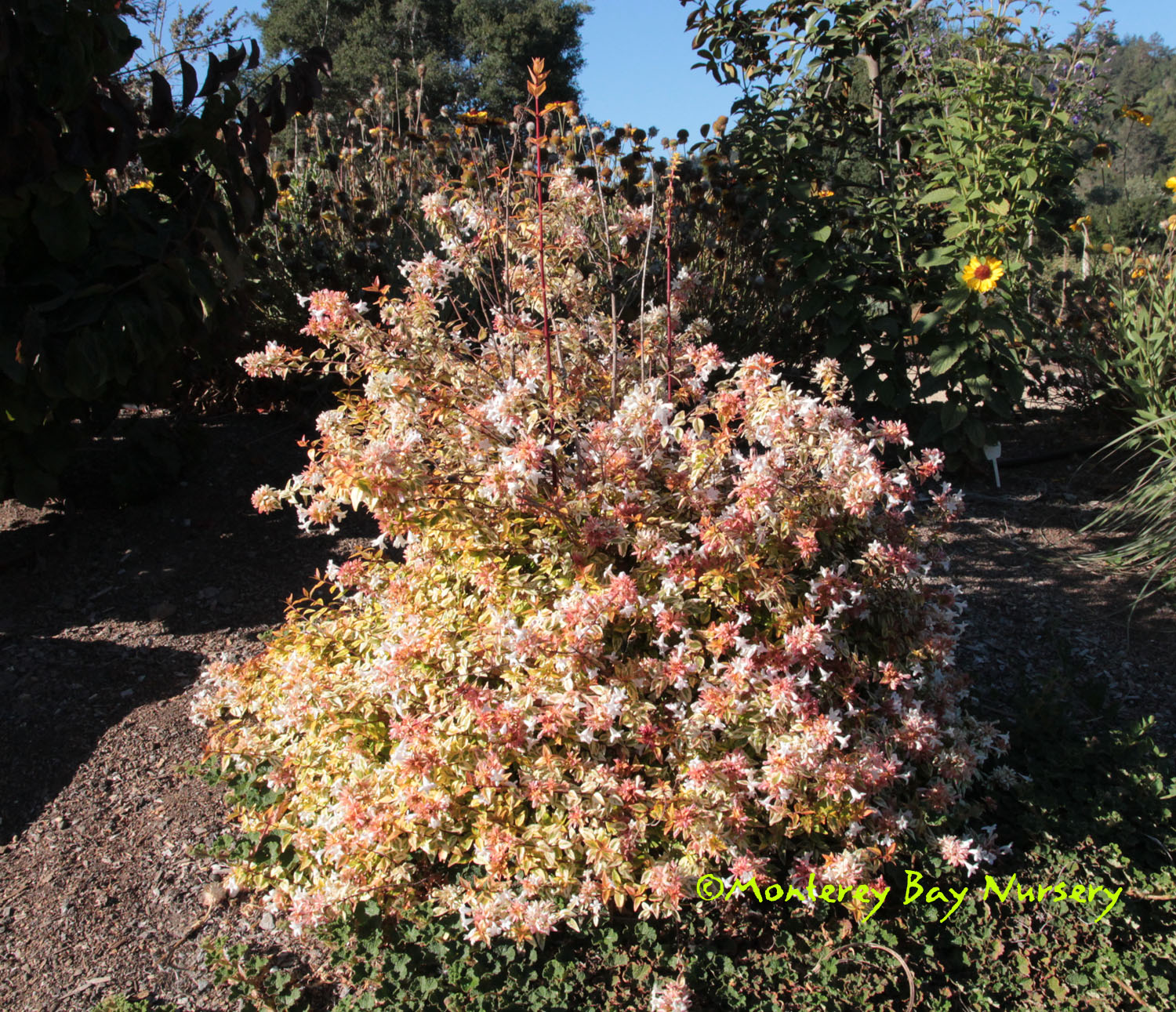
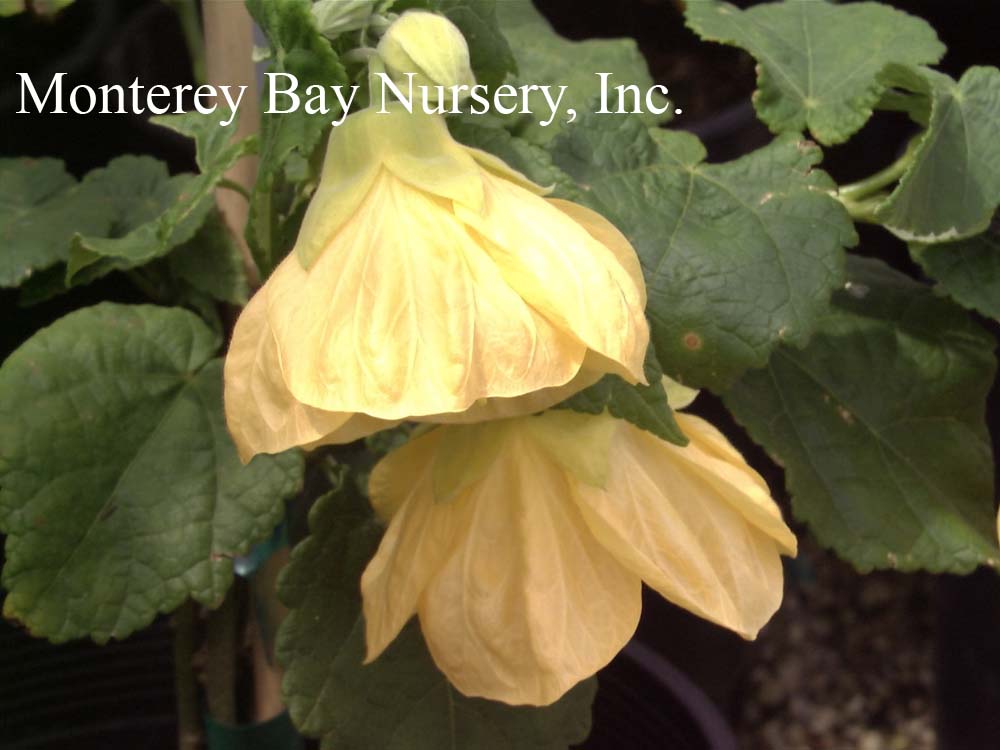
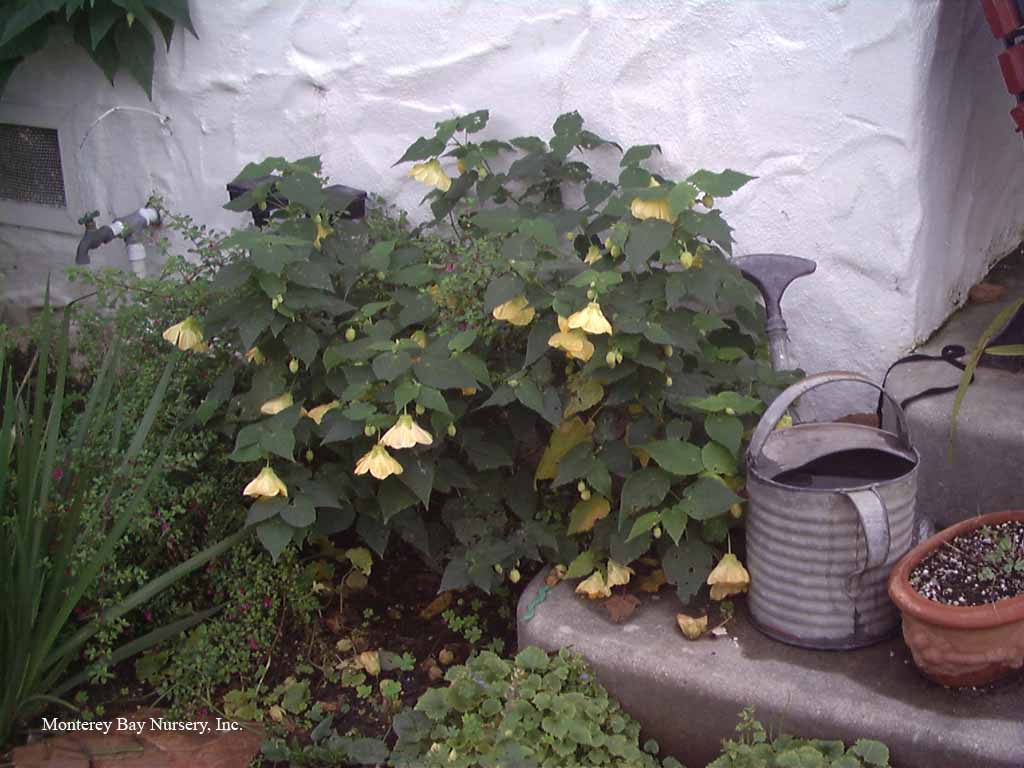
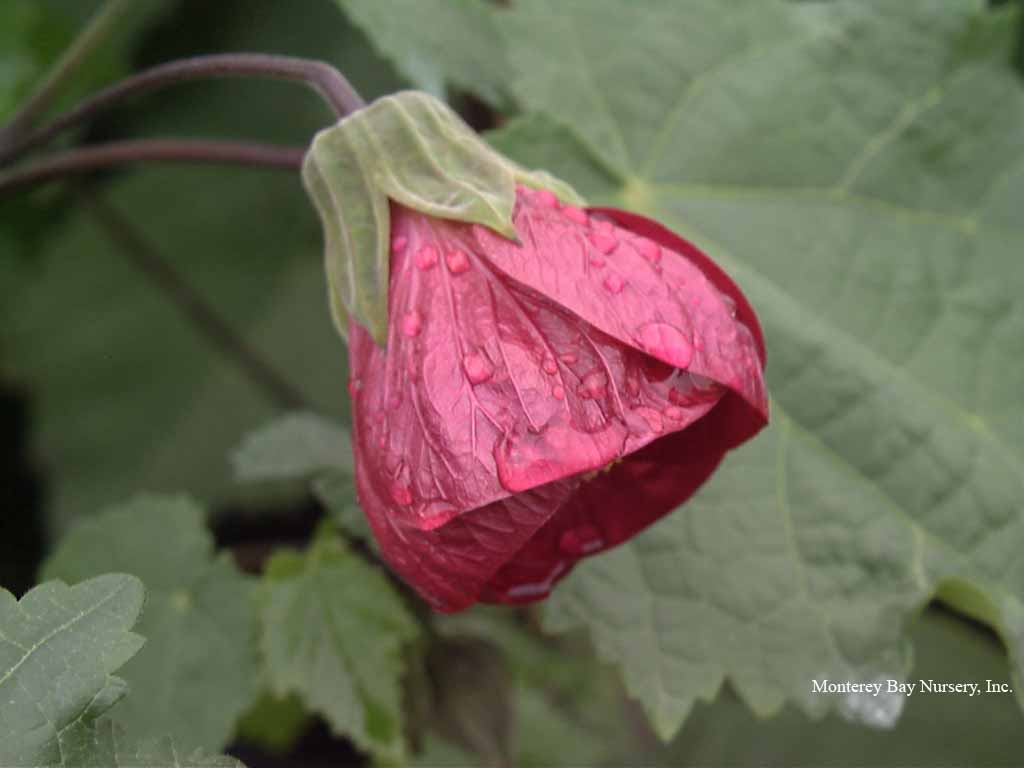
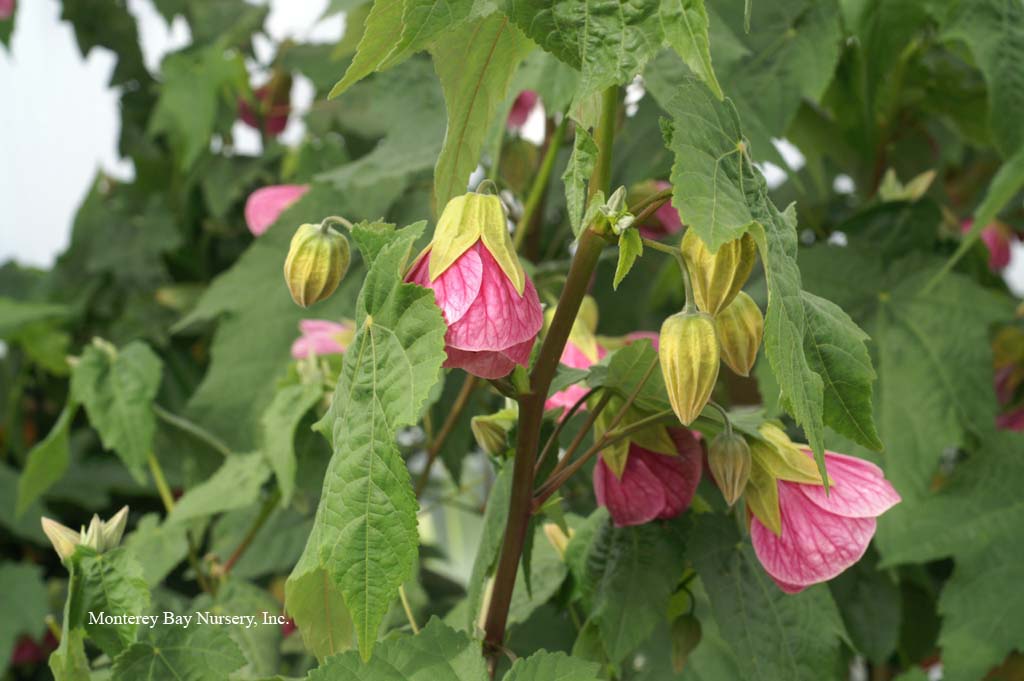
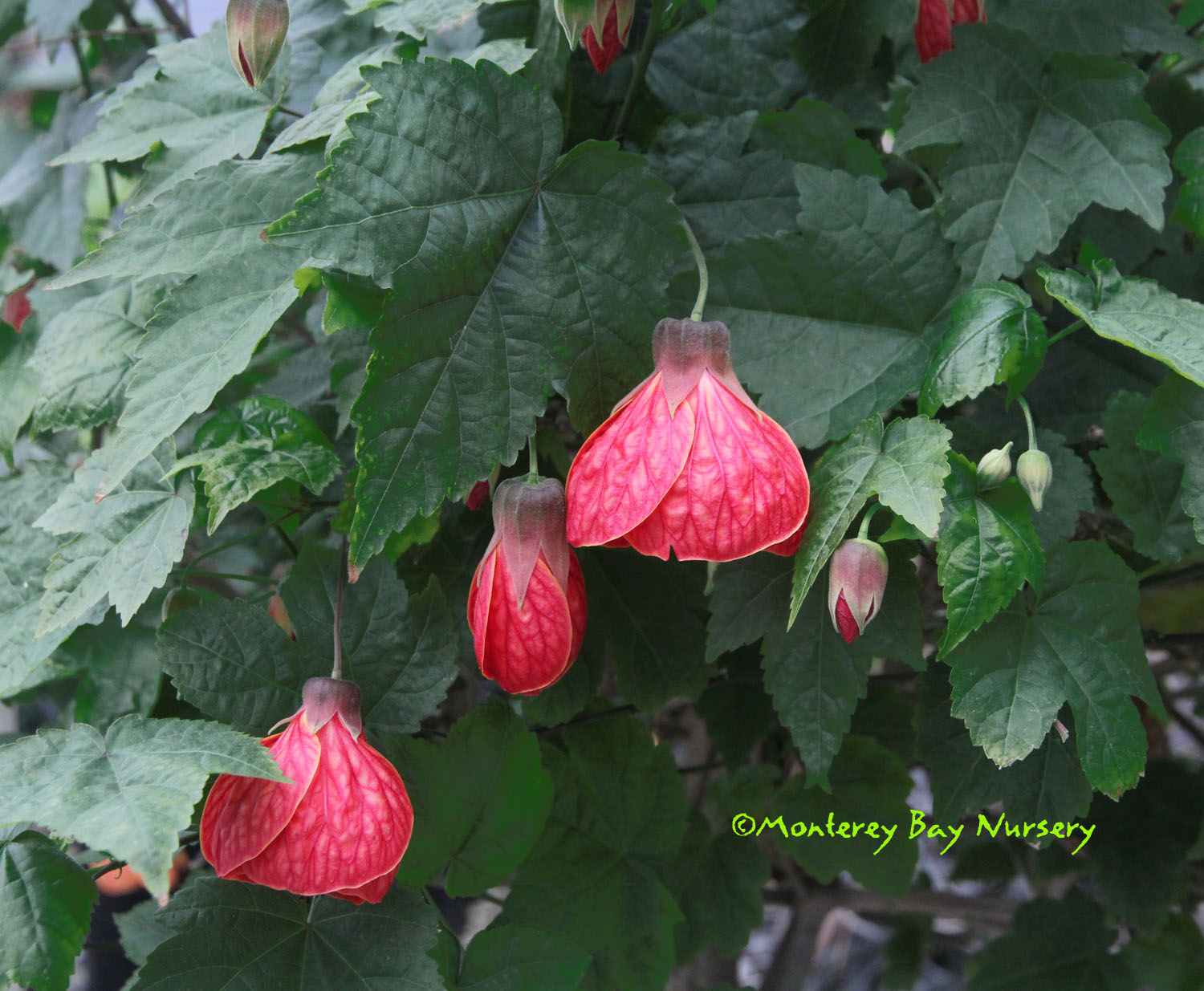
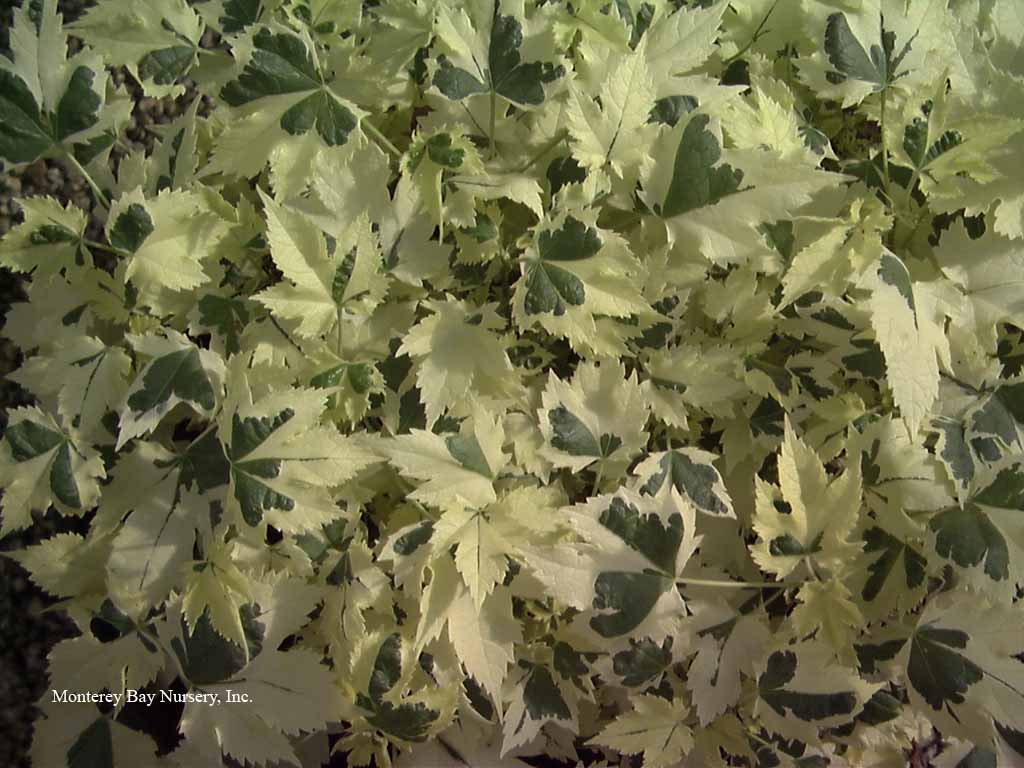
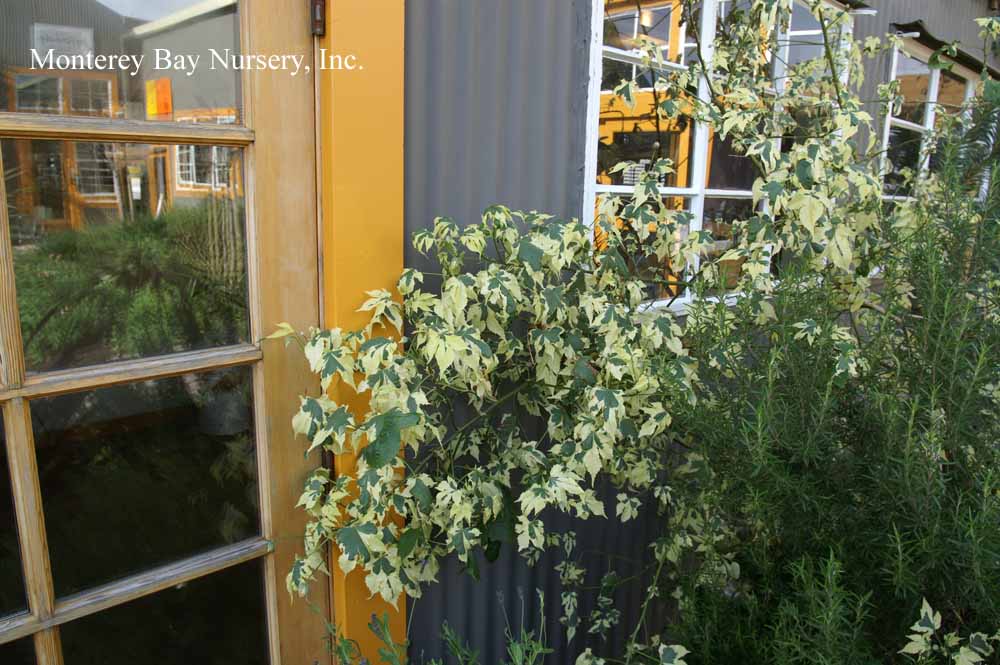
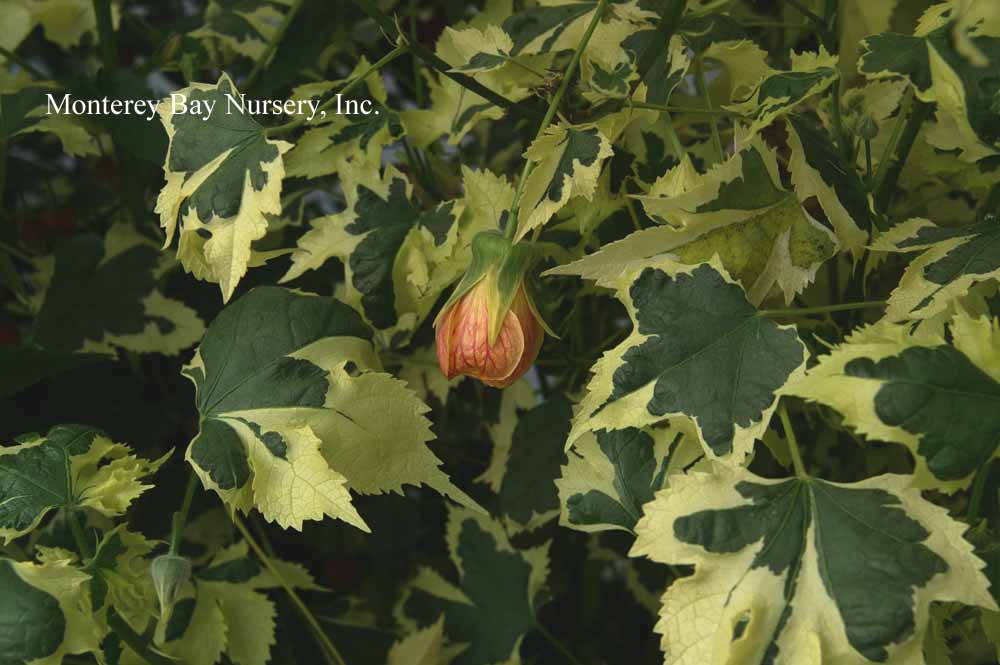
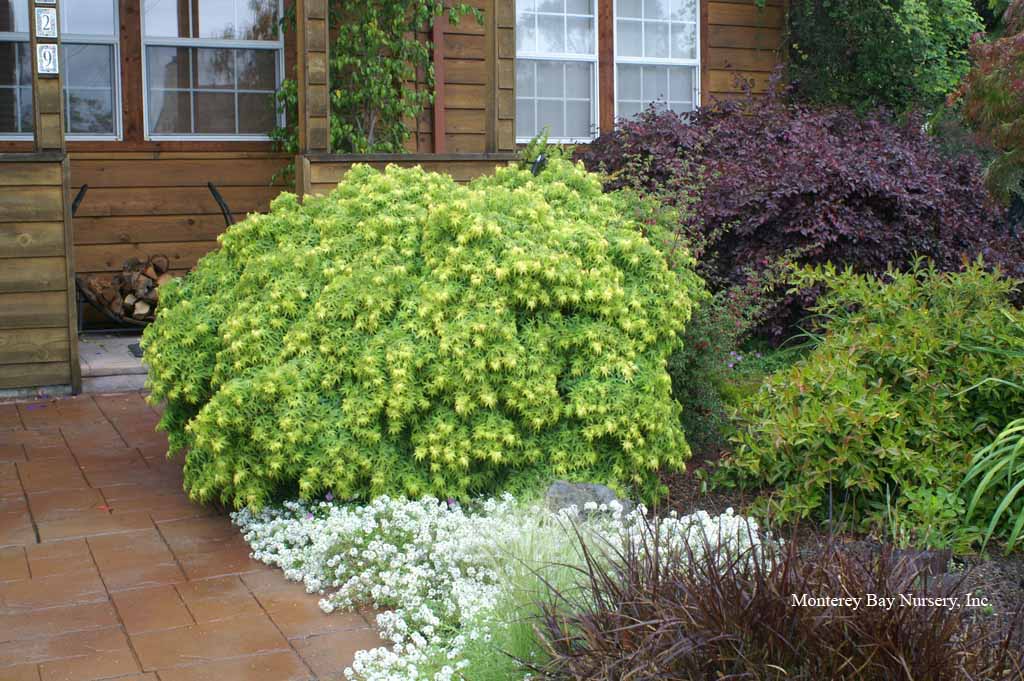
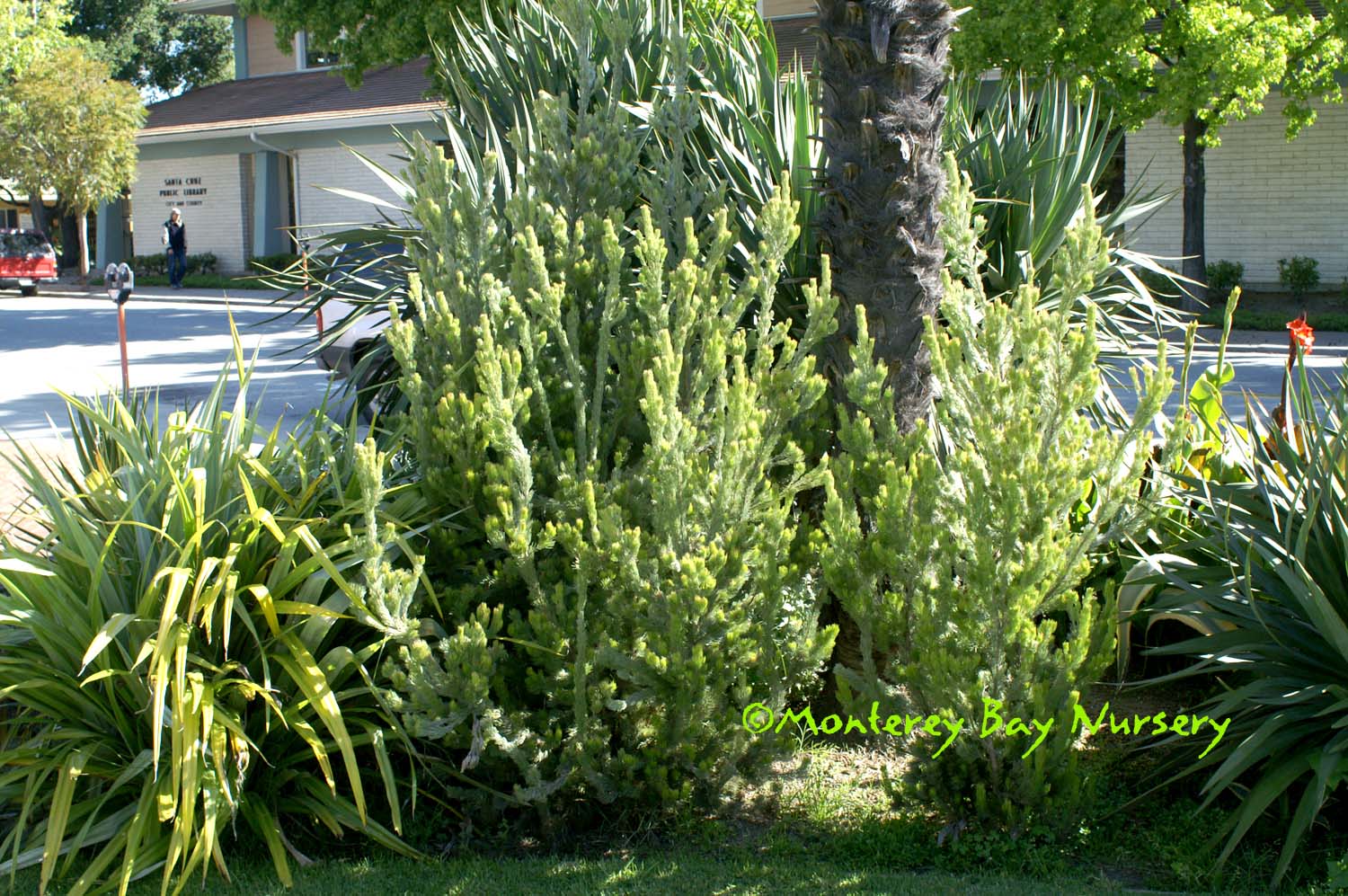
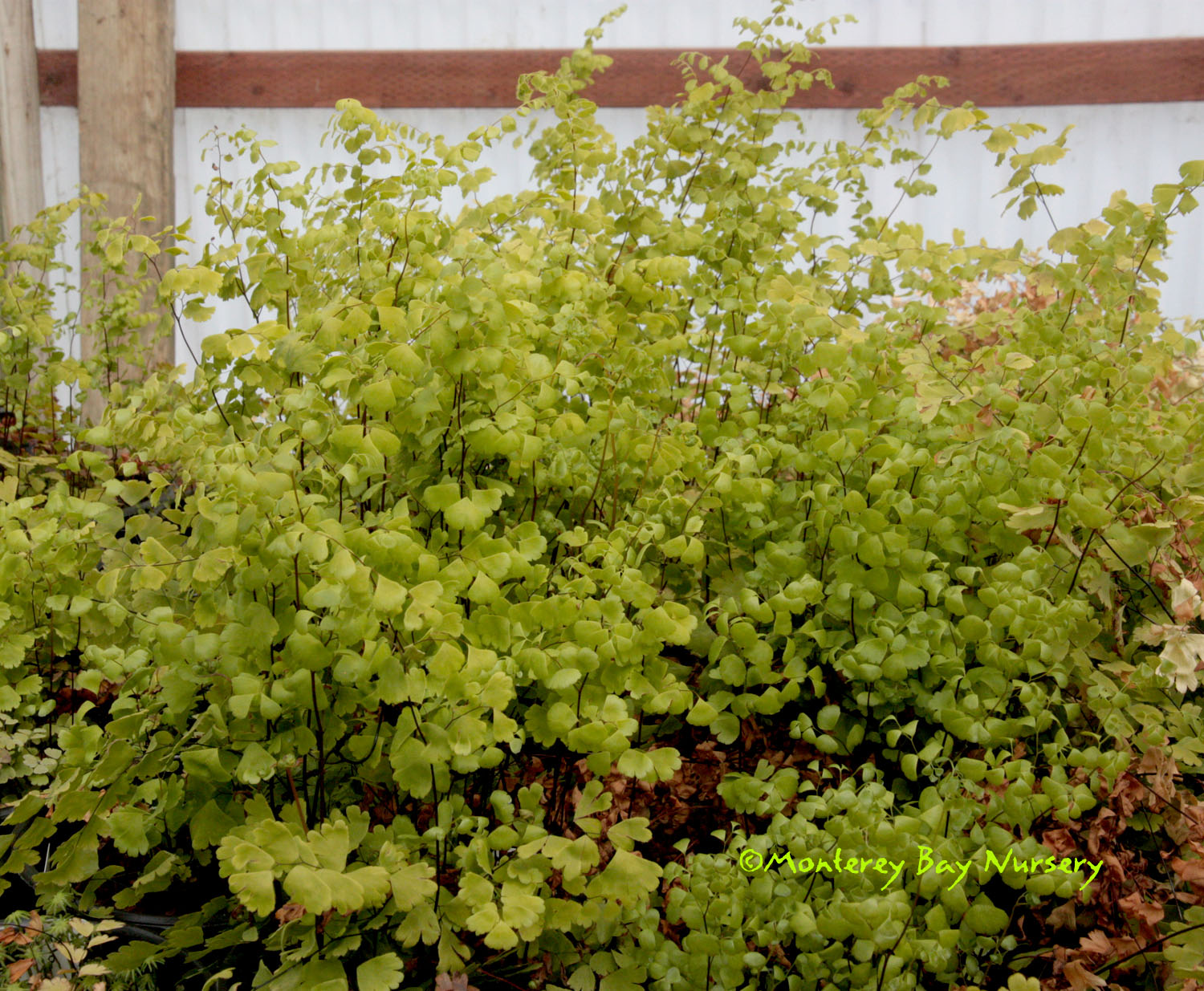
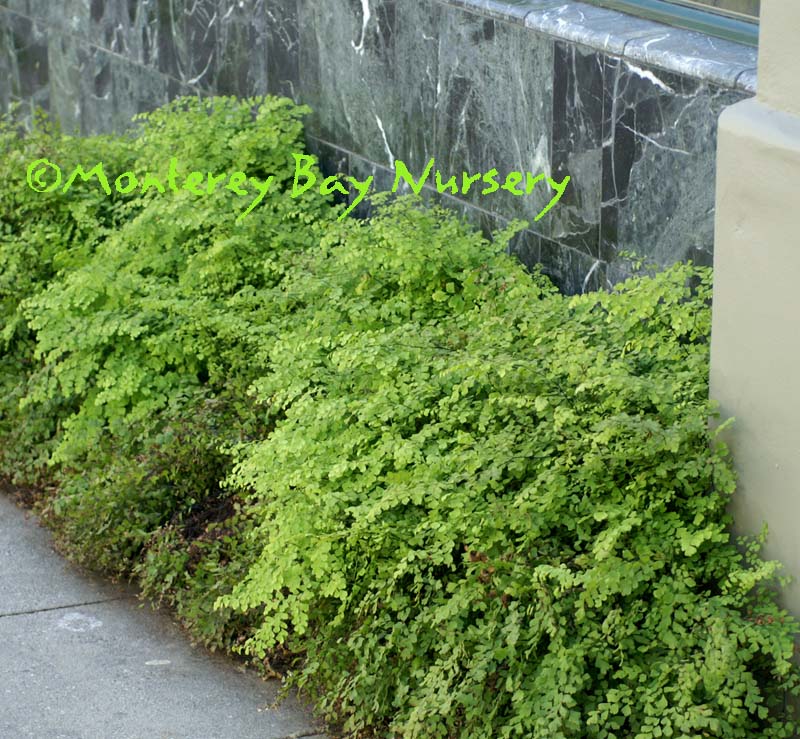
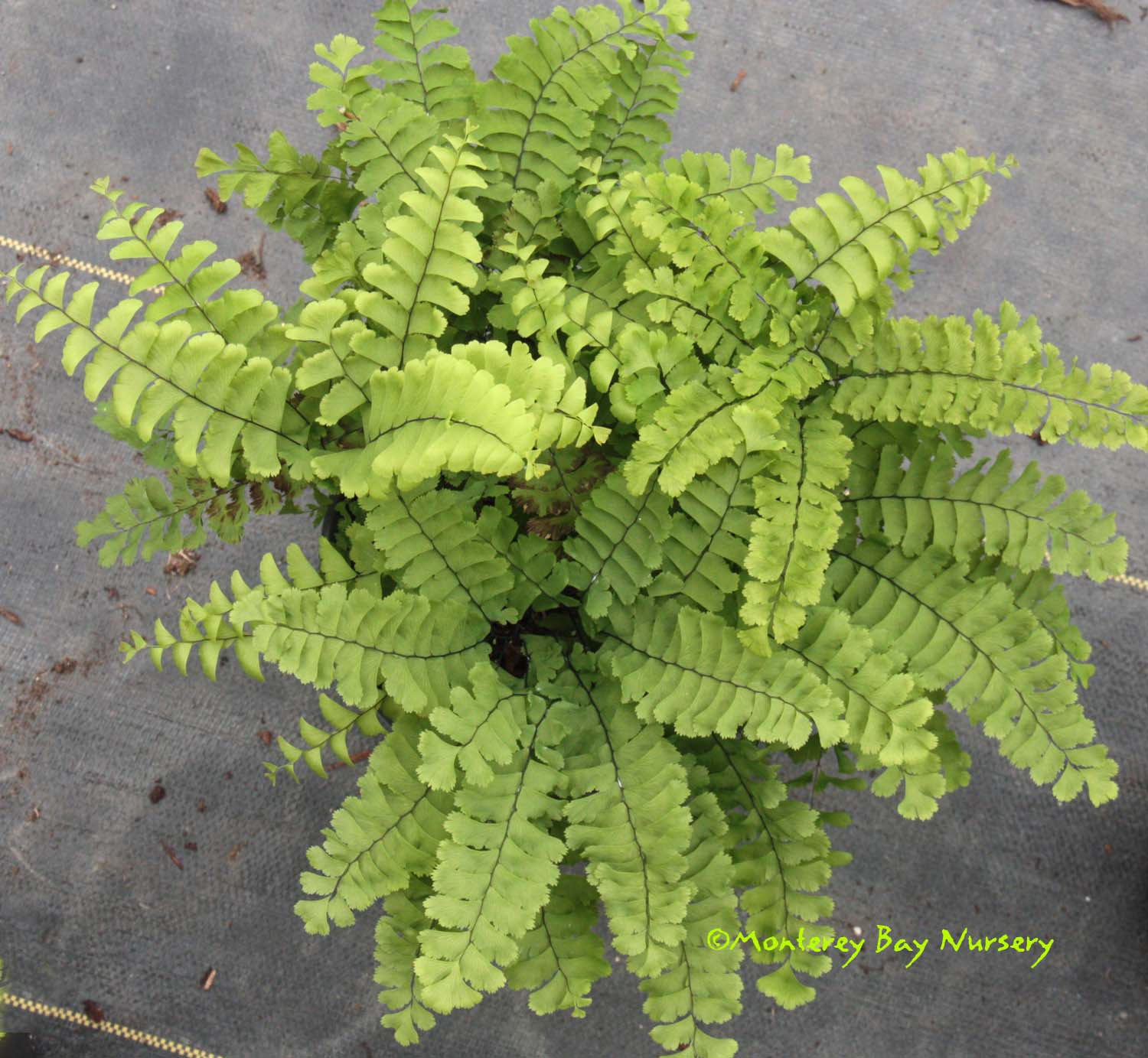
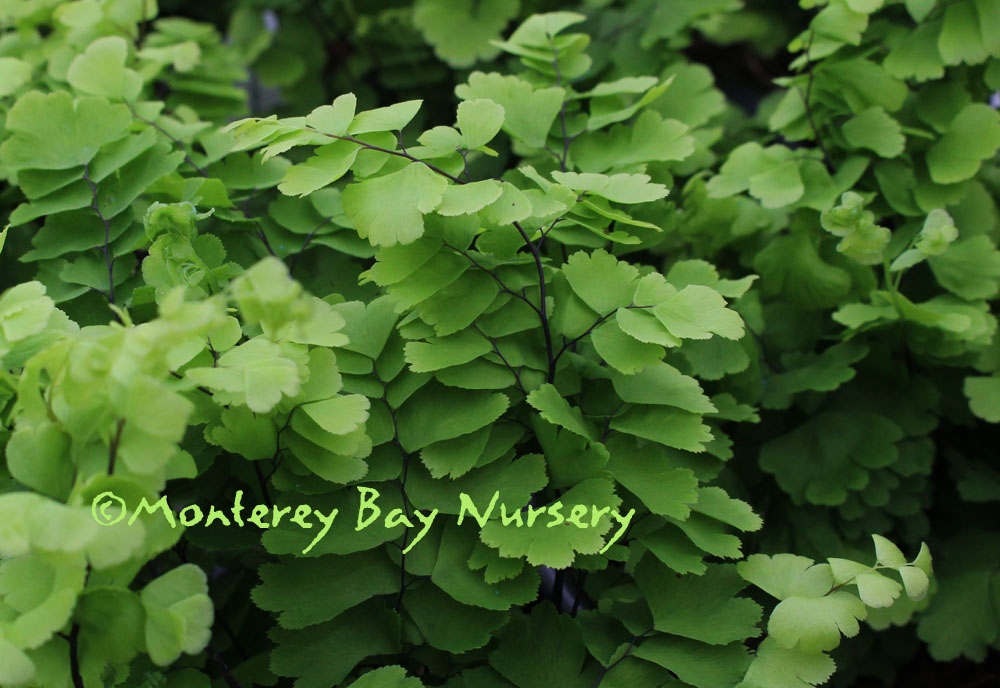
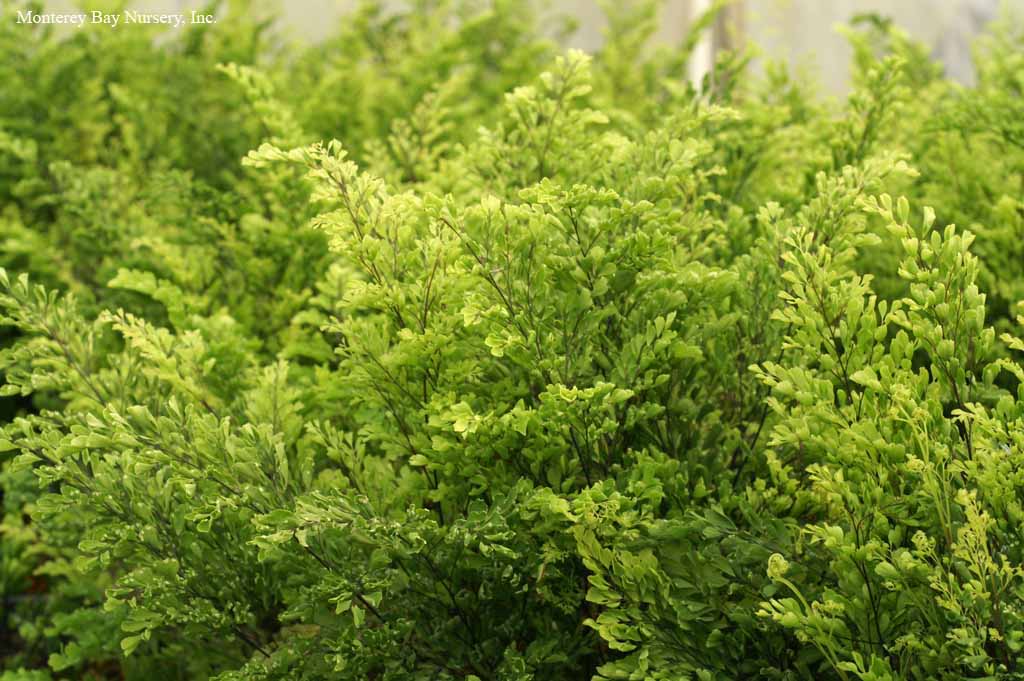
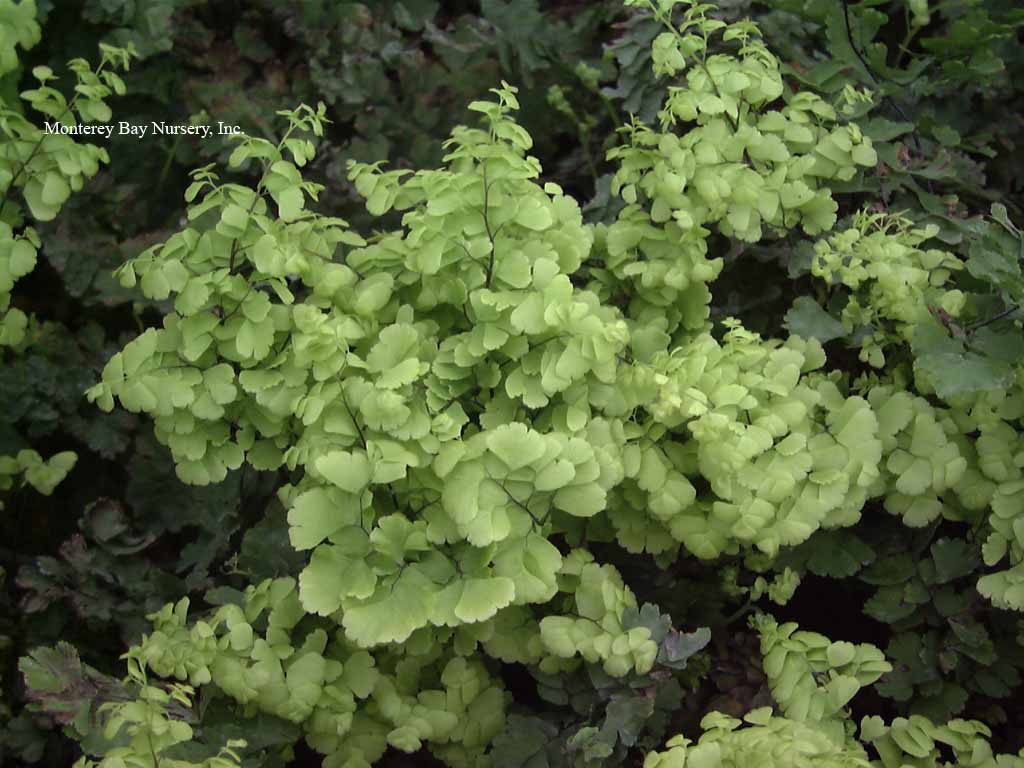
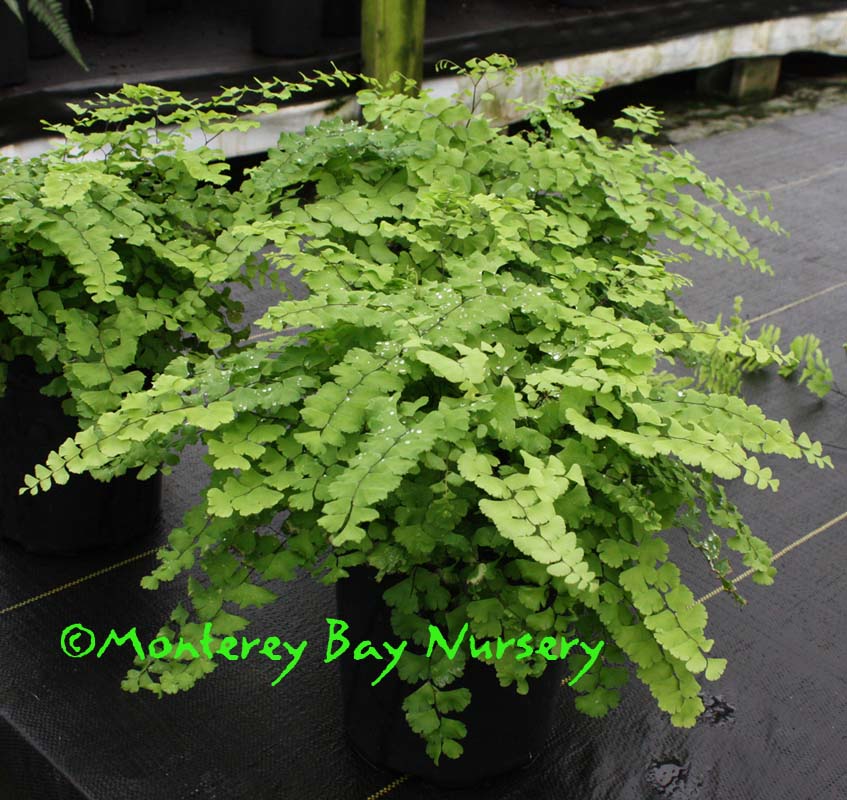
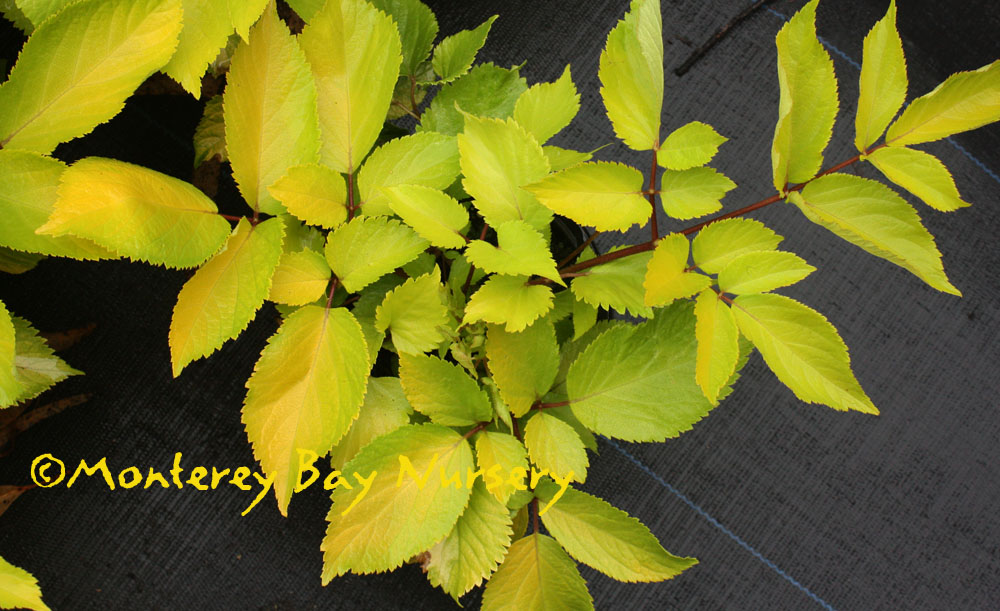
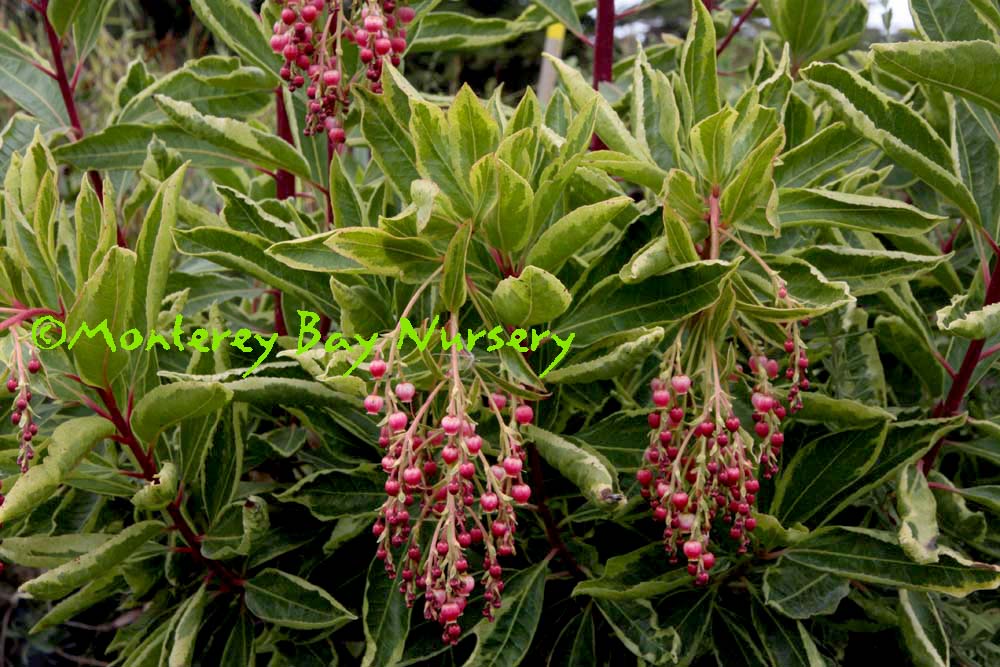
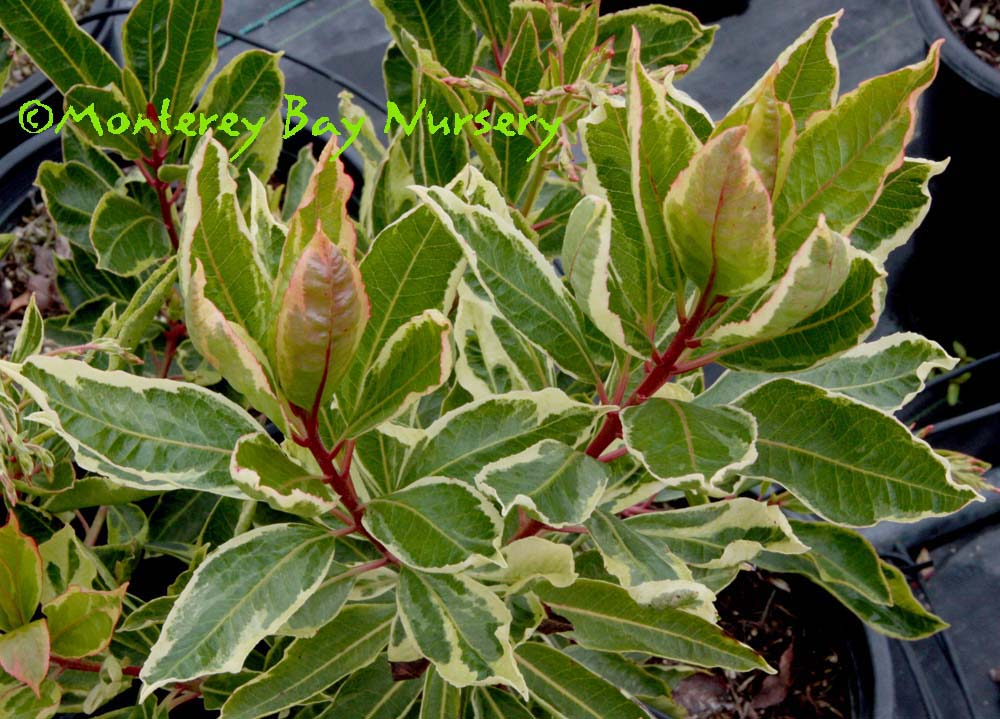
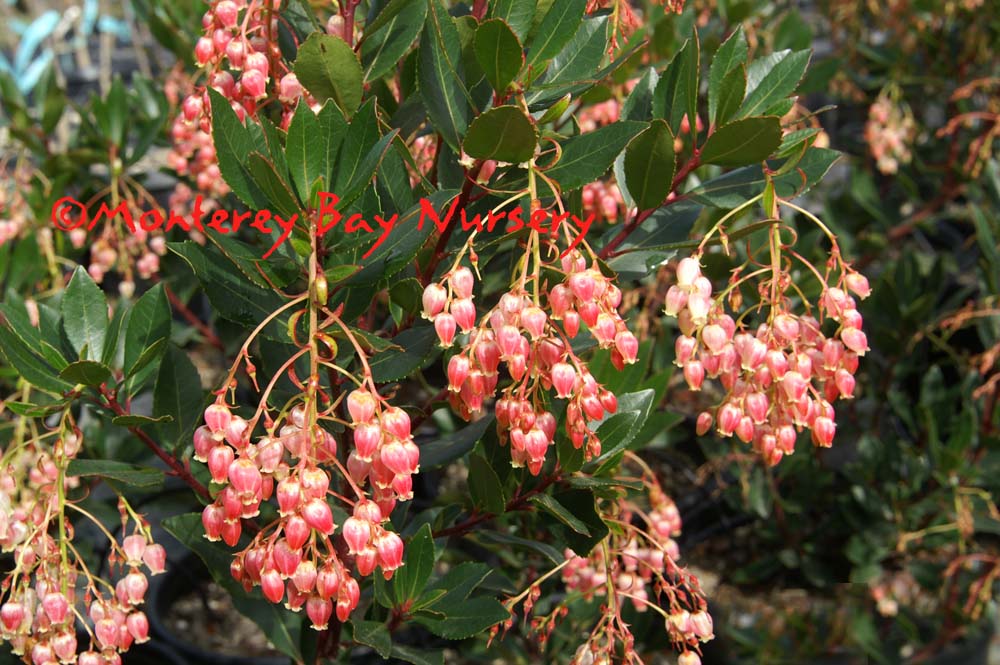
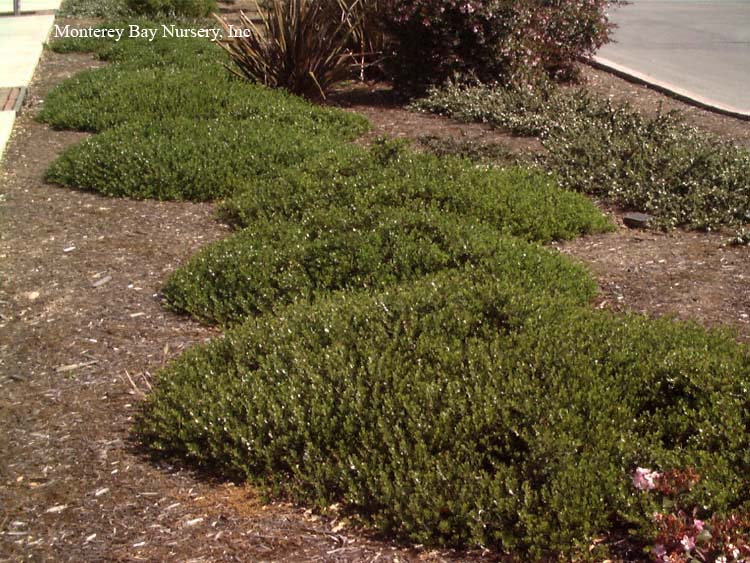
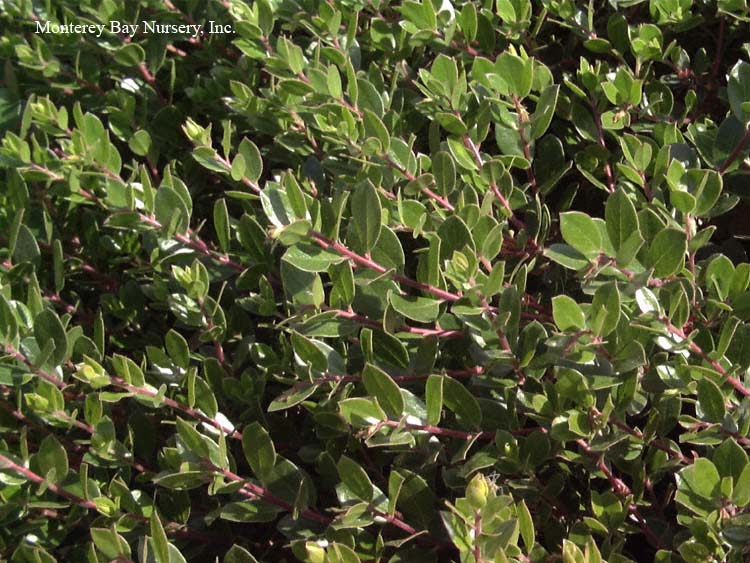
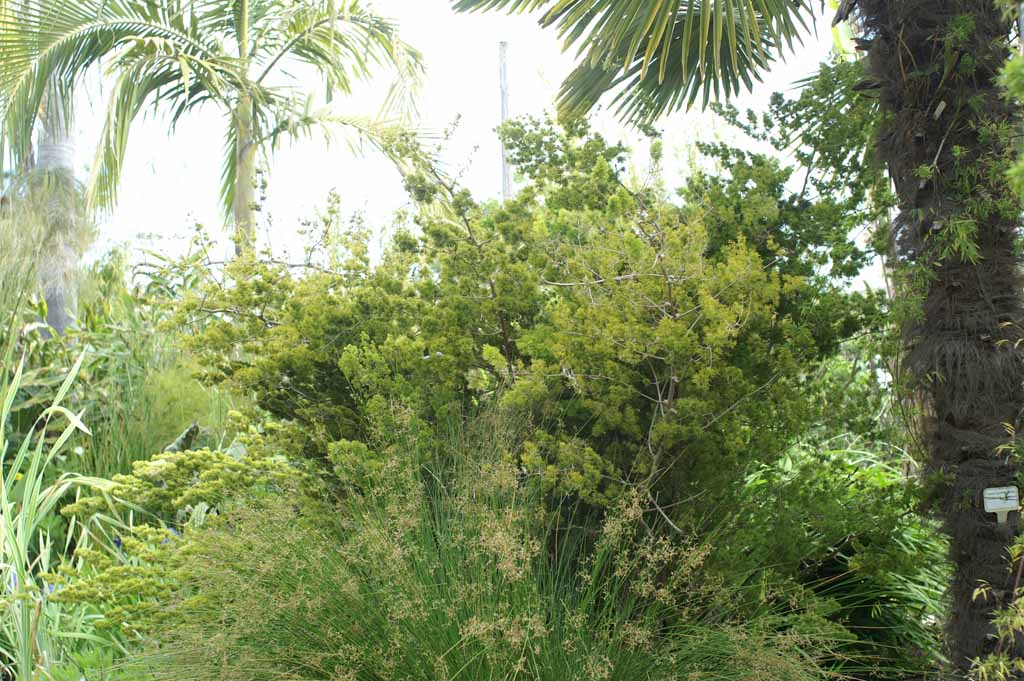
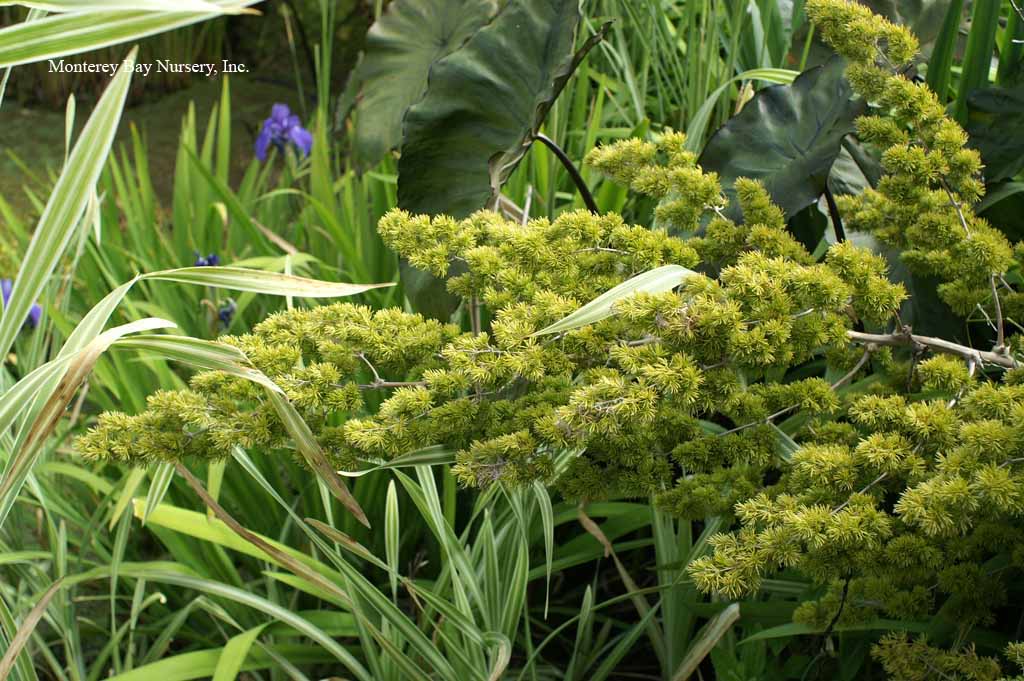
Abelia 'Francis Mason' foliage
with
flowers compact, dense, spreading evergreen
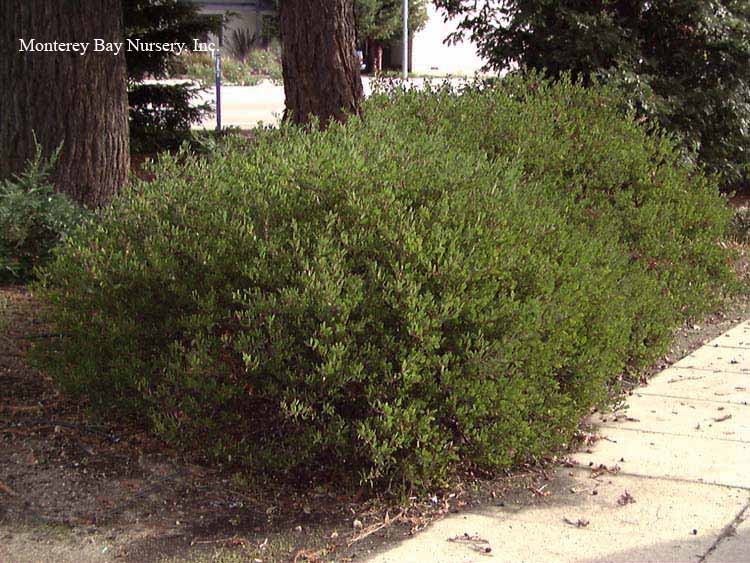
shrub to about 4' tall by 5-6' wide, one of the best shrubs for
golden-foliage available for our California conditions. Unlike
many light-colored selections it resists scorching except under
the hottest and brightest conditions and respectably drought
tolerant when established, existing in many areas without any
irrigation at all. The very warm, chartreuse to deep, rich gold
color looks great against the striking red stems and twigs, and
really stands out in the landscape dark backgrounds, including
shaded areas. Give it at least some direct sunlight for best
color, it is inclined to stay bright chartreuse green without
enough light. Pink flowers are an added bonus. Caprifoliaceae.
USDA zone 7, Sunset zones 4-24. rev 1/2017
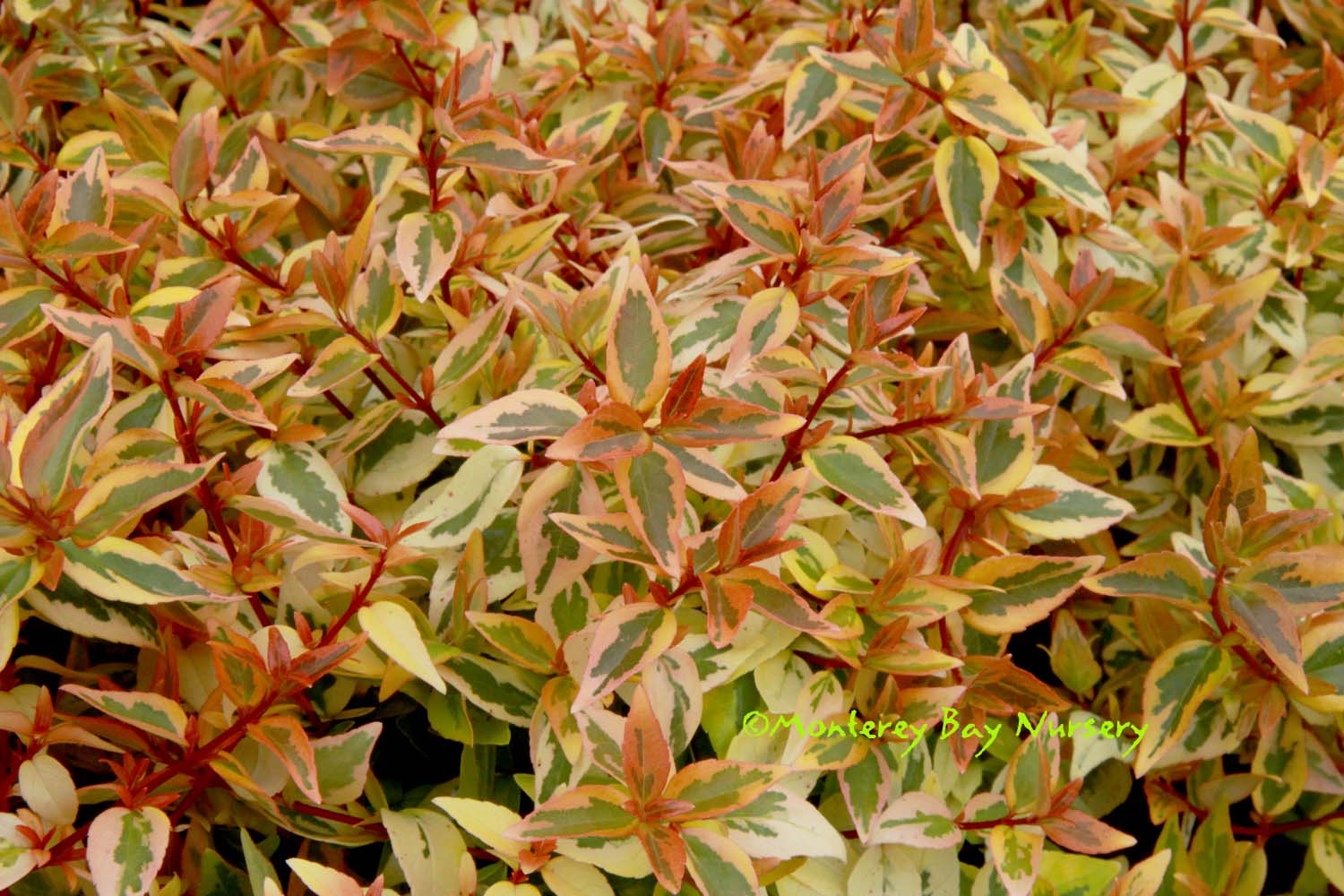
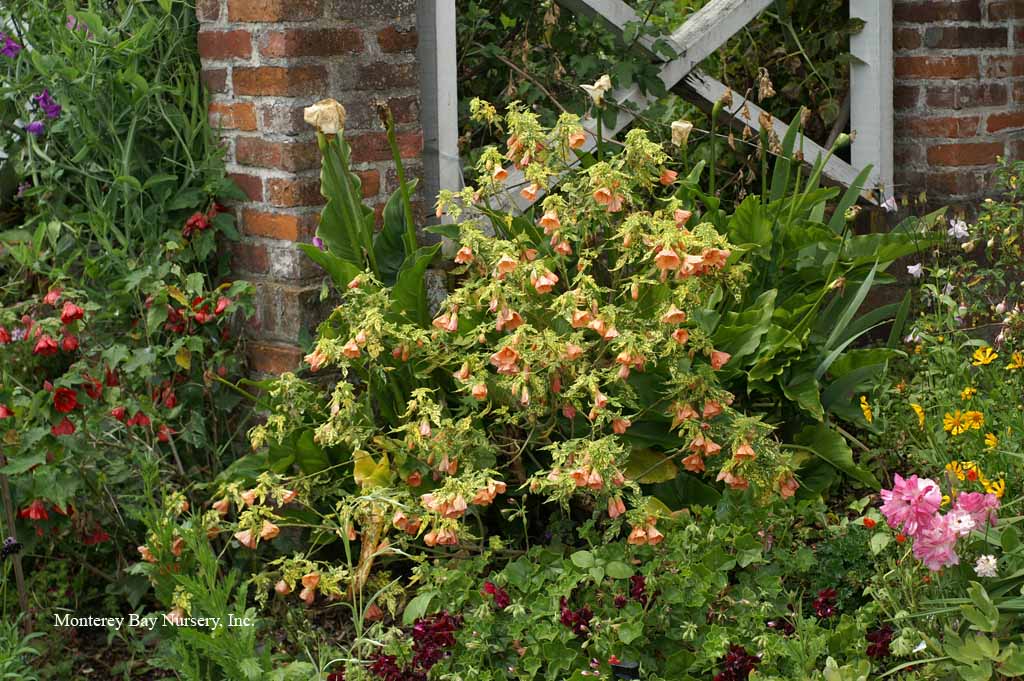
'Kaleidoscope' PP16988 hot foliage similar to 'Francis Mason' but with variegated golden foliage against striking orange-red twigs, with leaves turning hotter orange red in fall and winter. Small white bell-shaped flowers are produced in short clusters on mature growth that experiences modest morning chill, meaning it can bloom intermittently almost all year in much of California. A compact grower reportedly to just 3' tall by 4-5' wide but we see it getting larger, probably 4-5' by 6-7' wide. A Southern Living/Sunset Program variety. Sun to part sun, greener with increasing shade. Most soils, average to good drainage, low water use when established but will tolerate intermittent regular irrigation with good drainage. USDA zone 9/Sunset 4-24. rev 7/2021
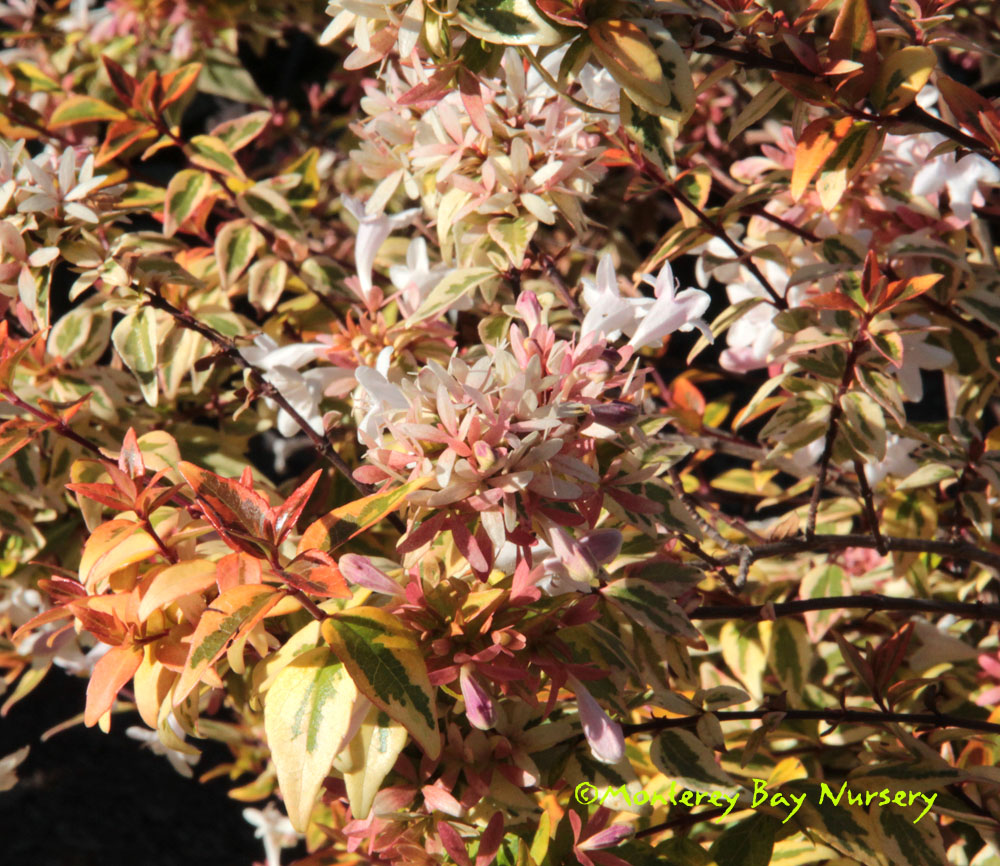
'Sunrise' flowers and new growth Stephanie Mills' Garden, 2014 a golden yellow variegated form similar to 'Kaleidoscope' but paler in color, lower, somewhat finer-textured. New growth is lighter orange red, flowers are very similar, white shaded pink on the outside of the petals. To 3-5' tall eventually, probably 5-7' wide, moderate growth rate. USDA zone 9/Sunset 4-24. rev 7/2021
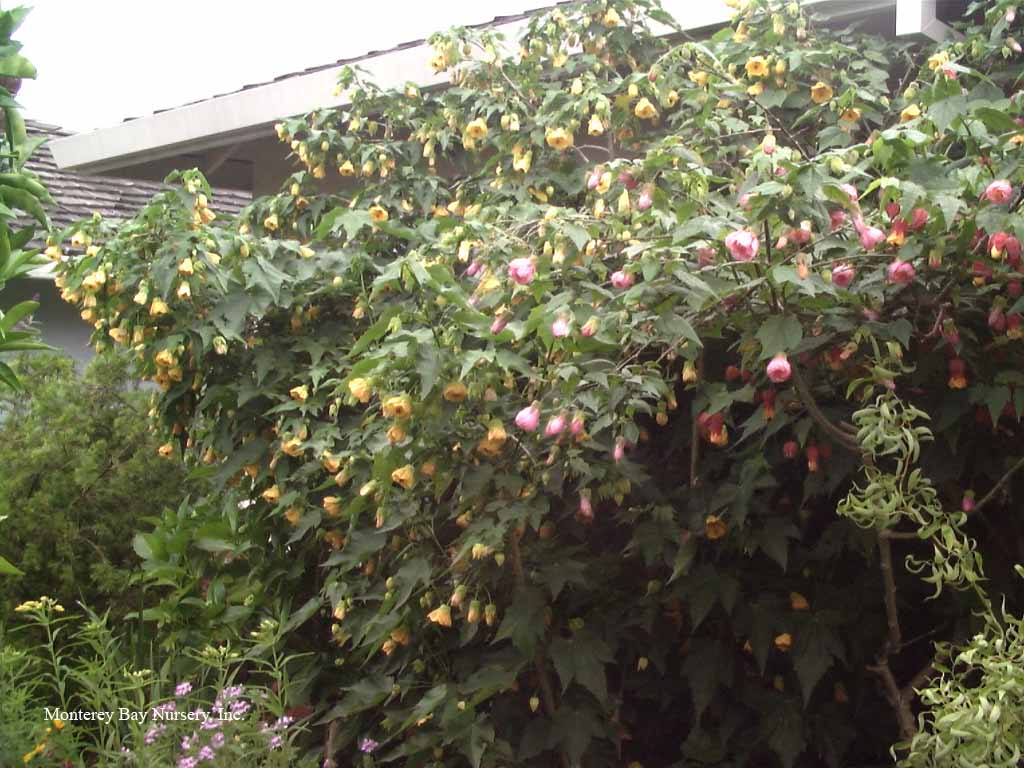
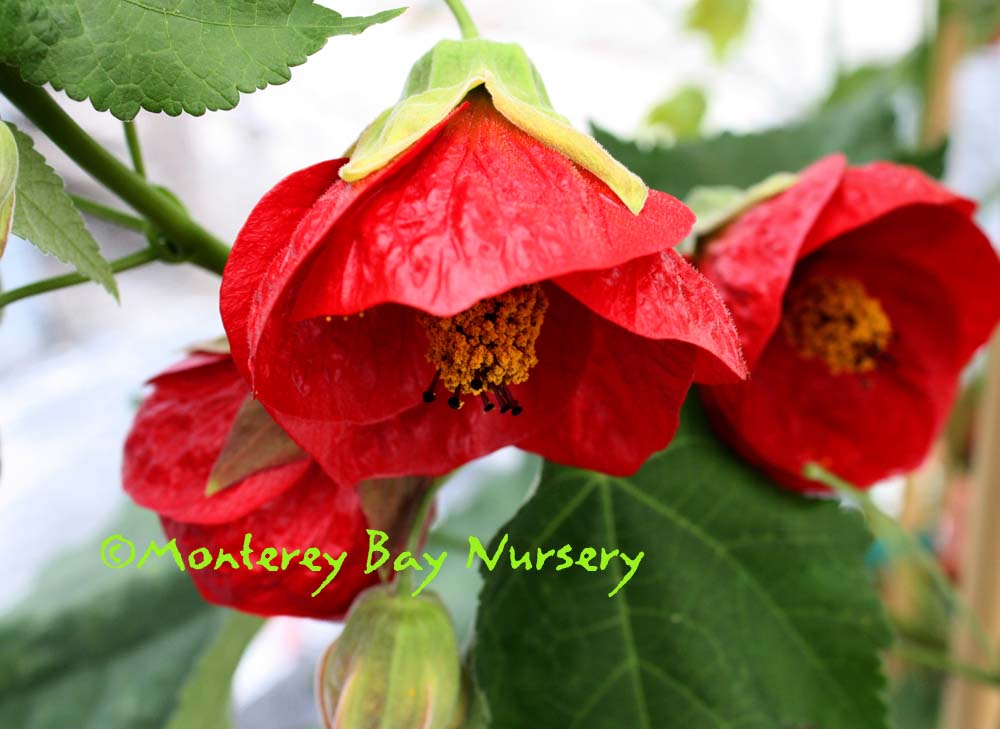
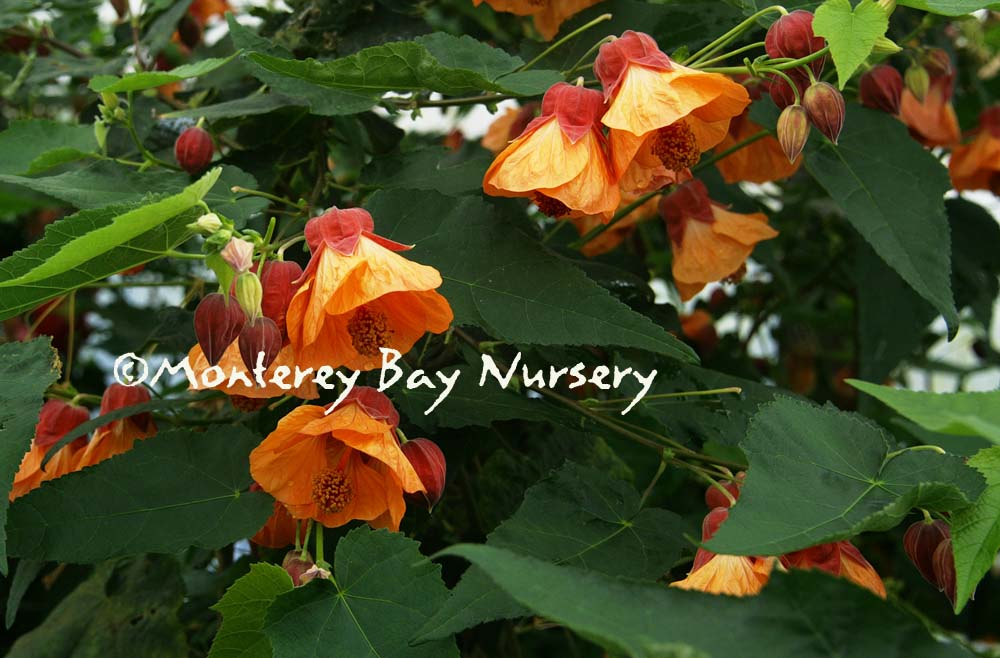
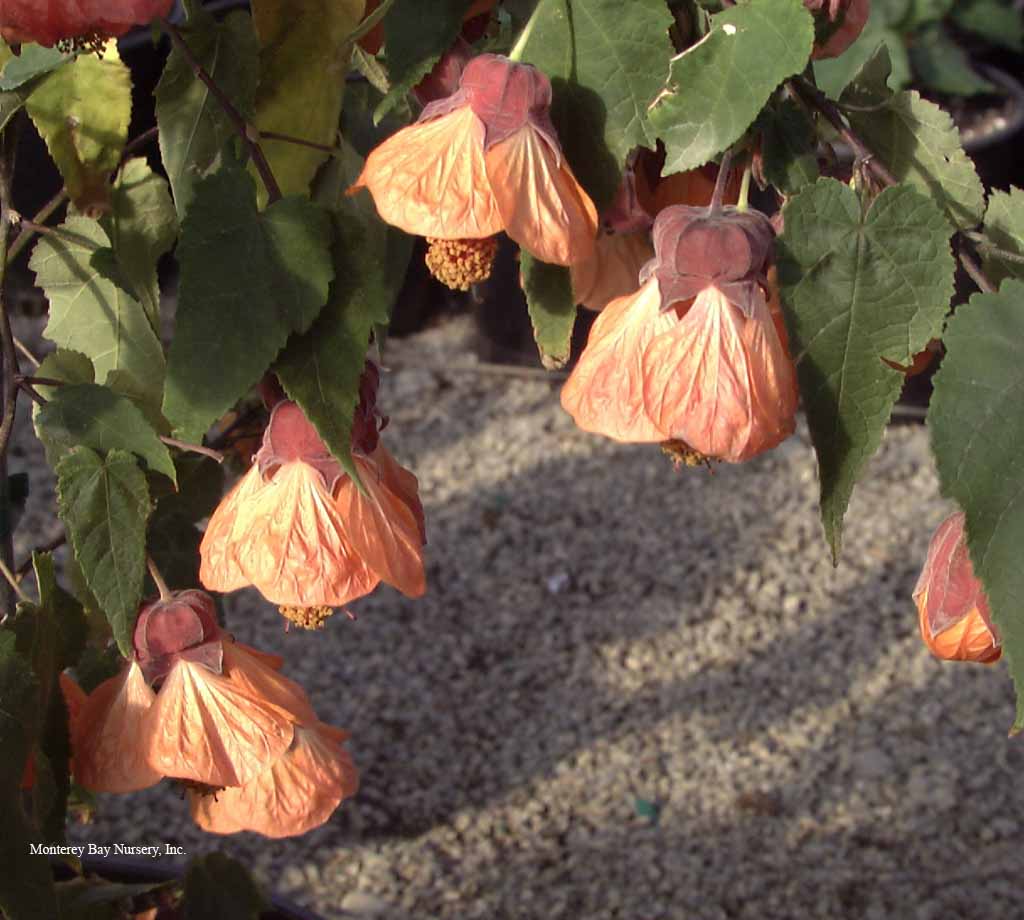
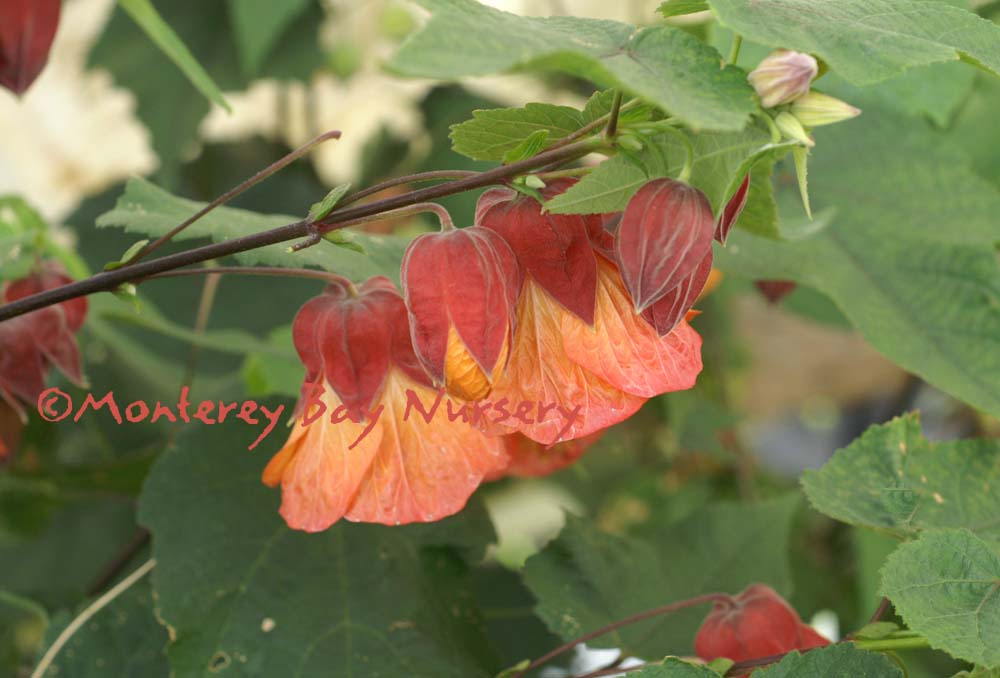
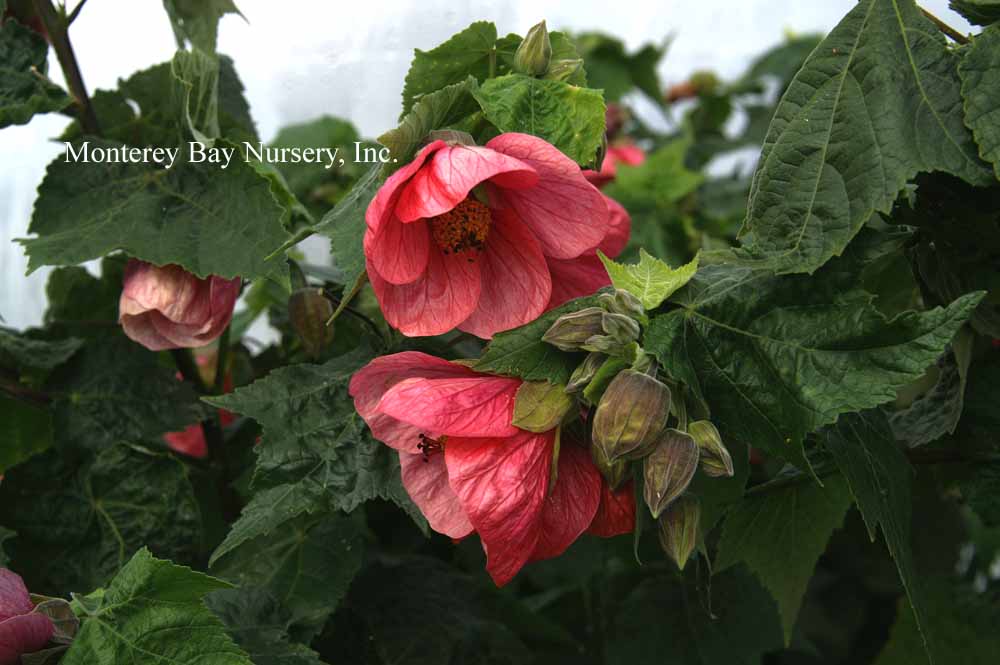
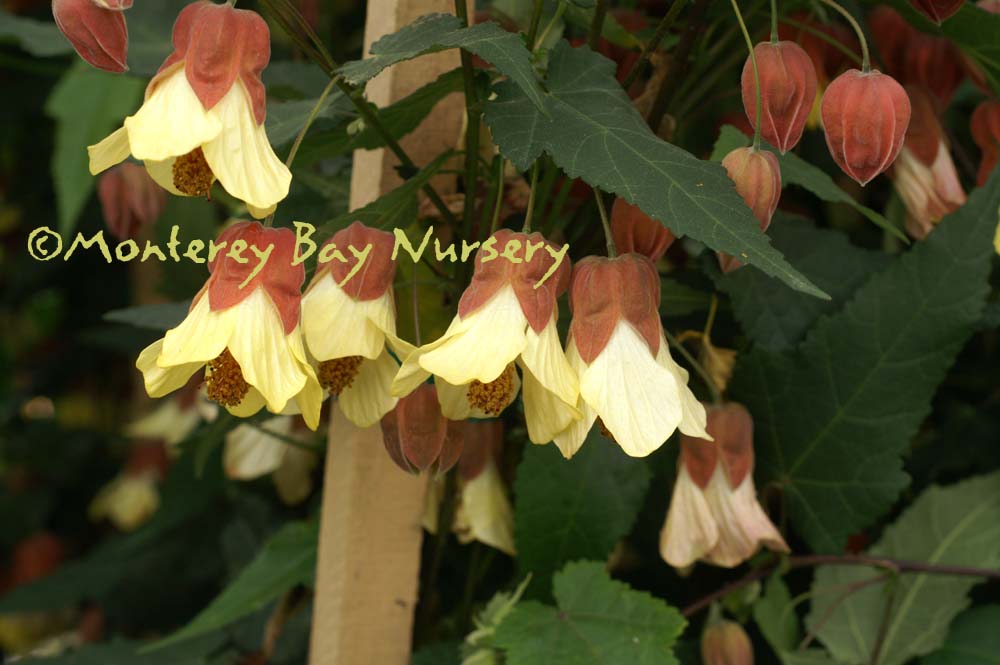
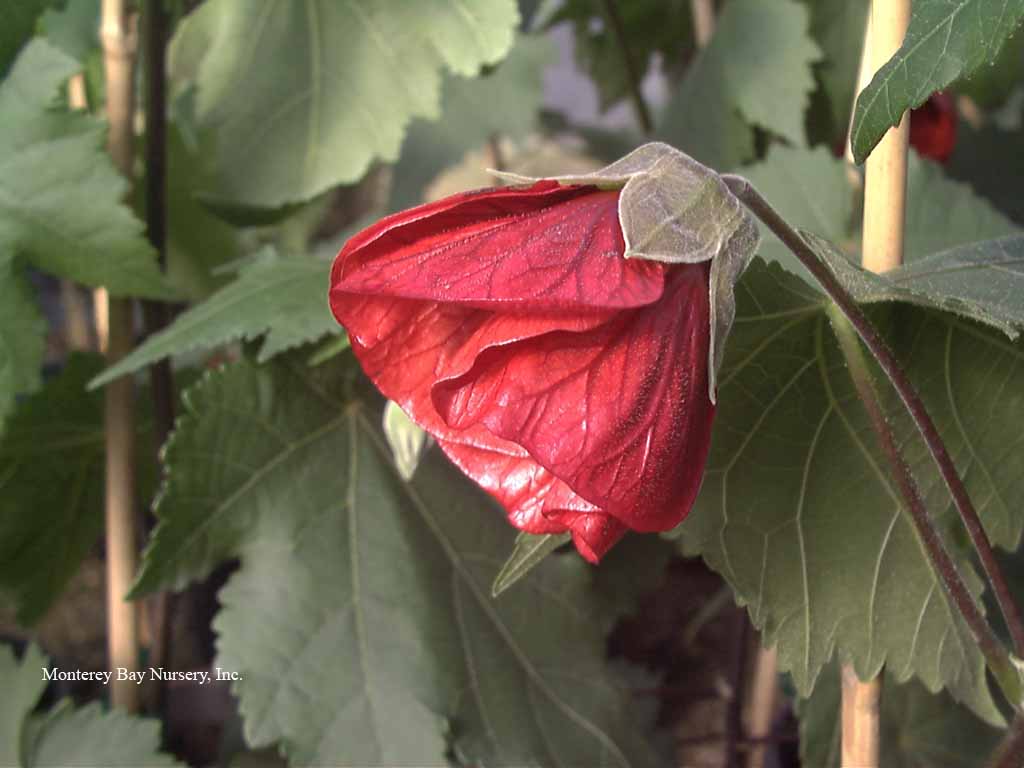
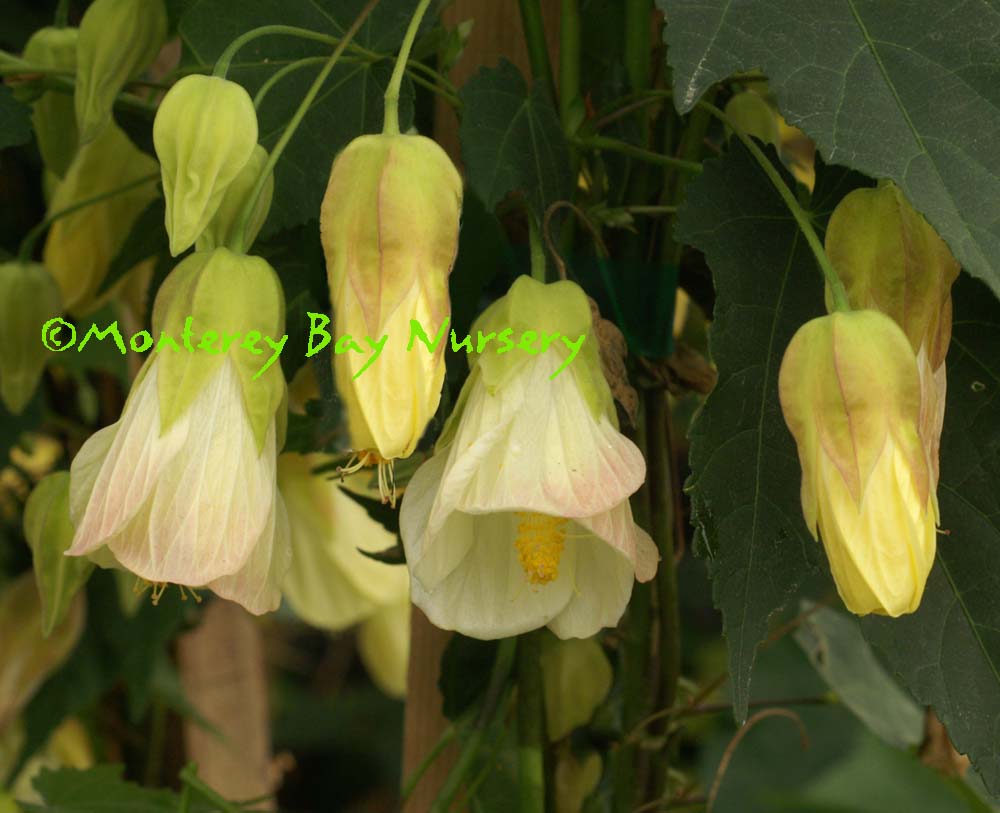
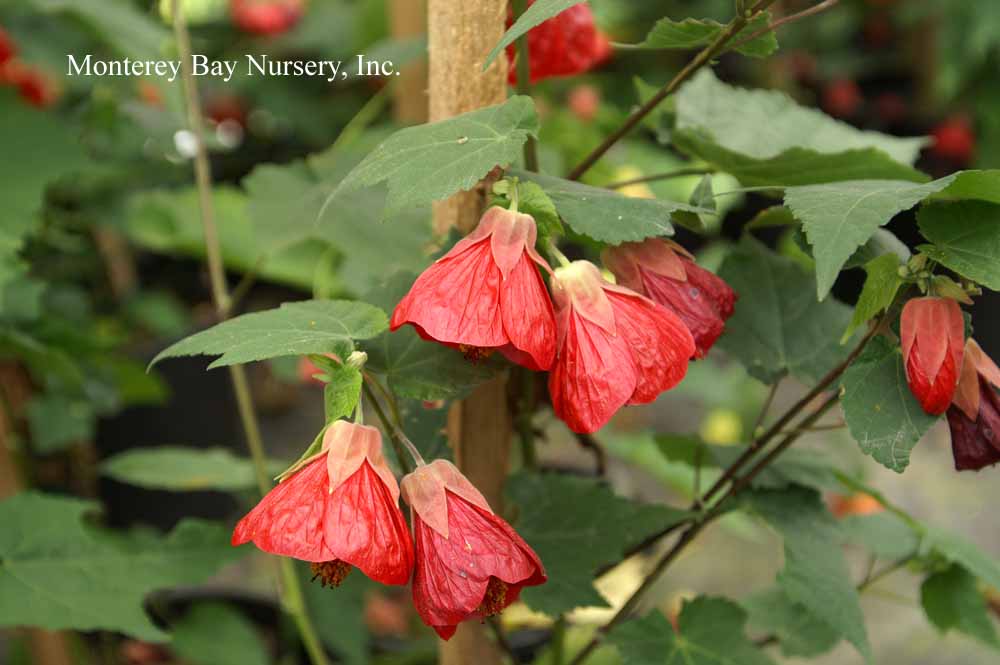
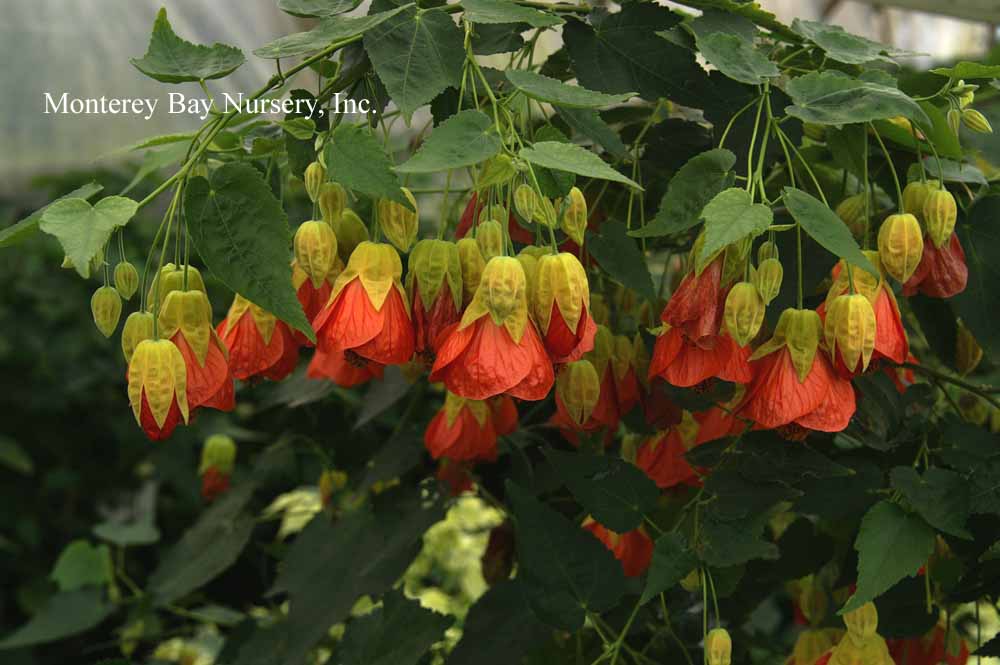
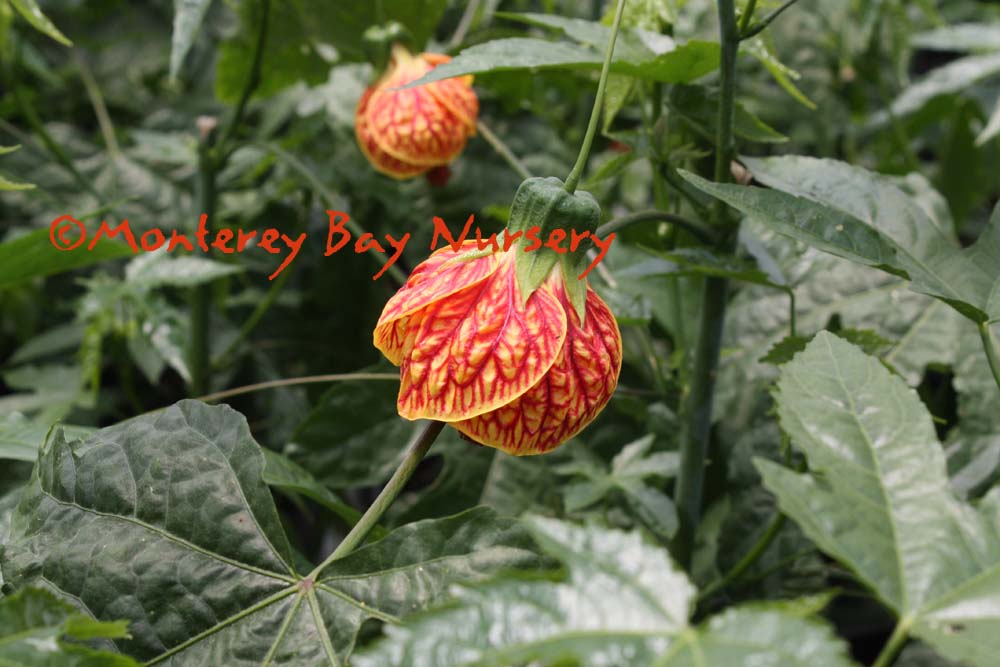
Abutilon hybrids FLOWERING MAPLE big shrubs small,
vining shade garden plants evergreen shrubs, some to
only 3' or even prostrate, others to 15' tall and wide. They are
loved for their wonderful colors, but probably their best and most
useful feature after their fabulous continuous flowering season
(truly daylength-neutral initiation) is the fact that those
ever-present flowers and heavy nectar production make them
absolutely irresistible to hummingbirds, all year. Also they are
irresistible to children, and adults like me, who also like nectar
and are prone to ripping the flowers apart to get at it. They will
generally tolerate frost to 25°F or lower with little or no
damage. Most just go deciduous to temperatures as low as 20°F, but
a few are branch-hardy to USDA zone 7 and won't even lose twigs at
15°-10°F. They like full sun or require some shade, depending on
variety, exposure and microclimate. Most will take more than half
a day of sun and will need little or no summer watering in coastal
areas, but lean towards more shade and water in hotter, drier
climates. Some, such as 'Moonbeam' and 'Victory,' are excellent
for containers or hanging baskets. Most of them make excellent
espaliers subjects, especially all of the megapotamicum
varieties and hybrids. Malvaceae. rev 1/2021
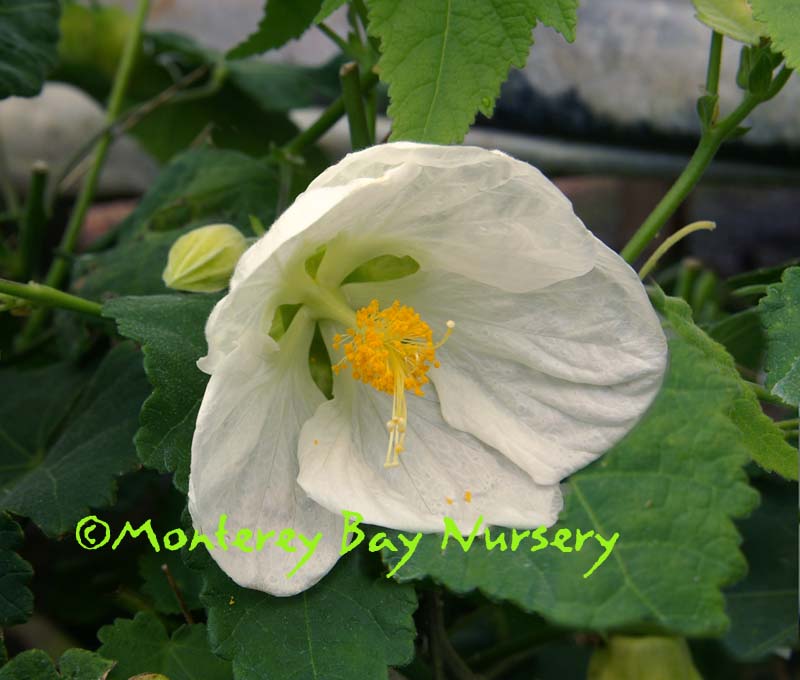
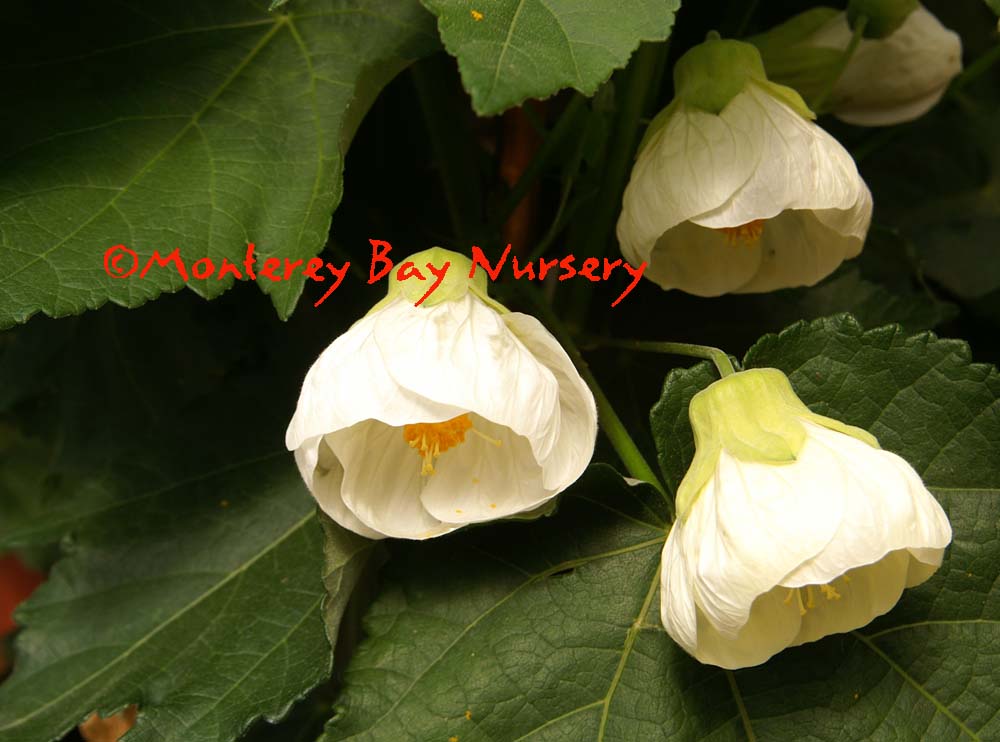
'Alpha Centauri' flower a large, pure white flower with almost no yellow tones, well displayed. Another superior white seedling of the old standard white trade form (see 'Canopus,' below). Modest size and vigor, to about 3-5' tall and wide. Properly 'Rigel Kentauri,' this G2 spectrum star, almost identical to the sun in color and brightness. It is the "A component" of three tightly grouped objects which make up what we see as the single object "Alpha Centauri," the third brightest apparent "star" in our sky. It can only be seen in the Southern Hemisphere. MBN INTRODUCTION-2008 rev 1/2017
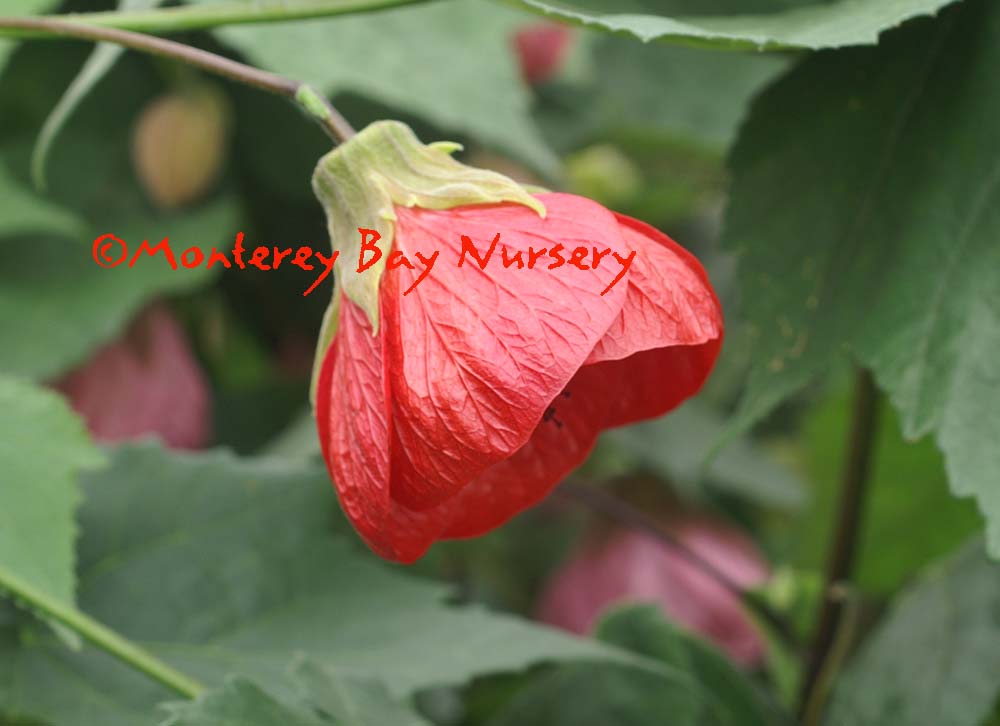
'Ann Red' closeup open bells, in a deep, very shiny red. Moderate size. rev 1/2017
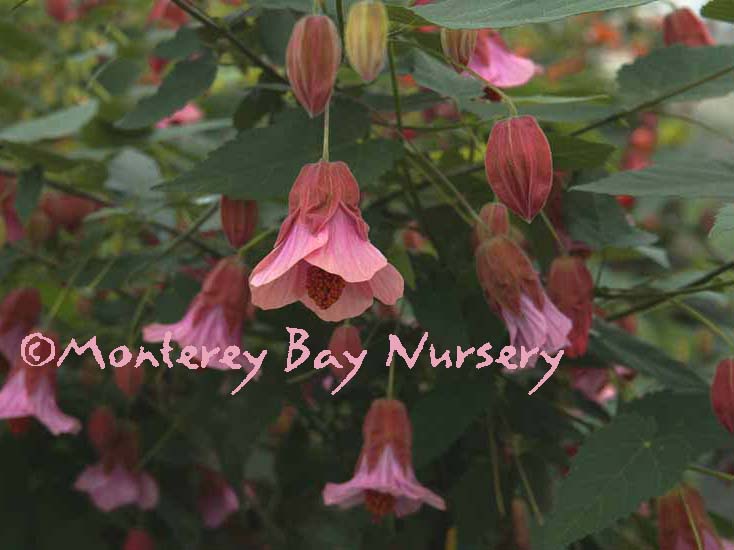
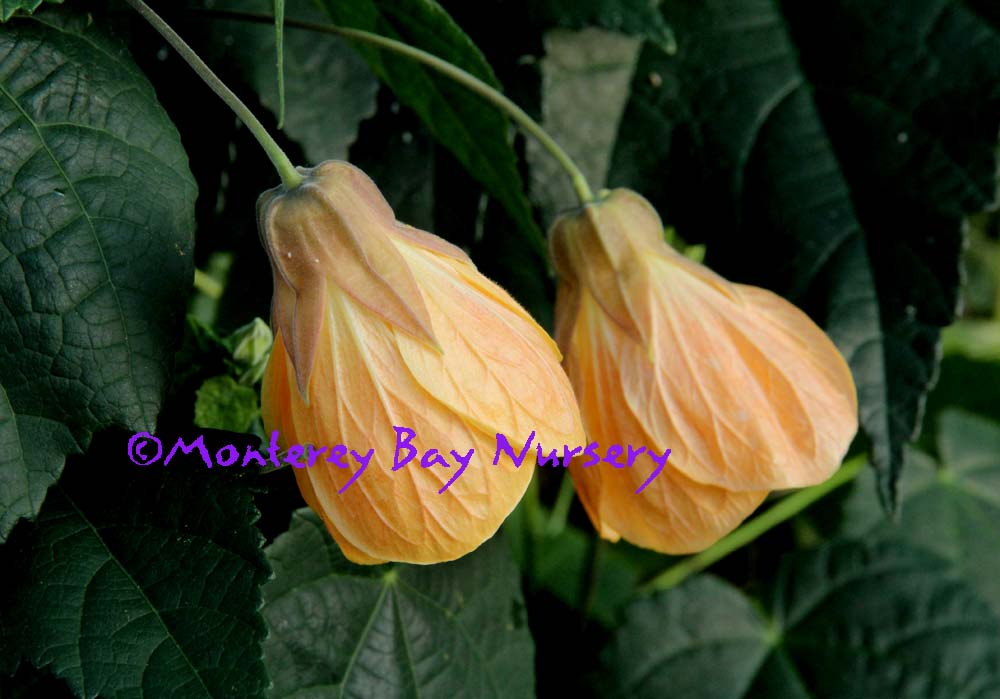
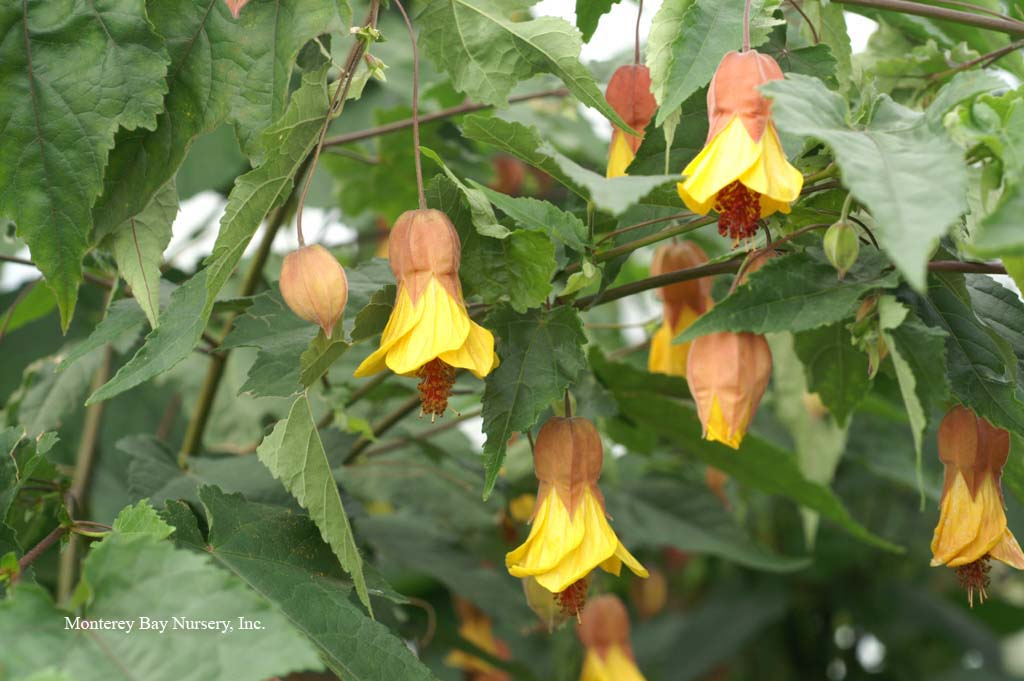
'Apricot' closeup the importance of background mixed garden placement cool weather flared, pendant, soft apricot colored flowers with reddish sepals, the flower petals becoming lighter in full sunlight or aging to dark, "Hawaiian Punch red" in cool weather. A thinner-textured flower, on a plant of moderate vigor, it grows moderately openly to about 3-6' tall and wide. Certainly this has at least some A. megapotamicum in the parentage, from the copious production of its smaller flowers and attractively long, narrow, almost uncut, dark green leaves. rev 1/2017
'Canopus' flowers this was our first seedling do-over, derived from the old, trade-standard white. It lacks the unwanted, impure, pink petal discoloration seen in its parent, which shows up most noticeably on older flowers under strong sunlight. This is also much more resistant to Abutilon Mozaic Virus (produces a mosaic-break "iron deficiency" pattern on the foliage, and reduced vigor) which is completely endemic in the trade, and was the primary reason for doing our seedling reselections in the first place. This medium-sized flower is close to the parent, but is a sharper, brighter and cleaner white. It also boasts higher vigor and flower production but is still just a moderate-sized grower. To about 4-5' tall by 3-4' wide. Perhaps best of all is that young stems, and leaf-reverses at all ages, are felty enough to mostly inhibit feeding by aphids and especially Those Who Shall Not Be Named (for Abutilon, at least!), dreaded whiteflies. Canopus is a -.72 magnitude F0 (yellow-white) spectral-type thermonuclear furnace located in the constellation Carina, about 100 light years from Earth, with an intrinsic luminosity of about 30 times that of the sun. The second brightest star in the sky, after Sirius, it is visible only in the Southern Hemisphere. MBN INTRODUCTION-2008 rev 7/2017
'Capella' flowers small, very profuse, perky medium yellow flowers and fine-textured, medium green leaves with moderately felty undersides (inhibits aphids and whiteflies). Rather upright growing, to about 6-8' unpruned by 4-6' wide, can easily be trained much tall and wider, or kept more compact by pruning. The third brightest apparent star in the Northern sky, after Arcturus and Vega, and the sixth brightest star overall. Capella is actually a double-binary system. The brighter binary pair are both G-type stars (like our sun) but are each substantially larger, 11 and 8 times our sun's diameter. The second pair are both much cooler and smaller, being type M red dwarfs. MBN INTRODUCTION-2008 rev 7/2017
'Cardinal' closeup a glossy red flowers, with large, ornamental, dark green foliage. Compact growth to 3-5' tall and wide. rev 1/2017
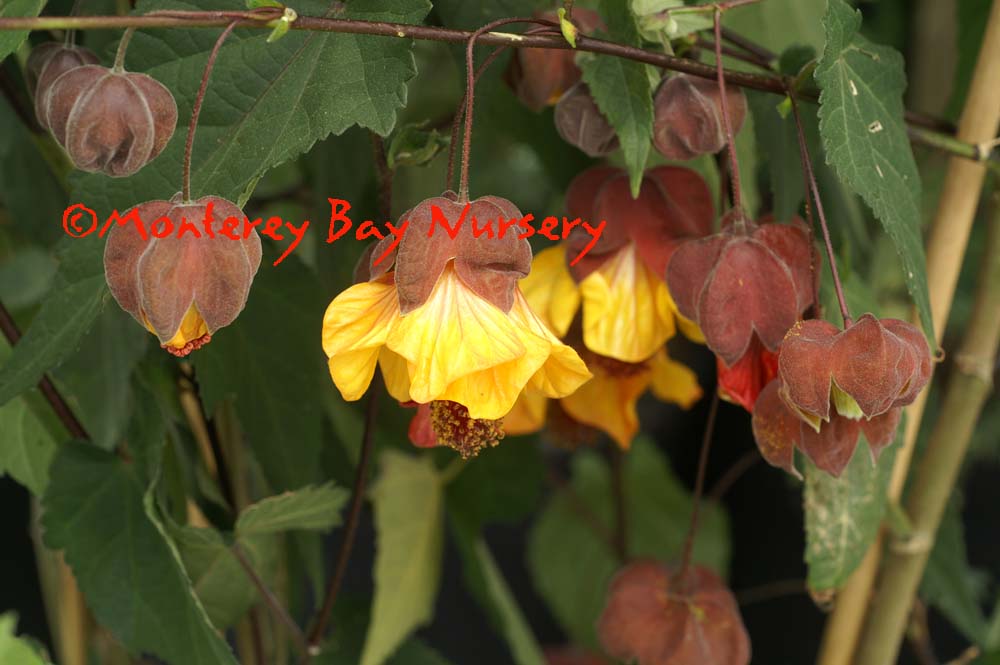
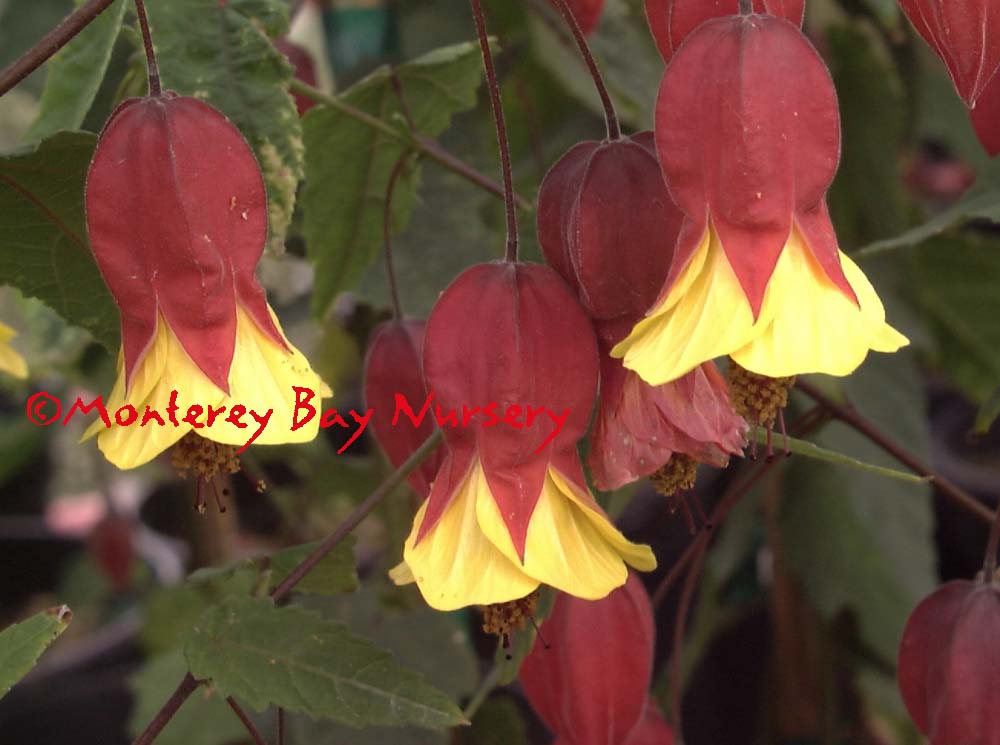
‘Challo’ (A. megapotamicum hybrid) closeup a very attractive and interesting flower shape, in a glowing, deep golden yellow with a rather broad dark maroon eye. Unusual, inflated flowers constrict at the waist, then the petals, which are often pleated and ruffled, flare widely to reveal a long dark style bearing contrasting bright yellow stamens. They buds emerge from round, pleated, sculpted, dark, silky, maroon-colored pods, which remain to become contrasting sepals of the open flowers. Dark, sultry stems make for even more contrast and interest. But hold on, that's not all! Moderate plant size is combined with good vigor, and the heavy flower display creates a great flower/leaf ratio. Now how much would you pay? But wait - there's more! In addition you get fuzzy, bug resistant leaves (!!!) on a plant of somewhat vining, easily trainable habit, to just 4-5' tall. That's right all that delivered in an attractive, weatherproof, waterproof, sunproof growing container already perforated for water drainage. MBN INTRODUCTION-2005 rev 1/2017
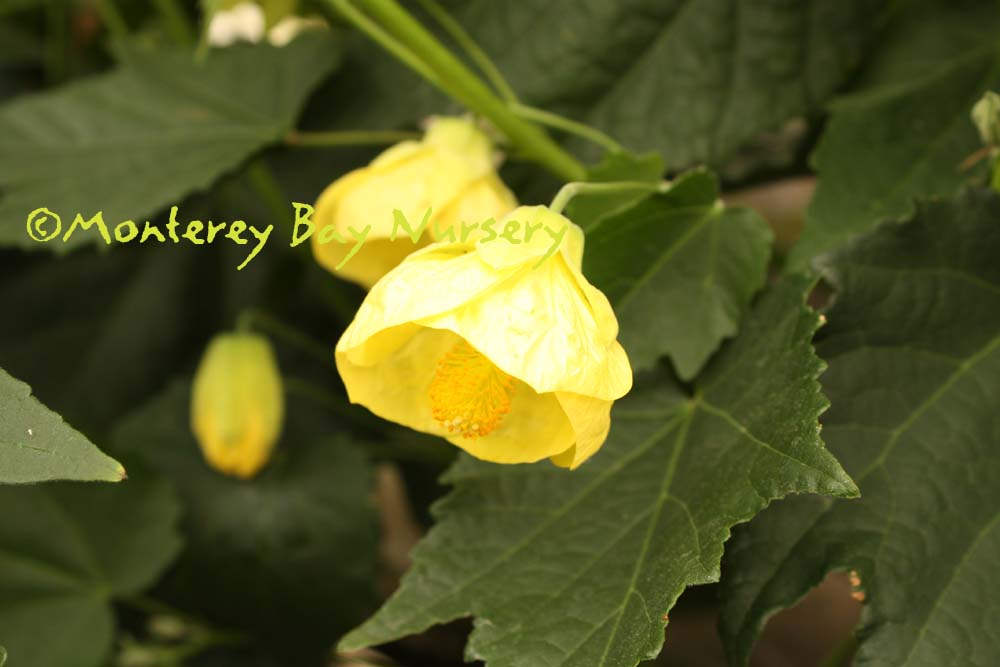
'Chiffon' flowers light lemon chiffon, that is. A fast growing, upright variety to perhaps 6-8' at maturity (unpruned), bearing clear, bright yellow flowers from yellowish bracts. Leaves are very dark green, branches, stems and flower stems are both dark burgundy, and flowers contrast well with all. rev 1/2017 MBN INTRODUCTION-2015
'Coral Earrings' bells a branch sport of our own yellow 'Capella,' with rich, coral pink flowers and medium green leaves, upright and vigorous, to 8' tall. A playground for hummingbirds. To about 6-8' unpruned, by 4-6' wide. rev 1/2017 MBN INTRODUCTION-2010
‘Cristina’ flower a very heavy producer of medium size, glowing, glossy, red orange flowers. The ruffly, fluted, oval petals are highlighted with darker red veins and edged with a fine, light line. The darker, maroon calyx and stems add contrast and interest. A dense, upright, grower to about 4-6' tall, unpruned, forgiving and easy to shape if you do attack it with clippers. This hybrid is largely A. megapotamicum, and the flowers show it, but not the leaves, which are full-sized. rev 6/2018 MBN INTRODUCTION-2004
‘Frieda’ flowers downtown Santa Cruz why I like it so much pendant, partially flared flowers have ruffly, bright to deep yellow petals highlighted with orange veins. Long, deeply cut, maple shaped leaves are dark green with olive and bronze tones and are closely carried on burgundy stems. Robust growth to about 6' tall and wide under the best conditions, taller if trained, and pushed, and in shade. This one really cranks out the flowers, with dense, tiered displays on branches that hang over from the weight of the load. The flower color contrasts nicely with the dark foliage and stems. A five-star hummingbird attractor and overall showy plant. Named for Frieda Dixon, mother of originator Jon Dixon of Half Moon Bay. rev 8/2017
‘Fruit Punch’ flower just about that color, a rich, shiny red with a touch of watermelon, maybe just a shade more orange, and size = large. Upright spreading growth to at least 10', eventually, and without cutting back, and medium size flowers. This variety has the immensely endearing quality of being exceptionally resistant to whiteflies, possibly due to the heavy coating of minute fuzz, especially on the undersides of the 6" leaves. This is a large-textured plant overall. MBN INTRODUCTION-2005 rev 1/2017
‘Harvest Moon’ closeup large, flared, silvery, pastel apricot flowers age to pale melon. A branch sport of ‘Moonchimes,’ our own find. Petals are very round and often doubled, and can flare to almost horizontal on the pendant flowers. Compact, spreading growth to usually under 3' tall and wide, dense and well branched. rev 1/2017 MBN INTRODUCTION-1998
'Hot Pink' flowers clear, hot rose pink flowers, a vigorous upright habit, broad, shallowly lobed, smooth dark green leaves, and burgundy stems. To 6-10' unrestrained, with narrow habit. rev 7/2017 MBN INTRODUCTION-2006
‘Ines’ (A. megapotamicum hybrid) flowers light yellow flowers to 2" across darken to rich yellow with age and display wonderfully against the contrasting dusky maroon red sepals and stamens. Good vigor, typical megapotamicum-hybrid type vining habit with long, dark green leaves and slender, dark stems. Just 3-6' tall unless encouraged higher. This is a very good, showy, high-contrast variety. rev 7/2017 MBN INTRODUCTION-2005
‘Jerry’s Red Wax’ closeup large, heavy textured, dark red flowers reach 3" across and hold their color well in sunlight. A fast, boldly upright grower to at least 6', with gentle and appropriate behavior modification, probably 15' or more unpruned. Leaves are very large, dark green, to 10" long and 8" across. Dramatic for foliage and outline as well as for flowers, and with nice, dark, burgundy stems too! rev 1/2017
'Lil' Lemon' (A. megapotamicum hybrid) flowers light, almost pastel yellow flowers against moderately dark leaves. The petal color darkens to rich yellow with age, and eventually picks up rosy tints before falling. It has narrow but very long, dark green leaves, dark stems, a light, somewhat open texture, and an open, vining habit to 4-6'. And - it's fuzzy! Grow this one for the heavy display of perky little contrasting light flowers against its darker background elements. MBN INTRODUCTION-2005 rev 1/2017
'Lil' Pink' (A. megapotamicum hybrid) closeup habit a lighter textured plant, but fast and pretty vigorous. Rich coral pink flowers age to deeper rose, with darker maroon-rose calyces. Arching, naturally open, semivining growth reaches about 4-5' on its own in a reasonable amount of time, unless trellised and encouraged higher. Provides a heavy flower display. rev 1/2017
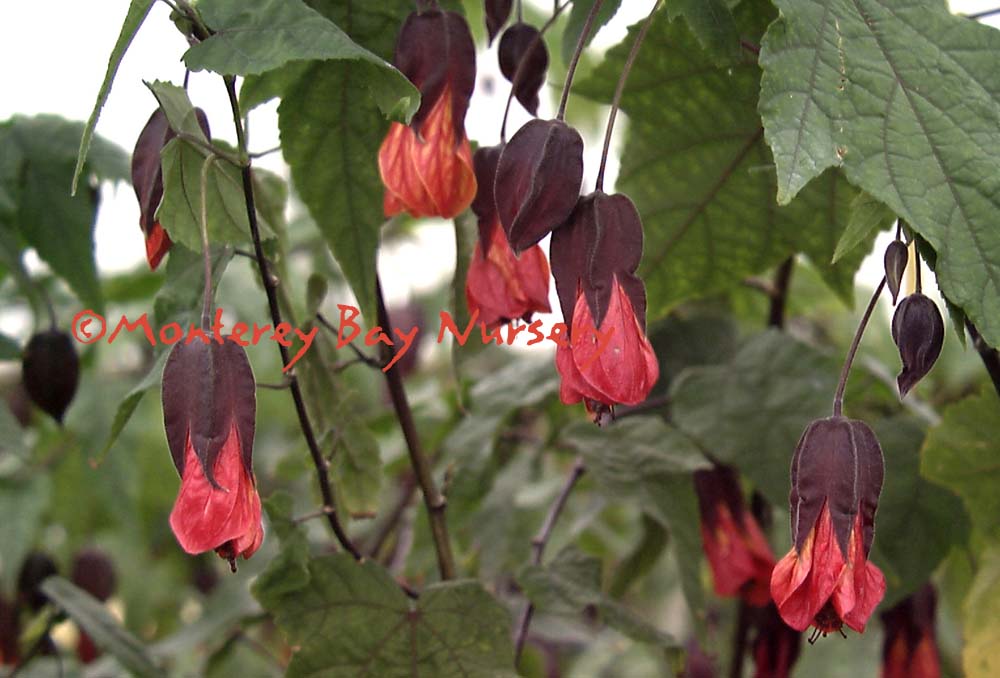
'Lil' Red' (A. megapotamicum) closeup bright, shiny, lacquer orange red flowers with darker red veins open from quite ornamental, dark, velvety, almost black, pod-like flower buds. The plant will grow up to 10’ if supported, with an open, semivining habit and long internodes. As a freestanding shrub expect it to arch over beyond 4-5'. Leaves are medium to light green with nice dark maroon veins. Reported to survive well as a deciduous shrub in Portland, Oregon, and to have survived frosts below 15°F without damage to stems. If you are going to experiment with Abutilons in colder climates, start here with this, the pure megapotamicums and their hybrids. rev 10/2019
'Mango Cheesecake' flowers light gold flowers with petals shaded orange, from light orange to burgundy sepals. Leaves are very dark green and form a good background for the lighter color. A medium-height grower, to perhaps 3-5' unpruned. Sun to part shade, expect frost damage below about 25F, ultimate hardiness unknown. rev 1/2017 MBN INTRODUCTION-2015
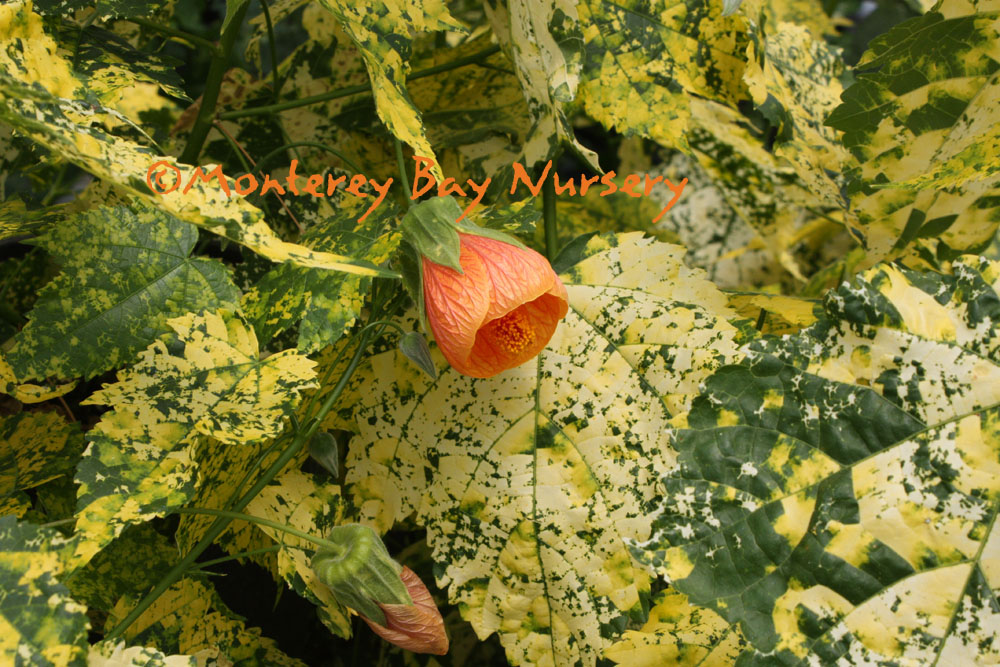
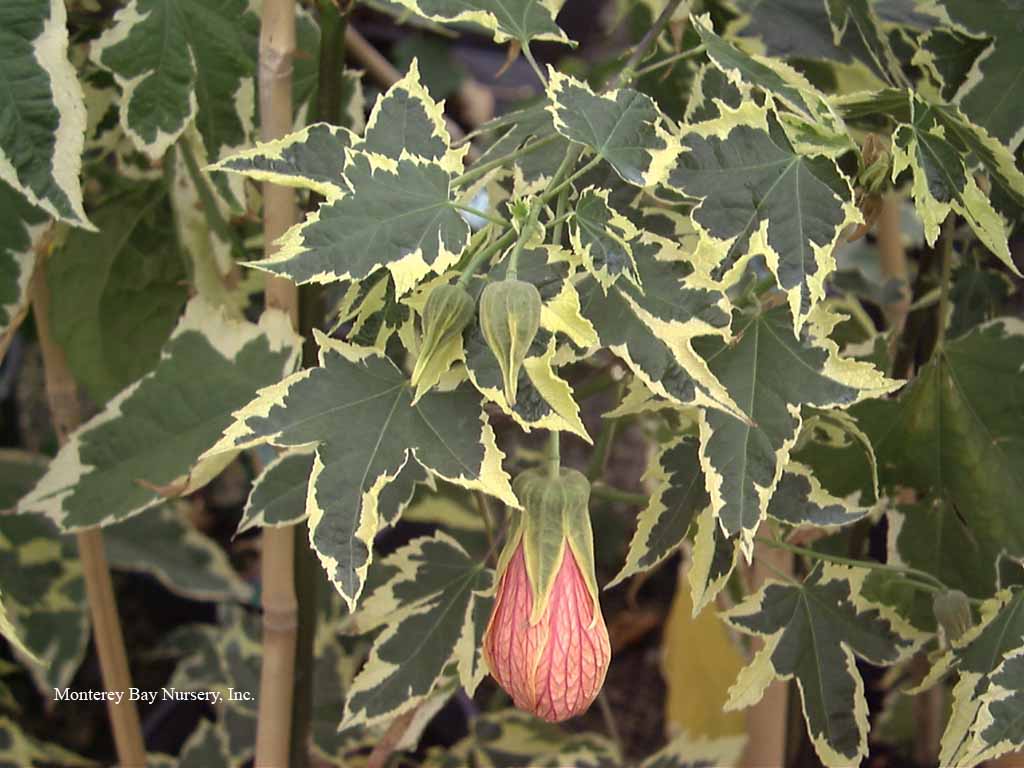
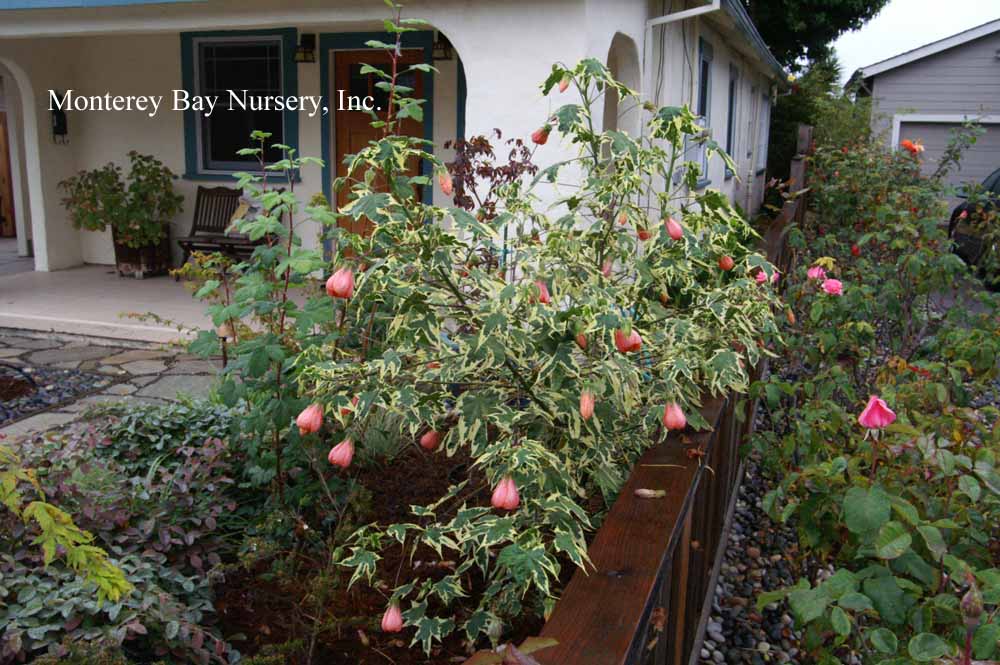
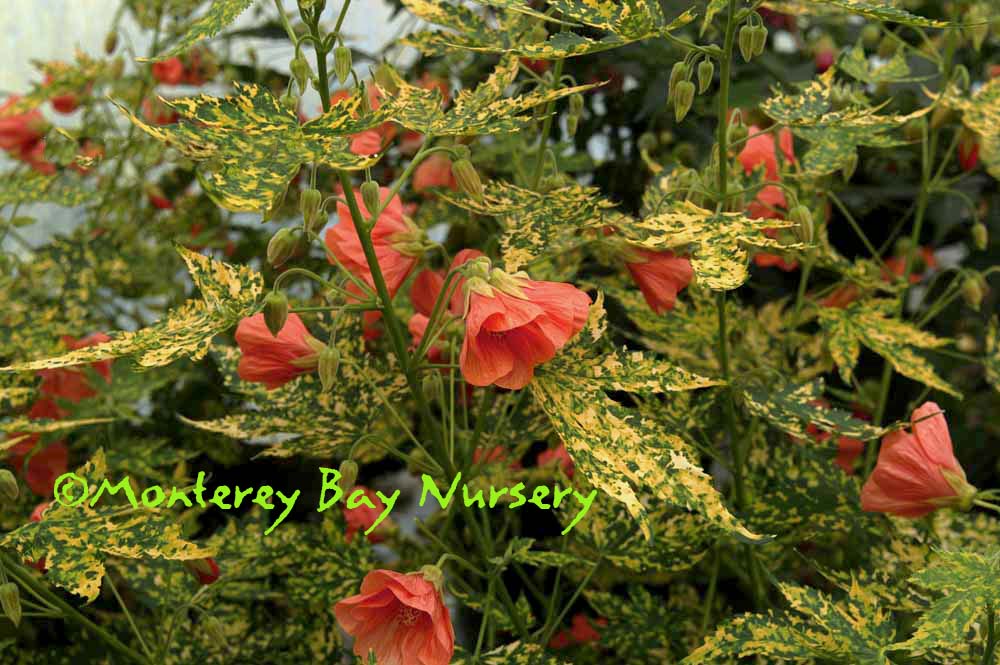
'Mardi Gras' (A. pictum) flowers and foliage a very vigorous form, with large leaves splashed boldly with gold, and much more humble, narrow, light orange flowers, but well produced. To 10' by 10' when happy, or easily kept smaller with pruning. Dramatic, large scale. Also known as A. pictum 'Aureomaculatum.' rev 1/2017
'Maui Punch' flowers more punch than even 'Hawaiian Punch.' Not just pink, not just orange, but pink and orange all at the same time! It's incredible! The flowers can be held almost horizontally, flower stems tend towards a nicely contrasting maroon, and the large leaves are very dark green. This more vigorous growing variety will probably easily get 6-8' unpruned. A branch sport off our own 'Watermelon Candy.' MBN INTRODUCTION-2011 rev 1/2017
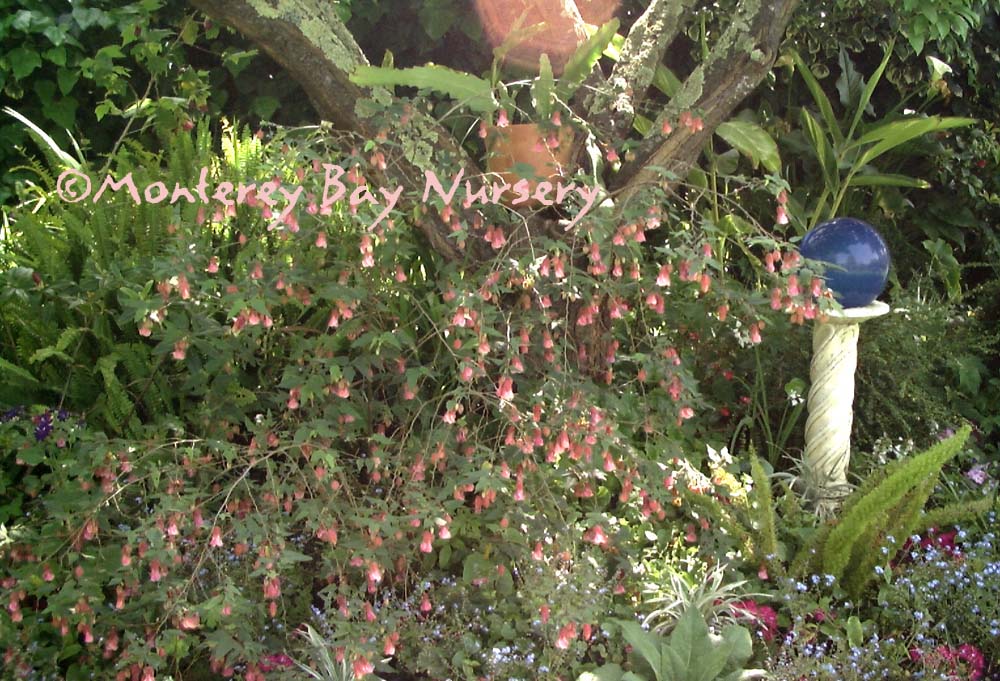
megapotamicum hybrids here, redundantly, are those on our list which are either straight selections of A. megapotamicum or its hybrids that lean mostly in its direction. Their characteristics include small, dark, narrow leaves, dark, relatively weak, wiry, arching stems, small, very pendant flowers and horizontal to loose, scandent, climbing growth habits. These are the ones most easily trained to trellises or used as vines against pillars, fences etc. rev 10/2020
'Mobile Cream' closeup a seedling from a cross involving 'Mobile Pink' on one side, it resembles that variety, with pendant flowers flaring open widely. The flowers are creamy white against light, ruddy, maroon sepals. Moderately dark leaves have maroon veins and are held on very dark stems. An upright grower but still probably not getting taller than 3' without training. Leaves are felty beneath, hooray! rev 1/2017 MBN INTRODUCTION-2005
‘Mobile Pink’ closeup a lower, more spreading grower to 4’ or less. Flowers are an attractive light salmon pink, with reddish sepals. Flowers are held pendantly and petals flare widely to horizontal. A compact and extremely showy selection with slightly greyer, felty foliage that is noticeably less plagued by all pests, including snails and slugs. This is a five-star variety. Its only drawback is its heavy seed capsule production, but even those are interesting. To 5-6'. rev 1/2017
‘Moonbeam’ flower a big, fast grower with small, dainty, pale lemon yellow flowers appearing on this upright variety of intermediate texture. It is narrow in habit, somewhat open, to 6-10' tall by 6-7' wide, and leaves are a lighter green. This plant brings a tall, yellow green presence to the garden. rev 1/2017 MBN INTRODUCTION-2005
‘Moonchimes’ closeup habit a very compact variety to probably only 2' tall and wide. Bears a heavy show of light, clear pastel yellow flowers. A dense grower and vigorous, continuous bloomer. One of the best for containers. rev 1/2017
‘Nabob’ closeup large, very dark maroon red flowers. A fast, vigorous, robust shrub, growing 8-10', with large, very dark green leaves and a strong central leader. rev 1/2017
‘Neon Rose’ flowers a hybrid between two of our pinks, this is a large, fast upright grower, probably to about 8-10' unrestrained but easily kept much smaller. The leaves are moderately large, slightly cut, and have enough fuzz under the leaves to be a bug-resistant type. Pendant, bell shaped, hot neon pink flowers are partially flared and feature a dark violet eye and dark red stamens, sepals are a contrasting bright yellow green. rev 1/2017 MBN INTRODUCTION-2005
‘Orange Hot Lava’ (A. megapotamicum hybrid) closeup another hybrid seedling involving A. megapotamicum ‘Red,’ with small, sometimes fluted orange flowers that flare slightly, and a very conspicuous outer network of very fine red veins. Sepals are a complimentary light maroon. Long, heart shaped, very dark green leaves have a pronounced drip tip, young stems and leaf undersides are felty, which helps keep aphids and whiteflies from attaching. A nice bushy grower to about 4-5', semivining, and a heavy bloomer, with a high flower/leaf ration. The dark stems add to the total, hypnotizing effect. One of our very most popular varieties. rev 1/2017 MBN INTRODUCTION-2005
‘Pablo’s Tangelo’ (A. megapotamicum hybrid) closeup found by Pablo Perez, our Abutilon specialist-grower at the time, this selection produces clouds of perky little light clear orange flowers with petals flushed deeper towards the base, rounded in shape and flaring out widely open with age. Each flower is held well away from the plant at a semipendant angle on thin, wiry peduncles to 6" long - clouds of blossoms seem to be floating in midair. Sepals are light reddish-tan, and it has nice, dark, heart shaped to moderately lobed leaves and blackish stems. Grows as a vigorous, well-branched, semivining to freestanding plant to 4-7'. This is one of the fuzzy-leaf types that whiteflies don't much like. rev 1/2017 MBN INTRODUCTION-2002
‘Paisley’ (A. megapotamicum hybrid) flowers a highly variegated form, with small, narrow, pointed leaves irregularly splashed and flecked with bright yellow. Small, round, very ornamental ,dark coral red buds open to light apricot yellow flowers, pinched at the waist, which then fade to deep coral peach with age. Sepals are dark, rich coral red, the peduncle (flower-stem) is extremely thin and wiry and disappears against the foliage, for that "floating in midair" look. Grows rather vigorously with a vining, open, upright habit, to about 3-5' on its own but scrambling airily higher if it can find support. rev 1/2017
‘Pink Parasol’ closeup color in sun rich, plum-rose colored petals flare widely, the large flowers can be over 3" across. Plant is vigorous, chunky and upright, with a strong leader and compact dark green foliage. Height should be 3-5' without modification by a human with clippers, ultimately more of course. Flowers are held well out from the stem and face slightly upright from horizontal, displaying the showy orange stamens within. Petals are rounded, ruffled, and often doubled. Young stems and leaf undersides are moderately fuzzy, for superior whitefly and aphid resistance. rev 7/2017
'Procyon' flowers flowers emerge almost pastel yellow but age to almost pure white. Another superior white seedling generated in our constant search for the perfect white Abutilon. About 4-5'. This is one of the "dog stars," higher in the sky and further west than Sirius, in Canis Minor. This is classified as a yellow-white spectral object (F5), it is about 11 light years from earth and is about 1.4 times as massive as our sun. MBN INTRODUCTION-2008 rev 1/2017
‘Rosalie’ closeup a big, fast, well branched plant to 6-10' unrestrained, with moderate vigor, very dark stems, and large dark green leaves. Medium to large, clear pink flowers have a somewhat lavender tint, darker veins and are more less globe shaped. Sepals are tinted pink, tender young stems and youn leaf reverses have a moderately fuzzy surface, for improved whitefly and aphid resistance. One of the most vigorous pinks. rev 7/2017
'Sangria' flower & classy dark stem with foliage medium size flowers flare to bell-shaped, coral with prominent bright red veins and darkish sepals. A found seedling, looks like it could be 'Tiger Eye' x 'Lil Red' (A. megapotamicum type) or some similar cross judging by its flower color pattern, stem color, semivining habit and longer, denser leaves. rev 5/2020 MBN INTRODUCTION-2020
‘Savitzii’ foliage detail at Kelly's Bakery rare, humble flowers a small, dense to vining shrub to 3-5’ tall, more with any support. Unusual foliage is creamy white with a splash of green in the center. One of the true mysteries of the plant world is how this plant manages to grow as vigorously as it does with almost no green foliage. Proportionally smaller pendant flowers are narrow and bright orange but rarely seen. Easy to use in almost any foliage planting, container or otherwise. rev 10/2011
‘Souvenir de Bonn’ flowers & foliage humble garden specimen actually 'Souvenir de Jeff,' since he reselected for the more stable, more broadly-margined variegation patterned strain we now grow. The large dark green leaves are boldly edged with ivory. Humble flowers are light coral orange with light red veins and a magenta blush, and are very narrow, barely opening. They stand well away from the foliage on long peduncles. Even the sepals are variegated, with a narrow, yellowish margin to each long, pointed segment. A fast, open grower to at least 10’ or more if not cut back, but can be maintained much lower with minimal pruning. A striking focal point specimen, good in full sun, at least along the coast. rev 10/2011
‘Strybing Red’ closeup a smaller, shrubby variety obtained from Strybing Arboretum, this variety bears medium size flowers of a bright, intense, shiny red, heavily produced. The interesting thing about this variety is that it has double the usual number of flowers per leaf node, four as opposed to two. Leaves are dark green with a hint of olive, have a felty texture, especially underneath where it counts most and are therefore highly bug resistant!!! (!!!) Stems are dark and add class. Moderate vigor means it is easily contained and easy to deal with in the garden. Fills in very nicely and needs little shaping, reaches 4-7'. A nice grower, this is also a high flower/leaf ratio variety. Still one of my very favorites. rev 5/2020
‘Sunset’ (A. megapotamicum) closeup nice garden plant with A. 'Lil' 'Red,' side garden another closeup a nice repeating combination of red and yellow. This looks like nothing more than the old “species” form of A. megapotamicum that was in the trade for years. In case we are wrong though, we will still use this name. The pendant flowers are held on long, wiry peduncles. Bright red sepals clasp narrow, tubular, flowers with constricted waist. The petals are a brilliant deep yellow, aging to apricot before falling. The central column is red with numerous yellow stamens. It can extend out of the petals about 1/2", for an overall flower length of about 1 1/2". Growth is light-textured, upright to spreading and scandent in habit, to 6-10'. This variety is excellent as a staked, trellised, or hanging basket subject. rev 10/2011
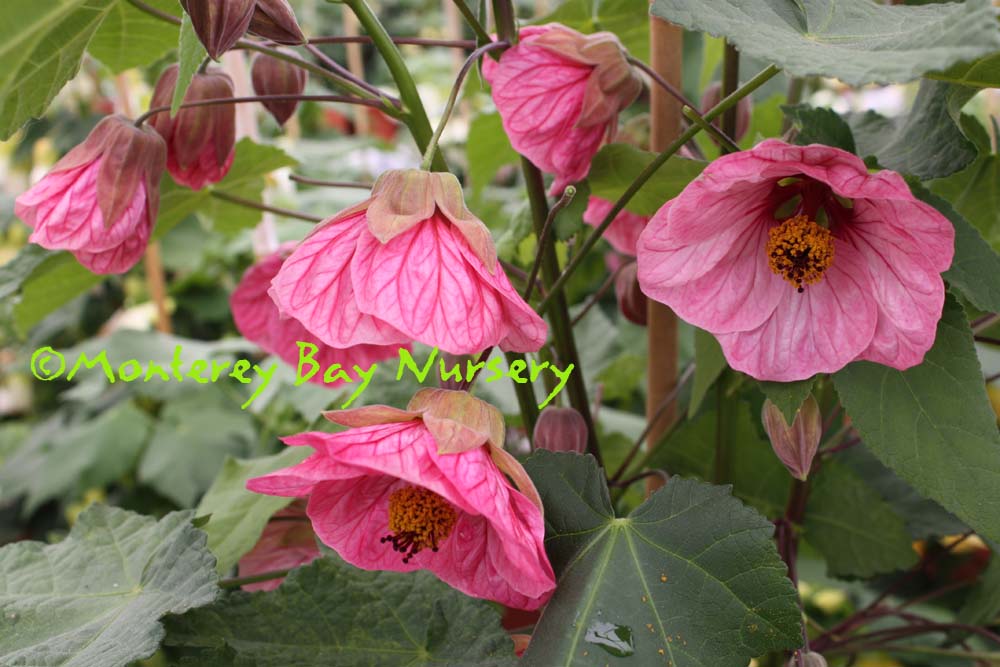
'Talini's Pink' flowers a moderately fast, upright grower, with strong, clear pink flowers, fading to white in the centers and with a big cluster of showy yellow stamens. Flower stems are robust and display the new flowers almost horizontally at first, then they droop gracefully as they mature. Sepals are light chartreuse, big, soft leaves are almost oval with maple-like leaflets. A seedling found and grown at Talini's Nursery. rev 1/2017 MBN INTRODUCTION-2008
‘Tangerine’ flowers glossy, clear orange flowers, with noticeable yellow stamens, contrast nicely with stark, bright lime yellow sepals and broad, smooth, glossy light green leaves to 6". A good branching habit on a large, upright, vigorous, rather open plant to probably 6-8' if not cut back once in a while. rev 10/2011 MBN INTRODUCTION-2004
'Tiger Eye' flower wild red veins with golden yellow petal color in between. Red stamens, green calyx, large flowers, large, boldly cut shiny green leaves, strong, rather vertical habit to 6-8'. A winner! rev 10/2011
‘Thompsonii’ (A. pictum) closeup of flowers & foliage habit a shorter, narrower grower, to perhaps 3-4’ tall by 2-3’ wide, with yellow speckled foliage and light orange flowers. Good vigor but a much smaller grower than most varieties. rev 10/2011
'Tropic Rose' flower large, luminous, rich, glowing rose pink, large, smooth, dark green leaves. Good flower production, plant fills out nicely with new side branches breaking from buds along the main trunk. To 6-7' MBN INTRODUCTION-2009 rev 7/2017
'Twister' (A. megapotamicum hybrid) closeup nice pod buds this hybrid is mostly megapotamicum, and a very heavy bloomer with small, glossy, dark orange red flowers with even darker red veins. The pendant flowers are sometimes partially flared, with petals that often twist around on one edge to reveal the brighter interior color, and hence the name. But others open almost completely flat so that their petals are widely horizontal. A fast, vining grower with thin, scanent stems and long, dark green leaves, easly reaching to 4-7' and stretching longer if it has something to lay upon. rev 8/2017 MBN INTRODUCTION-2005 (not currently in production)
'Victor Reiter' flowers a very large, very wide, very open tangerine-orange flower, with a lighter center and light yellow green calyces. Flowers reach over 2" across. Vertical habit but compact, and heavy blooming. To about 4-6' tall, 3-4' wide. rev 8/2017
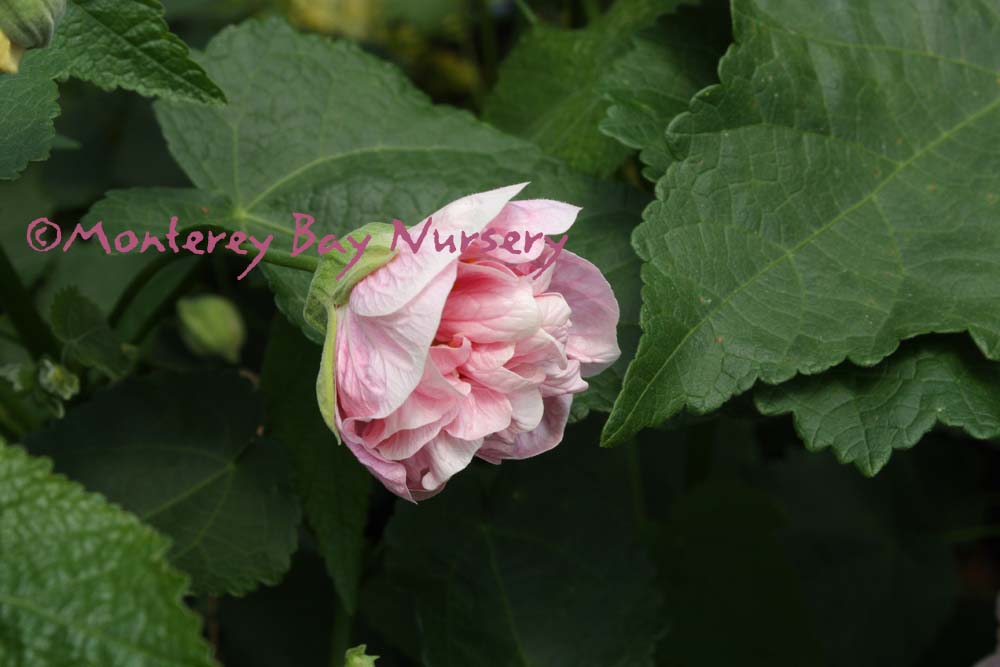
'Victorian Lady' flower fully double, light pink flowers. Lighter bloom production, larger, more open habit to 6-10'. rev 10/2011
‘Victory’ (A. megapotamicum) closeup essentially horizontal growth, with small, narrow, partially cut, dark green leaves closely set along dark branches. Small, narrow-waisted flowers are deep golden yellow, emerging from pale orange red sepals. Even the dark red columns in the center of the flower are showy and provide even more contrast. This is another variety noteworthy for considerable bloom vigor, and is best featured with some kind of support. It looks good against a fence or along a trellis and is especially exceptional in containers or hanging baskets, situated so you can look into the flowers from below. Despite its natural strongly horizontal habit, this makes an excellent small upright shrub if staked and just an outstanding standard (tree form) but only with firm discipline. A real favorite of hummingbirds. rev 3/2018
'Watermelon Candy' flowers a vigorous upright grower of small texture and compact habit, with oval dark green leaves and very dark stems. The slightly flared flowers are a dark watermelon pink, have dark sepals, and are very heavily produced all along the branches. This variety has a high flower/leaf value. To 4-6'. MBN INTRODUCTION-2005 rev 10/2011
Acacia WATTLES, ACACIAS trees, shrubs and groundcovers, mostly found in drier areas but with some wet tropical and subtropical forms as well. Species are found most numerously in Australia but also Madagascar, Africa, various Pacific Islands, and North and South America. Revisions and regroupings of this genus have variously been proposed but are currently mostly not followed. And they're confusing, so we don't use them either - yet. Leguminosae/Mimosaceae. rev 6/2018
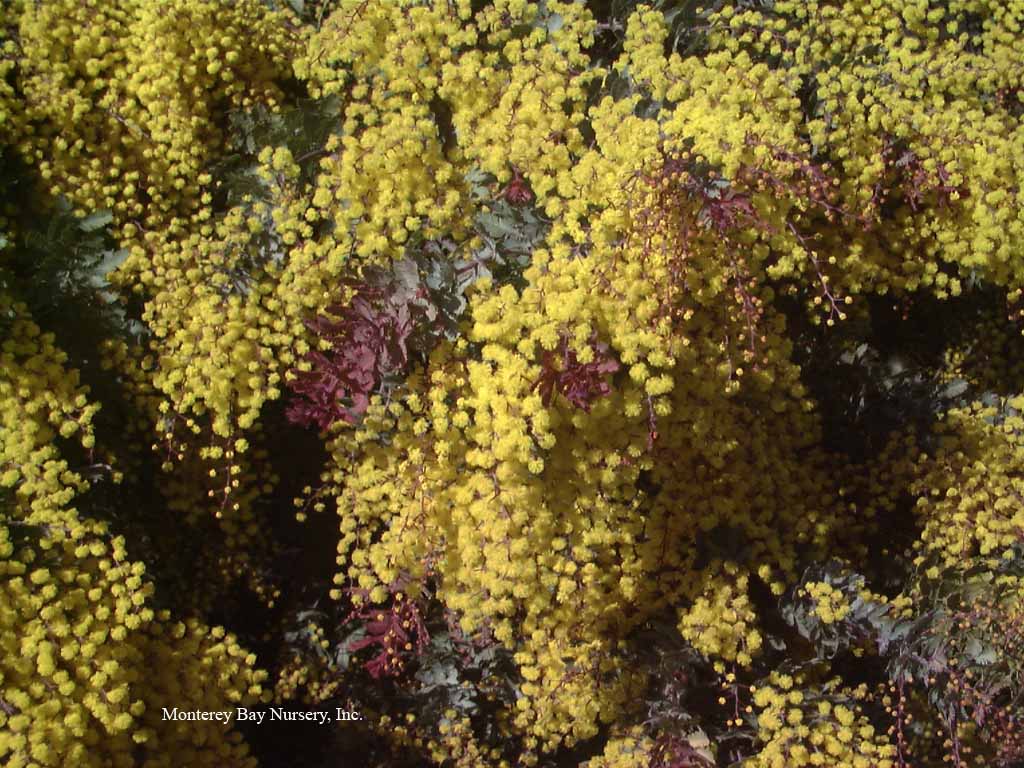
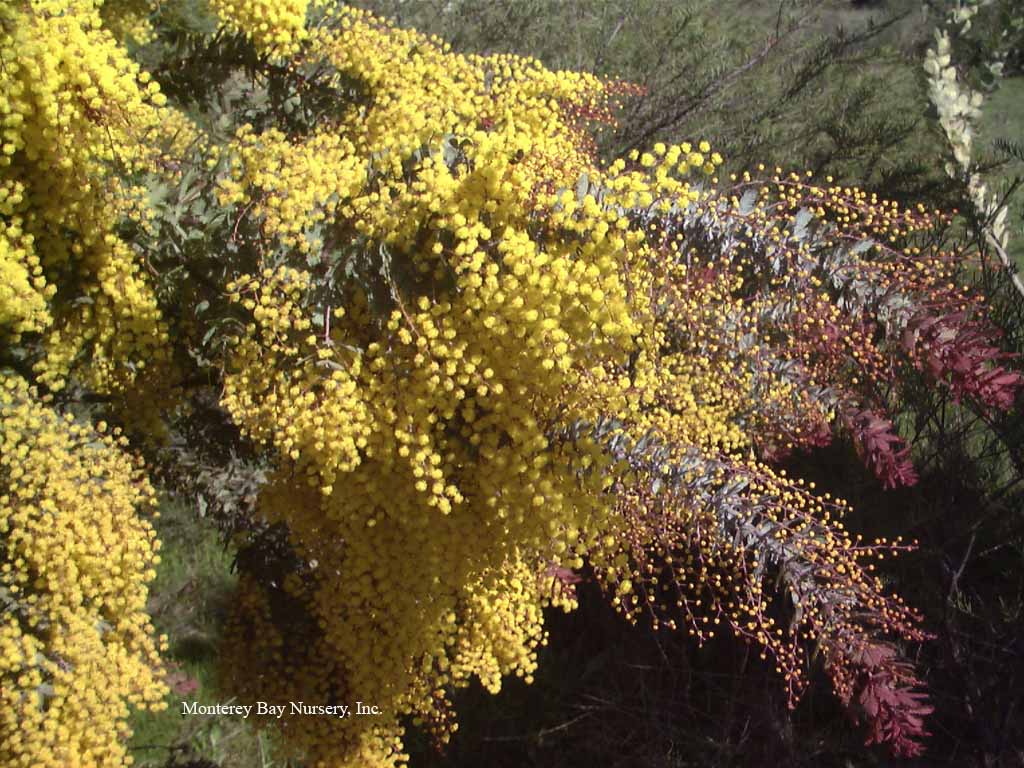
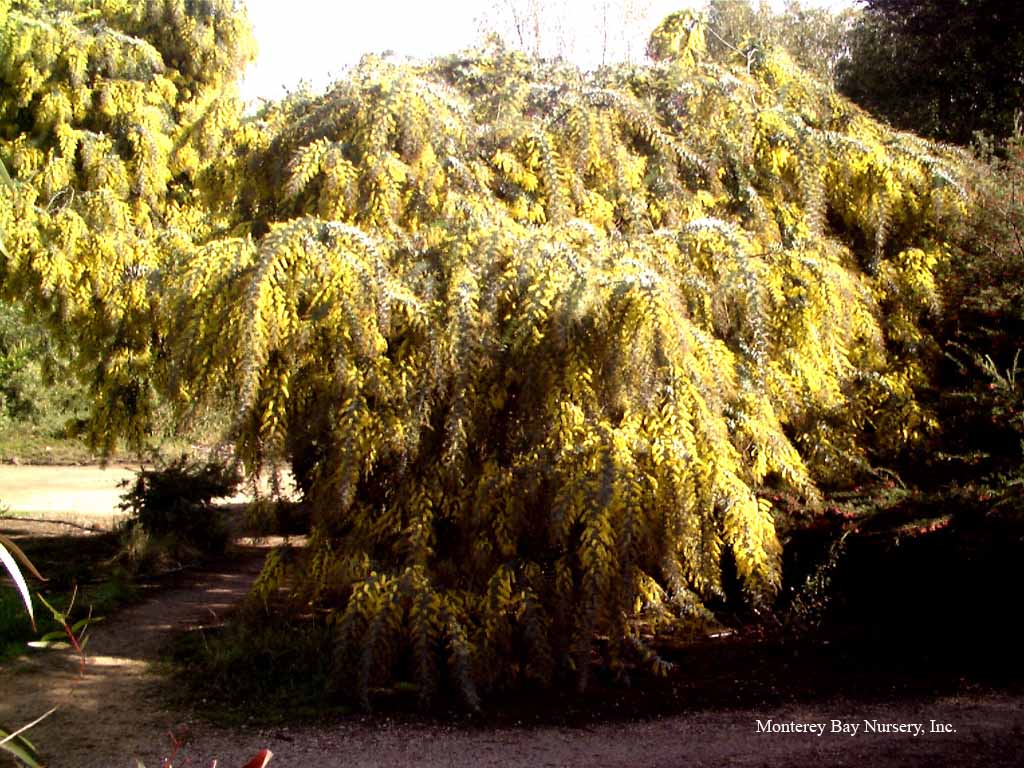
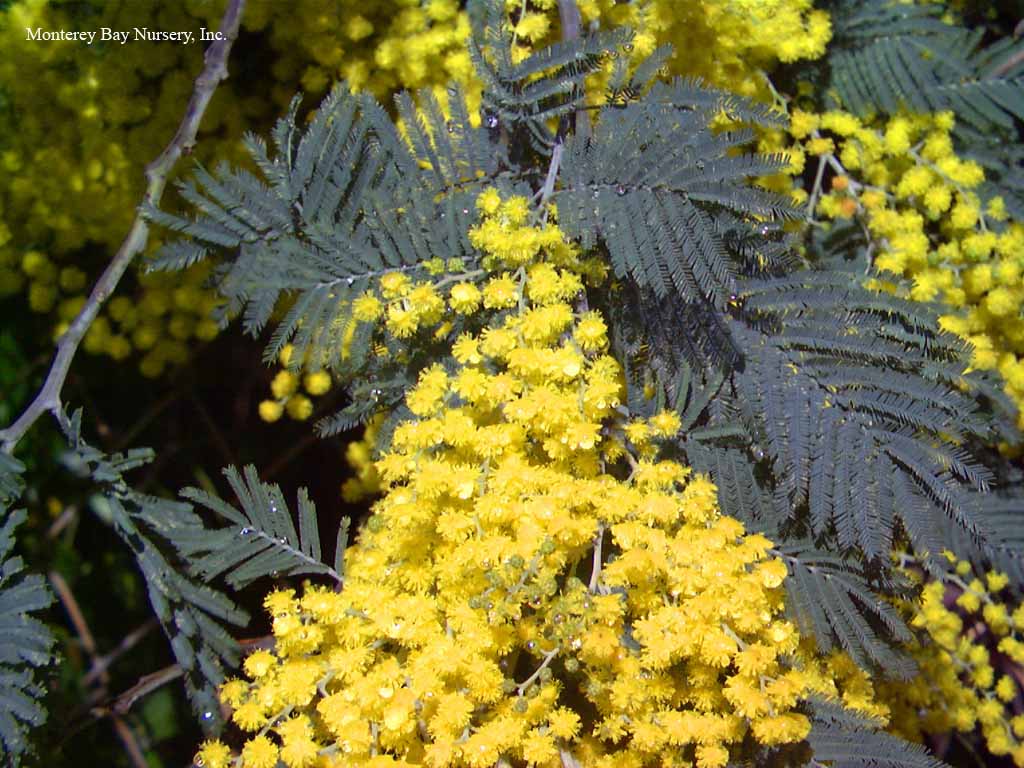
baileyana purpurea COOTAMUNDRA WATTLE (only in Ozzie Land, no one calls it that here in California) closeup another closeup habit one of the showiest acacias for California gardens. Usually grows to 15’ tall, with a compact, dense habit, and is one of the first plants to flower, blooming heavily in late winter. Soft textured leaves are blue grey, this seed strain displays variable purple red on the new growth. Very drought tolerant, hardy to around 15°F with damage. Southeastern Australia. Leguminosae/Fabaceae. This species will almost never reseed itself except on the very sandiest soils in cool coastal areas with mild, wet winters. rev 4/202
The real Acacia baileyana should not be confused with the properly hated, larger weedy types which can be found running wild in canyons along the Central California coast (closeup). Those plants have been placed variously into A. mearnsii, A. decurrens mollis or A. dealbata. In fact, if you watch separate stands carefully, you will usually notice that some individuals or groves actually flowering at quite different times of the year. What we think of as “that weedy acacia” can refer to a group of very similar species. Due to the lack of feeding insects and animals, lack of diseases, and considerably higher soil fertility levels here, many distinguishing growth characteristics are different compared to when grown in Australia and accurate separation of these species using standard references will be difficult. rev 5/2020
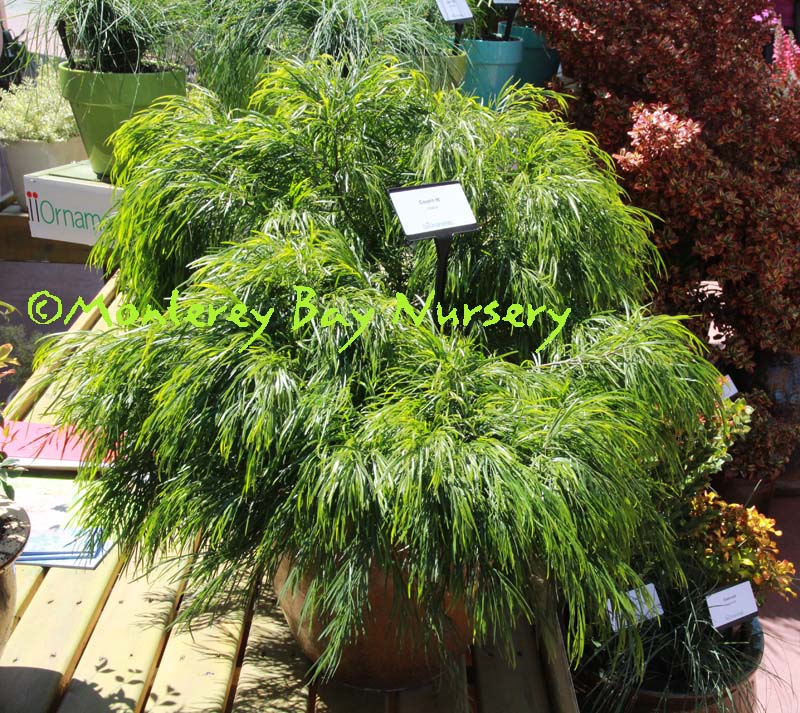
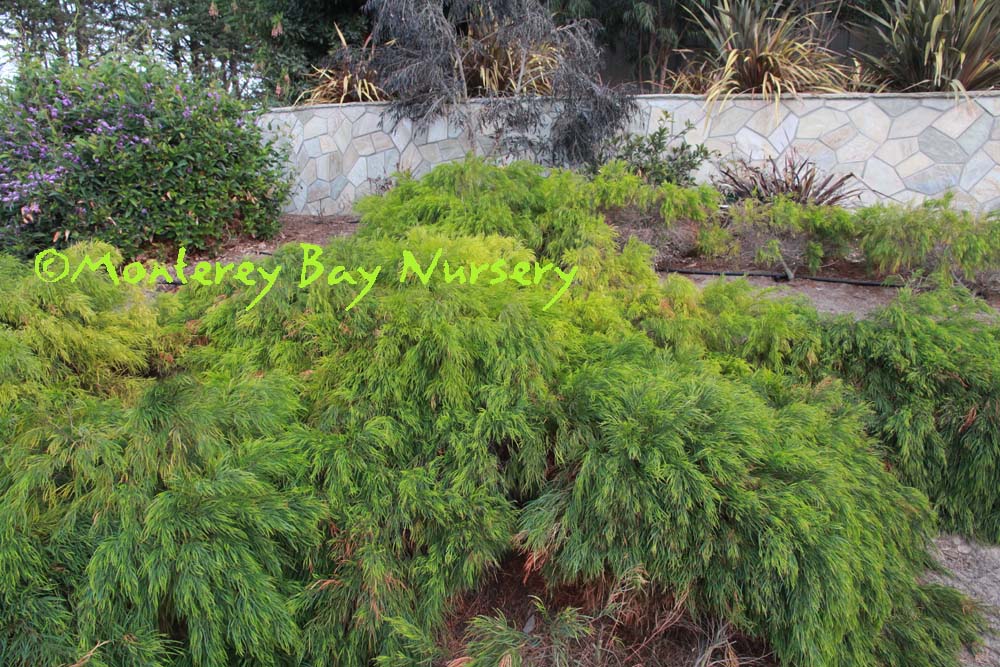
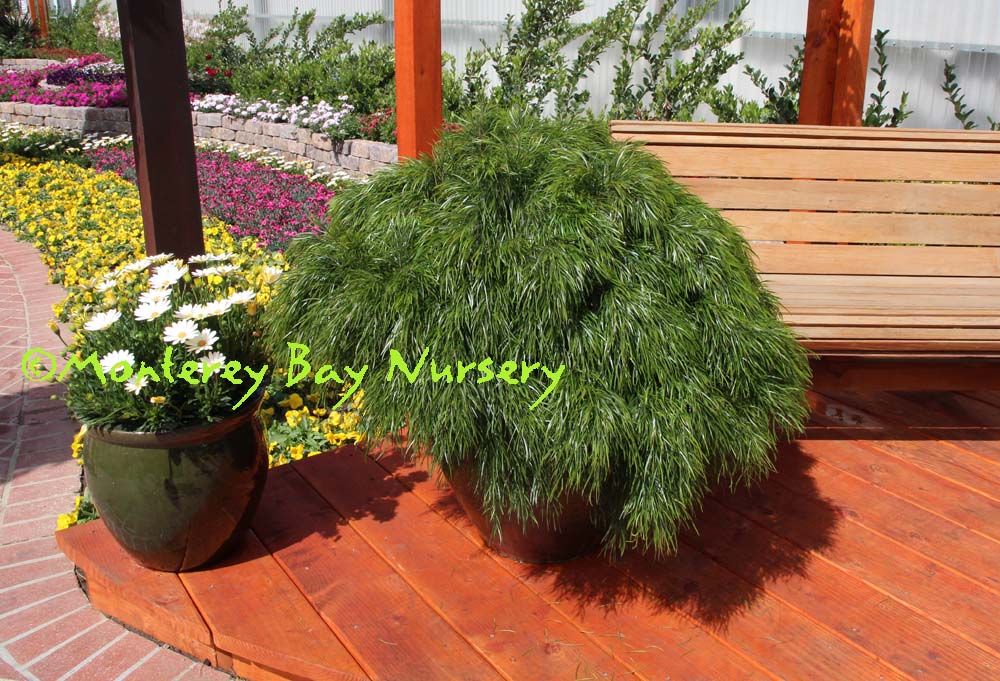
cognata 'Cousin Itt' PPAF shiny, lush foliage rare flowers established landscape plant at Ball Tagawa focal point container a very compact seedling selection of what is normally a small Australian evergreen Australian tree, this only seems to reach about 30" tall. It is probably at its best as a container subject, but it can also be used as a (short) focal point in a small scale landscape if pruned back occasionally. It can also become a low, large scale groundcover, but it is slow to spread and will need at least moderate watering, even under cool condtions. The shiny dark green foliage is best with pruning to keep it renewed, as fully mature foliage is less lustrous. Flowers probably won't be seen on this variety, but they are small yellow balls held in pairs at the leaf nodes. This will yellow quickly in soils with high pH, so a dose of sulfur around the edge of the hole on planting will help with that in almost all California soils. Also known in Australia as 'Mini Cog.' Sun to more than half shade, average watering in containers but less so in the ground, light feeding and only with fertilizers low or lacking in phosphate. Frost hardy to around 25F, when it starts to lose branches, but it likely will survive at least 5F more cold. Syn. A. subporosa. Sunset zones 8-9, 15-24/USDA zone 8. rev 6/2018
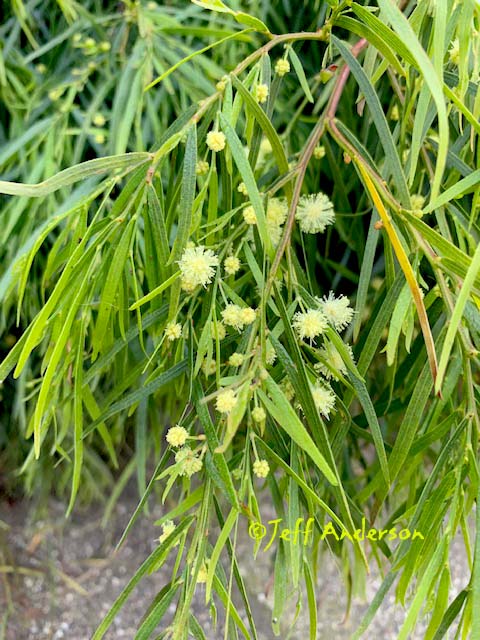
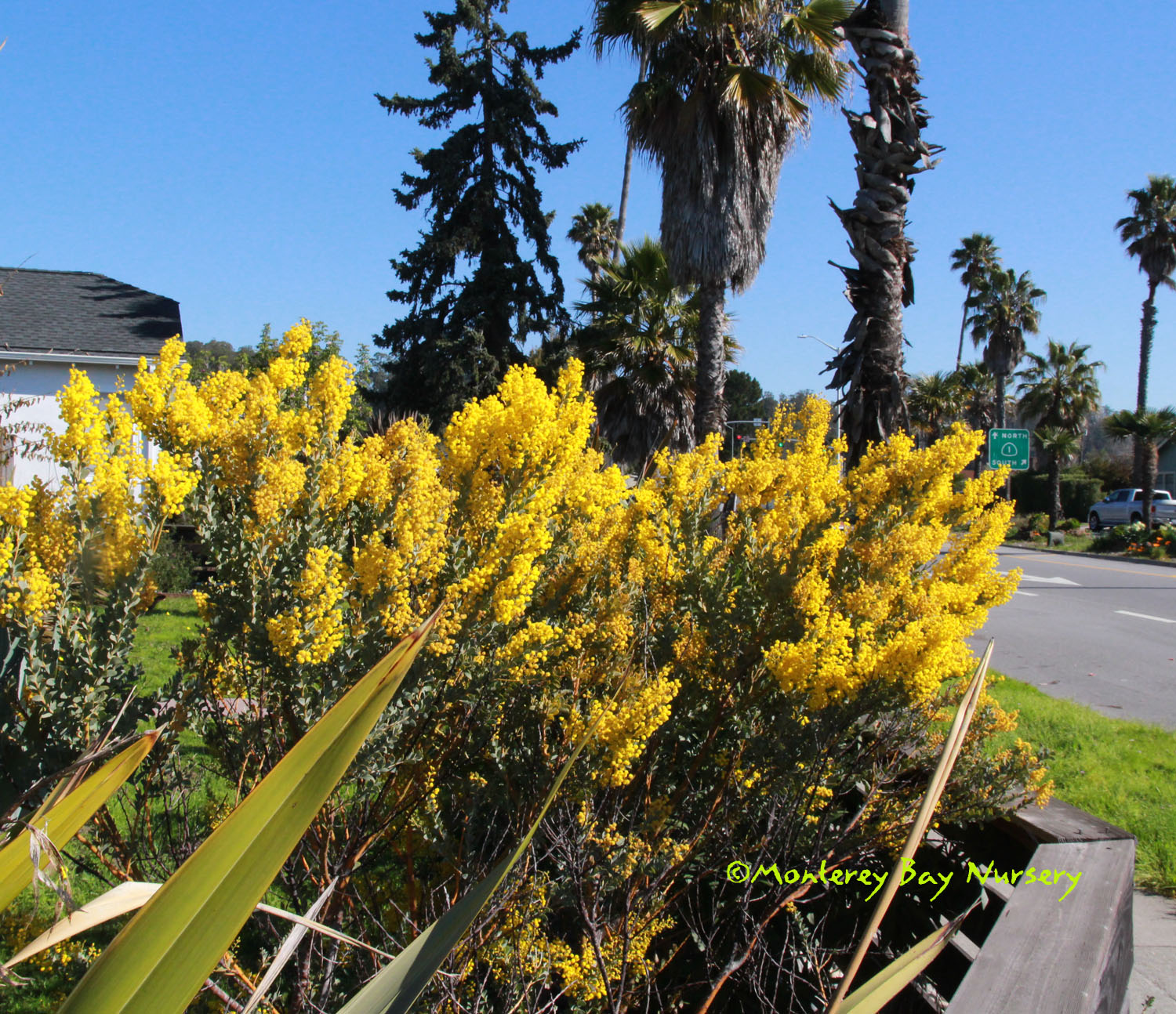
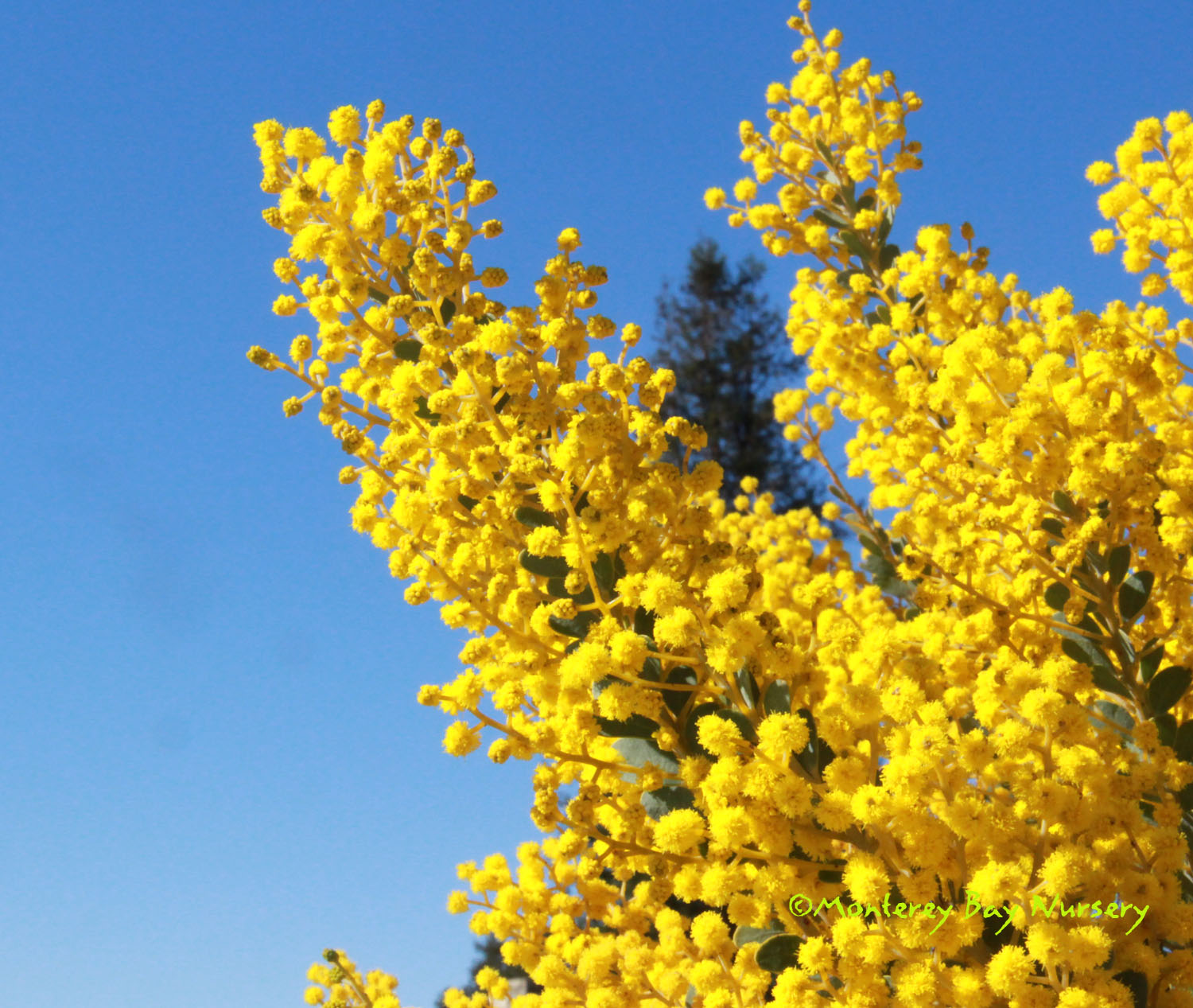
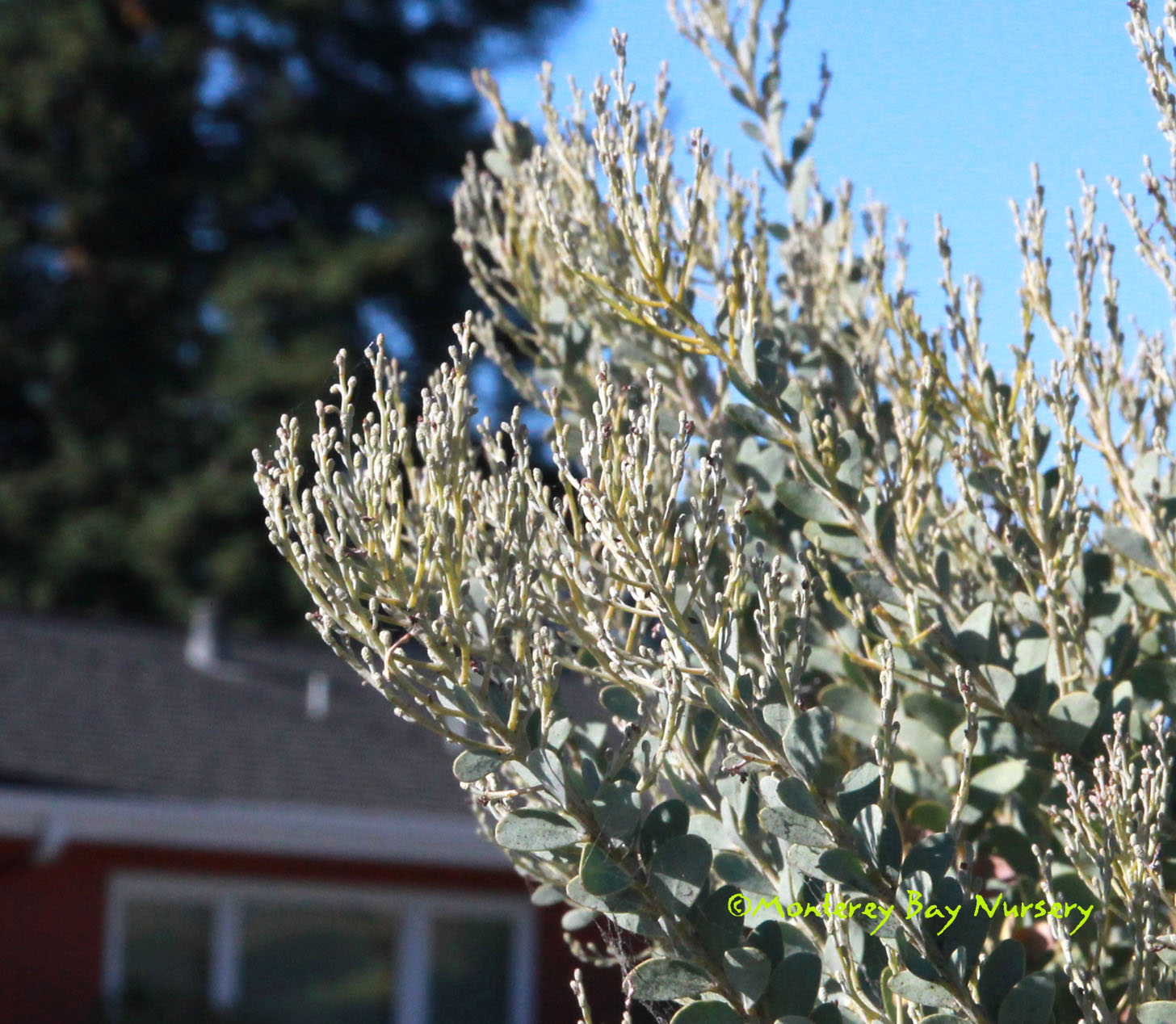
cultriformis KNIFE-LEAF WATTLE 4', Morrissey Blvd. and Chilverton spectacular flowers mature leaves and silvery flower spikes an upright to spreading shrub to 4-12', depending on the seedling, with close, almost clasping blue grey to grey green phyllodes and profuse, terminal and subterminal panicles of densely packed, intense yellow flowers which age to deep gold. Spring bloom usually starts in early March and lasts 4-6 weeks depending on temperatures. By early fall and before the onset of short days the new growth has already initiated and quite ornamental silvery spikes cover the crown of the plant and hold through winter until bloom commences in spring. Phyllodes ("leaves") on young seedling plants are roughly triangular, smooth, usually glaucous to at least some degree and relatively soft. Mature foliage becomes quite hard and much more substantial in texture. Both phases show one straight leaf margin and one curved. On many individuals mature branches are somewhat pendant towards the tips. Though not widely used here in the US or California (yet!) this is considered a tough, adaptable, drought tolerant, frost resistant shrub and is popular in gardens and the landscape trade in Australia. Rodger Elliott, in his epic Encyclopedia, mentions it is useful for controlling soil erosion and that the flowers and leaves are sources of natural dyes. Seed set is variable but it can be quite low, especially on at least some isolated plants, presumably due to varying degrees of self-sterility but also possibly in combination with variation of pollen sensitivity to rain during bloom. At least one low groundcover form is in the trade in Australia. Sun to part shade, good drainage, very drought tolerant but will tolerate intermittent summer watering, generally frost hardy to 20F. Southeastern Australia. rev 4/2020
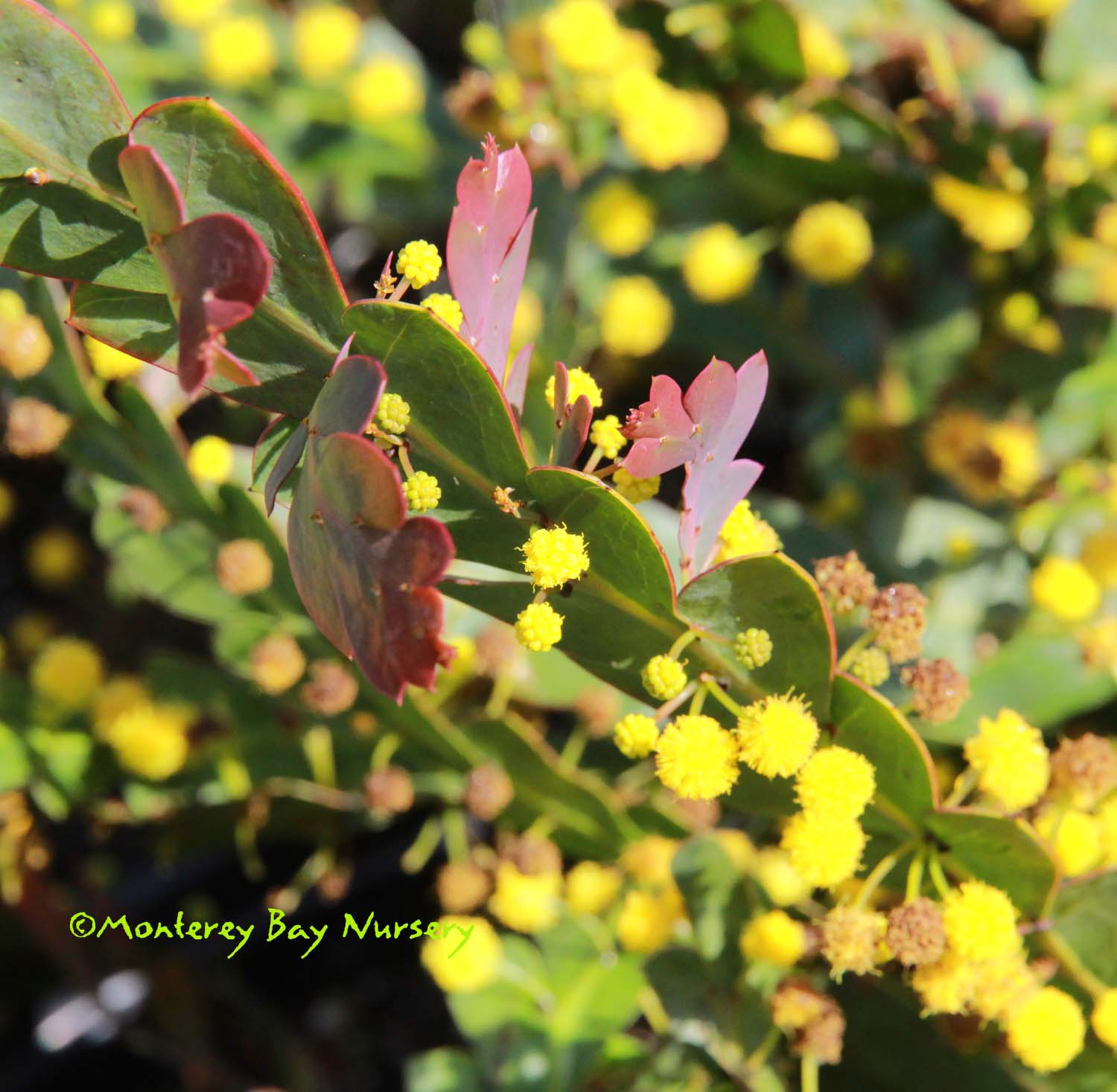
glaucoptera 'Prostrate' PROSTRATE CLAY WATTLE closeup, flowers and leaves a very low, very fast prostrate to sprawling groundcover with conspicuously purple-red new growth, blue green knife-like leaves which cling to the dense stems. This is primarily a big, tough, fast, wide, weed-smothering, drought tolerant groundcover with very interesting foliage and form all year. It also produces a very good but somewhat short show of intense deep yellow flowers in late winter, tiny clustered balls held directly against the stems. This plant can cover some territory, with old plants at the UCSC Arboretum only kept to 15' across with regular pruning, leading me to think 20-25' unrestrained would be no problem. With age stems in the center plus a few outliers can arch up to 30" or so but for its spread it stays remarkably low. Full sun to some shade, will take heavy soils but not combined with a low planting site, some summer watering is best but of course it's very drought tolerant. Begins to lose foliage and stems somewhere between 25F and 18-20F. All the specimens at the UCSC Arboretum survived the record 1990 freeze, which dropped to those last numbers. Southwestern Australa. UCSC Arboretum. rev 9/2020
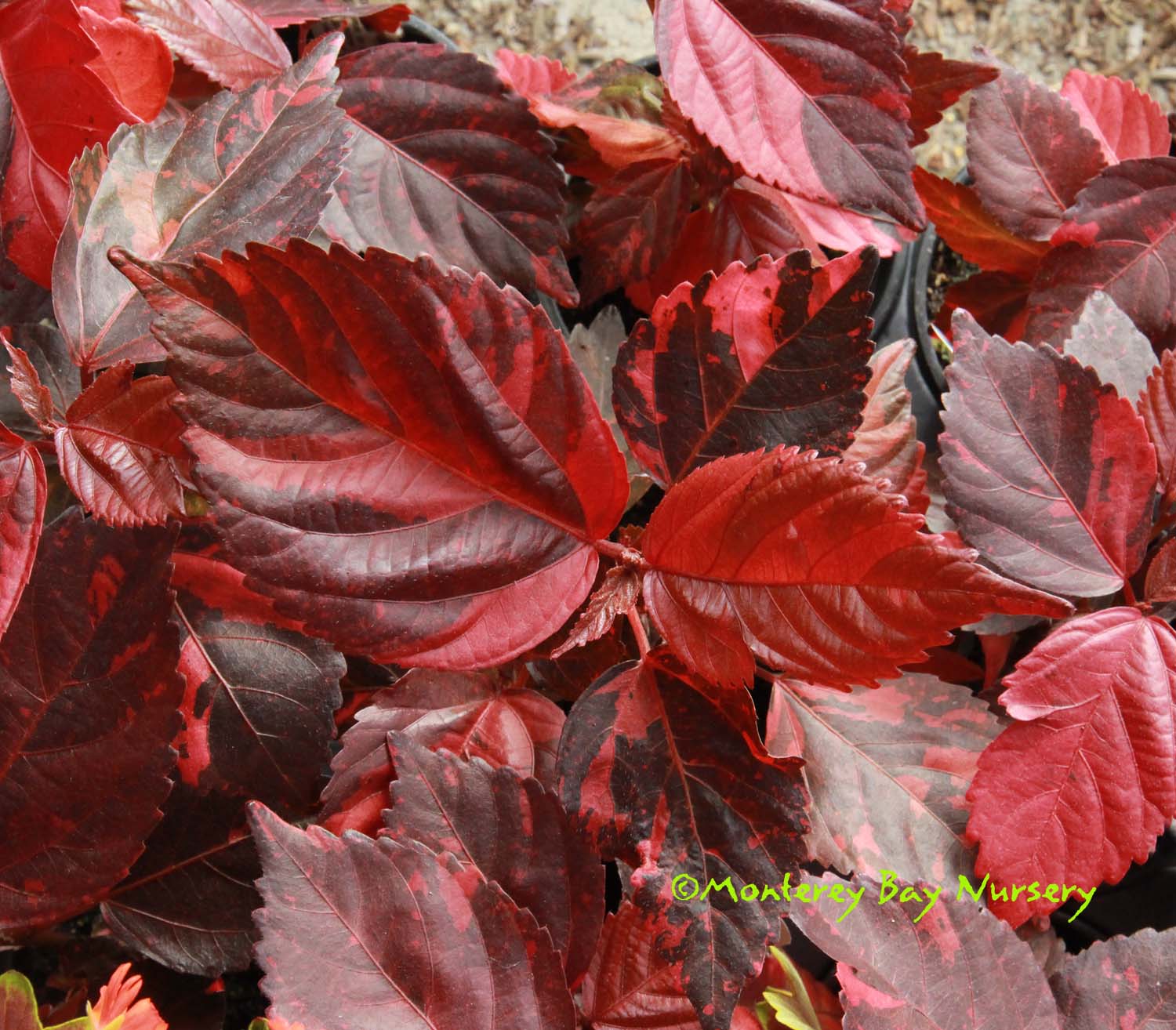
Acalypha wilkesiana 'Bronze Pink' COPPER PLANT, COPPERLEAF why you must have it combo container a soft tropical shrub used during the warm season for its spectacular foliage color. This selection has lots of bright magenta pink coloration. Fastest under warm temperature, high humidity and full sun, but give it part sun here with our lower humidity or leaves may scorch. Best as a patio plant or indoor/outdoor item, plants will die if roots go below 50F, normal for almost all of California. Flowers are small, fuzzy, not showy. Normal watering needs. In tropical climates this can reach 8-10' with an 8' spread, here if you get it half that big you'll be in the newspapers. Euphorbiaceae. Fiji, Pacific Islands. rev 5/2017-
'Tiki Cloak' all colors green, bronze, red and maroon, all on the same plant, at the same time. Same size/culture as above. rev 5/2017
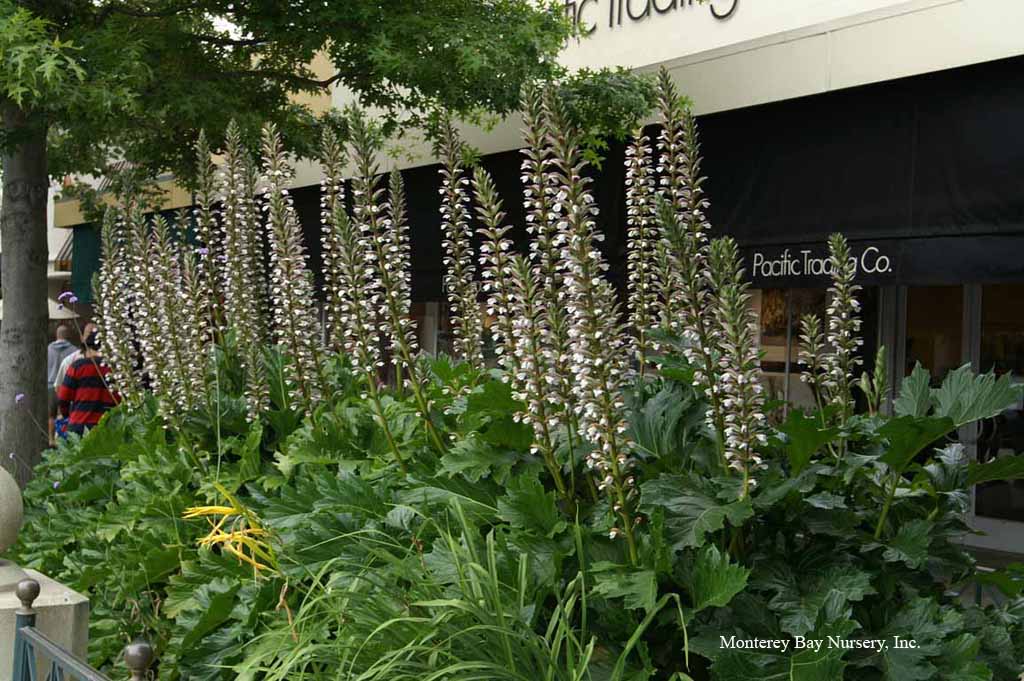
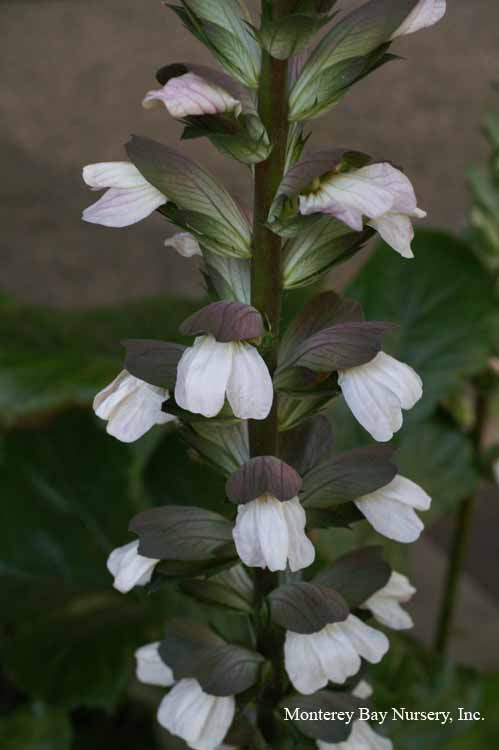
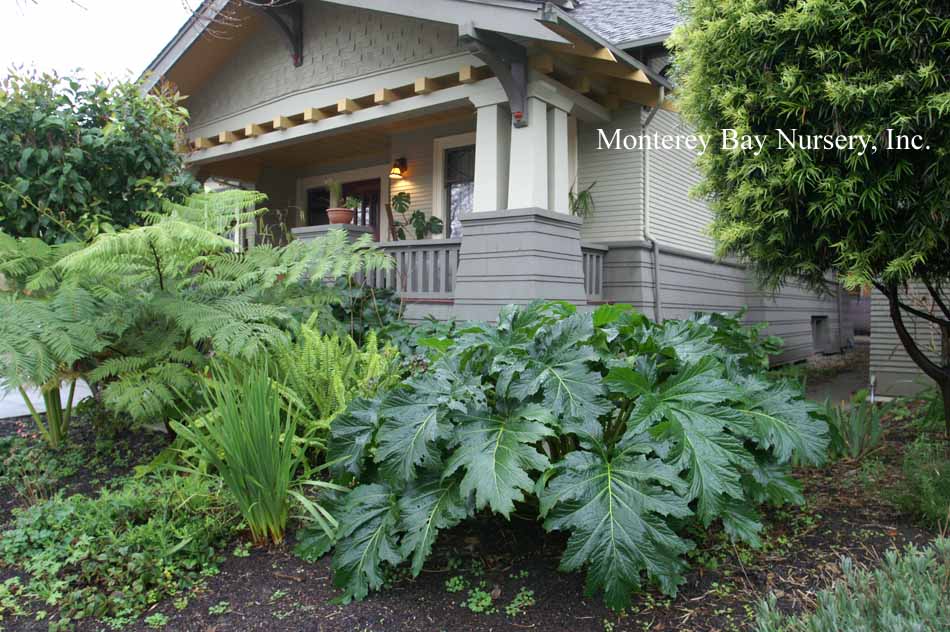
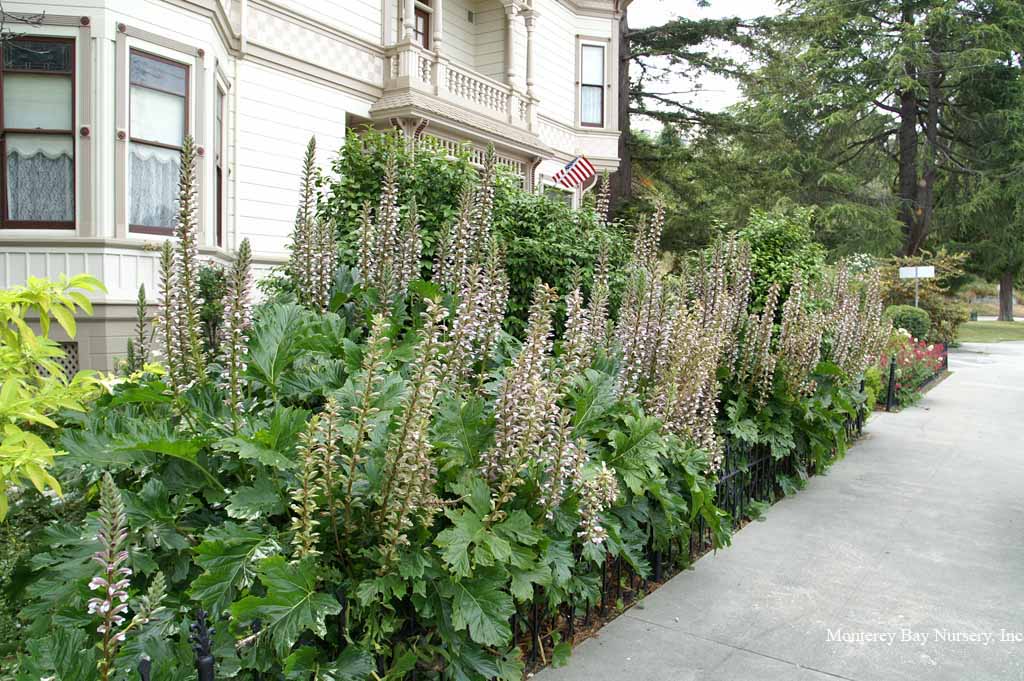
Acanthus mollis ‘Oak Leaf’ flowers flower closeup Craftsman landscape habit Victorian landscape planting a summer-deciduous perennial usually grown for foliage that also bears showy flower stalks to 4’ tall in late spring. Part sun to shade, little or no summer watering when established, frost hardy. For evergreen foliage, flower stalks need to be removed before blooming and plants will need some summer water. Makes a dramatic container plant. Mediterranean. Acanthaceae. rev 3/2007
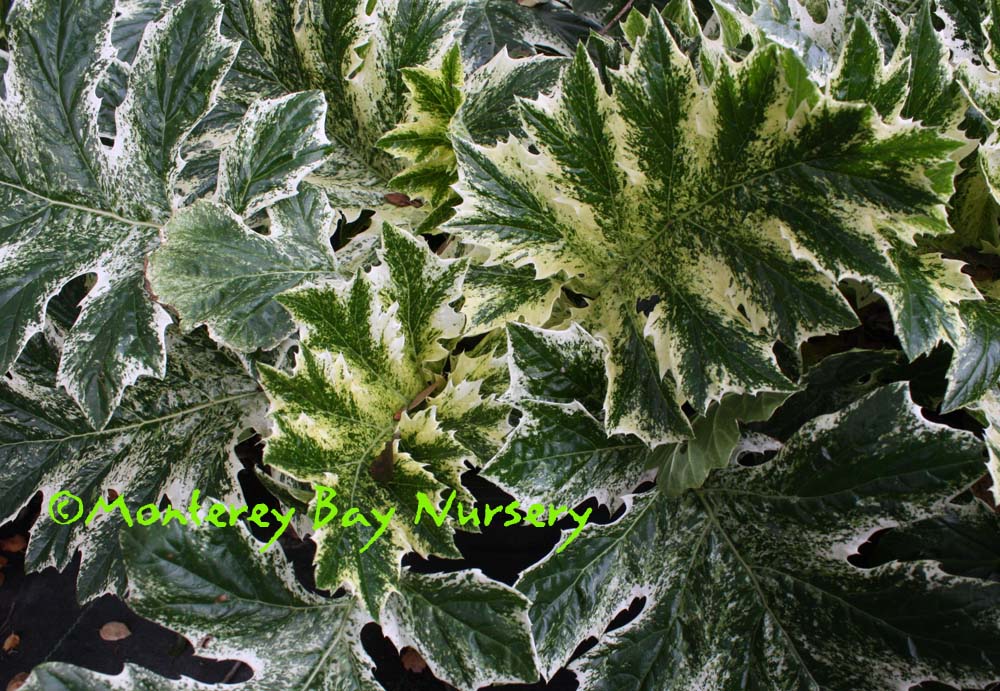
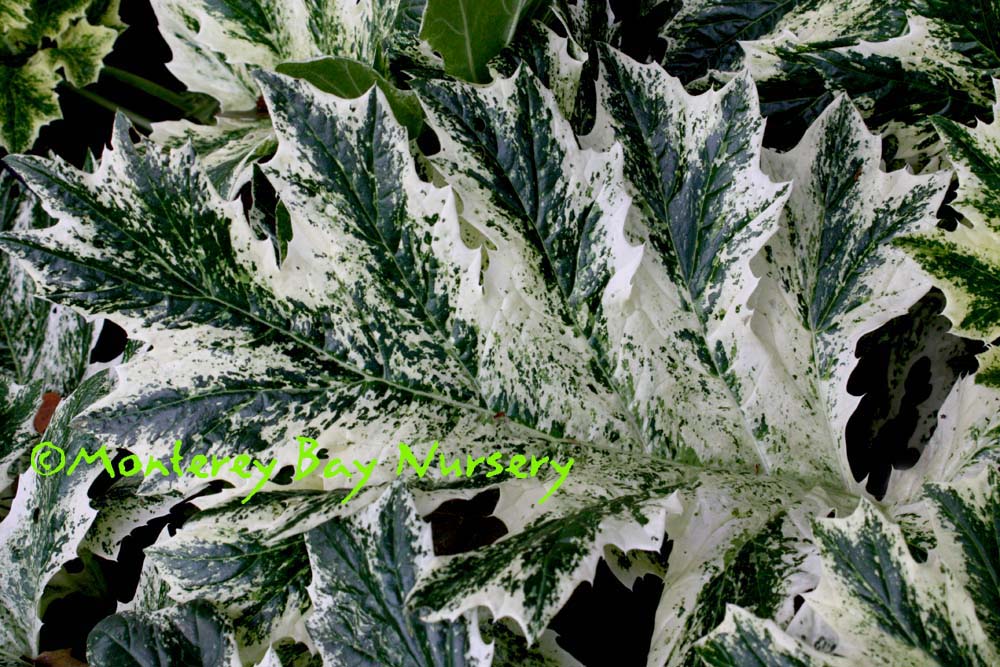
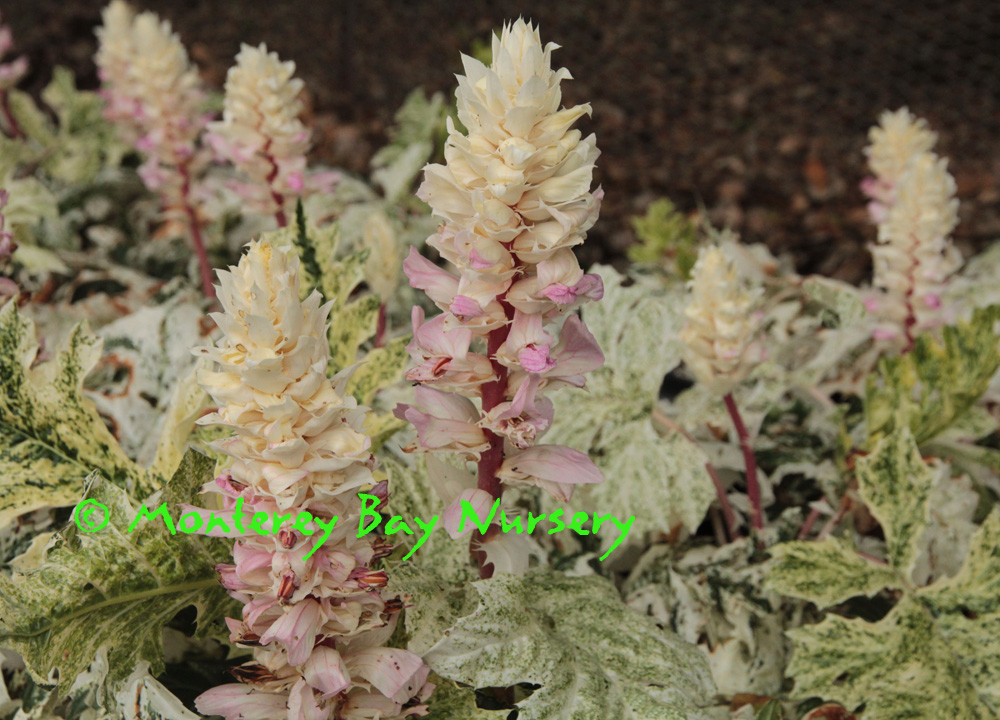
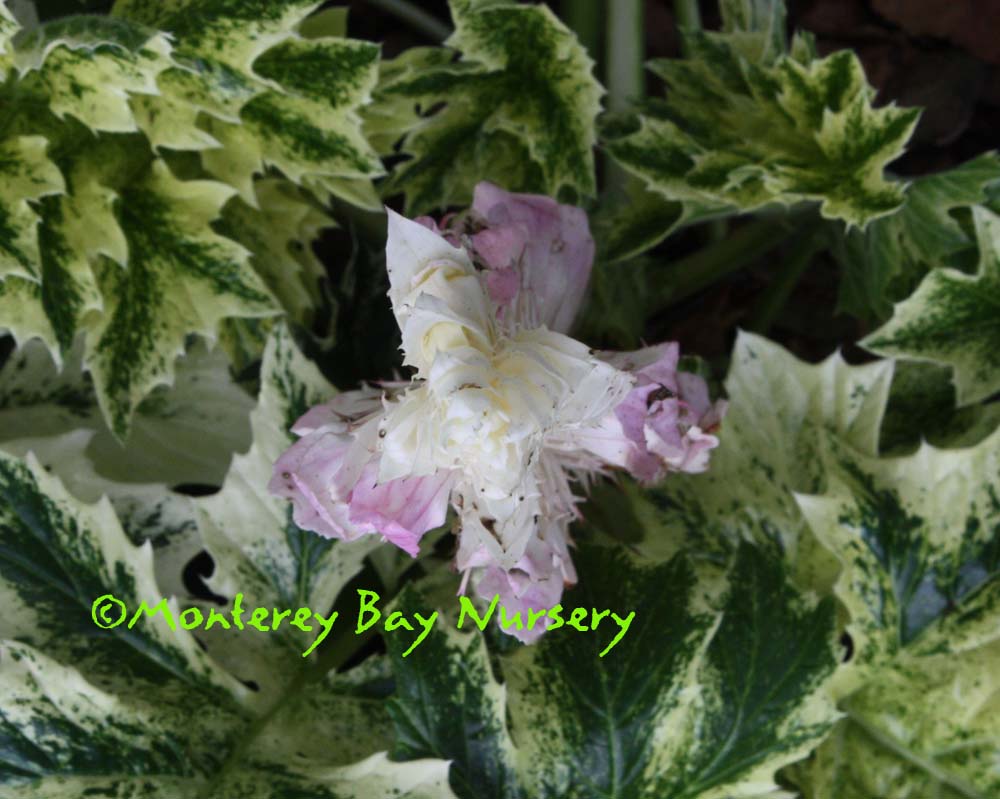
'Tasmanian Angel' emerging fall foliage mature leaf color flowers from above a study in frantic white/green variegation, this selection really lights up against a dark background. The pink flowers are a complete surprise, and are sparingly produced mostly in summer. Much slower than the regular green form just from lack of chlorophyll, it is also easier to manage it in the garden compared to its vigorous original source. Needs mostly shade or very diffuse direct light else the white leaf tissue burns. Quite drought tolerant when established. We've sold this before in very small lots, and it was never properly introduced nor added to our catalog before now. rev 10/2017
Acer MAPLE trees and a few shrubs, native mostly to Asia but also Europe, North America and Africa. One Southeast Asian species, A. laurinum, occurs in Indonesia and ranges across the Equator into the Southern Hemisphere. Many maple species offer graceful form and attractive foliage, bark, flowers and/or seeds. A large number present good to exceptional fall color. our California native species are Bigleaf Maple (A. macrophyllum), Vine Maple (A. circinatum), Mountain Maple (A. glabrum and its subvarieties) and Boxelder (A. negundo). Formerly placed into its own family (Aceraceae) it is now usually placed in the Sapindaceae based on genetic relationships. rev 8/2019
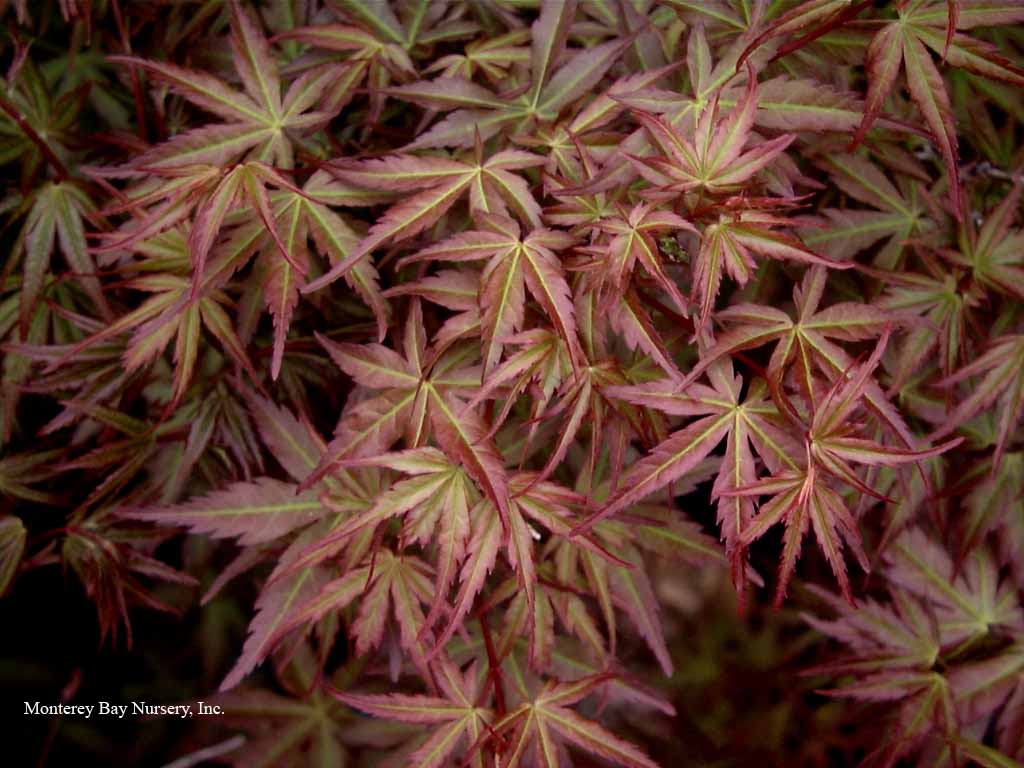
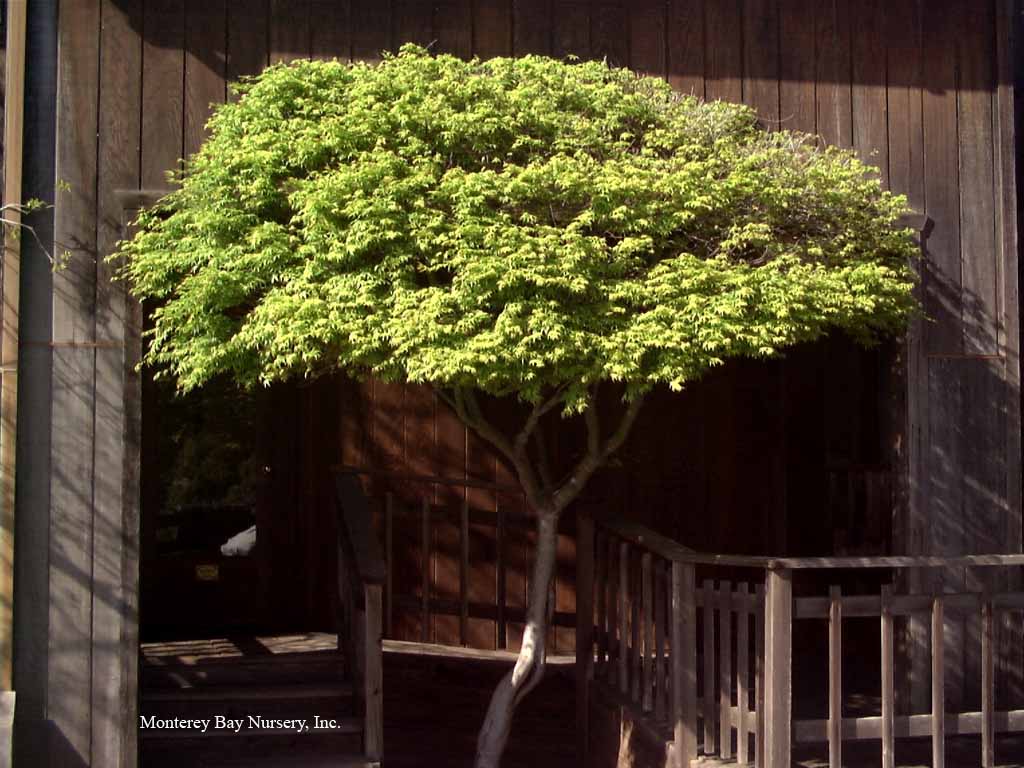
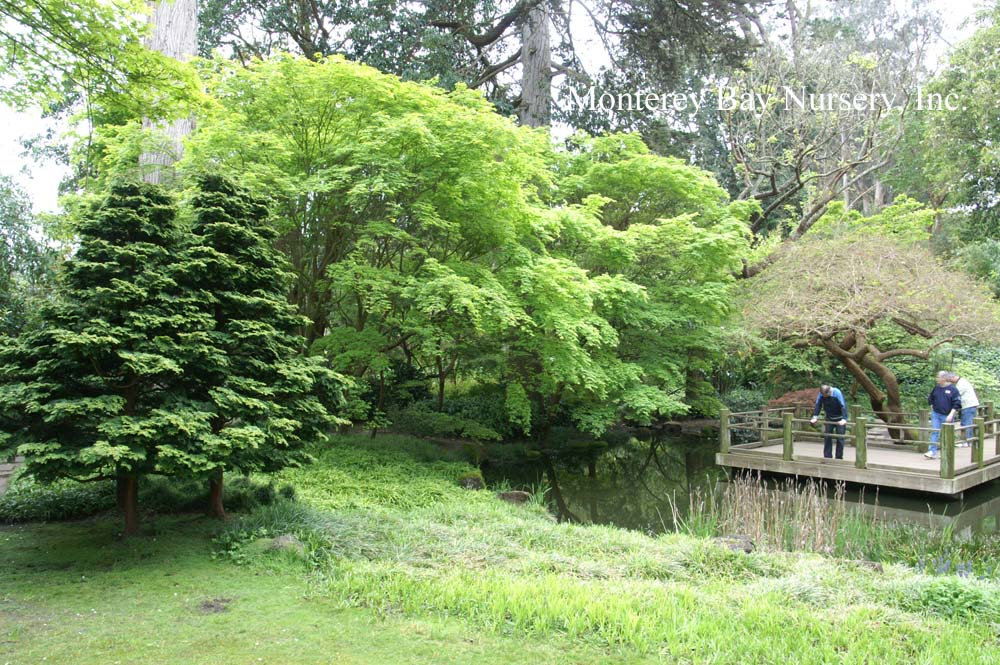
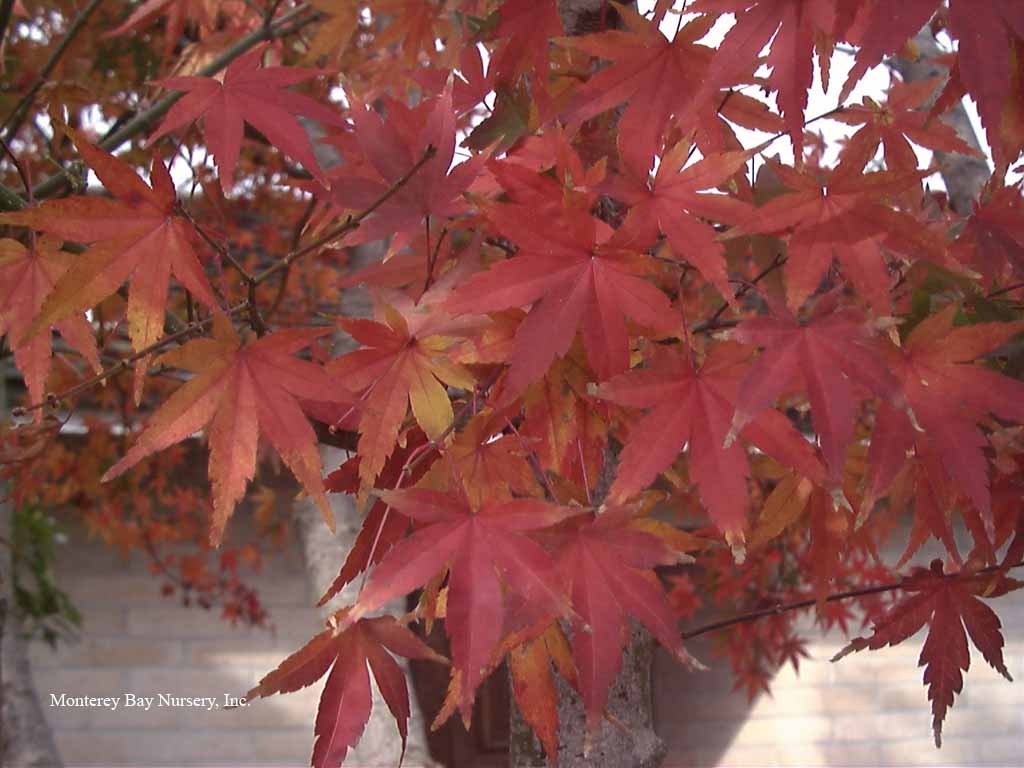
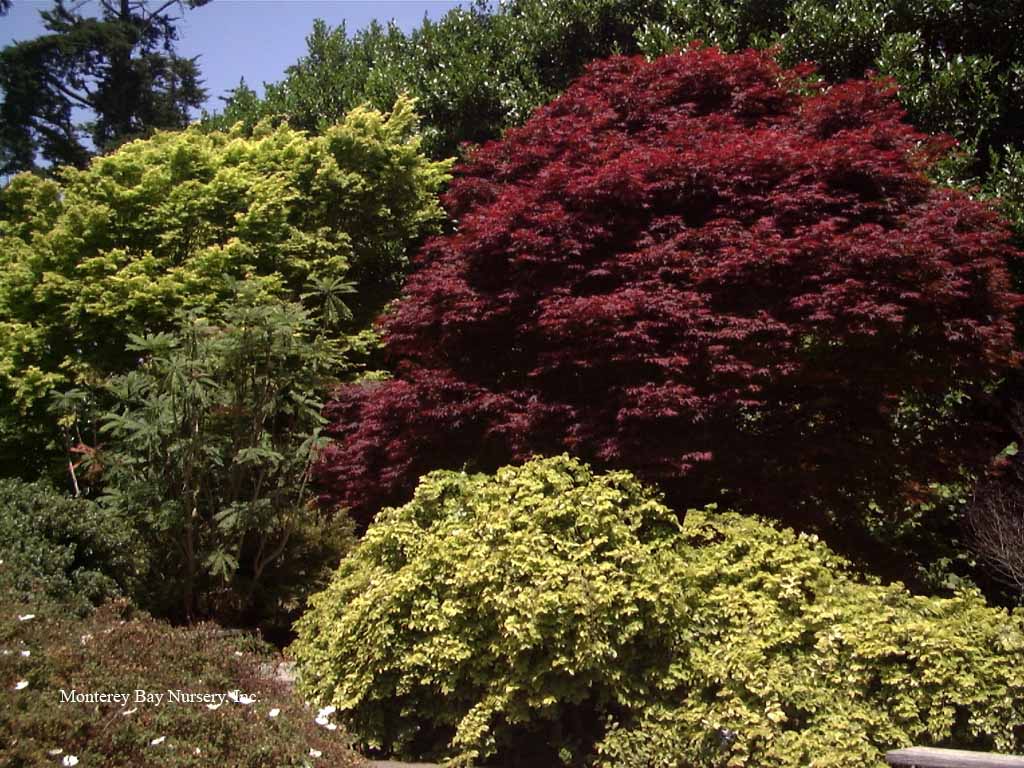
palmatum JAPANESE MAPLE, MOUNTAIN MAPLE new growth clipped into a small tree shrub form classic siting, Strybing Arboretum fall color detail a wonderful small to medium size tree loved by all for its striking grassy green bark and upright, fine textured, compact to willowy spreading form. It can take considerable shade, and is one of the best small trees for narrow alleyways or wall plantings. The bark and leaves contrast well with walls, whether leafing out in spring, in full summer foliage, or turning color in fall. They do well in very large or small containers, and look good in wide range of colors or materials. They only ask for not too much heat (especially reflected) and regular watering. Its winter form is interesting, and it combines well with either formal commercial architectural designs or informal, woodsy plantings. It has so many attractive facets they are hard to list. Have you ever noticed how beautiful it is in a spring rain when the droplets are hung like silver pearls from the swollen burgundy buds? Its easy motion in breezes and fine leaf and branch texture add light/shadow interest to walls and paved surfaces. Have you noticed how nice the color is on the newly unfolded leaves and flowers? It is just exquisite in a wet fall, when the rain makes all its bright colors light up.
Japanese Maples can be grown in full sun if they are supplied with plenty of high quality water. It's form will be very compact, rounded, regular, and a little chunky. Nevertheless, its very fine-textured foliage gives it a soft, almost mossy look. It is probably at its best in either part sun or mostly shade though, where its branches tend to be long, willowy, and show little taper. It really, really enjoys a cool, moist root run. As an understory tree by natuer it will tolerate full shade if it has an open view of the sky, or even just reflected light. Tree ferns (Cyathea, Dicksonia) make wonderful shade companion plants, as well as regular ferns, Mahonia bealei and Aucuba. Famously good for bonsai, although you had better thicken the trunk in the ground or a large container because trunk girth enlargement essentially stops once it is planted in a small container. Frost hardy. Korea, China, Japan. Aceraceae.rev 2/2018
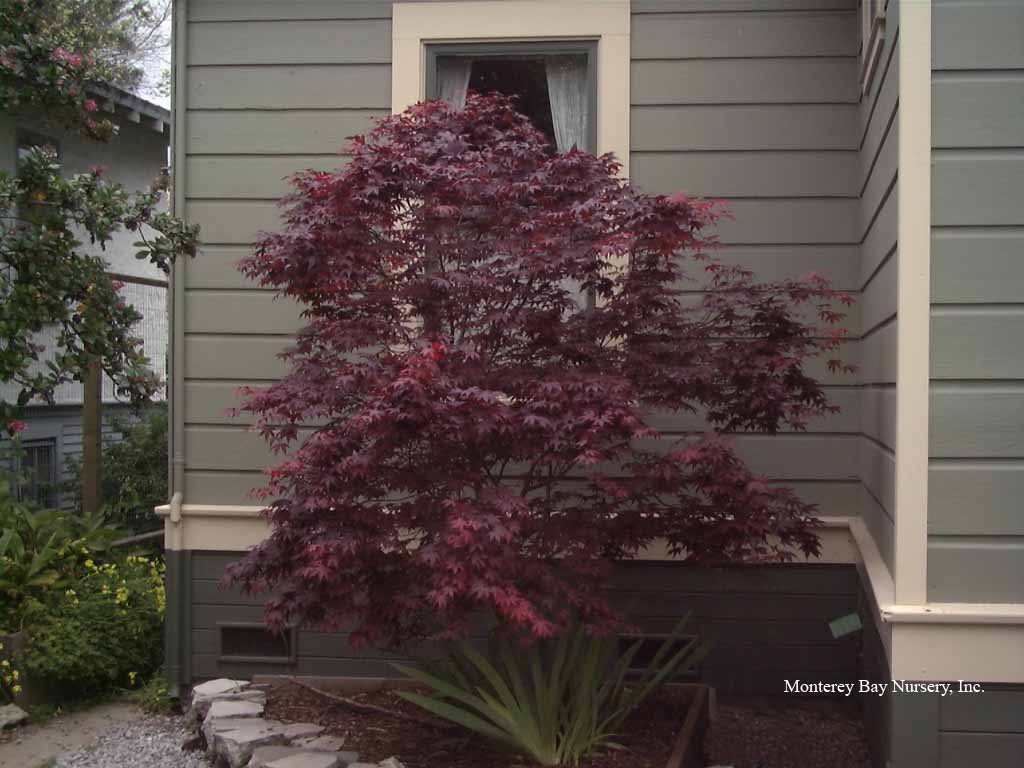
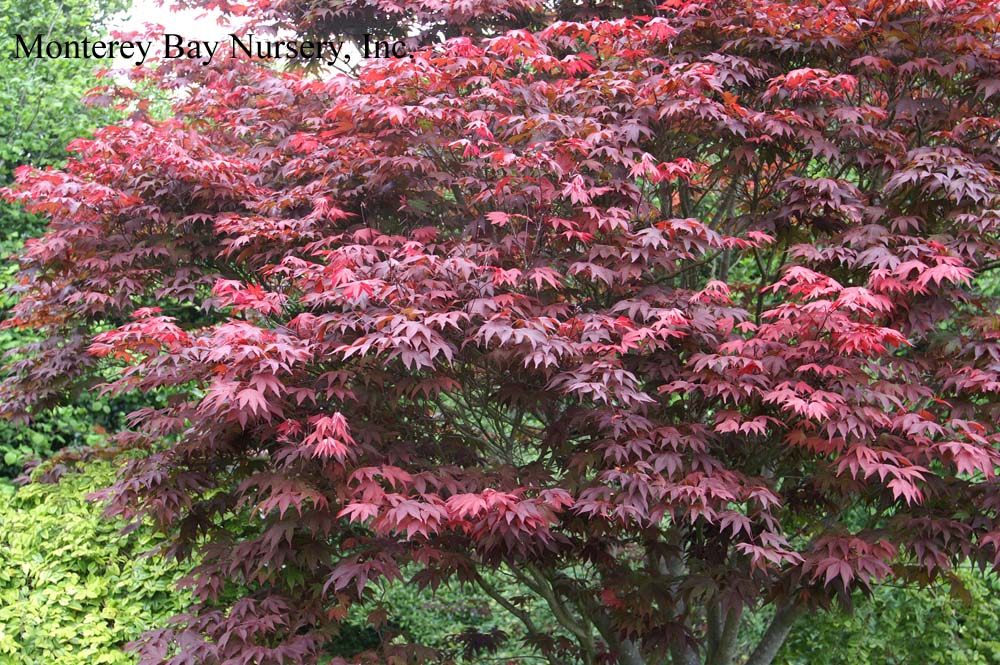
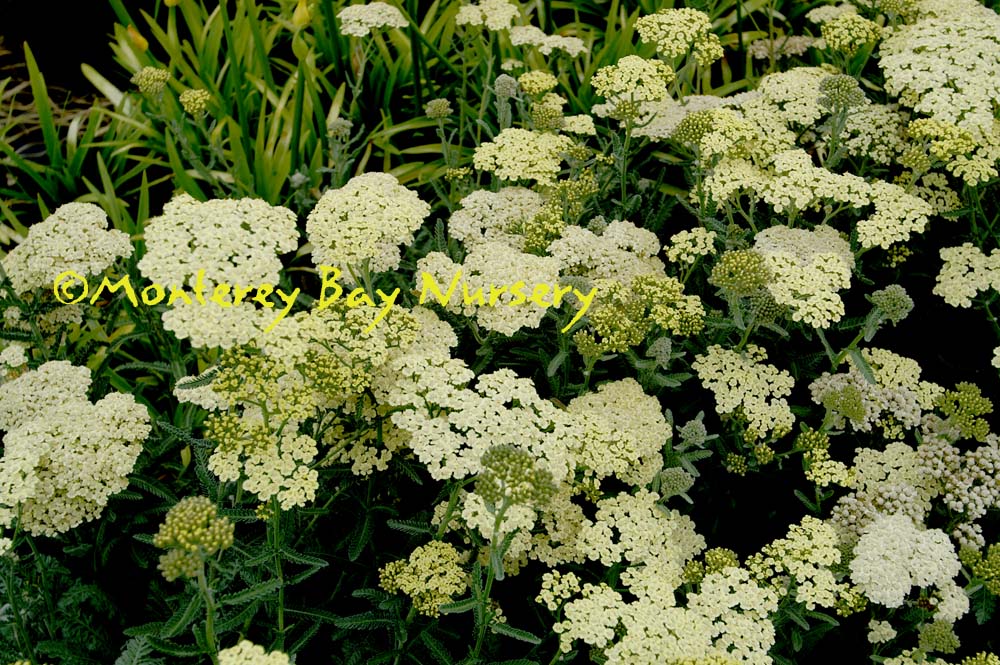
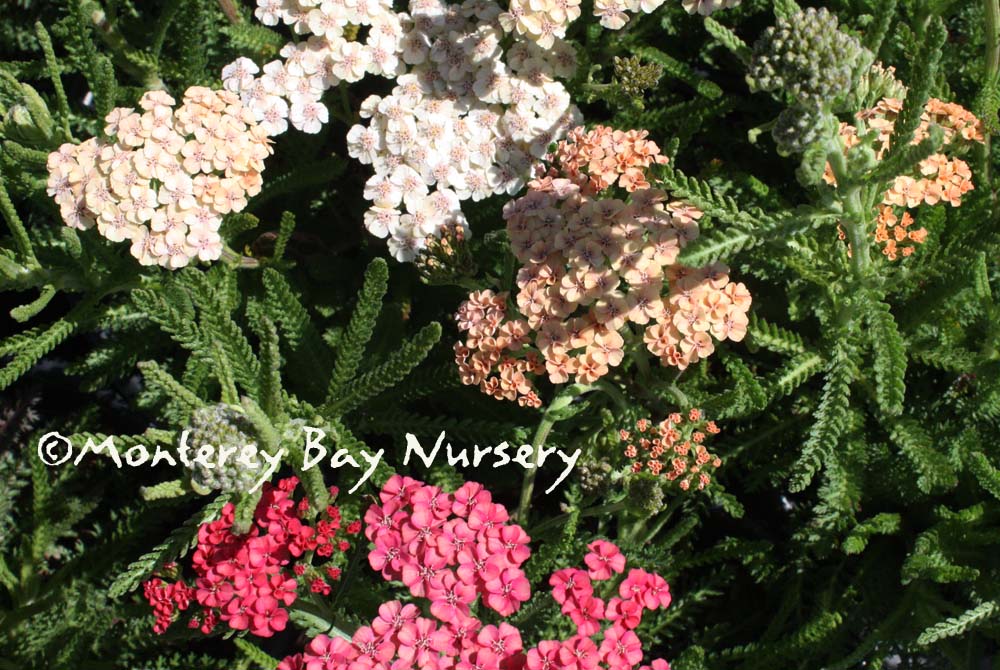
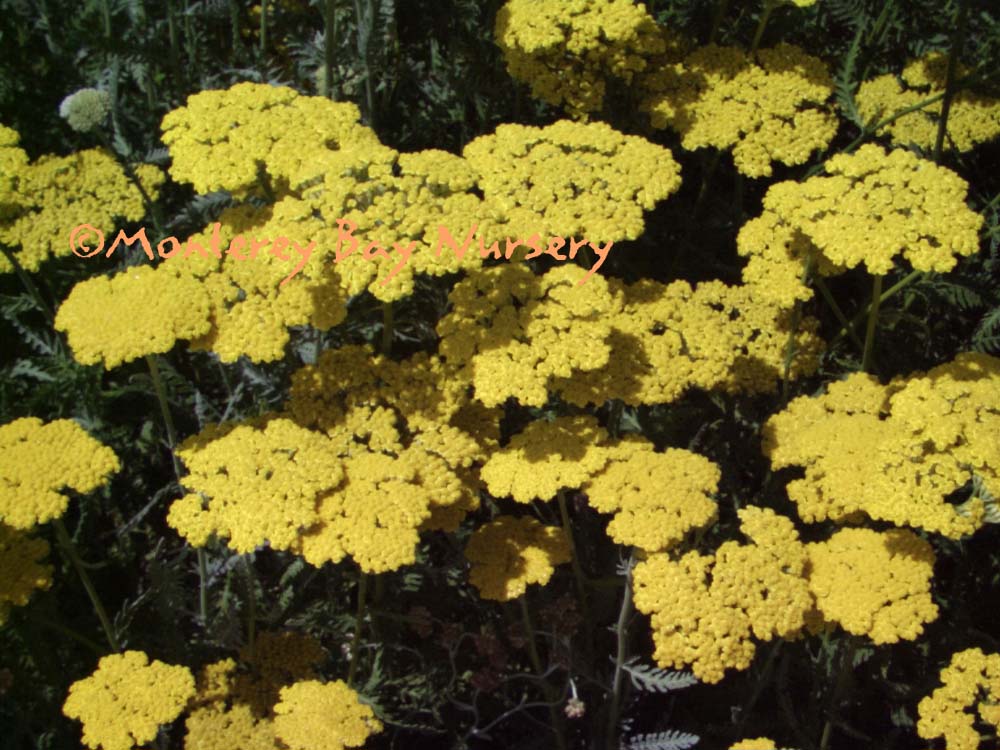
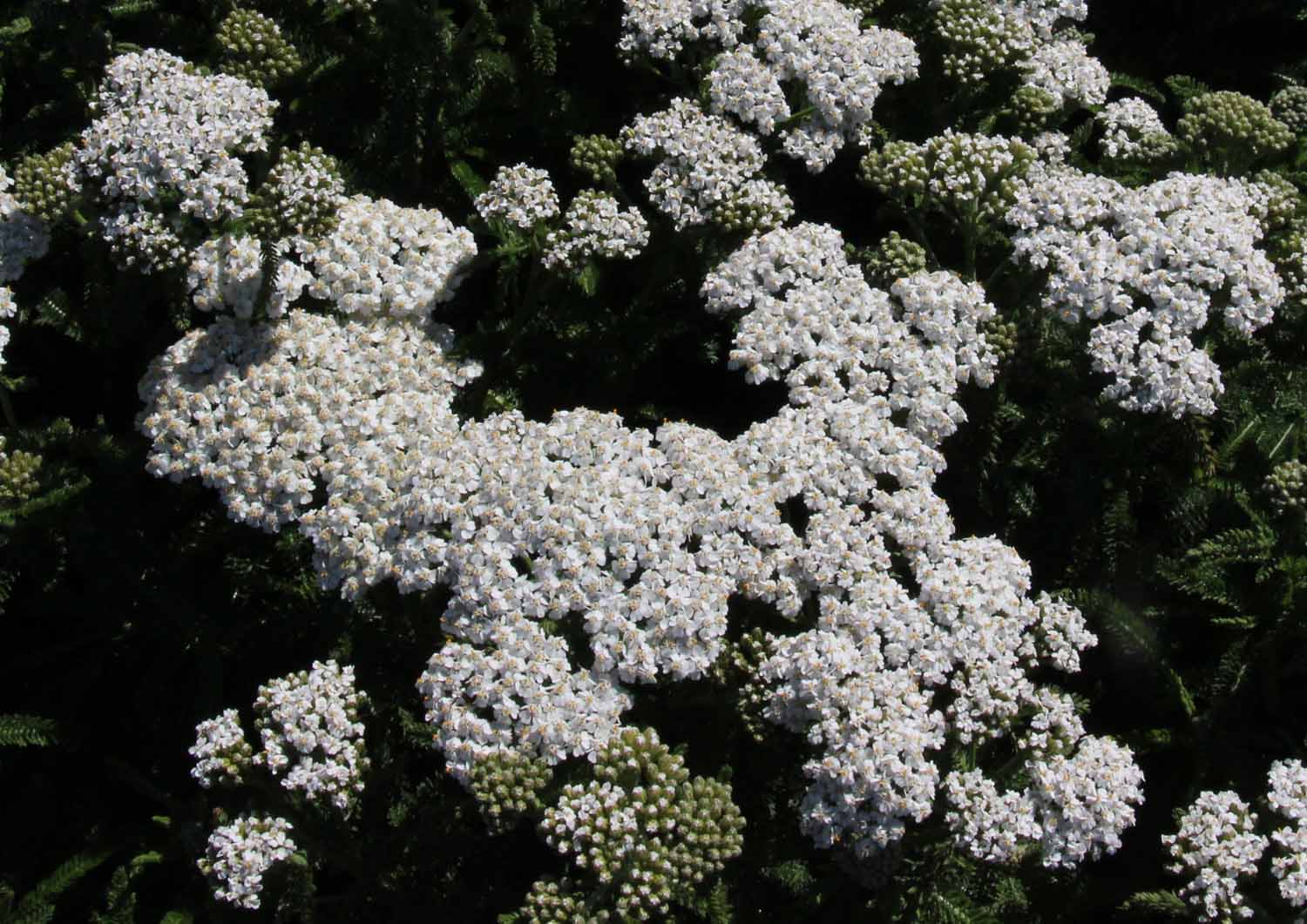
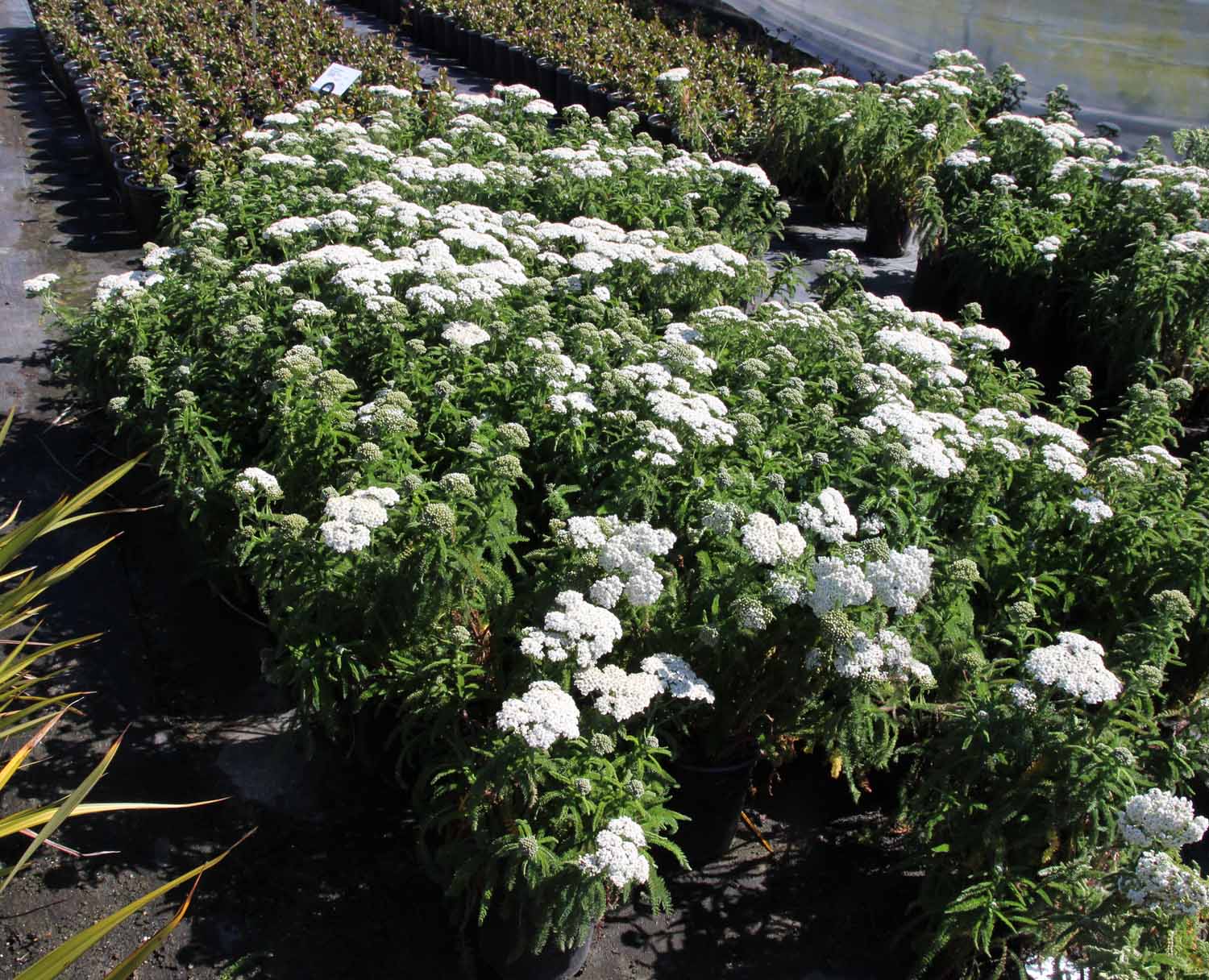
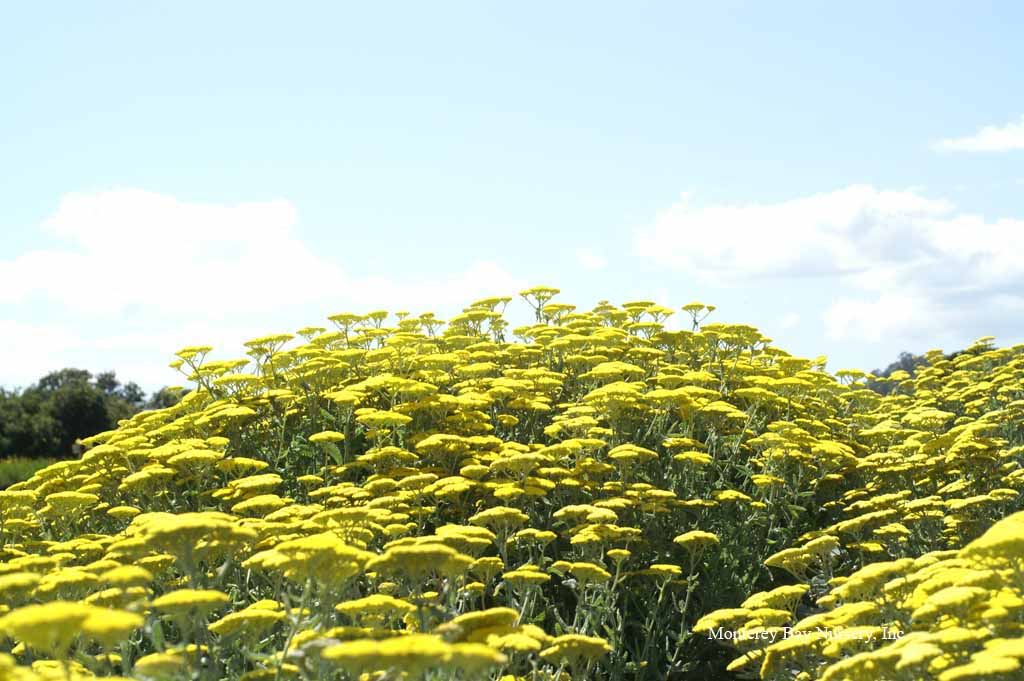
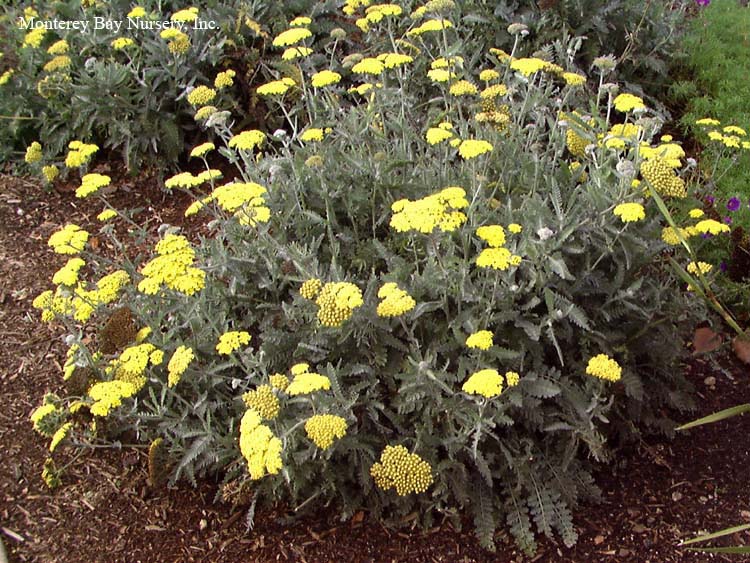
Achillea evergreen to deciduous perennials, all very frost hardy. Useful for cutting, in mixed boarders or even as small scale groundcovers. All are very good as nectar sources for beneficial predatory and parsitoid insects, like hover flies, tiny wasps, etc. And butterflies love them too. Compositae/Asteraceae. All Sunset zones, USDA zone 3. rev 6/2011pentaphyllyum FIVE-LOBED MAPLE Manuel's tree, 15 years old leaf leaf underside another leaf an ultra-rare Chinese species with leaves divided into usually 5 very long, narrow, graceful, glossy dark green leaflets, usually 3-5" long. Undersides are glaucous white, petioles are bright red. Mature bark is attractively mottled green, tan and light brown. Fall color has been good even in our mild-winter region, bright yellow to orange and red. This grows with an upright habit and those long leaflets hanging down gracefully from the young stems. It casts light shade at all ages, spreading as it matures to reach about 15' tall and wide in as many years. Specimens can reach over 30' tall in nature. Sun, acid soils, average water, frost hardy to USDA zone 7. rev 8/2019atropurpureum RED LEAF JAPANESE MAPLE young plant leaves nice tree at Strybing Arboretum similar to the regular green form, but these seedlings have reddish purple foliage in spring when new leaves emerge. Color is best in at least part sun, can be retained until mid summer on best seedlings. In shade expect the foliage to be mostly green. Usually these plants offer stronger fall color than green seedlings. rev 1/2013
'Bloodgood' handsome young tree dark red foliage. Famous for not greening in summer, which red seedlings tend to do. Reliably deep orange red fall color. rev 1/2013
'Emperor' foliage detail the best of the dark red leaf forms? Very dark foliage never greens and turns reliably dark orange red color in fall. Smaller texture than 'Bloodgood.' rev 1/2013
'Sango Kaku' CORAL BARK JAPANESE MAPLE bark color intense glowing coral red bark on new growth makes quite a display in fall and winter. Fall color from typical green leaves is bright yellow and contrasts perfectly with the bark. Mature bark is grey, so this variety responds better than most to being pruned for forcing new branches. rev 1/2013
'Anthea' flowers a more compact and lighter colored version of 'Moonshine.' Foliage is somewhat greyer, growth is somewhat more compact. rev 1/2013
'Apricot Delight' flowers opens coral rose, ages to apricot then eventually cameo pink. Green foliage with just a hint of grey. Long day initiation, flowers April through October. rev 1/2013
'Cameo' (not currently in production) soft pastel peach flowers touched with mauve. rev 2/2019 MBN INTRODUCTION 1993
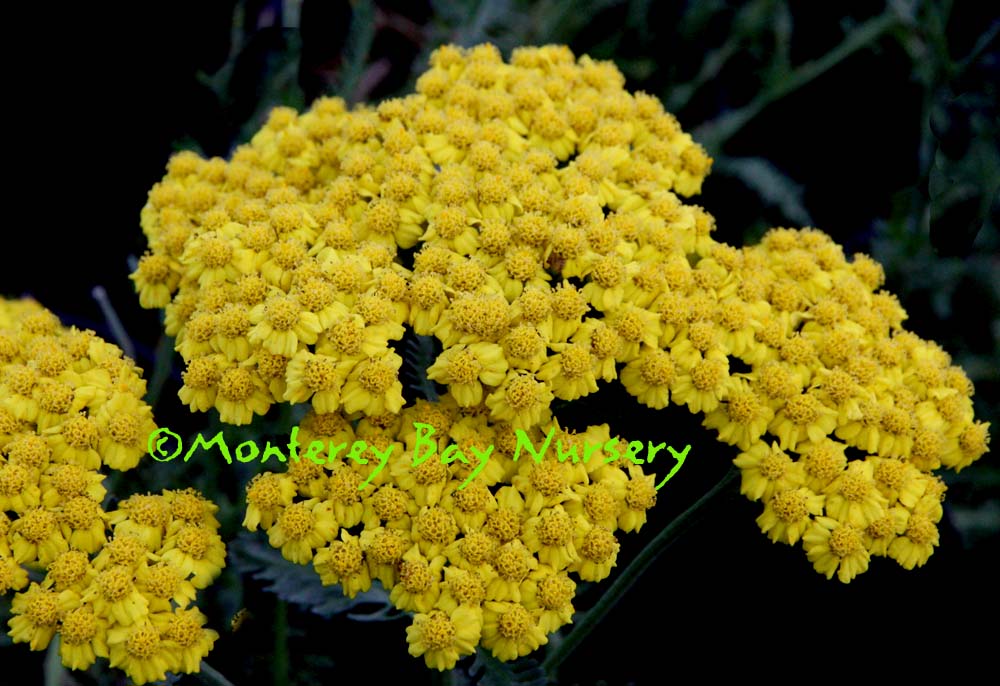
'Coronation Gold' flowers fast, tall (to 36"), green leaves and deep golden yellow flowers starting in late April. Repeats lower if cut back but still best in back of everything else. Great dried or fresh as a cut flower. Full sun. rev 1/2013
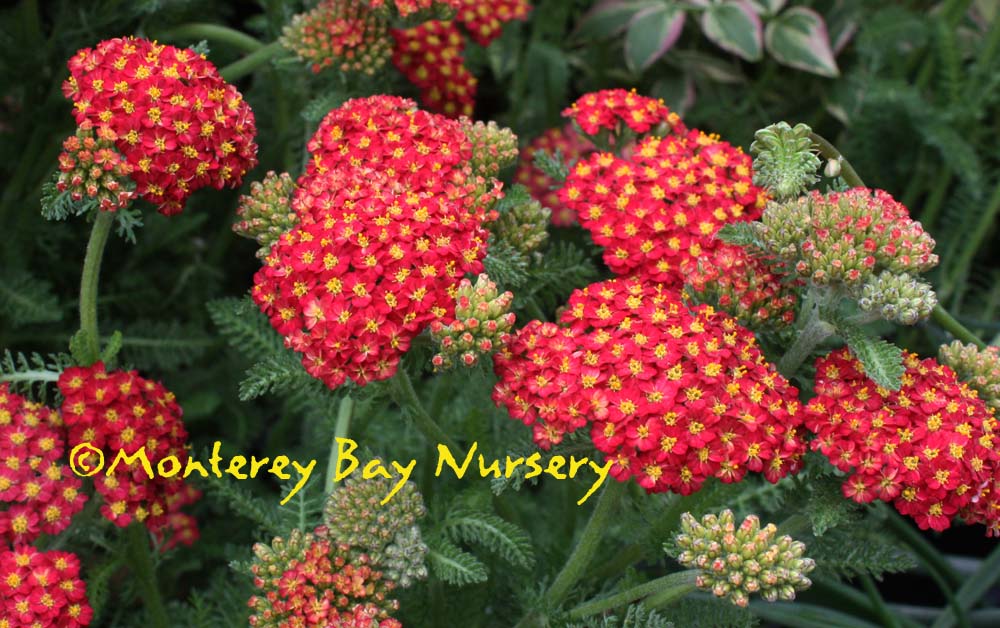
'Desert Eve Red' PP2233 deep red flowers ferny, fragrant foliage forms a compact plant, with large clusters of brick red flowers in spring and, if deadheaded, continuing into fall. Attracts a plethora of beneficial bugs, butterflies, and hummingbirds to the garden. Easy to grow, low maintenance, low water user, and makes a great cut flower, fresh or dried. rev 5/2015
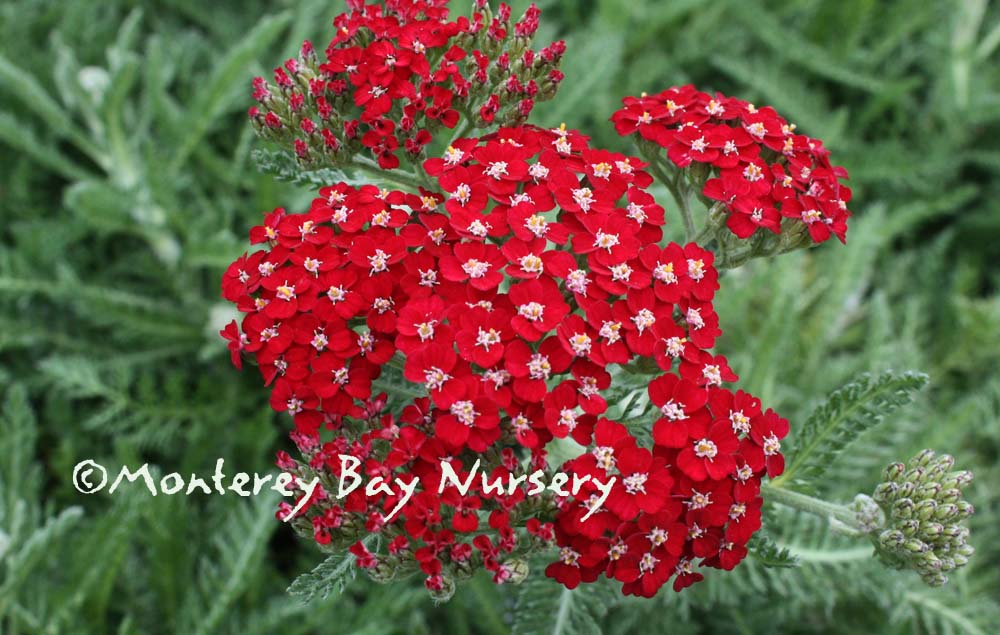
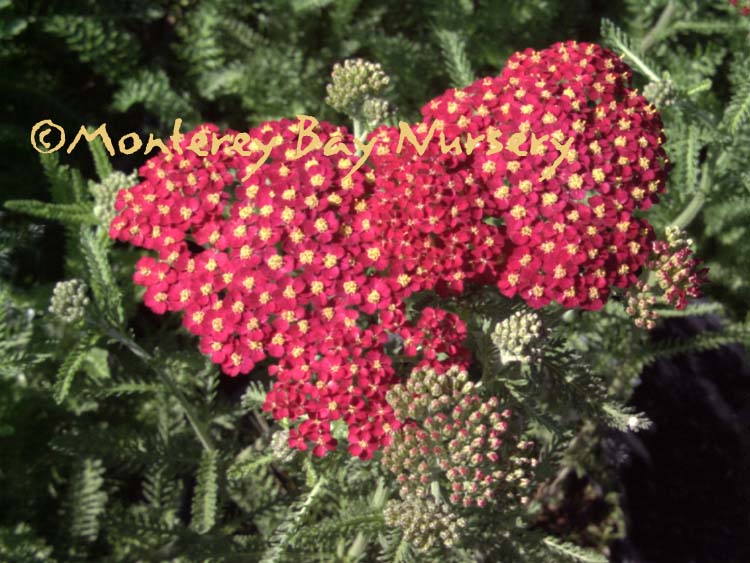
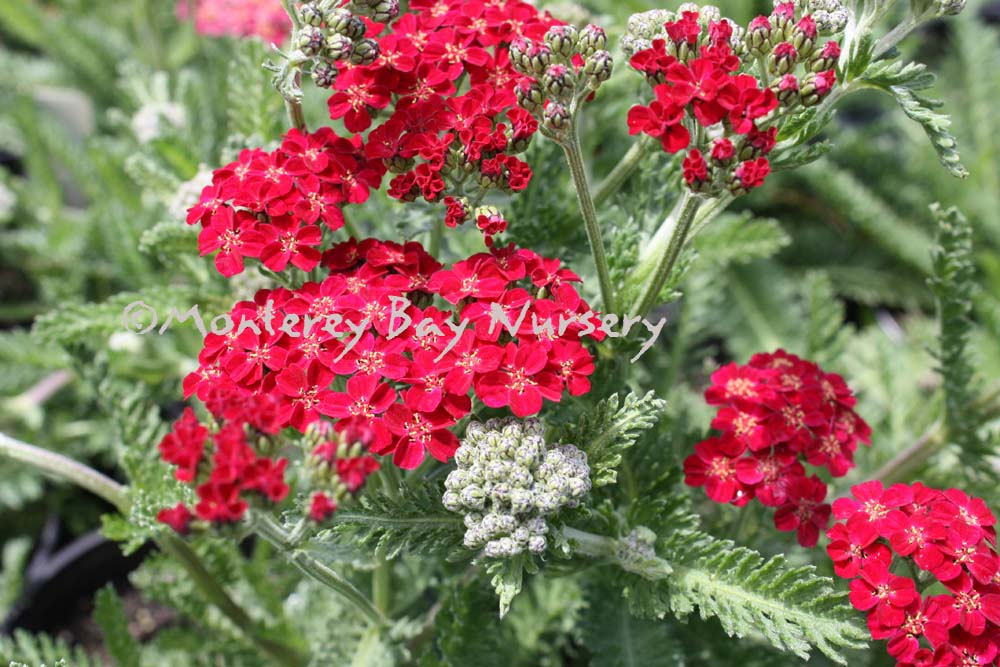
'Laura' red, red, red! this is a compact A. millefolium selection, to 15" tall and clumping. The flowers are non-fading, intense, clear bright red with a white eye. A wonderful addition to summer bouquets or dried in winter ones. Attracts bees, butterflies, and beneficial insects. Sun, little watering once established. All Sunset zones/USDA 5. rev 5/2013-Suzy Brooks
'Little Moonshine' fall flowers same intense golden yellow flowers, clusters are a little smaller, plants are only going to reach 12" tall even under full, long-day, summer-stretch conditions. Definitely the one for the very front, and most container applications. USDA zone 4/Sunset all zones. rev 11/2016
'Lost Coast' (millefolium) flowers untrimmed-height, production crop this showy, compact form is tough, highly drought tolerant, pest and abuse resistant. It's quite useful due to its ultra-low mature height. This form was selected from along the Lost Coast of Northern California, a rugged, so-far roadless stretch of craggy coastline near Cape Mendocino. It puts on a great show when flowering that attracts lots of butterflies and beneficials. Nice to know a stock-native form can compete with the breeders' best! Infrequent to no summer watering depending on site and climate, sun to half shade, most soils, should survive to USDA zone 5. rev 6/2018
I have seen this amazing species growing wild across an incredible range of habitats and climates: along the coast from Big Sur to north of Santa Cruz, in the Griswold Hills between Coalinga and New Idria, at middle elevations in Death Valley plus nearby Pahrump, Nevada and Clark Mountain, as a roadside weed next to the wheat fields outside Walla Walla, Washington, at high elevation in the forests of the Blue Mountains of northeastern Oregon and most recently in the forests and edges of cultivated fields near Wroclaw ("Breslaw"), Poland. rev 11/2019'Moondust' PP25838 flowers pastel yellow flowers, beginning in spring and continuing into fall. Like a more compact version of 'Anthea,' or A. aegyptiaca v. taygetae, with similar grey-green leaves. Sun, average soils, somewhat drought tolerant when established. USDA zone 3/Sunset all zones. rev 6/2016
‘Moonshine’ flowers habit a semievergreen to deciduous perennial, showing a wonderful combination of fuzzy grey green foliage and bright, intense, clear yellow flowers in flat clusters to 30" high. Primary bloom is early spring through fall but it likely shows cumulative long day initiation and can bloom through mild winters if cut back in fall. Best in full sun with average to little summer watering when established and all are frost hardy. Good for cutting. Compositae/Asteraceae. rev 8/2006
'Paprika' (A. millefolium) flowers deep, true red flowers with dusty yellow stamens, held in big, flat panicles to about 2' tall, with grey green, ferny foliage. This is great for borders mixed with traditional perennials and does double duty cut and displayed in a vase. Flower time is spring through fall (if cut back). Mix it with penstemons, the larger salvias, coreopsis, and of course other yarrows like 'Moonshine,' etc. rev 6/2011
'Red Velvet' YARROW (not currently in production) flowers silvery green foliage with dark, true red flowers that attract butterflies and beneficial insects. An easy perennial for sun and heat. Suitable for herb gardens and vegetable gardens, and wherever pollinators are wanted. A nice cut flower used fresh or dried. To about 2-3' tall and wide, clumping bigger and better each year. Average to little watering. All Sunset zones/USDA 3. rev 11/2019
filipendulina
'Sunbeam' intense golden yellow heads against
grey-green foliage on 3' stalks beginning in June. rev
2/2019
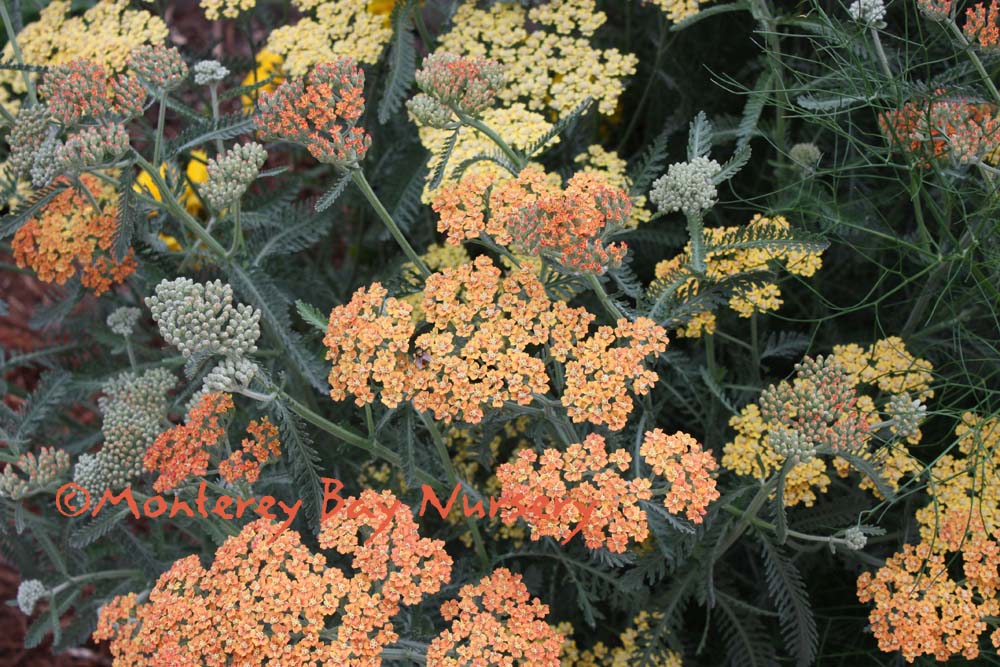
'Terra Cotta' flowers this starts pale gold, warms to peachy orange, and finishes tawny coral red. To about 2', grey green foliage. rev 1/2011
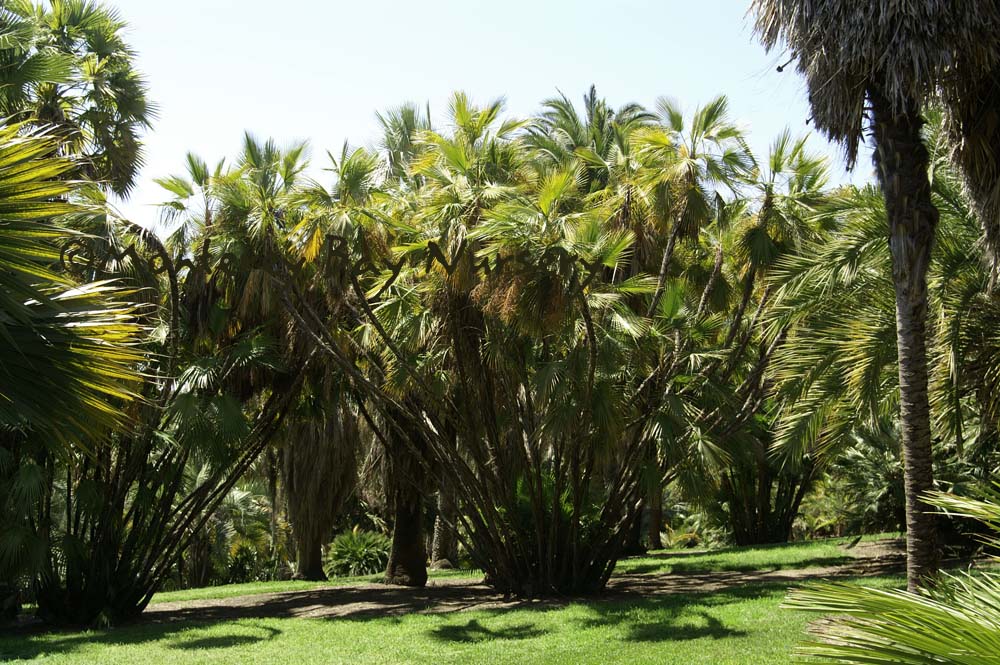
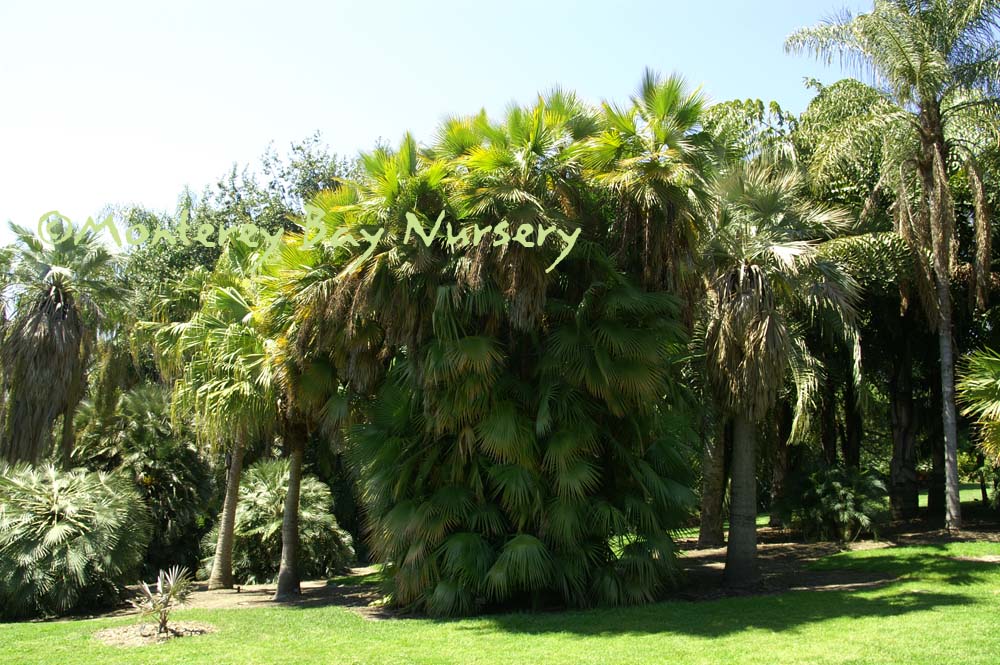
Acoelorrhaphe wrightii
EVERGLADES PALM, SILVER SAW PALM, PAUROTIS PALM (not
currently in production) graceful
Huntington specimen another
at the Huntington we are trying this palm out because
I have admired a nice specimen in an Eastside Santa Cruz yard, and
if it can be grown there it can be grown throughout the Bay Area,
most of the Central Valley, and all points south outside of the
desert. It forms a compact crown of spiky yet graceful, somewhat
elongated light silvery green to grey green fan fronds, each
only about 2-3'" in diameter, on long, elegant petioles and on
long, thin trunks, reaching 10-15' after many years. As the trunks
get taller the silvery leaf undersides become better displayed.
Old leaves must be cut off, but the petiole bases remain as
thatching. It clusters quickly, and will form a nice, elegant
clump with age. This has tolerated cool summers and frost to 20F,
though it would most like to grow in Florida. The more sun, heat,
water and fertilizer you give it, the faster it will grow. It is
useful as an easy to take care of foliage plant that won't
outgrow its spot or container. Sun, has some drought tolerance but
prefers at least intermittent watering, and will take standing
water, needs feeding/trace elements in cool soils. Sunset zones
8-9, 14-24/USDA zone 9. Native to Florida, the Caribbean and
Central America. Palmae/Arecaceae. rev 11/2010
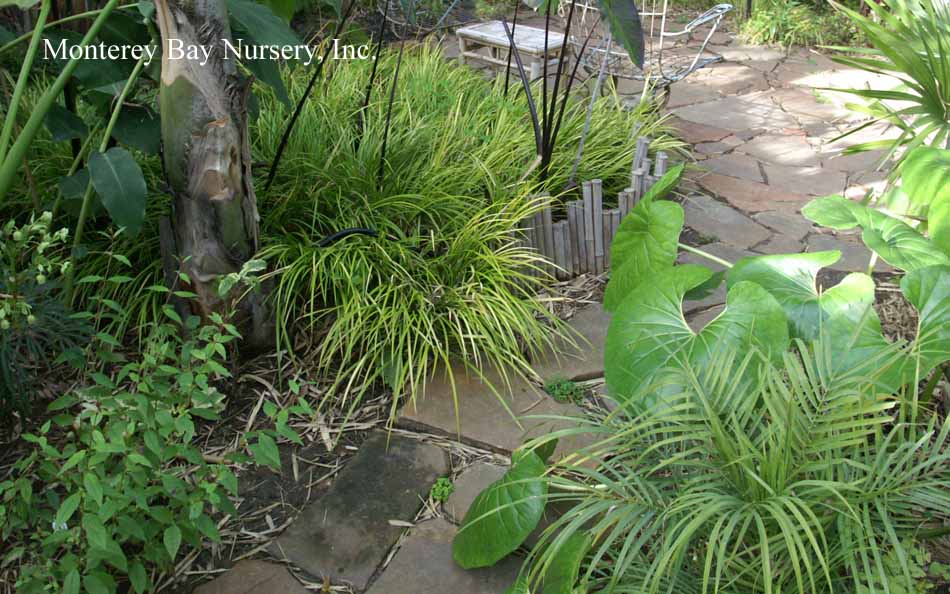
Acorus gramineus ‘Ogon’ habit
the rare all-green form of this dwarf, clumping sedge-like plant,
it is usually seen as one of its variegated forms, below. It grows
as a small, spreading rosette with narrow green leaves to 6" tall.
Slow growing and compact, it can tolerate rather dry soils but
always needs at least some regular watering, and will accept
very wet conditions to the point of extended
inundation. Excellent in containers or as bonsai
accompaniments, and this species and its varieties can even be
used in aquaria (I know, 'cause I did it!Just wash the soil
off the roots and shove it down in the gravel. Worst that can
happen is it dies, but I think you'll find it won't.). Frost
hardy. Southeast Asia, Japan. Araceae. rev 12/2013
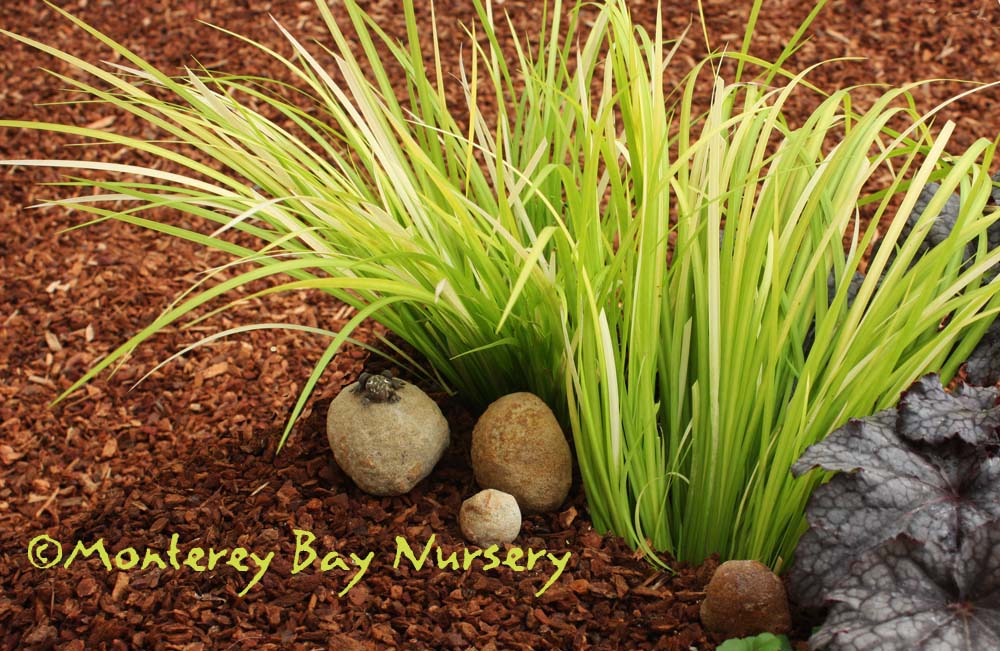
'Golden
Lion' with
sand balls this is a simple all-gold sport I selected
out of A. gramineus
'Ogon.' Its function in life is to provide a short fountain of
narrow, soft, luminous, golden, arching, grass-like blades that
grow in neat fans. Easy to blend with other plants, in pots, in
the shade garden, and by water features. Or use it in dry steam
beds and similar creations to suggest water when none really
exists. To about 10-12" tall and slowly spreading. Easy to grow, not demanding at
all. Morning sun, or mostly shade, average watering, but will grow
in wet soils. Sunset zones 3-10, 14-24/USDA 6. rev 11/2011 MBN INTRODUCTION-2011
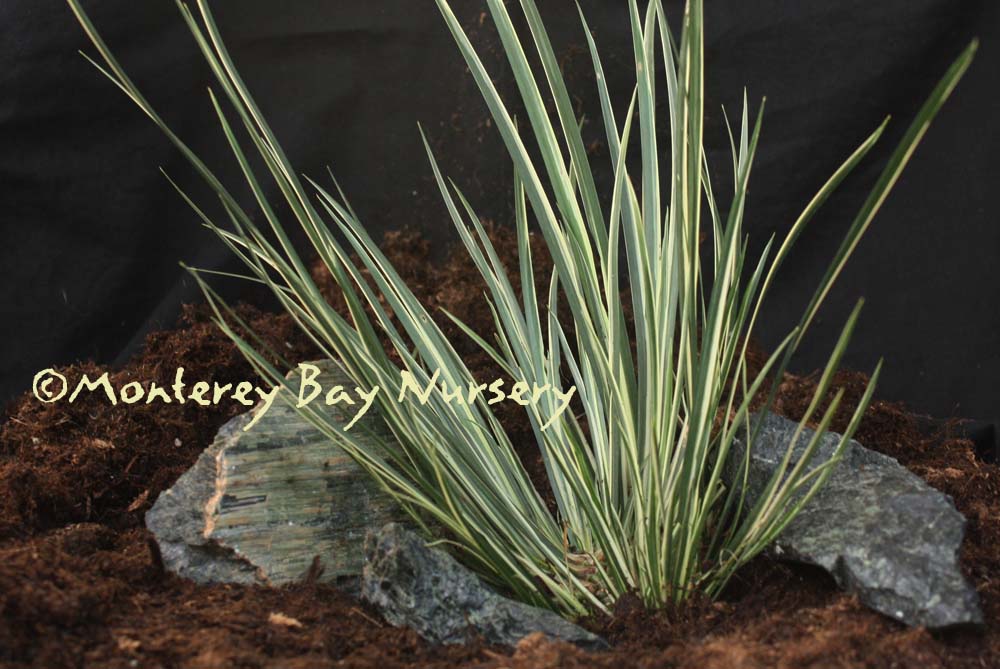
'Masamune'
DWARF FLAG (not currently in
production) a
clean white and green statement an
upright, but soft evergreen grass with variegated
leaves of green and creamy white. A natural for
pond edges, beautiful with rocks, and a fine
container subject, 6-8" tall and slowly forming a
clump. Part to full shade, average to lots of
watering. Sunset zones 3-10, 14-24/USDA 6. rev 11/2019-Suzy
Brook
‘Ogon’ habit
well known and commonly seen, recognized by a golden yellow
stripe along each edge. Slow growing, compact. rev 12/2013
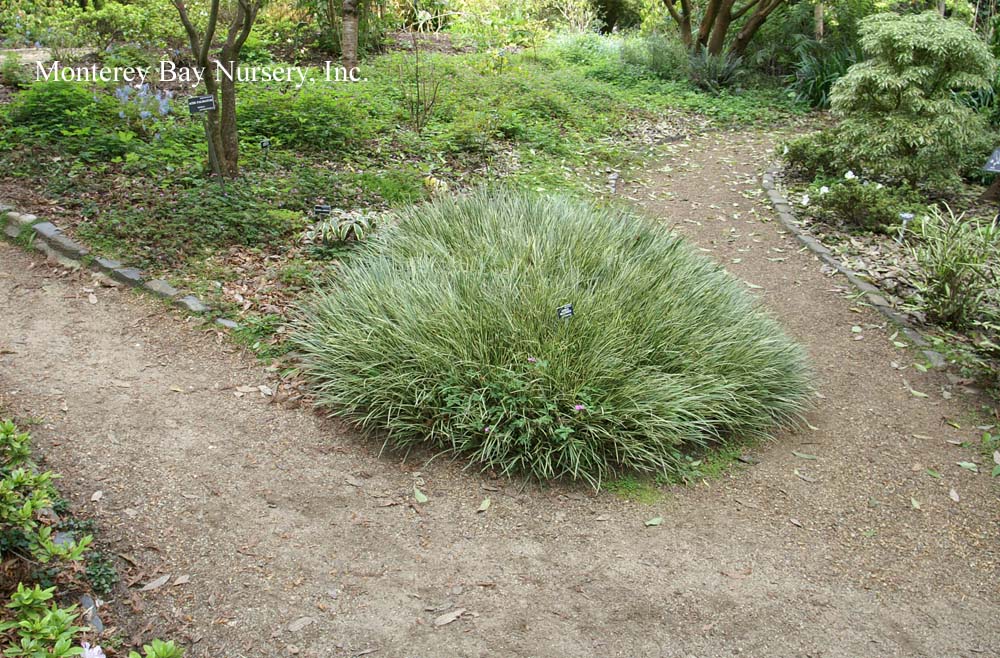
‘Variegatus’ at
Strybing Arboretum creamy white leaf margins, probably
the most commonly seen variety. rev 12/2013
Actinidia see Kiwi Fruit.
Actiniopteris australis EYELASH FERN nice
green eyelashes too cute, and a spectacular Instagram
hit-wonder, and deserves the honor. Fronds are little semicircle
of eyelash-like pinnae (leaflets). Ony grows to a few inches tall,
clumping and spreading slowly. This has turned out to dislike
growing in cold, wet soils and should be used as a house or
seasonal porch/patio subject only. It does show the amazing
ability to dry out so far you can crumple it in your hand, then
revive completely upon watering. Amazing. Shade, warm,
moist, rich, well-aerated potting soils. Native to hot, dry
regions of tropical and subtropical regions of Africa and Asia.
Polypodiaceae. rev 2/2019
Adenanthos WOOLYBUSH, JUGFLOWER about
thirty species more or less of shrubby Australian plants. All are
found in Western Australia except for the silvery-foliaged,
yellow-flowering A. terminalis (southeastern Australian
states of South Australia and Victoria) and A. macropidianus
(endemic to Kangaroo Island, South Australia). All are primarily
useful for their wonderful foliage effects though in some the
flowers are quite showy and they are at least noticeable and nice.
Plus all forms in cultivation in the US are attractive to
hummingbirds. Many are grown commercially for cut foliage. In most
species coloration of the terminal foliage intensifies during
flowering to at least some degree, becoming deeper pink or red,
especially under cool conditions. Most need at least average
drainage though one species (A. obovatus) occurs in wet
soils. All our current offerings are from the UCSC Arboretum.
Proteaceae. rev 11/2019
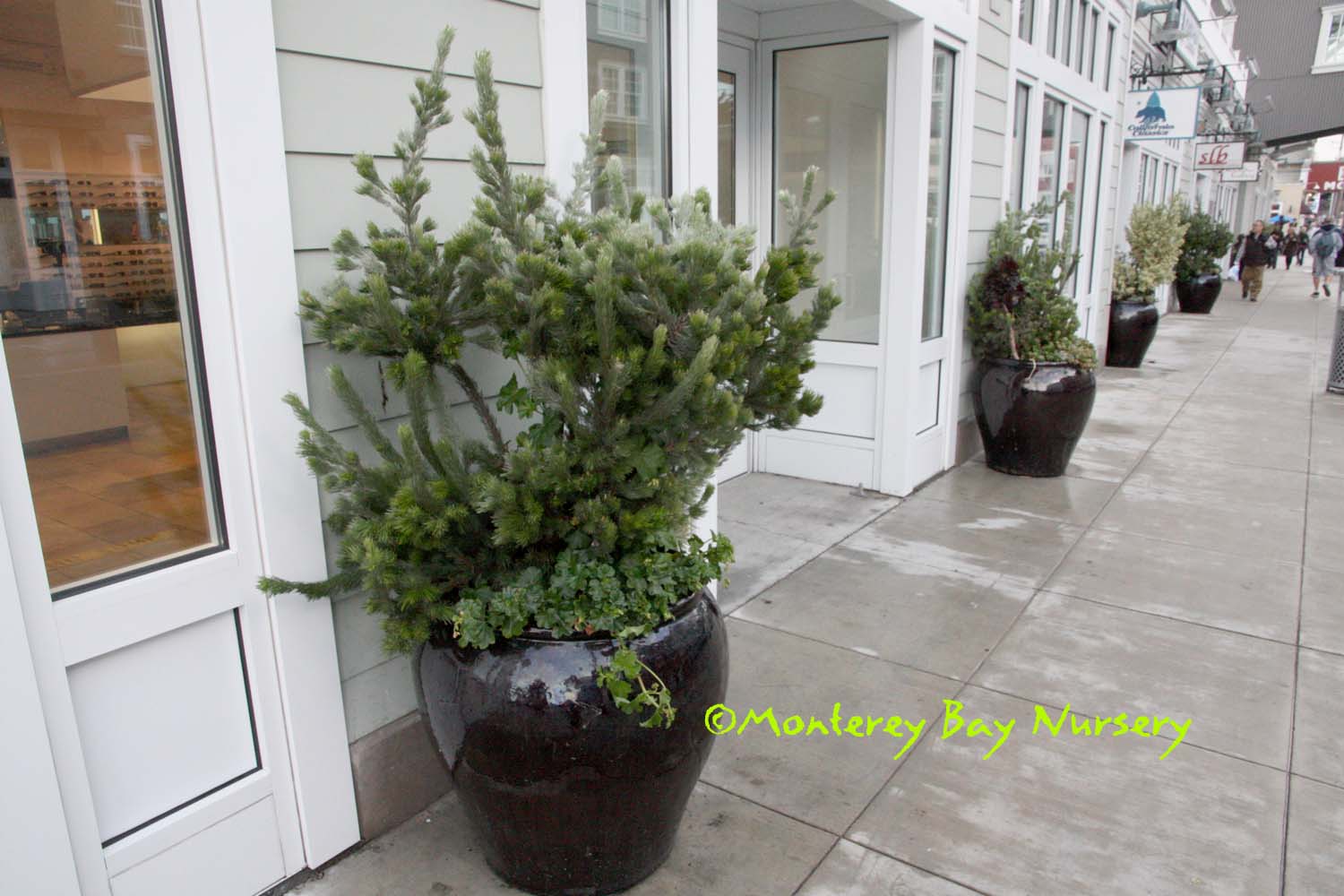
cuneatus 'Coral Drift' COASTAL JUG FLOWER, FLAME BUSH wild form, Albany District, Western Australia why you grow it, UCSC closer young plant, UCSC tiny flowers a semiprostrate to horizontally spreading shrub grown for its wonderfully silver foliage highlighted by intense coral red branch tips when pushing new growth. This is a much smaller and more compact form of a normally much taller and more open species, native to the south-facing coastal and near-inland areas of Western Australia, from the Albany district through the Esperance district. It forms a low, moderately dense spreading shrub to 3' or so, occasionally a little taller, and about 5-7' across. It is dense enough to exclude weeds, needs little summer watering in most areas when established and, being from the southern edge of the continent, is frost-tolerant enough to be used throughout most of the densely populated areas of California. The tiny flowers attract hummingbirds, cut foliage is durable, long-lasting and combines well with other elements. In most cases this can be planted, established and then ignored. Sun to half shade, moderate to very little or even no summer watering when established, tolerates frost to ~20-25°F. Makes a very nice and notably forgiving container plant, withstanding amazingly dry soil before showning signs of wilt, as do many other members of this family. UCSC. rev 12/2020
x cunninghamii ALBANY WOOLYBUSH 30+ years old, UCSC nice new growth flowers lush, dense, dark green, fine-textured feathery foliage with a nice silvery sheen. Branch tips are shiny coral red when pushing new growth vigorously in late winter to early spring, even off-season after cool or moist spells. Grows as a spreading shrub, more upright as it matures. The oldest plants at the UCSC Arboretum are about 6-7' tall and wide, with dense, nicely compact habits. Small, narrow flowers are deep red, seen in late spring to early summer. Likes average drainage at a minimum, excellent drainage and mineral soils are its favorite. This is a tough, durable plant that will withstand considerable drought, and is especially forgiving in that regard when used as a container plant. It also tolerates moderately frequent summer watering well but will survive in much of populated California on almost none after a year or two in the ground. It is relatively cold hardy, showing just light foliage damage here after being tested several times to 25F, including five nights in a row. UCSC Arboretum. rev 11/2019
'Silver Haze' why you grow it happy plant, UCSC older summer, UCSC a much more upright form of this hybrid species, with slightly darker red new growth at the tips of more vertical stems. Mature leaves are slightly green, softer to the touch than our original, regular form of A. cunninghamii. To about 6-7' tall by 8' wide, unpruned. UCSC Arboretum. rev 11/2019
sericeus ssp. sericeus WOOLYBUSH UCSC, full maturity closeup flowers UCSC Horticulture Building Santa Cruz City Hall garden trimmed hedge even!! commercial shade container Cannery Row sidewalk containers a feathery, shimmering light green to silverygreen evergreen shrub to about 5-10' tall by 7-12' wide at full, unpruned maturity. It grows with a open, upright habit until older, when it fills in to become quite dense. Its very fine foliage is its prime feature, the pale red to salmon pink flowers are small, solitary and modest. showy and occur scattered through the year, probably responding to light morning chill events. Branch tips will color subtly pink when flowering. This form is damaged below 25F but has survived 20F - barely. (We briefly grew a form I got from Paul Bonine at Xera Plants. It was grown in the Portland area some years ago and persisted until the Great Evil Freeze of 2011. If you know of any plants that made it through to the other side please contact us!). Grow this in full sun (really silvery) to almost full shade (!! - it's really green but even softer), with at least average drainage and no more than average watering, with its preference for very intermittent irrigation. It will survive on no summer irrigation in many cool-summer California climates. It usually requires little or no fertilizing beyond perhaps occasional iron treatments in heavy or alkaline soils. This is one seriously tough and forgiving container plant, seriously, and can tolerate going essentially completely dry. It will almost always revive with virtually no visible damage. Native to just a very small region in the very southwest corner of Australia. rev 11/2019
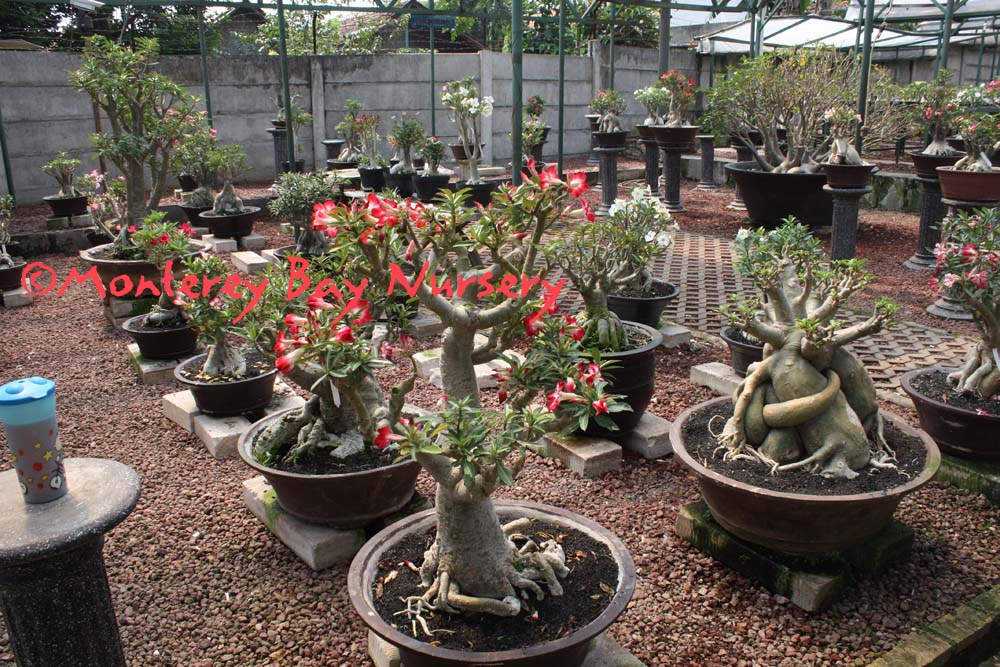
Adenium obesum (seedlings) (not currently in production) Jakarta container specimens a compact succulent shrub related to Plumeria, this species is what you would create if you put Mandevilla flowers onto a dwarf shrub with a picturesque, fantastically swollen base. These seedlings will eventually produce large, trumpet shaped flowers to about 2-3" across in dark red, pink, stripes, white, with white throats, or picotees, you name it. They will also form the wonderful, coveted swollen bases very quickly compared to TC forms, which have known, uniform flower color in their favor. But most of the satisfaction comes from that incredible trunk, and seedlings are therefore the quickest route to happiness. Bloom time is essentially all the time it is growing, which is as long as the plant is warm, watered, occasionally fertilized, and is mature enough to form flowering wood. It should dry between waterings, and the real Achilles' Heel is that is really, really, really doesn't like the cold, wet soils (below 50F) typical of California winters. The way to grow this successfully outside the subtropics is as a patio plant you later move inside to a bright spot, or as greenhouse/sun window specimen. It needs a frost protected, mostly dry winter rest period, during which it will be leafless. We originally started growing this as a wild, carefree experiment, since I knew nothing about the plant. Seeing it on our availability list Kathy Echols of Danville mentioned that she has it as a container plant at her house and it absolutely blooms its head off, just covered, for about ten months of the year in return for very little care. Full to mostly full, hot sun. Wait until leaves begin to grow in spring before resuming watering (the plant will let you know when). Outside in Sunset zones 23, 24/USDA 10, but as a container plant anywhere. Be advised this plant's sap is highly toxic, especially in concentrated form, enough so that sap dried onto arrow heads is used in hunting by native East African hunters. East Africa, Madagascar. Apocynaceae. rev 11/2011
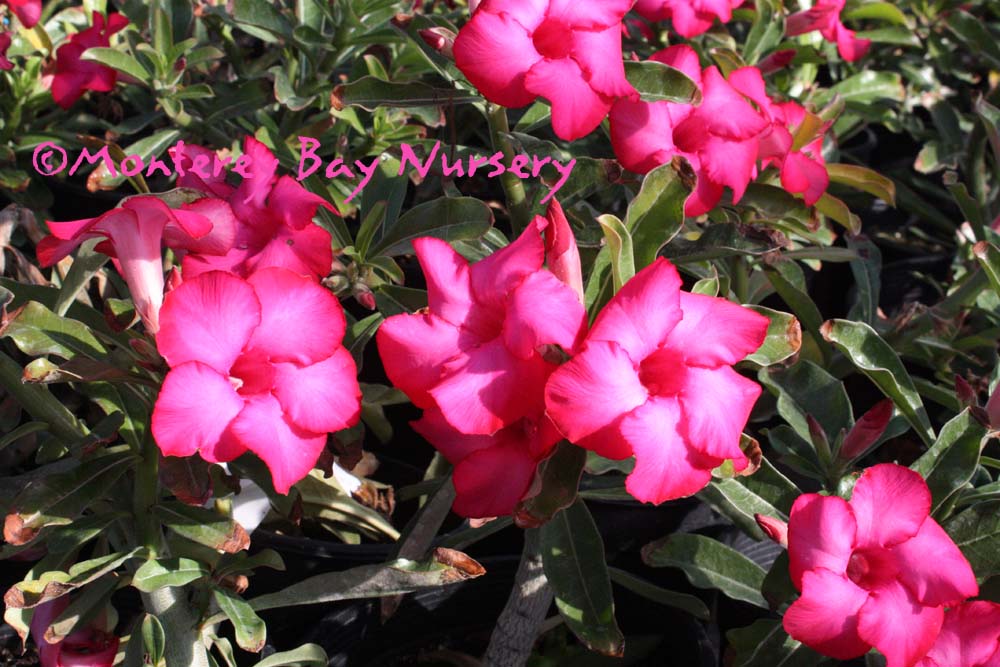
'Evelyn Marie' (not currently in production) DESERT ROSE flower bears an almost continuous show of tubular, brilliant rose pink flowers over a very long period during the warm season. It eventually forms a compact shrublet to a foot or two tall as a container plant and reward you with an unbelievable display of flowers. Outside in frost free, relatively dry winter, hot summer climates it can even reach 4-5' tall but I've never seen one that big in California except in the desert greenhouse at a botanic garden. They are even used for bonsai, where you are guaranteed a swollen trunk. Supposedly highly rot prone we have lost very few so far in our production blocks. Full, hot sun, careful watering, moderate regular feeding, good drainage, no frost. rev 11/2011
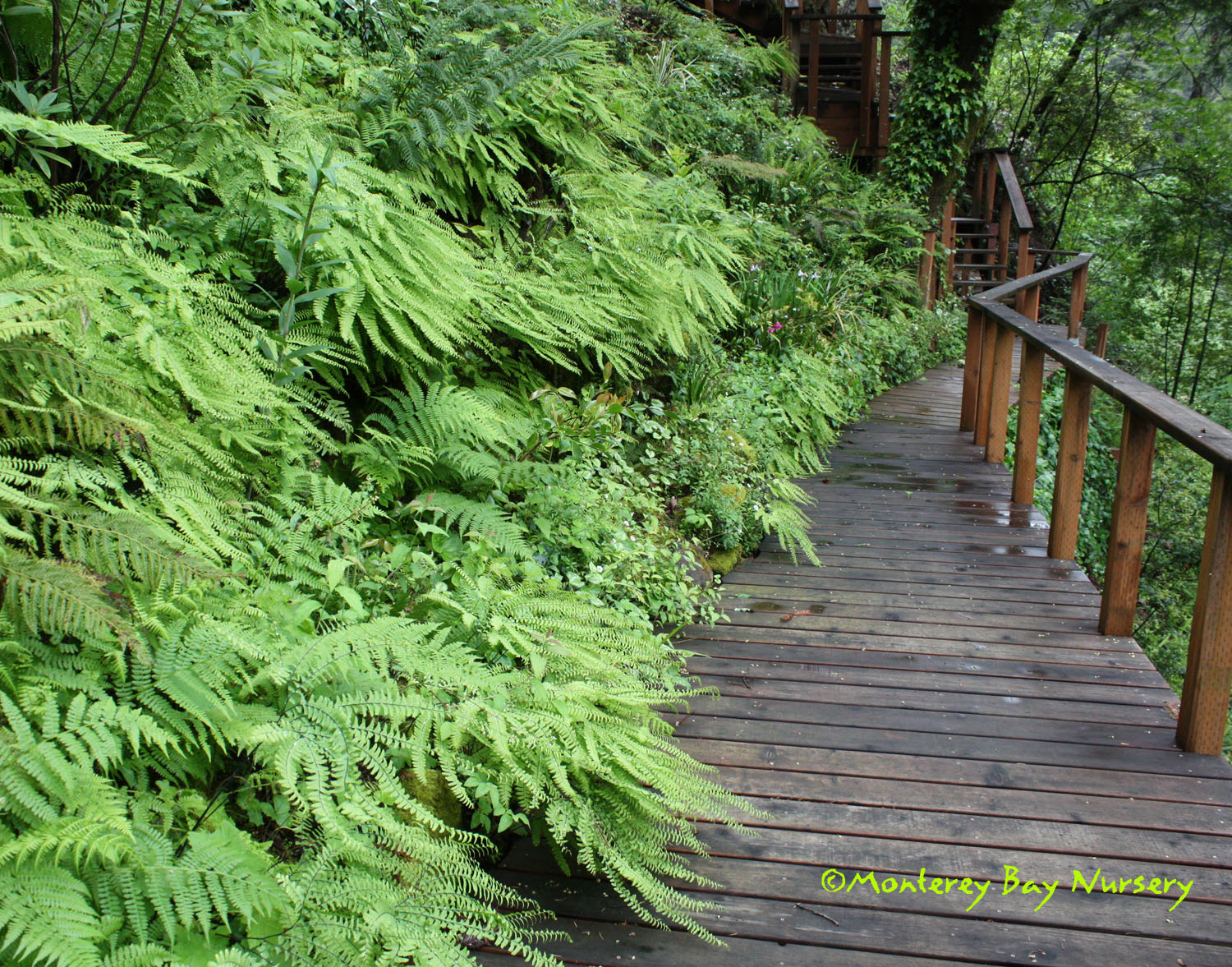
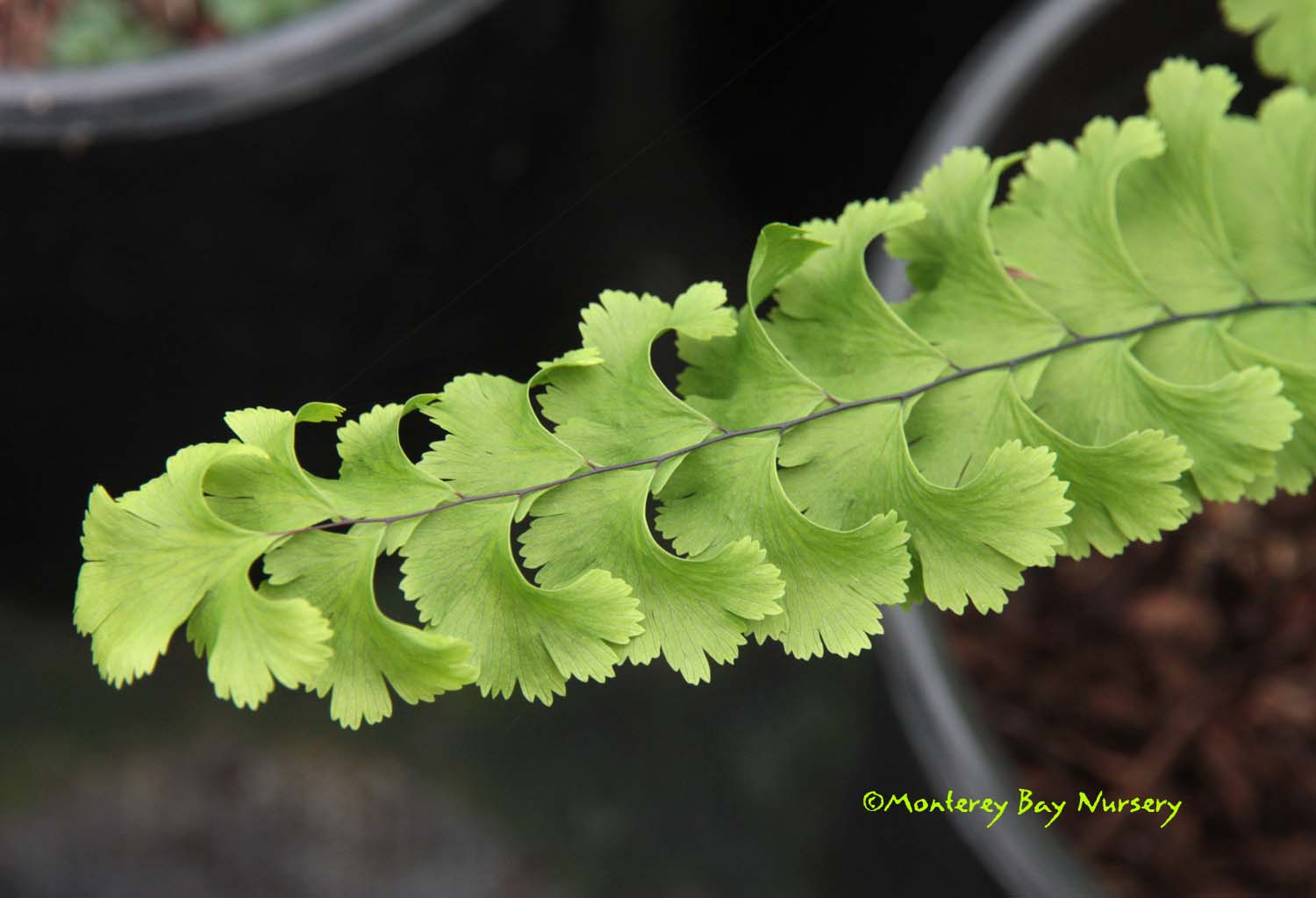
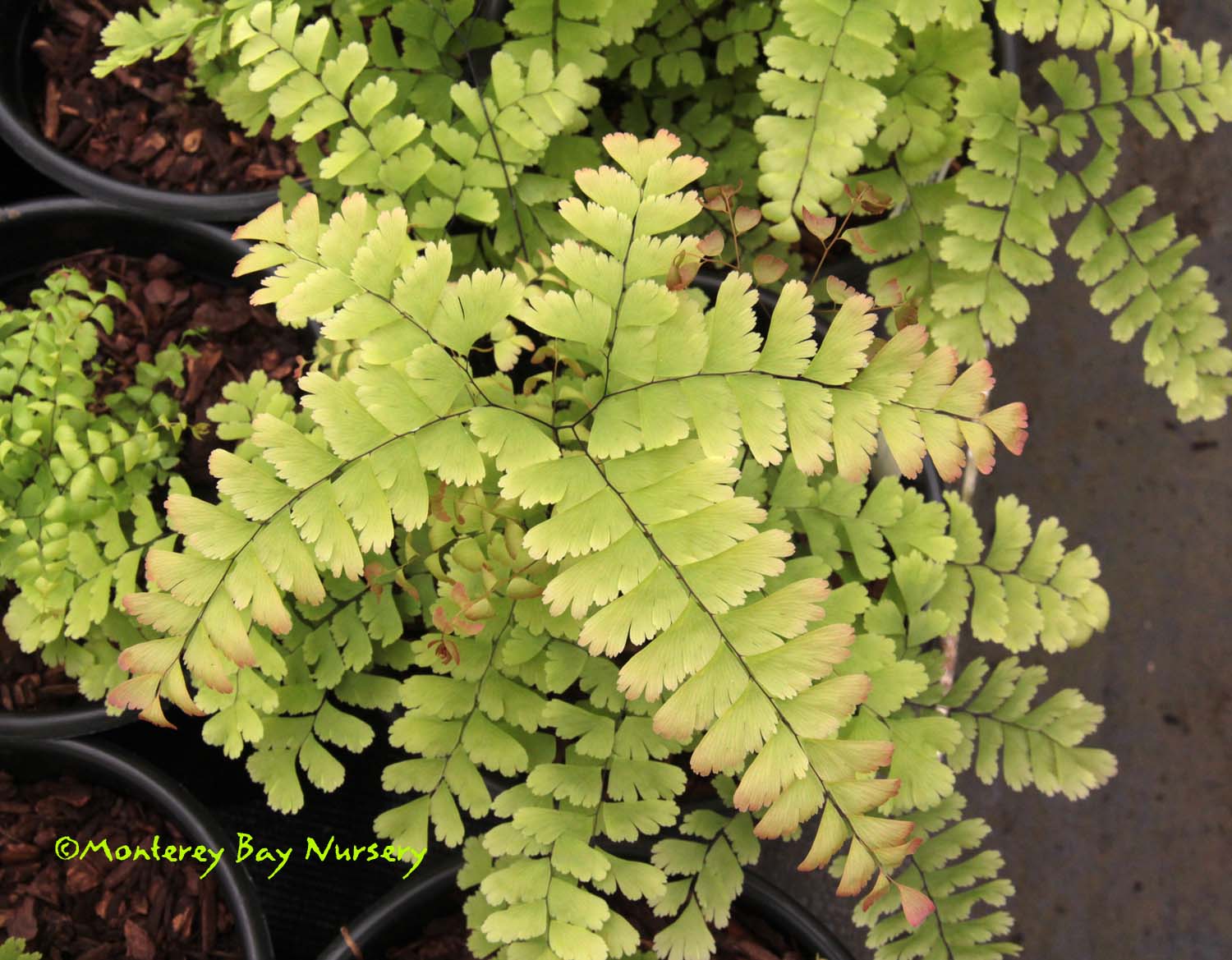
Adiantum MAIDENHAIR AND FIVE FINGER FERNS
evergreen to deciduous ferns of relatively small stature. Many
will tolerate full sunlight based on water availability; some can
take full direct summer sun as long as they are constantly
saturated. Native species are usually found on limestone
seeps. Adiantum species can usually be given a
complete cutting back in late winter as the new fronds just start
to push if they don't go naturally deciduous by themselves. The
only plants that won't be renewed by this treatment will be plants
that are struggling. Those should not be cut at all. All are
excellent in containers. Some love being kept standing in a
shallow saucer of water. Polypodiaceae. rev 8/2018
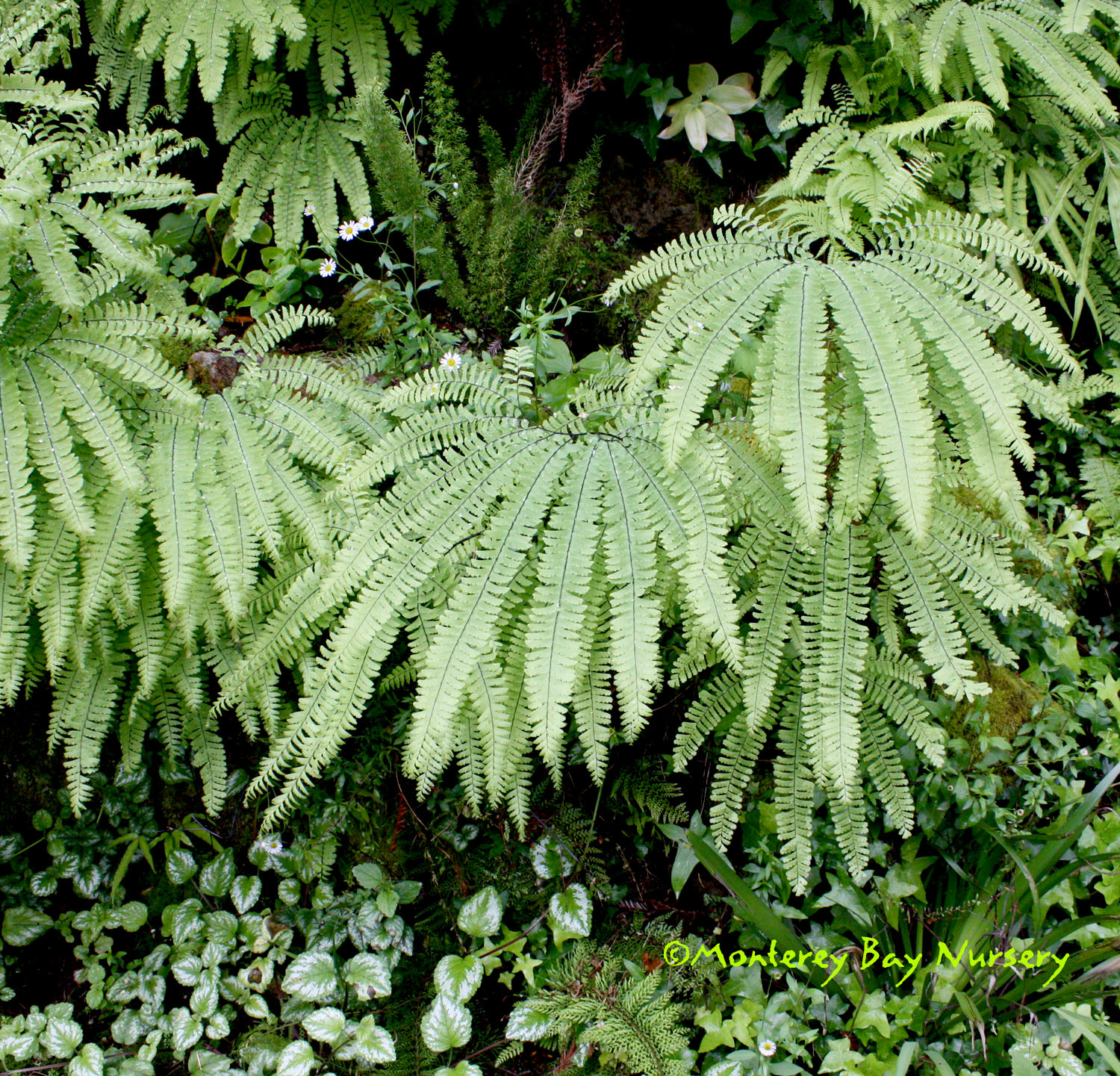
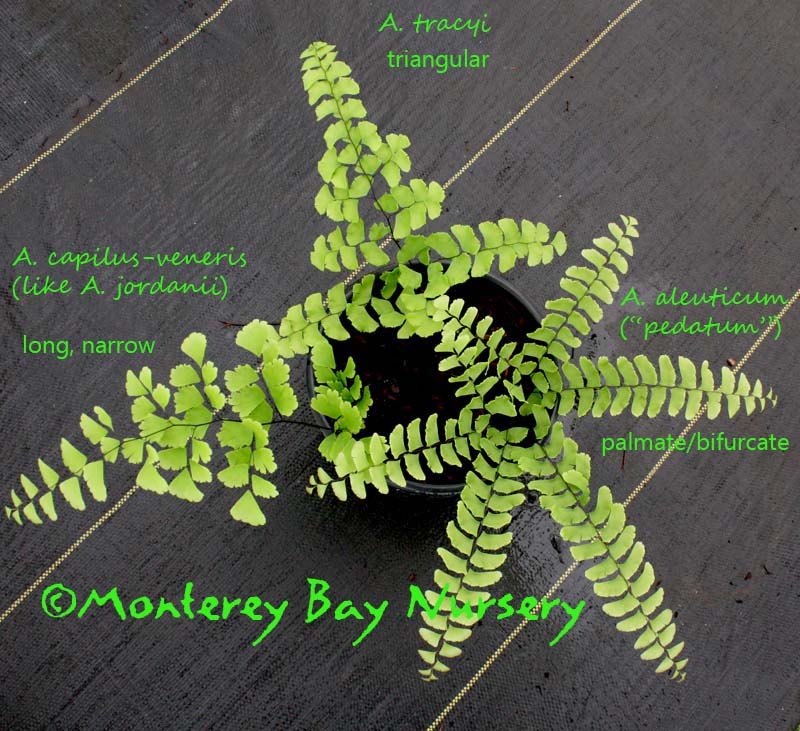
SEPARATING A. ALEUTICUM FROM A. PEDATUM we face this problem constantly as we sort out plugs purchased as "A. pedatum." Very few container growers produce ferns from spores themselves - it is a long and specialized process. Many of our fern species vary from crop to crop, even when purchased from the same plug grower. Many of the fern propagators outsource their spore supply for common species and purchase from several vendors, who themselves can depend on another source for actual spore collection. As the small plants begin to fill out their containers we separate them here by observed characteristics but results are imperfect. If you are out in the wild it's relatively simple. In the West you will find A. aleuticum - that was easy. If you see it in the East it is A. pedatum . . except . . . if you're at one of the very few, very small and very special places which retain disjunct populations of A. aleuticum, or the even rarer and more special A. viridimontanum, found on serpentine and talus in the Green Mountains of New England. In cultivated or horticultural material we look for six features:
1). stature - 12-18" tall (A. aleuticum) vs. short, 6-10" tall (A. pedatum)
2). overall frond shape or outline - more hand-like, with a partly open side and fingers pointing at least somewhat downwards to fully pendant on mature fronds (A. aleuticum) vs. very round or circular overall outline for A. pedatum and more horizontal or even slightly upright-canted fingers (A. pedatum)
3). finger lengths - long (A. aleuticum) to very long vs. short (A. pedatum)
4). and therefore leaflet/pinnae counts - very many per longer finger (A. aleuticum) vs. fewer per shorter finger (A. pedatum)
5). shape of individual leaflets/pinnae - more feathery and deeply cut (A. aleuticum) vs. more entire or just sparsely or coarsely cut (A. pedatum) - this is the least dependable characteristic
6). and last, degree and timing of shedding leaves - more evergreen in winter and/or generating new fronds with the onset of short days, and/or facultatively summer-deciduous in the landscape (A. aleuticum) vs. partly or completely winter-dormant, even in the greenhouse, and never surviving even a partial summer dry period in the garden or landscape (A. pedatum)
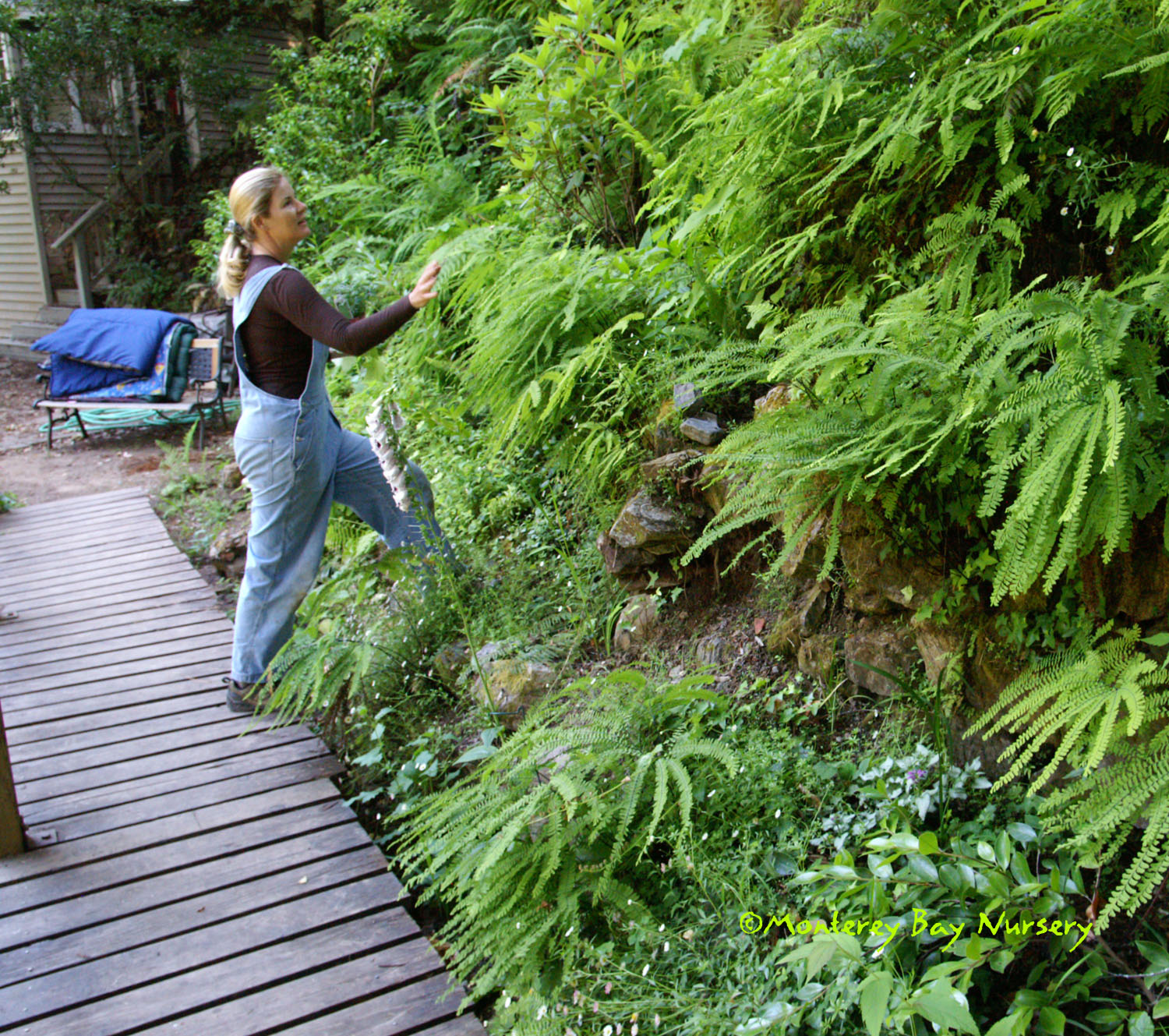
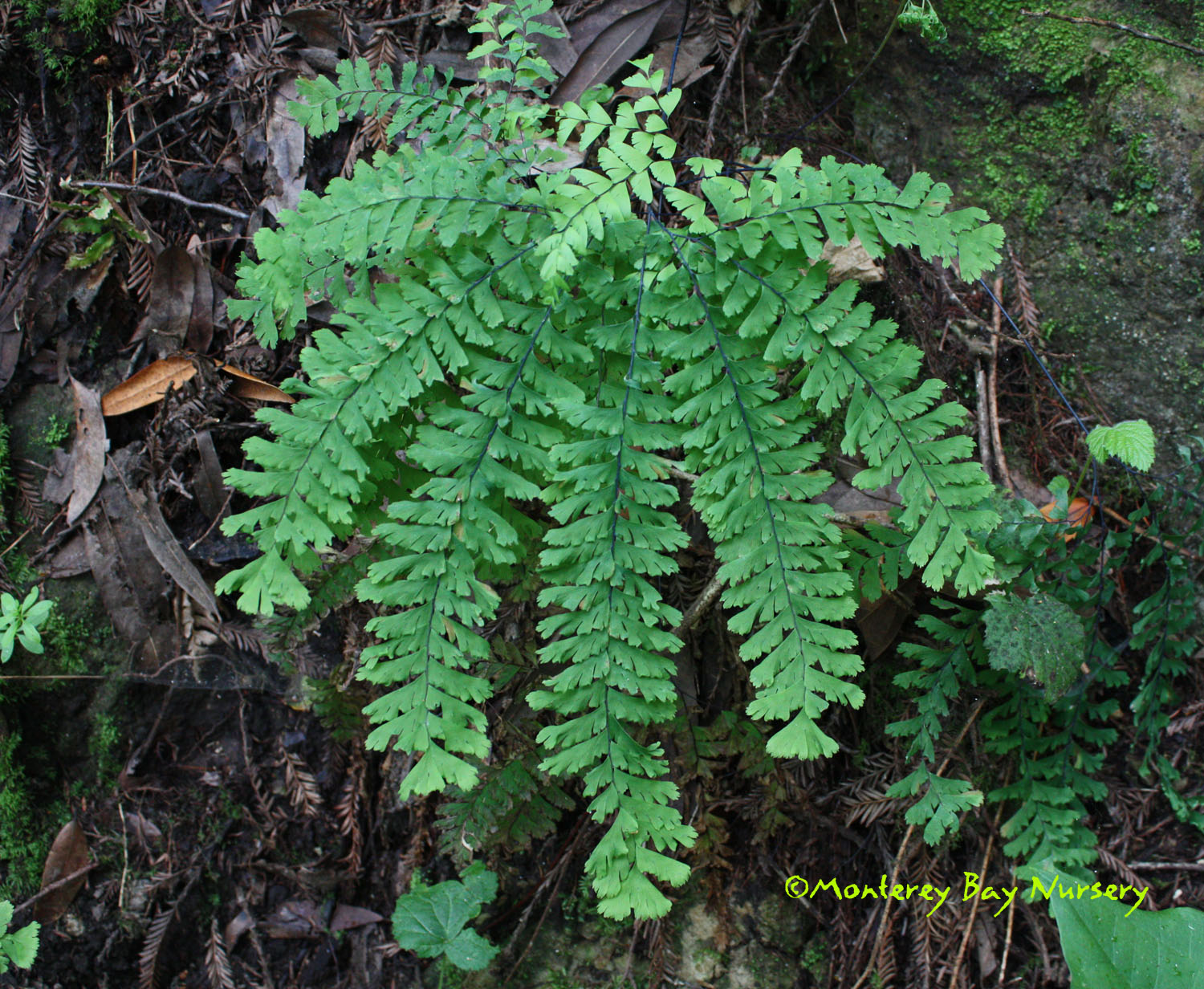
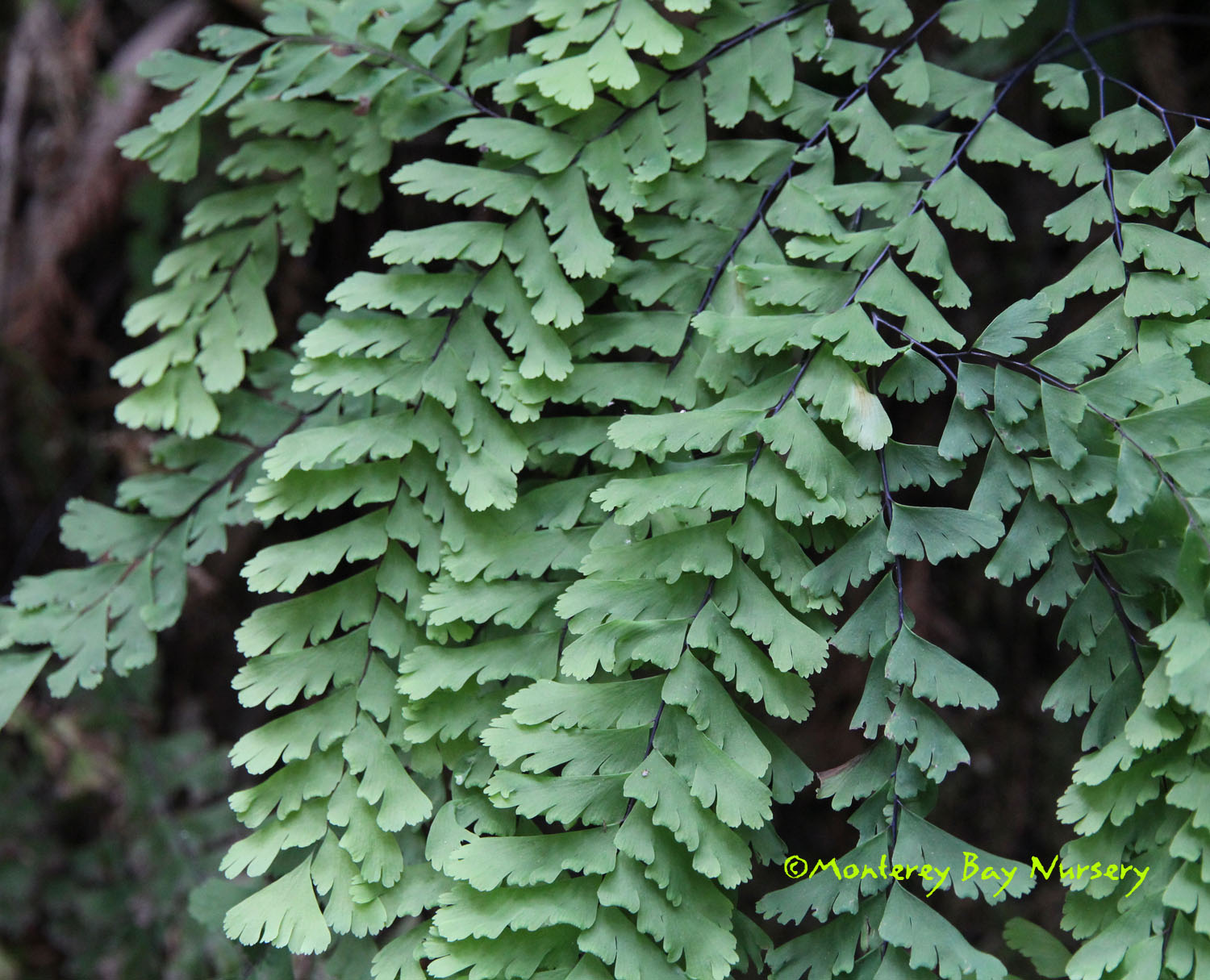
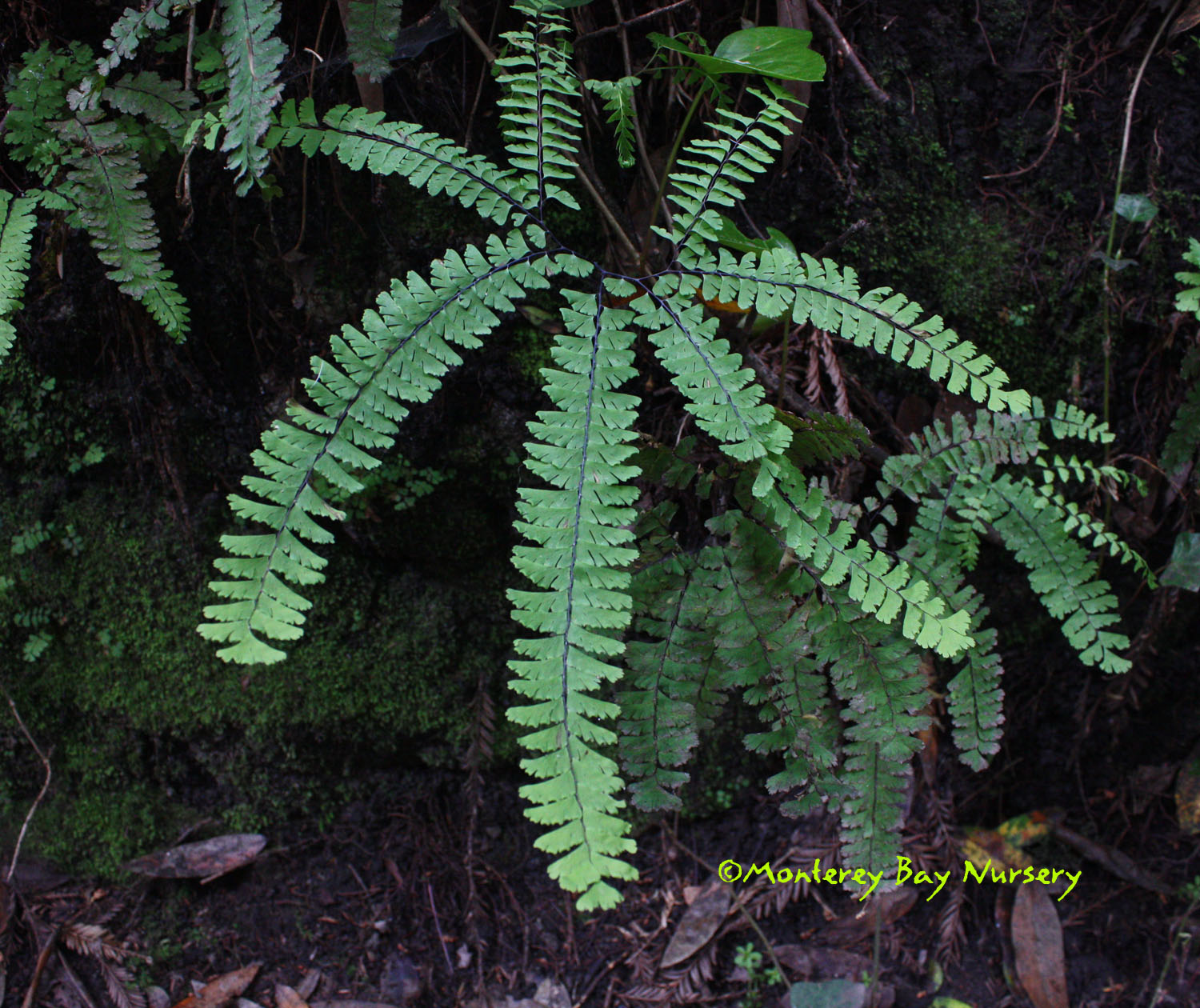
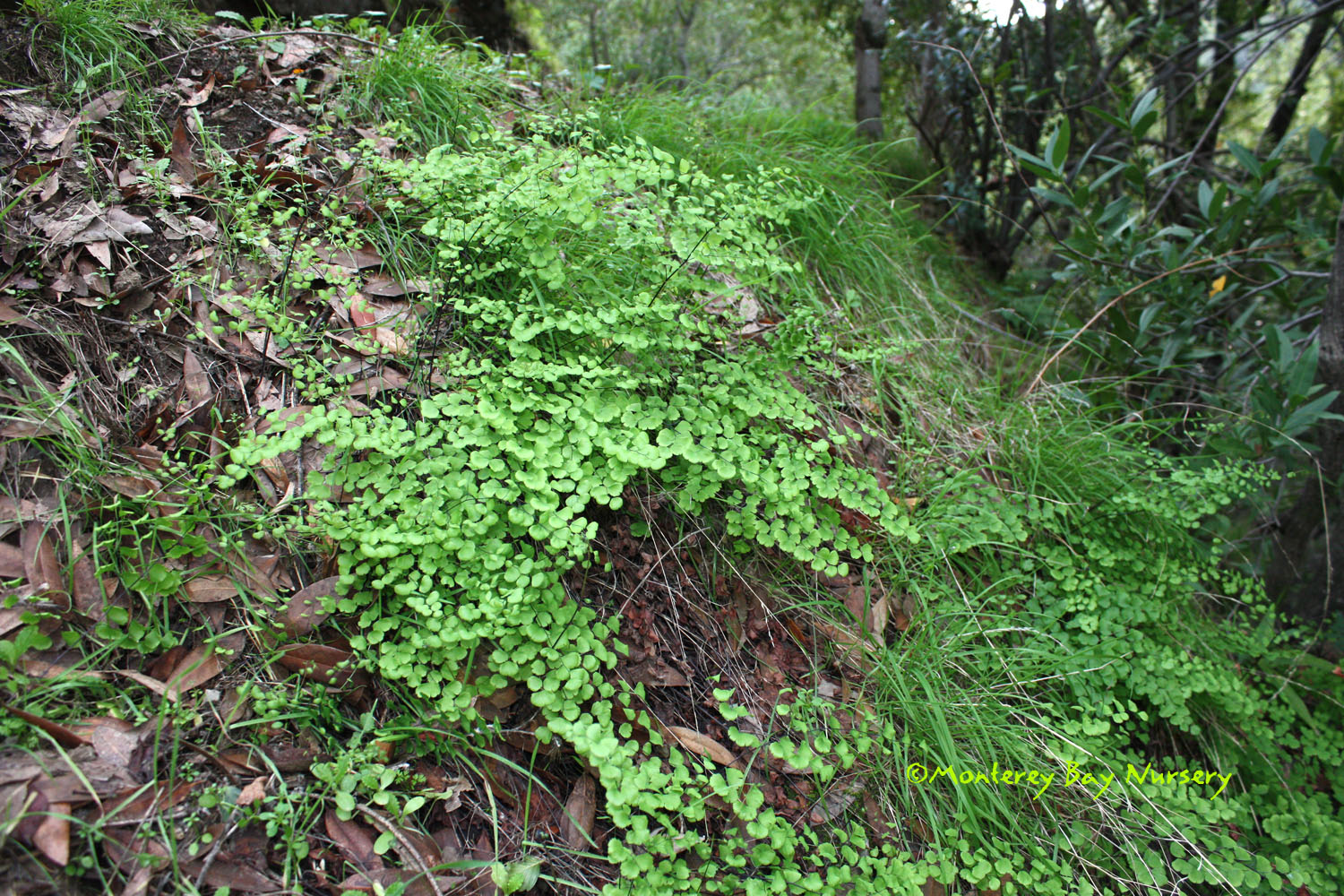
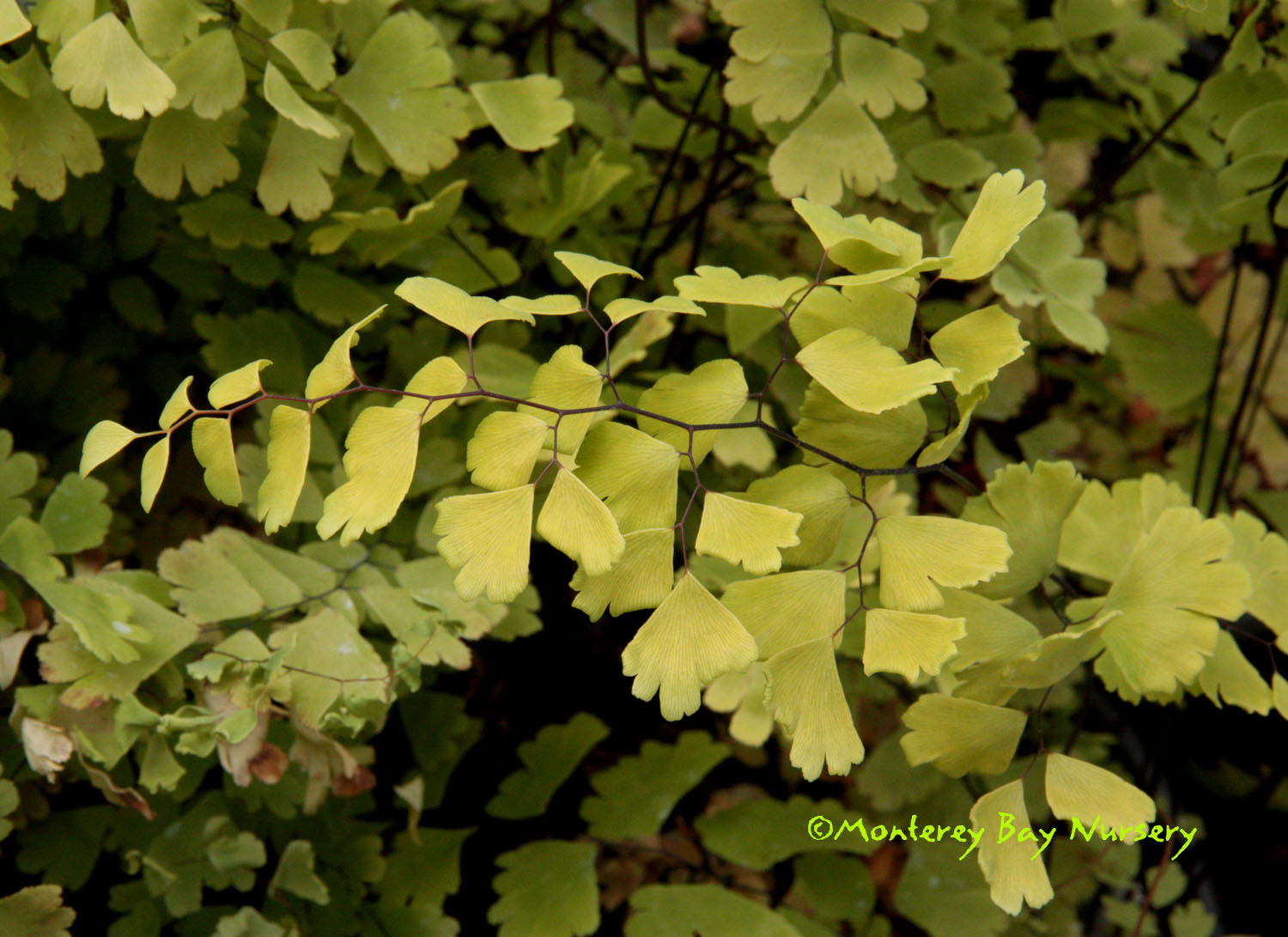
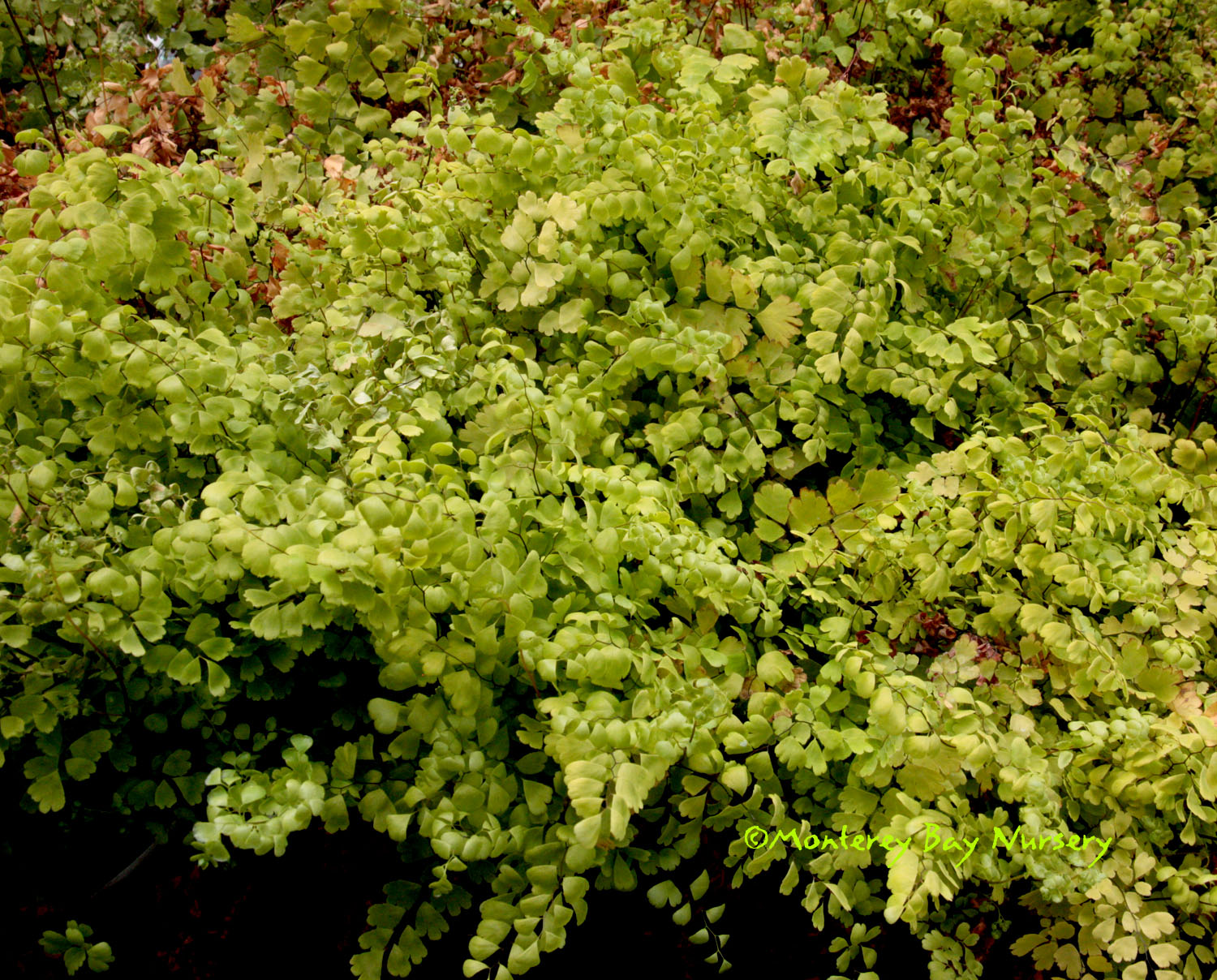
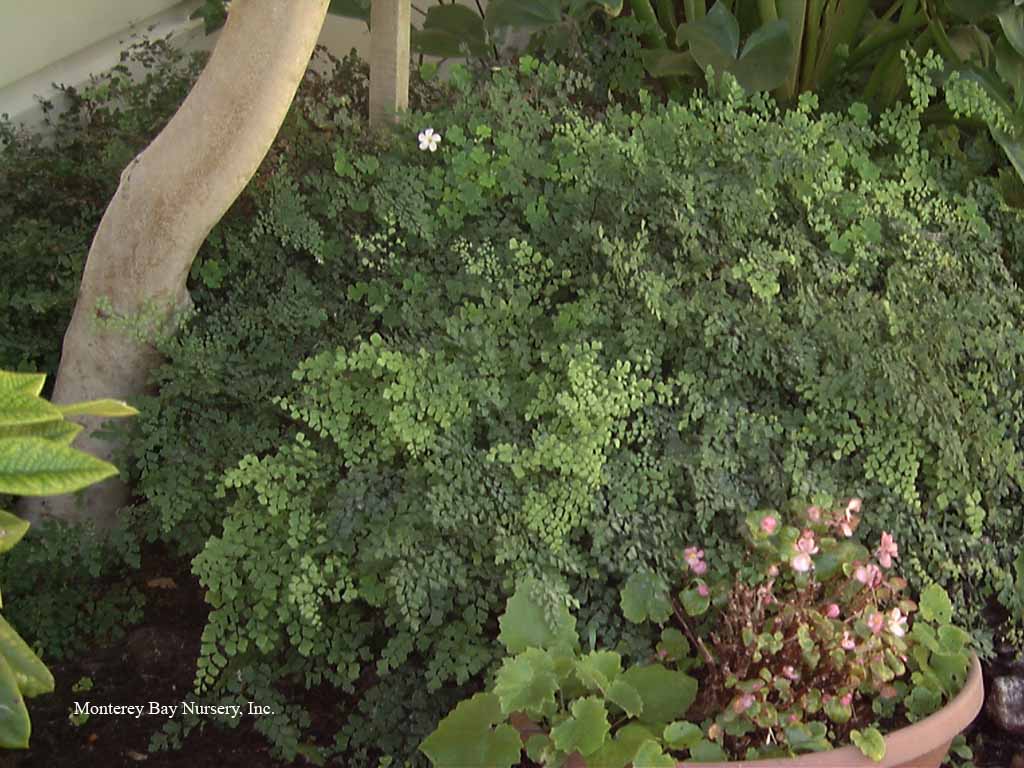
There's my best criteria for now, I'll update here if I find easier or more distinct identifiers. rev 1/2021capillus-veneris SOUTHERN MAIDENHAIR FERN wild, Wheeler Gorge outside Ojai frond detail compact juvenile/vegetative phase taller/longer, more vertical reproductive phase a rather short, evergreen fern of very light, airy texture that appreciates at least three quarters shade, a relatively constant source of water, and moderate temperature levels. This is also one of the easiest Maidenhairs to grow, forming dense colonies of very dark green leaves by sending out short underground stolons. It has the vigor to fill beds or planters and exclude weeds. It took me decades to finally recognize this plant is relatively dimorphic, with a more compact, smaller-leaflet juvenile or vegetative phase and a taller/longer, more open, larger-leaflet mature or reproductive phase. It can take a freeze due to its stoloniferous nature, but don't expect it to survive in cold winter areas. Worldwide in distribution, in tropical and temperate regions. The race found growing in the wild in California often occurs on limestone or dolomite seeps. Distinguished from our other native species, A. jordanii, by its pinnae (leaflets), which are cut and irregularly margined in A. capillus-veneris versus rounded with smooth margins in A. jordanii. rev 4/2021
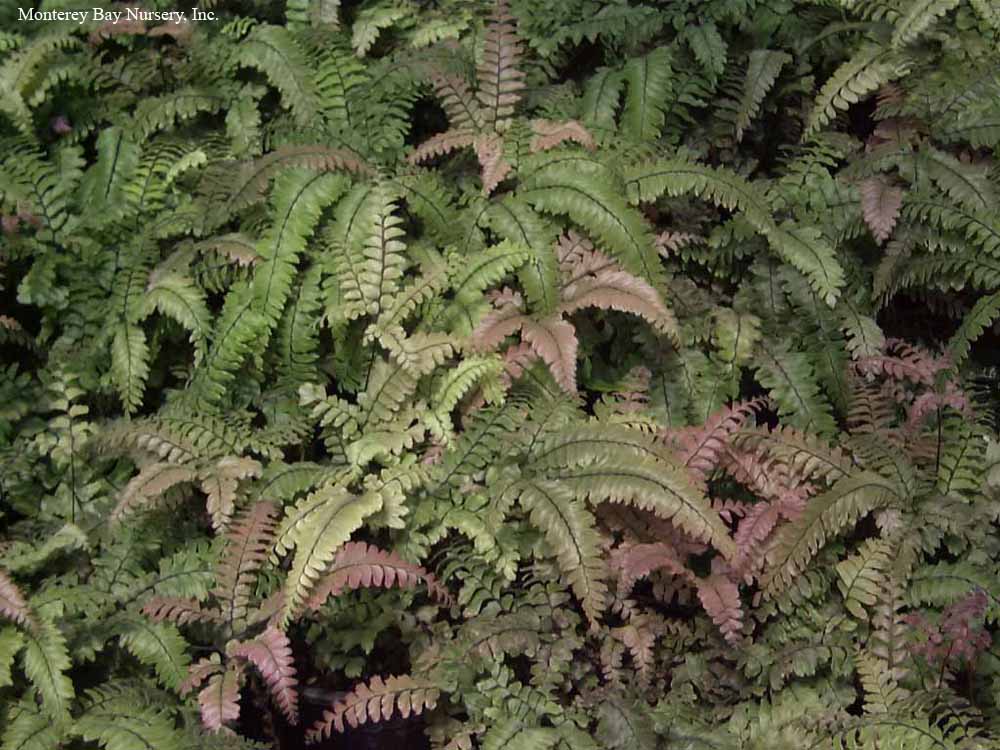
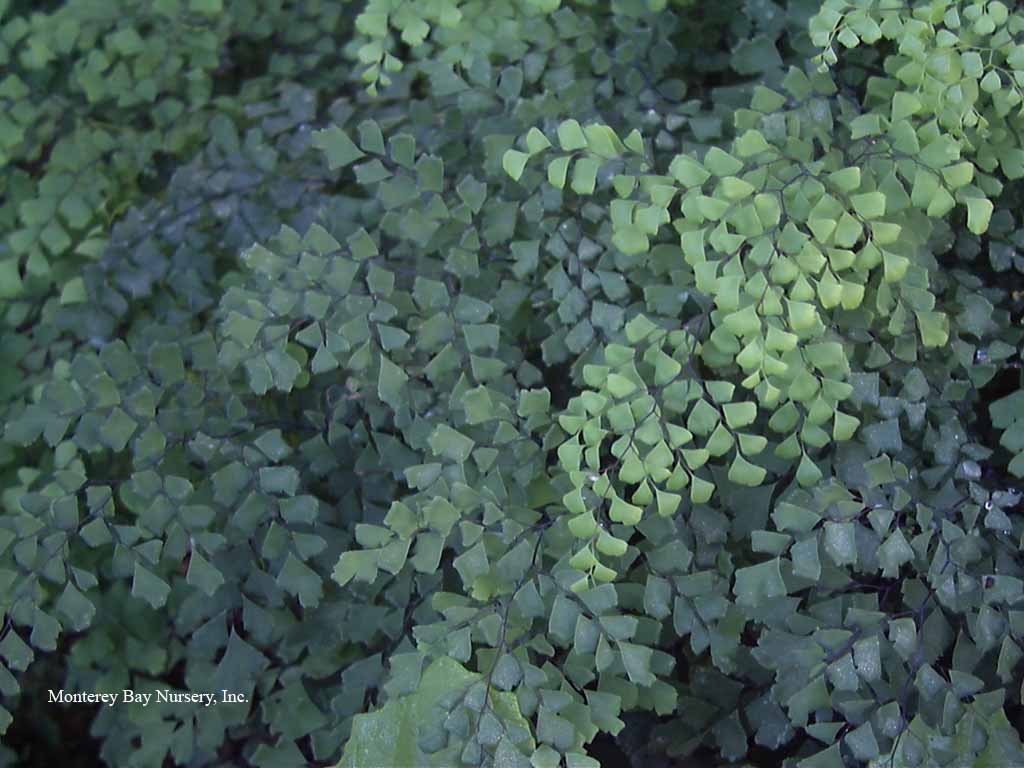
‘Rosy Maid’ fronds new growth is brighter rose pink, fronds are a little more compact, with smaller, slightly ruffly segments. rev 6/2020
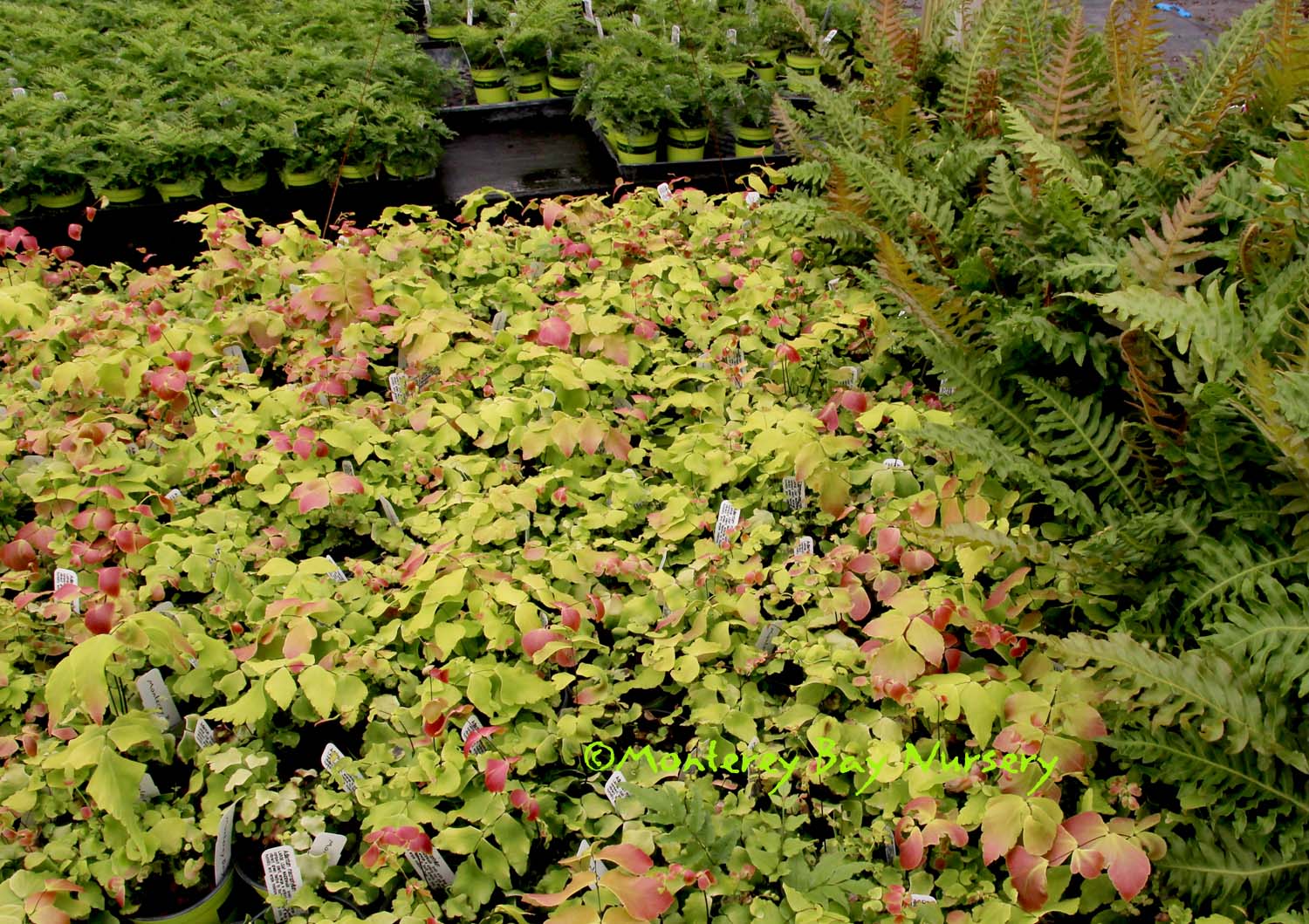
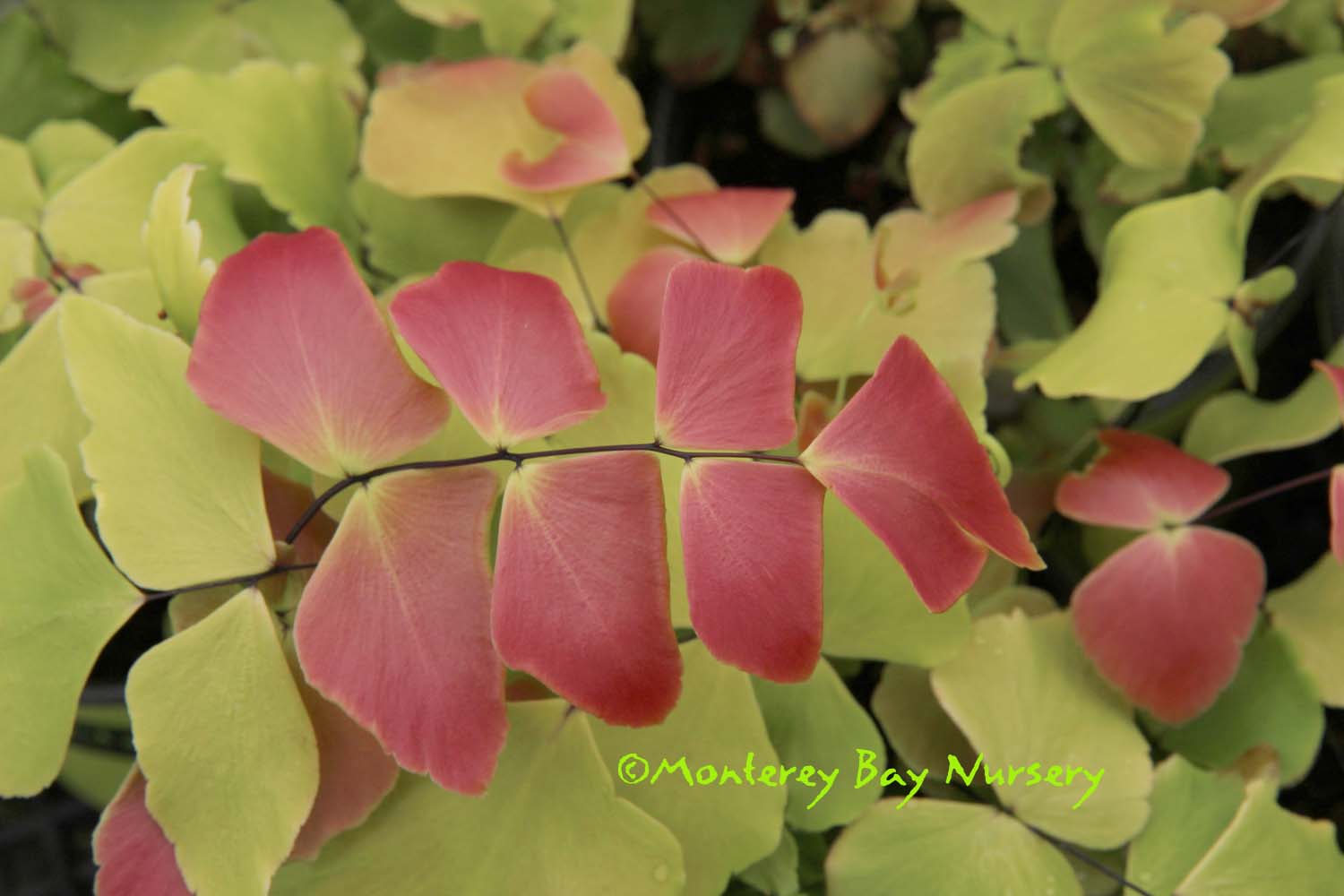
macrophyllum LARGE-LEAVED MAIDENHAIR, GIANT MAIDENHAIR new frond young crop another new frond this has been the least temperamental of "the biggies," with our first small crop actually surviving all the way through one winter in an almost-unheated greenhouse (~40F). The other rare giant species, A. peruvianum, is even more incredible but a hopeless tease. It's a dedicated warm/hot growing subject, and reliably falls apart dramatically and permanently once temps fall below about 50F, like oh-so-many other truly tropical "greenhouse queens" as I call them (African Mask Plants, Cavendish-type bananas, the showy-bract Anthuriums, etc.) We have hopes we can reselect our own strain for even more cold-tolerance that would extend this plant's usefulness. Probably 12" tall by about as wide? Grow it in moderate to low light shade with regular watering, at least some moisture always available at the root but a little drier in winter. It makes a great houseplant for a humid kitchen or bathroom, and a wonderful porch, patio or outdoor/indoor container plant. Outdoors USDA zone 10 until further notice. American Tropics. rev 8/2018
'Mairisii' MAIRIS' HARDY MAIDENHAIR FERN close Santa Cruz Pacific Garden Mall a worthwhile variety, being sterile and thus providing more vigor and forming denser rhizomes than many other hardy maidenhair ferns. It is very frost hardy, but deciduous with any cold. The late, very great Barbara Hoshizaki, our current best standard for fern references, states this is a hybrid of A. capillus-veneris, the Southern Maidenhair, possibly an Eastern US strain, with probably A. aethiopicum, that arose in the 1800s at Mairis & Co. Nursery in England. Clumps slowly grow to 18" tall, displaying that beautiful, lacy, airy foliage. This is a great companion for cyclamen in an autumn container, and is one of the better varieties for shade landscape use in challenging, abused (i.e. commericial) situations. Regular but intermittent waterings, rich, moist, organic but well drained soil (=peat moss! yes! loves it!) . Sunset zones 5-9, 14-24/USDA 7. rev 6/2020
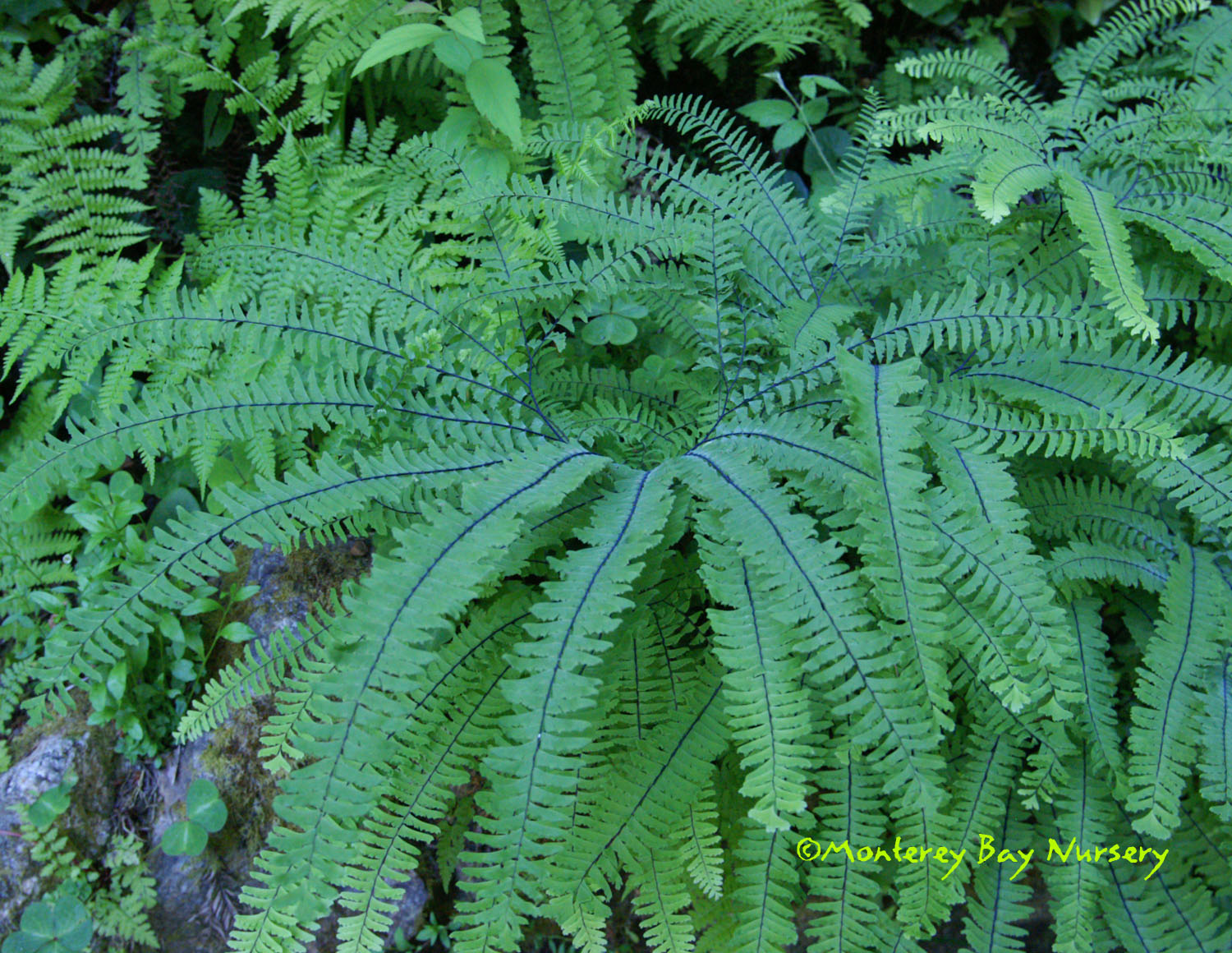
pedatum EASTERN FIVE-FINGERED FERN round frond outline short stature frond wraps around round fronds round fronds (see discussion under A. aleuticum, above) this species is only found growing wild east of the Rocky Mountains. It is shorter than our Western native counterpart, with rounder fronds when viewed from above, shorter fingers and thus correspondingly fewer pinnae/leaflets on each. It behaves as mostly winter-deciduous in our long production experience, even in our unheated fern greenhouses. Cultivated plants are mostly fancier and more ornate than seen in most images of wild populations, likely the result of propagation by spores harvested from fancier or nicer-looking, more domesticated individual stock plants. Each provider sends us a slightly different strain, and within these strains there is usually at least moderate variation. Sometimes the variation between individual plants is quite large though. Several strains are supplied to us, usually more compact and lush than most of what you'd find growing in the wilds of the East. Grow this fern in part sun at most to full, deep shade with regular watering spring-fall. USDA zone 3. rev 6/2020
'Imbricatum' shingled leaflets shingled ornate leaflets rosy new growth though listed by Barbara Jo Hoshizaki as a variety of A. aleuticum what we receive fits better in A. pedatum, with shorter stalks, shorter fingers and a very round overall frond outline viewed from above. Their smaller size means it is a slower crop for us, especially because it is consistently winter-deciduous even in our unheated greenhouses, with some variation in time and depth of dormancy . We're often sent this as regular A. pedatum or vice versa, depending on whether the vendor thinks we'll notice (we do!) or even care (we do!) and with plausible deniability since it is technically still that species, just a special form. These intriguing and captivating "Venetian blind" forms are always highly variable but when mature all will show some degree of tightly overlapping, "shingled," usually backwards-curving and/or ornately-frilly pinnae/leaflets. In extreme cases nice, mature specimens can look like a ball of soft green fluff. Being a shorter, smaller form it is slow to achieve sellable size. Interestingly David Jones, in his Encyclopaedia of Ferns, says this form "is often confused with A. aleuticum. It has crowded, stiffly erect fronds which are markedly glaucous." His image of A. pedatum 'Japonicum' (supplied by his friend Rodger Elliot) shows plants more or less identical with what we receive as 'Imbricatum.' He notes for 'Japonicum' that it is "a form from Japan with pinkish-bronze new fronds," which we have observed sometimes in what we receive as 'Imbricatum.' Barbara Jo equivalates 'Imbricatum' with ssp. subpumilum, which David describes as a West Coast/Vancouver Island dwarf variety with fronds "somewhat glaucous and pinnules [leaflets] overlap to give a crowded impression. Very adaptable in cultivation." But then Barbara Jo goes and describes A. pedatum as also occurring in Eastern Asia. Are you confused yet? rev 6/2020
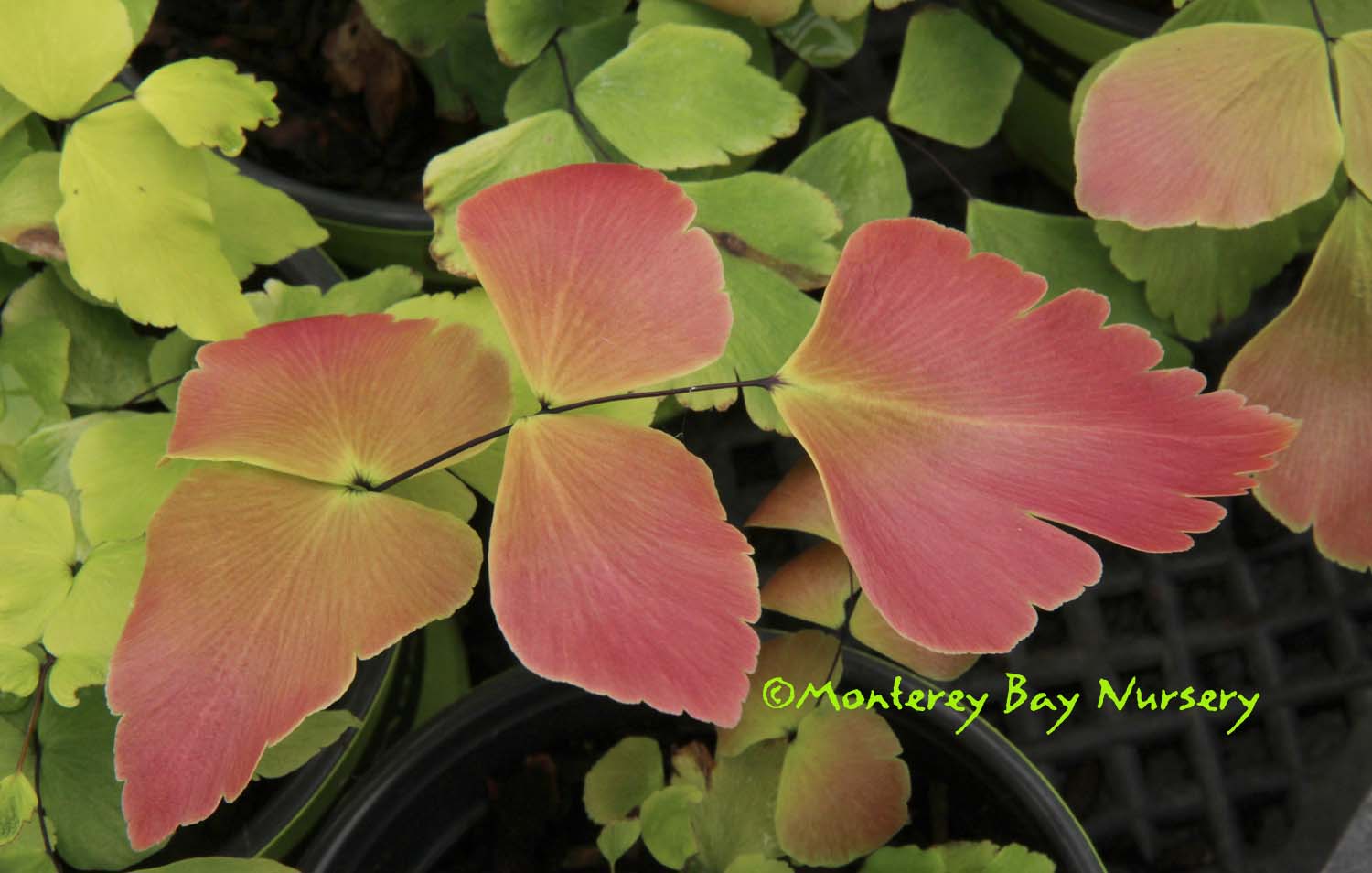
peruvianum SILVER DOLLAR MAIDENHAIR, GIANT MAIDENHAIR a tropical to subtropical species from central South America, with leaflets to about 1 1/2" across held in long chains on mature, happy plants. This species has seemed more sensitive to cold soils in winter than A. macrophyllum, above, but in our new secret fern container mix it might prove to be as-durable as it's cousin, maybe even more so. In very warm, shady sites and in rich, moist, acidic soils choice specimens can reach an incredible 3' tall and wide, displaying long chains of the gigantic leaflets. New fronds emerge bright coppery red then light chartreuse and deeper green at full maturity. This is an indoor or porch/patio item for much of California but bring it in during really cold spells, that's when it seems to go downhill. rev 8/2019
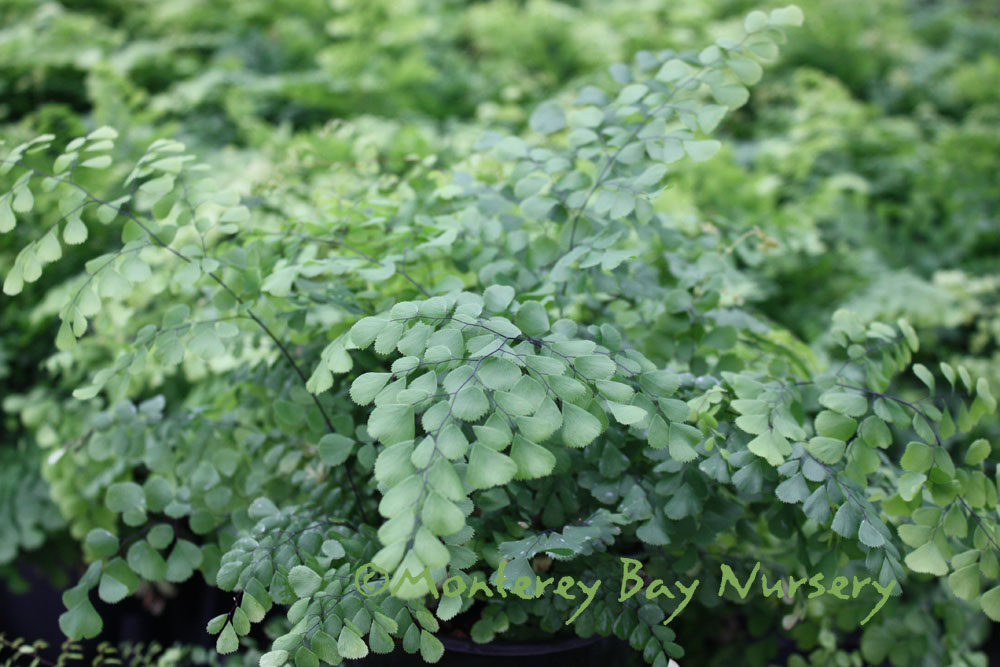
raddianum DELTA MAIDENHAIR FERN foliage open, tall, airy fronds bear rounded to very delta-shaped pinnae (leaflets). Another very easy species. Great in containers, and probably the best variety for the garden. This species and its varieties will tolerate infrequent watering if kept from direct sun. Grow in frost-protected outdoor sites in zones 8-9, 14-24/USDA 9 or as a house/greenhouse plant. Central and South America, West Indies. rev 7/2015
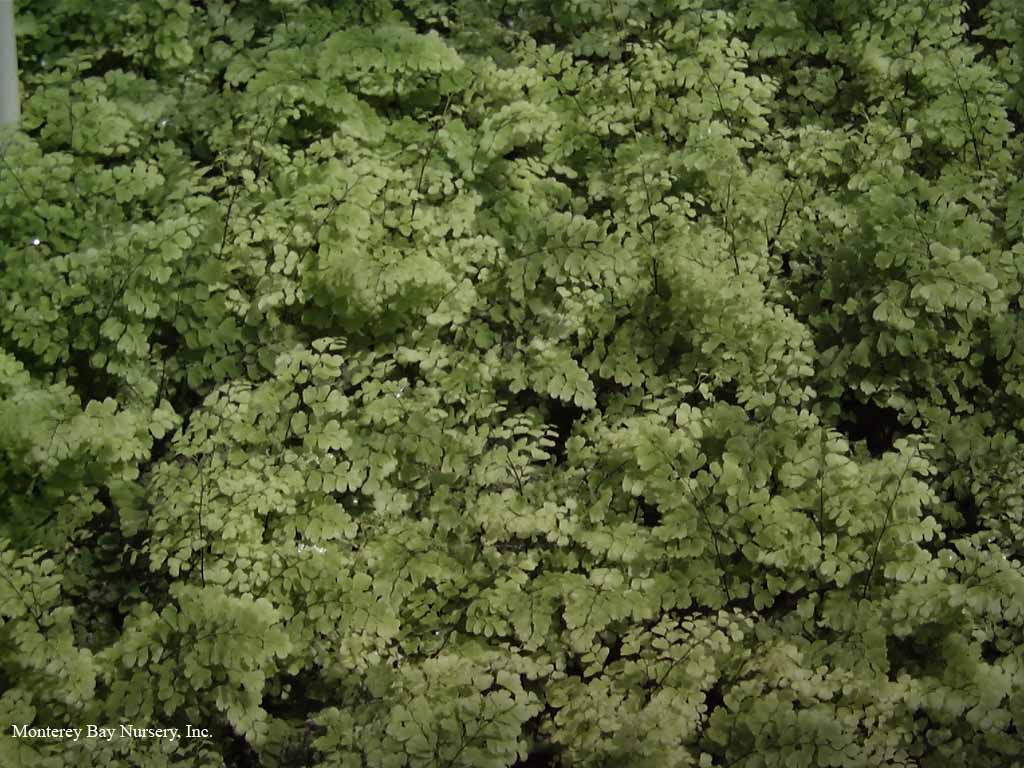
'Blondie' GOLDEN BLOND MAIDENHAIR FERN (not currently in production) golden frond beautiful, warm golden yellow fronds, breaking to yellow with green streaks. It seems to be an inherently unstable chimera, and in spite of repeated, careful reselection for many years every plant seems determined to eventually sport something back to green stripes or more. Full shade (turns white and/or burns with more than a little direct sunlight) with regular but periodic watering, use peat moss in the soil mix to keep things easy, stick to liquid or organic fertilizers, both no more than half strength. Should be frost hardy like the parent species to USDA zone 9/Sunset 8-9, 14-24. rev 12/2017 MBN INTRODUCTION-2015
'Cuneatum' fronds closeup habit like the typical "regular" form of A. raddianum, but more compact and spreading. This can make dense, tight colonies, thick enough to exclude weeds even, as the plants fill in with maturity. It seems tough enough to survive better in commercial situations better than perhaps any other Maidenhair species or variety. It also seems to tolerate less-than-perfect soils, watering and water quality quite well. Leaflets tend to curl down a bit, color is usually very dark green. Tolerates moderate amounts of direct sunlight. rev 7/2015
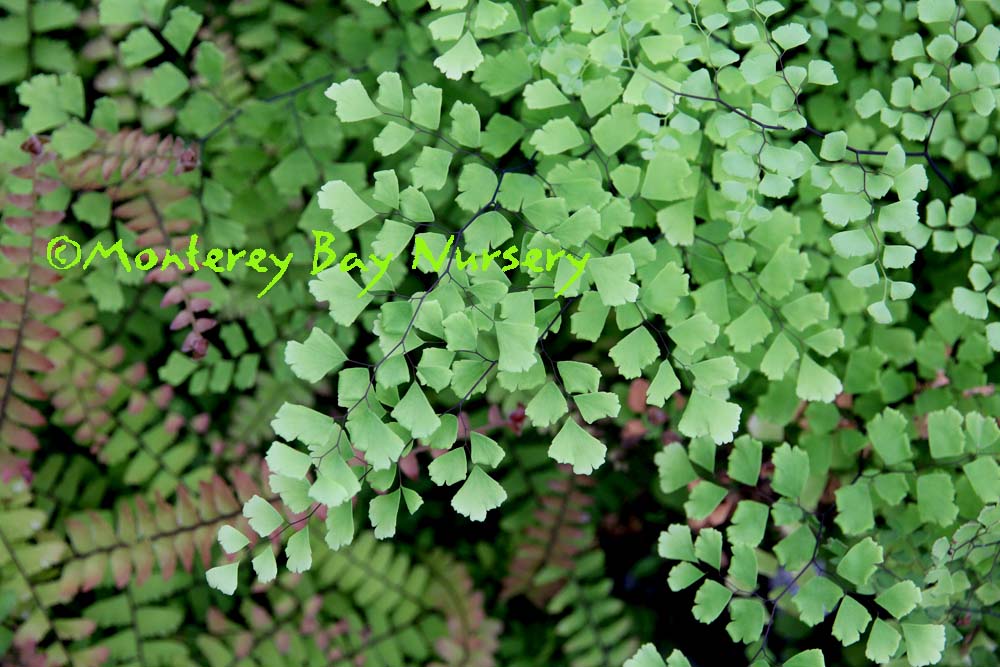
‘Fragrantissimum’ a relatively vigorous, typical form with moderately open fronds. Segments are cut. rev 2/2010
‘Fritz Luth’ foliage dense, compact variety, more cold hardy. rev 7/2015
'Microphyllum' nice crop extremely minute, leaflets make for new fronds that almost look like mist. The leaflets expand to be simply "tiny" when mature. Distinctive and different, one of my favorites. rev 7/2015
'Monocolor' broad leaflets a modestly different variant, within the rather large maidenhair universe at least, but useful for its primary reason for existence, which is being a very compact grower. If you have a small, special container though, or a small space, then it really shines, as it probably won't get more than 12-16" high and wide, at least any time soon. Mature fronds have leaflets that are stacked neat and tight, closely shingled against the next one down. Also it has the usual cheery, bright lime green new growth seen on most A. raddianum cultivars. rev 5/2017
‘Ocean Spray’ foliage overlapping micromini leaflets, tinier even than 'Microphyllum,' are usually a lighter golden green in color than other forms. Habit is very upright, ultra compact. rev 7/2015
‘Pacific Maid’ foliage fronds are compact, with very large, lacy pinnae. Another more cold hardy form. rev 7/2015
cristatus CRINKLE LEAF PLANT close this is small, light green to grey white (depending on source), plump-leaved species is recognized by almost cylindrical, vertically held, crinkly-edged leaves, and humble flowers and flower spikes that greatly resemble those of Haworthia (though they're very unrelated). To just a few inches high, clustering modestly, narrow flower spikes to 6-8" bear whitish flowers, long-day initiation. This is one of the most forgiving of a generally picky group. It seems to need at least part shade to do best in most climates, and will tolerate very low levels of sunlight outside. Inside give it at least some direct sunlight if possible but watch for scorching. It can grow with bright indirect or artificial light but will look quite different - usually greener and more perfect (unblemished). This makes it a better than average houseplant, of course, as long as you absolutely let it dry *completely* between waterings, but not necessarily for very long. Slow growing, to just a few inches high and across, use typical open, well-drained, well-aerated cactus/succulent potting mix, keep the drain holes up off the saucer a little so air can circulate beneath, water when dry, hold off in winter if at all possible. Note however that this species is one of the most forgiving and can even survive in the ground in Southern California and probably Northern California as well, even in the fog belt (unknown species, Chace St. Santa Cruz). To 25-30F but only if kept very dry. Crassulacea. South Africa, Eastern Cape. Sunset zones 1-24/USDA 6. rev 6/2021
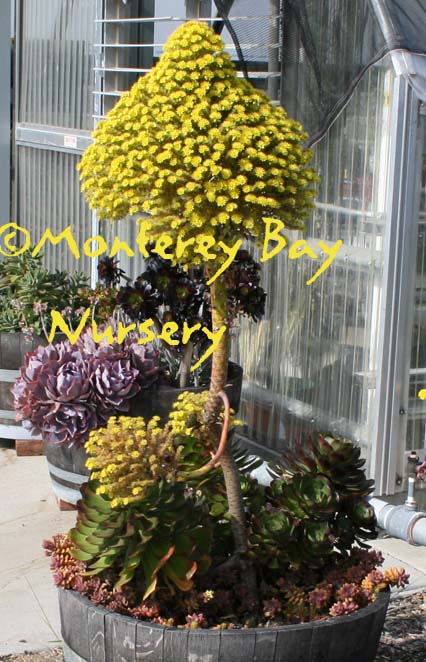
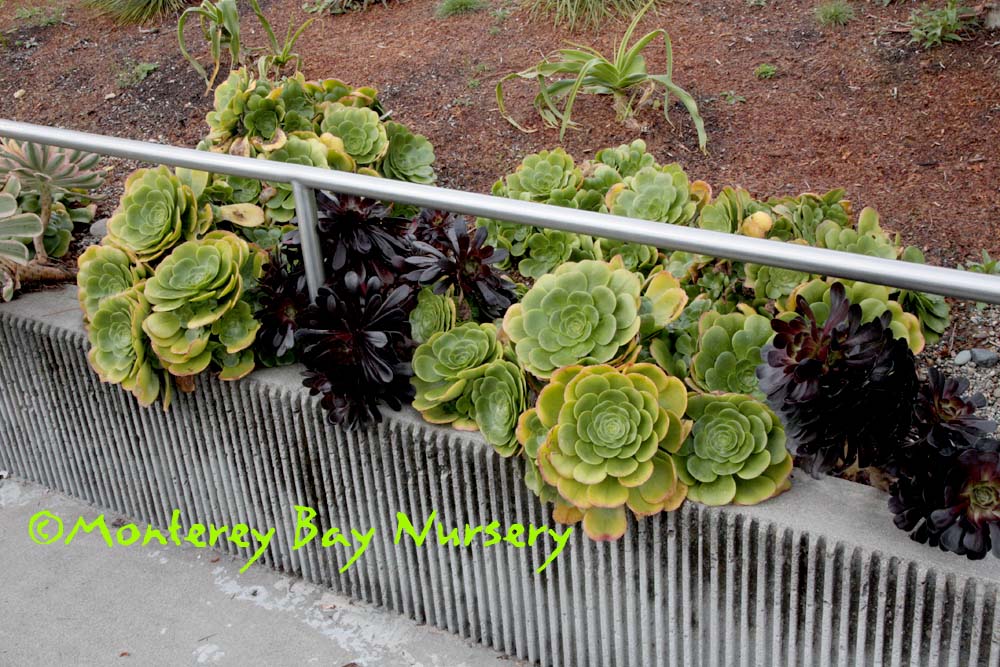
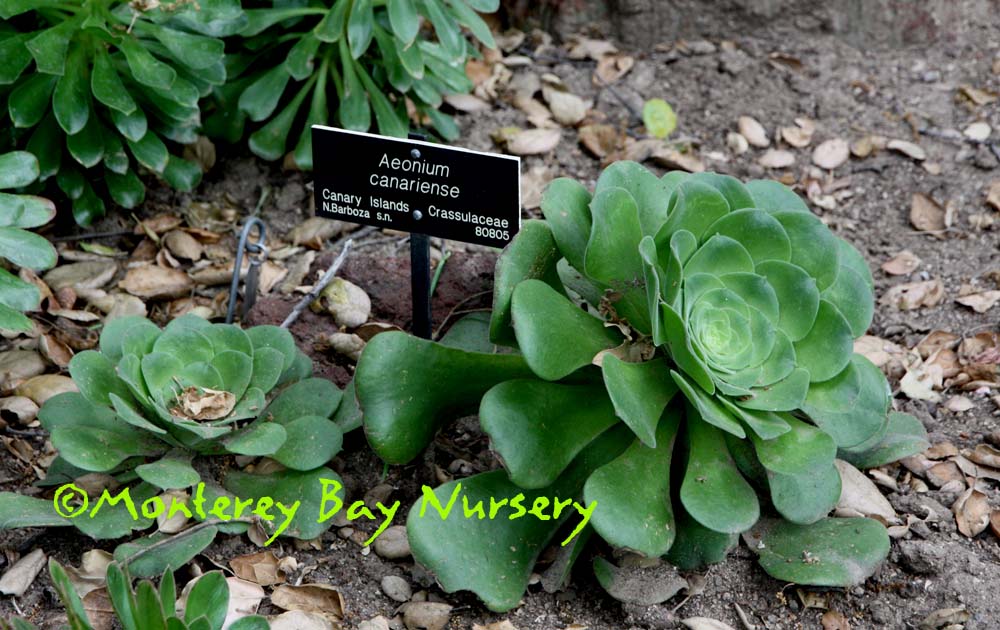
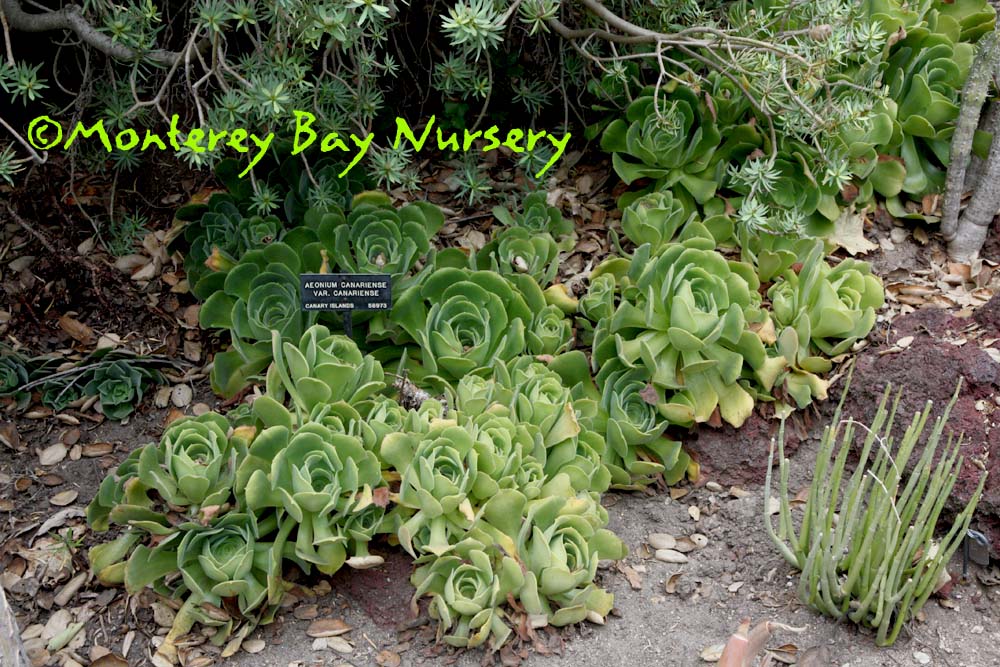
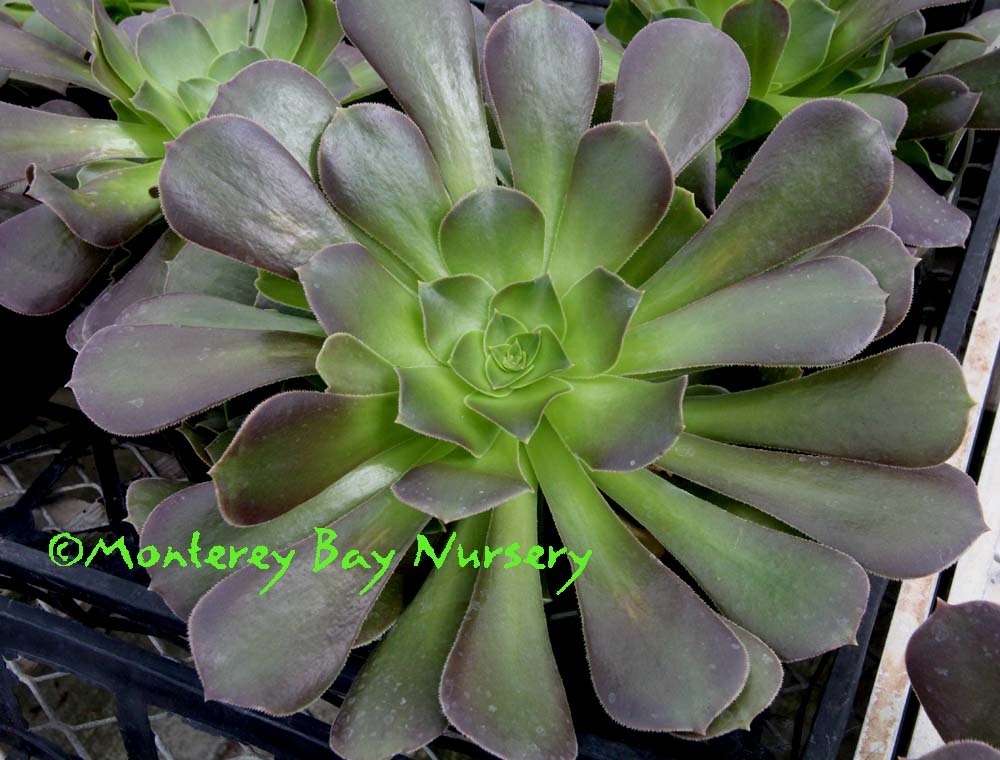
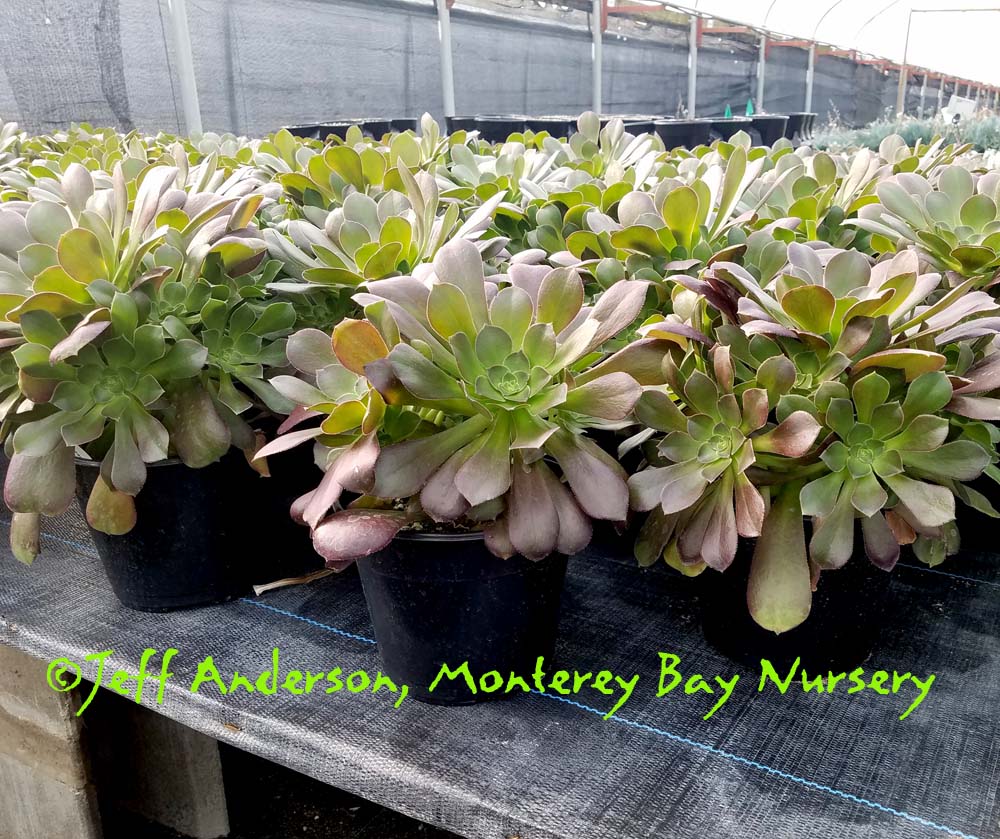
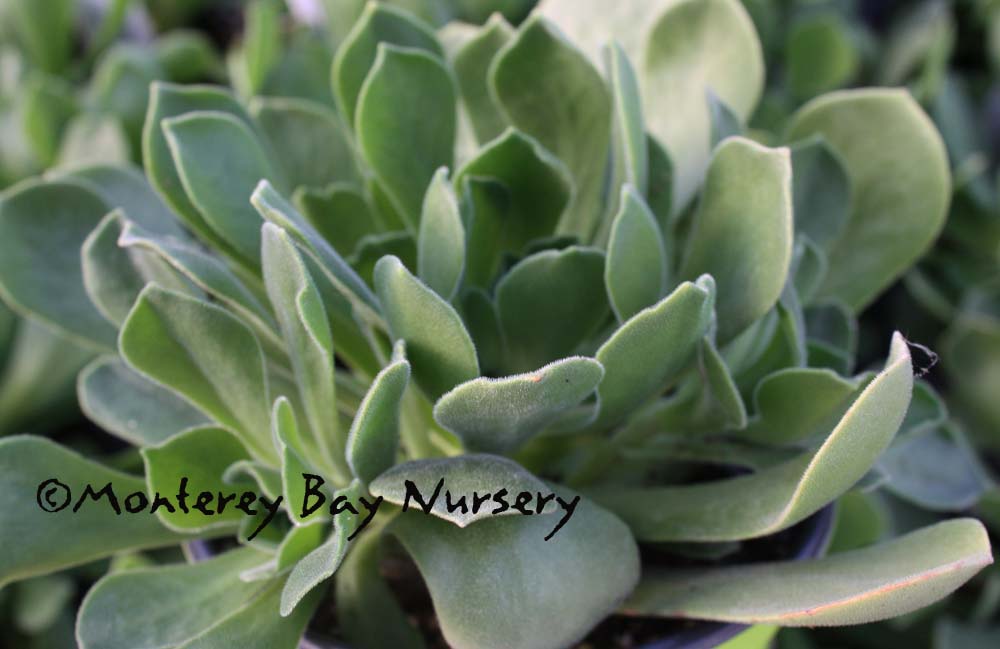
maculatus CALICO HEARTS, SPOTTED ADROMISCHUS juvenile plant grows as a low clustering mat or dome of leaves to 4-12" high. Juvenile foliage is very round, very glossy and marked with a maroon edge that breaks down the leaf into spots and irregular blotches. Mature foliage is grey to grey green with more muted maroon coloring showing through. Haven't seen it in flower yet, or even fully mature but flower stalks should be 6-12" tall with whitish or pinkish flowers, long-day initiation. Part shade, typical very good drainage, let dry between waterings of course. Native to the Langeberg Mountains of the Cape Region, South Africa, and it can take some (but not much) frost if adapted to outdoor conditions and kept dry. rev 6/2021Aeonium usually pronounced "eee - oh - neee- um." Mostly rosette-forming succulents mostly native to the Canary Islands and the west coast of North Africa. Grown for exquisite form and often very showy flowers, usually yellow. Tender to frost. Crassulaceae. rev 1/2010
Agapanthus LILY OF THE NILE clumping evergreen or deciduous bulbs with rounded to campanulate flower clusters atop tall stems. Sizes listed for varieties depends on age and density of clumps, specific planting site conditions, watering and feeding, degree of regrowth necessary after winter and exact timing of initiation and flower spike development. Smallest plants are those that have to recover from a freeze, get little or no irrigation and feeding, are in full sun, aren't crowded by clump density or nearby plants and develop their spikes under less than very-long-day conditions, which is a primary factor in stem elongation, possibly along with day-night temperature difference. All evergreen Agapanthus varieties are at least deciduous with hard frost and can be badly damaged if it gets cold enough. If you expect to be USDA zone 8b/Sunset zone 7 or colder, use the deciduous varieties, which can go a couple of zones lower. Don't forget that all Agapanthus are dearly loved by hummingbirds. The darker blue and purple clones are especially valuable in hotter Central Valley and Southern California climates, where hotter, 100°F-plus temperatures badly bleach the lighter blue and lavender flowers in full-sun conditions. The genus is native to South Africa. Amaryllidaceae. rev 6/201
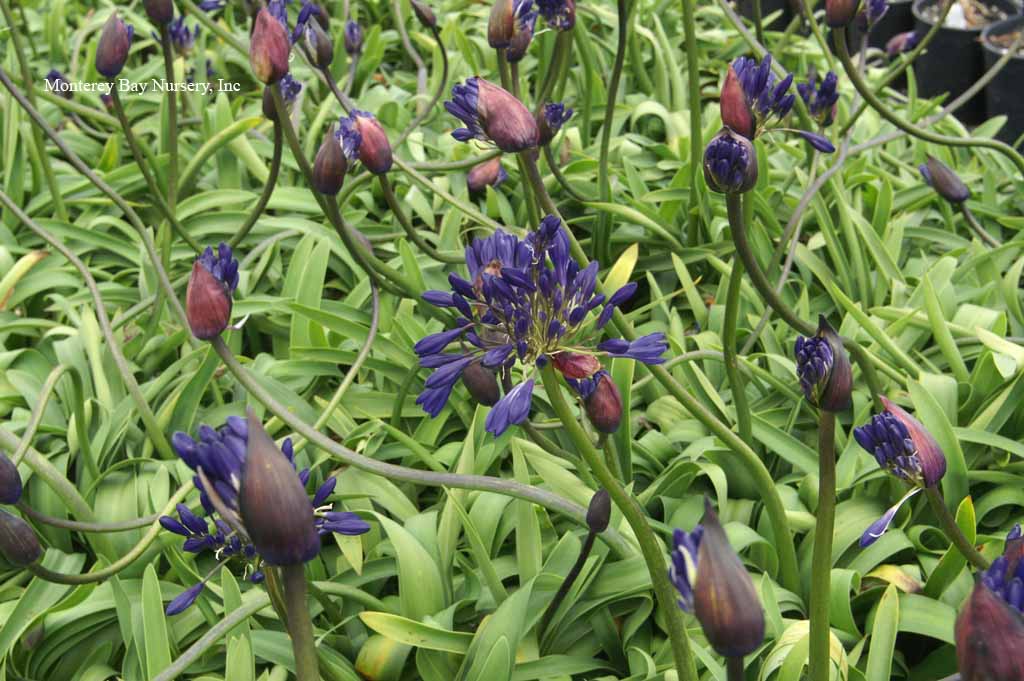
'Blue Medusa' PP 20,839 nursery plants a sport or mutant discovered within our block of regular 'Storm Cloud,' this grows with rather prostrate leaves, intriguing, snaky, curving flower stems, buds that look like snake heads, and foliage that appears greyer than the original type. Total overall height has been below 2' on plants in the nursery. The overall effect is quite serpentine, between the twisted, low foliage and the cobra-like buds. The flowers are the same beautiful dark blue as 'Storm Cloud.' rev 1/2012 MBN INTRODUCTION-2008
‘Frederick Street Park’ TM (not currently in production) blooming nursery plants the best improved Peter Pan type we have found yet, with very compact growth, shorter, more robust stalks, and darker blue, more heavily textured flowers than seen on other plants sold as ‘Peter Pan.’ Foliage is dark green, stalks are reliably compact. Facultative long day, so it can bloom in winter or very early spring as well as during the usual summer period. 20-30" tall when in bloom, evergreen. rev 11/2019 MBN INTRODUCTION-2000
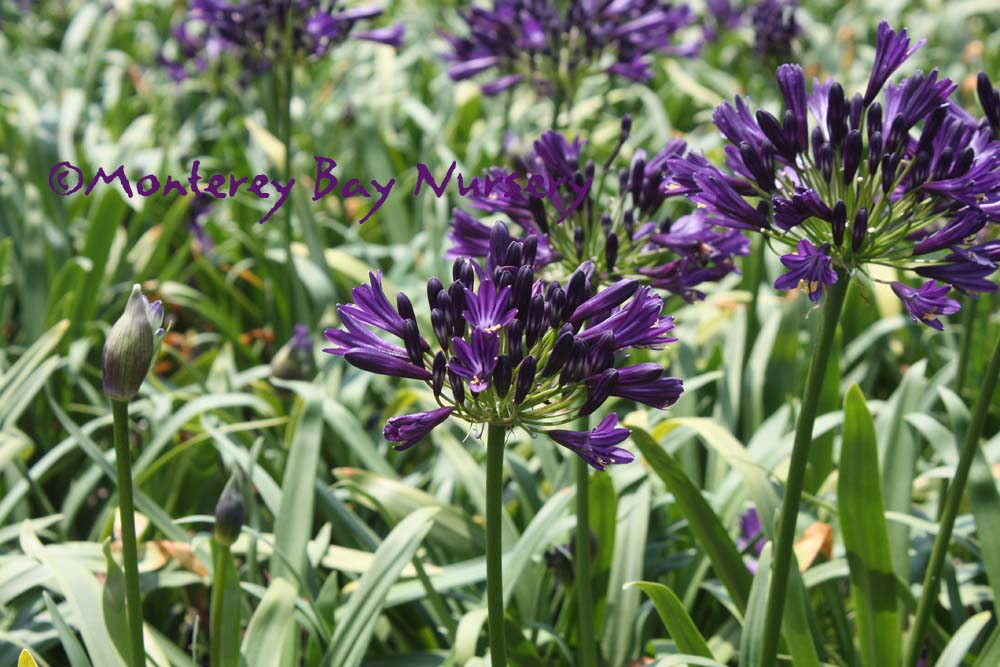
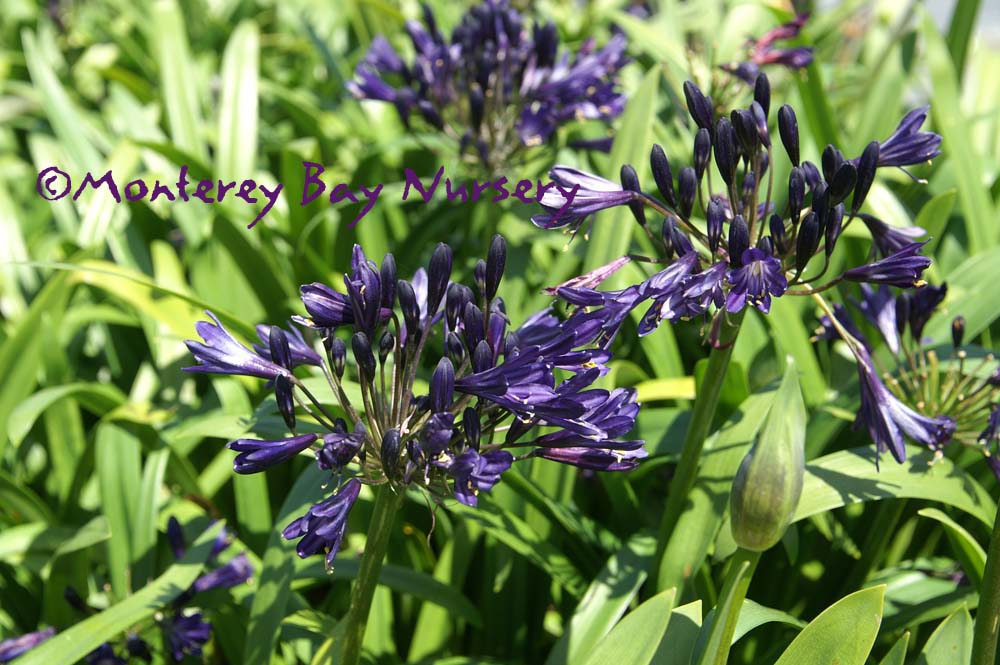
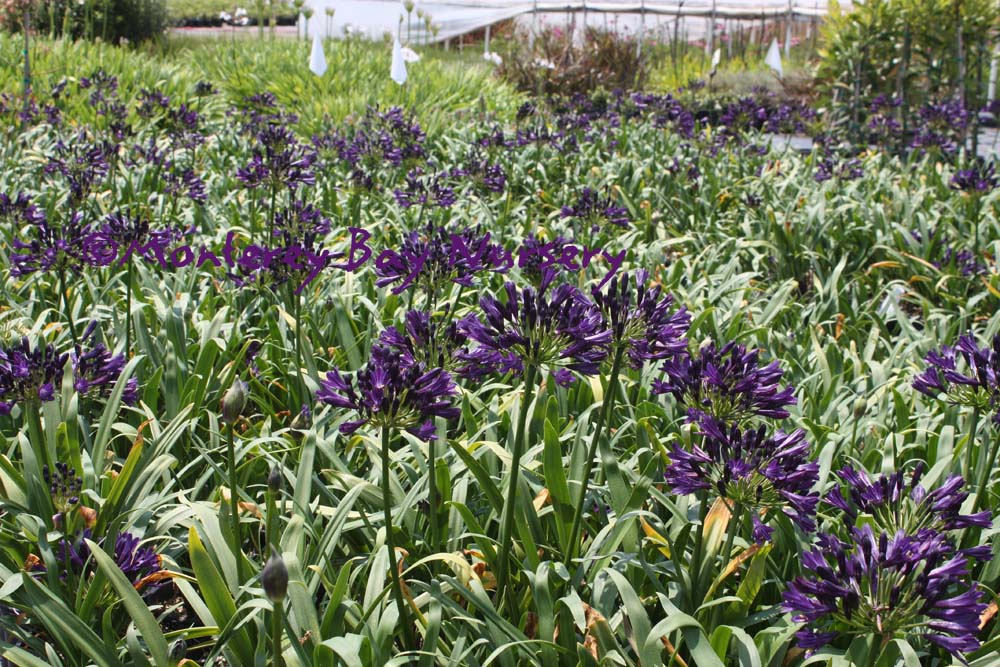
'Hush' deep purple deeper purple first crop deep purple, hence the name. Sometimes the color looks almost black from a distance. Flowers are produced on very short stalks on top of compact foliage, plants can bloom lightly off-season but are usually in bloom by late spring, can repeat in fall or sometimes even mid-winter. The whole package can finish under 16" tall, with max size around 30". As far as I am aware this is the only variety of Agapanthus to be truly, absolutely and incorrigibly sterile, both as female and male parent. This is a hugely fortunate blessing as it's depressing watching varieties and landscape plantings "drift" with time as they become intermixed and overgrown with their own off-color spawn. This dropping of seed into and around the dense original crowns is almost impossible to stop without ruthless and obsessive attention to dead-heading before seeds can ripen and drop. Miss one wave of bloom because you've foolishly let your attention wander and you've lost the war. I have never observed any seed set at all on this plant in over 20 years of production growing, including personal efforts at manual, directed crosses in both directions. I have only found three pods which didn't abort and held on the stalk until turning tan, all were empty. Normally this is at least partly evergreen in our area, deciduous with any hard freezes though below ~28F. It survived and recovered well from five nights at 25F in 1998 growing in 1g containers. This was a first-generation, selfed 'Storm Cloud' seedling I pulled from several thousand siblings, and the only sterile plant in the block. Its name popped into my head right away when I found it but no one else ever makes the connection. USDA zone 8/Sunset zones 7-9, 14-24. rev 6/2020 MBN INTRODUCTION-2010
'Indigo Frost' PP25519 captivating flowers the best tu-tone flowers we've seen yet, a really clean separation of white petals against deep blue bases that really catches your eye. The flowers flare open nicely, face mostly upright and horizontally and are neatly held in proportionately-sized clusters. This is a medium-scale variety, not as bold or vigorous or large in the landscape as your regular, tall, broad-leaved Lily-of-the-Nile but definitely larger and standing taller in foliage and in bloom than Peter Pan types. Foliage should reach about 18" tall and clumps should spread slowly to 2-3' wide in a reasonable amount of time. Flower spikes will reach 3-4' tall depending on age, exposure and growing conditions. Bred in South Africa this was originally released as 'Twister.' This new Sunset/Southern Living Collection(s) handle is better by far, easily memorable and appropriately descriptive. Should be as winter evergreen as standard seedlings or the dwarf landscape types, probably holding foliage to around 20-25F but surviving to 15F if it has to. Expect more than one wave of bloom per year in any of the moderate coastal California climates, where new growths can mature and initiate within a few months. Sun to almost full shade, very little water needed when fully established but looking best with at least occasional summer irrigation in almost all our climates. rev 10/2018
'Little Blue Fountain' PP25966 Spring Trials display first flower head a new, very good, compact, low growing Peter Pan type (narrow, gracile stems, narrow leaves) with very dark blue flowers. To 1-2' tall and wide, typical conditions, low water use, great in containers. USDA zone 8/Sunset zones 6-9,12-24. rev 12/2021
'Little White Bird' TM flowering plants a variegated seedling of 'Storm Cloud' from Saratoga Horticultural Research Foundation, sent to us when they closed their growing grounds and distributed their plant materials. They released this without royalty or variety protection. It is an intermediate height form, to maybe 30"' tall, with flower stalks to 3'. Flower heads are reasonably large and the blossoms themselves are white, appearing in summer. This is almost a white 'Tinkerbell.' The Little White Bird was a book published in 1902 by J.M. Barrie in which the character of Peter Pan was introduced, sans all the later accouterments like Lost Boys, Pirates etc., just fairies living in the garden. Thanks to our former rep Shelby Hall for suggesting that for the name - good on you, Shelby! Zones 6-9, 12-24. rev 6/2018 MBN INTRODUCTION-2010
‘Midnight Blue’ closeup shady garden a shorter-growing variety with medium dark blue flowers of exceptional, bell-shaped form, flaring fully open, in full, round clusters well-separated from the leaves. The individual flower petioles and bases are tinted burgundy, the spikes themselves rise to about 24-36", neat, narrow, relatively vertical leaves usually stand no more than 12" tall. This is conveniently deciduous and respectably cold hardy where it has to be, but is mostly evergreen in mild-winter locations. The cost of its stronger winter durability is a shorter and somewhat later flowering season, which usually begins in early summer. USDA zone 7a. rev 6/2018'Midnight Sun' PPAF flowers and background foliage a unique variegated form found in our 'Midnight Blue,' this has very strong yellow and white leaf variegation with wonderful blue flowers almost exactly as rich and deep in color as 'Midnight Blue' itself. The only cost for that amazing foliage is that it blooms slightly less, but still probably as strongly as any other variegated Lily of the Nile. Almost certainly the only cold hardy, variegated blue variety currently available, anywhere. To 24-30" tall. Presumed USDA zone 7a, just like its parent. rev 6/2018 MBN INTRODUCTION-2018
‘New Blue’ flowers the notable feature of this variety is its very large flower size, to over 3" across. In addition, each flower displays a central blue stripe against lighter blue edges, sometimes with a defining dark marginal stripe on each side as well. Many other varieties also have this feature, which can be seen if you look closely, but in 'New Blue' it is obvious and distinctive because of the unusual flower size.The only drawback is that the flower clusters don't have that high a bud count. Evergreen to semideciduous, based on how much cold it gets, and frost hardy, with rich, medium blue flowers of intermediate height, 20-30". Often blooms in mid to late summer, though I have seen waves of bloom in early spring as well, and it can continue to bloom until fall. Foliage is notably thin and grassy, habit is quite compact. rev 6/2018
‘Peter Pan’ flowers planting massed bloom our own improved selection, featuring darker blue flowers, a high flower count, strong bloom vigor wit, gracile flower stalks, long petals which reflex back nicely for full-opened flowers and excellent overall confirmation, with well-proportioned peduncles holding the flowers up and out instead of down shorter growing, to 24-30", with lower, more horizontal, narrower dark green leaves. This is . As evergreen as any other Agapanthus variety. Can flower in winter, spring, summer or fall, depending on growth cycle, seasonal maturity and initiation timing (facultative short day + chill?? ) but in most of Californai you'll usually see a strong bloom in spring followed by another in late summer or early fall. rev 6/2018
'Prunetucky Lass' typical bud count bee's-eye view rep's-eye view the best compact blue Lily of the Nile yet? Compact round heads are packed with deep, clear indigo blue flowers, flower stalks are strong and trustworthy, and it usually flowers twice a year (late spring, and fall), and sometimes thrice (winter too). Shiny leaves are dark green, almost standard-scale and are as resistant to winter die-down as regular blue A. orientalis seedlings. So far maximum height on crowded, mature clumps appears to be around 30" but they migh push 36" if crowded, shaded and/or extending flower spikes under very long daylength. This 'Frederick St. Park' (female) x 'Midnight' cross is the best of our recent hybridization efforts so far- with more new and improved Monterey Bay Nursery intros coming soon!! rev 7/2018 MBN INTRODUCTION-2018
'Prunetucky Summer' June flowers a transitional release from our intensive breeding program, looking for the perfect dwarf to intermediate sized, dark blue, long-flowering, evergreen Agapanthus. This is an intermediate-size grower, with spikes reaching 36-48" or so on established clumps in the ground, and usually begins flowering sometime between April and June, depending on the spring, then repeating, often with bloom in midwinter as well. Sun to mostly shade (yes! it's true!), average soil/drainage, little summer watering required when established, but some irrigation will go a long way. As with all other Agapanthi, The Gopher usually doesn't seem to bother them. rev 6/2018 MBN INTRODUCTION-2017
'Purple Storm' TM mass individual a seedling selection from Storm Cloud selfed, this is a rich light to modestly deep lavender purple in color as opposed to dark blue purple in its parent. It is also comparatively lower growing (about 4-5'), earlier flowering and more evergreen than its parent. USDA zone 8 (7?) rev 6/2018 MBN INTRODUCTION-2010
'Sapphire Storm' TM flowering in April the best deep, clear blue Agapanthus available? This is our own seedling selection of 'Storm Cloud,' one of only three or four to make the cut out of the many thousands we have grown out and trialed over many years. A little shorter than its parent (30-36"), very dark clear blue instead of dark purple blue purple, with noticeably shiny flowers, more evergreen in winter, and faster to flower in spring, often by mid-April vs. 'Storm Cloud's' usual June. Flowers can initiate and form at almost any time, once an individual culm is sufficiently mature and experiences some level of chill + light. This means you can see spikes sometimes Dec-Jan, or start at any point in between then and late-spring, and again in fall if your cut-back schedule and the year's seasonal conditions are conducive. It really puts on a show when it comes completely into flower during its main spring flush. Probably USDA zone 8 (7?) rev 6/2018 MBN INTRODUCTION-2010
'Snowball' flowers a very compact yet vigorous form, under 16-24" tall, that bears almost pure white flowers that rarely set obnoxious seed heads. This is the cleanest white we've found so far (no yellow in the bud or at the base of the flower), with good petal and flower conformation, a very compact habit, and a great flower production. rev 6/2018
‘Storm Cloud’ closeup a seedling of ‘Mood Indigo.’ Bears very wide, round tipped strap-like leaves with a glossy sheen, to 2’ long. Stalks of dark purple blue flowers appear in summer, reach 4’ tall. A vigorous grower and bloomer, and makes and excellent cut flower. Only about as winter hardy as other evergreen Agapanthus, so damaged below 20°F. Introduced by Saratoga Horticultural Research Foundation. At one time our most popular variety, eclipsed now by 'Sapphire Storm' and 'Prunetucky Lass.' rev 1/2020
‘Tinker Bell’ closeup young planting variegated evergreen leaves, medium blue flowers. A slower grower. Mostly summer bloom, and then not very heavily. rev 7/2004
Agastache HYSSOP, HUMMINGBIRD BUSH closely
relatived to Salvia.
Flowers can be relatively large, long and tubular or shorter and
in smaller, more condense clusters. Some are very tough and
drought tolerant, others like more traditional irrigated
conditions. All have minty foliage, most have fragrant flowers,
all attract hummingbirds, butterflies, pollinators and a wide
variety of important benefifials. Some have medicinal or culinary
uses. Initiation can be long day or facultative long day.
Labiatae/Lamiaceae. from the Northern Hemisphere. rev 7/2016
'Blue Boa' PP24050 flower spike a tall, vigorous, upright form from Terra Nova that bears a heavy show of small deep lavender blue flowers packed into dense terminal clusters. Flower spike size increases as the clump establishes and sizes up, mature specimens can be really impressive, with loooooong clusters of those small flowers attracting a large range of hummingbirds, pollinators, beneficials and butterflies from June through early fall. To about 3' tall and wide, not picky about soils, likes well-drained soils, drought tolerant when established but best with at least a little summer water in most California climates. Hardy to USDA zone 5. rev 6/2019
Kudos® series - 'Ambrosia' PP25614 'Coral' PP25613 'Gold' PP26410 'Yellow' PP26563 'Mandarin' PP25381 'Silver Blue' 'Yellow' new colors from Terra Nova, selected for compact and bushy growth habits and dense, heavy, long flower displays and mildew resistance. Plants reportedly stay around 16" tall, to 20" when in bloom and stay about 2' wide at maturity. Terra Nova reports long-day initiation response, flowering heavily in spring then continuing until frost in the PNW. Typical minty foliage, typical hummingbird frenzy, typical tough, drought tolerant, dry-garden culture. Small pollinators and important beneficial insects are especially attracted to these small flowers with their narrow tubes, which protect the precious nectar within. Likes at least average drainage, that's about their only pickiness. Hardy to USDA zone 5! rev 6/2019
Agave CENTURY PLANT, MAGUEY, MESCAL, SISAL familiar, tough, leathery to hard, usually spiny, cactus-like plants of varying size, drought tolerance and frost hardiness. They are used for fiber (A. sisalana), with production occurring in tropical areas worldwide, for food (see below, also currently-popular Agave nectar) and fermented products derived from the starchy, fibrous cores (I think you know what I'm talking about). They all like a dry spell for some time each year but many of the more tropical species can take considerable moisture as long as air and soil temperatures are not too low. All make good container plants (considering foot traffic, if spines are involved) but some will need very large containers indeed at full maturity. Give them all very good drainage and grow them with the understanding that some will rot in wet winters anyway, some will freeze in the coldest years and almost all do best with at least some hot-season watering. All are susceptible to gophers, most especially if you water directly against the crown, so use at least some basket at planting to protect the heart of the plant. Almost all but the very most chlorophyll-deficient will flower at some point in their life. Some like the subtropical A. marmorata flower in their 5g containers every year for us. Others, especially the large landscape specimens such as the common but still often quite beautiful, strikingly blue Century Plant, A. americana, or the usually massively gi-normous A. salmiana can take 10-20 years or more even in pampered cultivation. Growing slowly in the wild, all dry and withered and tortured, those large species can take many decades to accumulate the massive carbohydrate stores necessary to generate a 15'-40' woody, flower stalk with subsequent seed pods, then experience enough of a cool/wet season to trigger its single, ultimate Blessed Event. In all species the parent rosette is monocarpic (dies after flowering) but also in many (A. vilmoriana, A. 'Blue Glow,' A. guadalajarana) no pups or offsets are usually produced at all, meaning that your spot is thus free for filling with a new or different plant. There are a lotta lotta lotta variegated forms. Asparagaceae, formerly Agavaceae. rev 5/2018
Recipes I like how in plant catalogs they give recipes for the various plants they sell, like for tomato sauce from heirloom tomatoes, or for home garden beans and basil sauteed in virgin olive oil. You know what I mean. So to make sure you don't miss out with our catalog, here's a couple of Agave recipes I got from our workers:
Chivo
(young goat) in Agave
leaves Cut off the leaves of one large Agave, such as A. americana, A. tatula, A. ferox,
etc., and lay some of the leaves down together. Put a goat on top
of the leaves lengthwise, then layer more leaves on top until it
is totally encased in them. Note: the goat must be killed first.
Don't try this with a live goat! Anyway, once you have the goat
covered in leaves, make a small cut partway through the upper
surface of a leaf right below the terminal spine and pull the
attached strong fibers down until you have stripped them to the
base. Cut them there, and use this "needle and thread" to sew/wrap
the leaves together into tight bundle. When the package is nice
and tight, dig a big pit. Big. Big! Big enough for the goat in
its leaves, and then some. Then get a big, big fire going and burn it
down to a mountain of coals. Shovel some coals into the bottom of
the pit, then place the goat in its blanket of leaves on top, and
finish by shovelling more coals on top until you have big
mountain of coals with a goat somewhere in the middle. Cook
him, and keep cooking him. Cook him until the leaves turn black.
Cook him a long time because the longer and slower you cook him
the more tender he'll be. Cook him until he's all the way done.
Enjoy!
americana CENTURY PLANT nice setting a large to gigantic woody succulent, forming an impenetrable rosette from 4' to 7' tall and wide on the most massive specimens. This is the distinctive, large, common landscape plant you see all over. There are several reasons you see so many Century Plants around, for all their faults. First, they are reliably blue to blue grey, probably the best blue-foliaged plant you can easily find. Second, they are quite adaptable to cool or hot climates, high or low rainfall, warm or cold winters. Third they are notoriously forgiving of soil. And fourth they last a long time once in. People just love them. They are best used where they won't be crowded, won't be near any humans or pets, and can be a focal point, or be displayed against some kind of distinctive background, such as rocks, a wall, other plants, etc. Or use it as a backdrop itself, to let other plants scramble on or be displayed against. The very best place for this is across the street in your neighbor's yard, where you can see it clearly but don't have to deal with it. Gift one today! They also make excellent, excellent security barriers, such as under windows or at points where someone might jump a fence. They vary from seed and quite modest in stature - you might get lucky and end up with a three footer! After many decades in an unwatered desert environment, or a decade or two in a garden, it will throw a narrow, candelabra-like spike to 15-20' tall bearing your usual yellowish green flowers. The plant will die a few months later and usually pups will arise all around the base. Choose one you like and rogue the rest out with a shovel or pickaxe. Sun to half sun, almost no summer watering, frost hardy to USDA zone 8/Sunset zones 8-9, 14-24. rev 5/2018
'Aureomarginata' why you grow it (Huntington Botanic Garden) HBG II HBG III HBG IV young container plant broad yellow edges, blue green, blue grey to grey green centers. Can get big with age, 4-6' tall (or more!) by 5-7' across (or more!). Very striking as a centerpiece or focal point subject, against walls, especially those painted over to bold colors, in large containers and anywhere it becomes backlit. Slower than non-variegated plants. Choice!! rev 5/2018
'Mediopicta Alba' nothing like it! one of my very favorite Agaves, because of its wonderful slate blue-grey color bordering leaf's clean white center, its slower growth (due to lack of chlorophyll) and usually smaller, more easily siteable mature size. Nothing quite draws your eye like a stand of mature specimens of these beauties! Best against a simple background (fence, stucco wall, rocks, groundcover, gravel) where it stands out cleanly and doesn't get lost. As a solitary container plant it induces peaceful contemplation. Offsets usually don't appear until later, but not always. Your plant may be predisposed to piles of precocious, pernicious pups popping up prematurely. USDA zone 8/Sunset zones 7-9, 13-24. rev 11/2020angustifolia 'Marginata' landscape Capitola orderly leaves first crop, 1g Bridge St., Soquel curved, narrow, toothed upright leaves, light jade green, with clean ivory white margins. Usually seen as a 1-2' tall landscape specimen it can reach 3-4', and quickly with any supplemental watering. It will offset a few pups but they usually wait to develop until after the mother rosette blooms. Flower spikes can reach to over 10' tall and 3' across, usually reaching peak bloom in late summer. This species is commonly seen enjoying life in deeply tropical climates (Jakarta) as well as here in cool Northern California (Capitola) and can take frost to around 20°F. It seems to grow and sucker more aggressively in hotter/wetter climates. The sap of this species is especially irritating, take care to cover eyes and skin when trimming or removing any green tissue. Sun to part shade (less variegation), almost no summer watering. This apparently northerly form can take frost to at least 25°F, possibly lower. USDA zone 9. rev 7/2020
This species is the most widely distributed of any in North America, ranging from both coasts of Costa Rica north to both coasts of Mexico fairly adjacent to the US border (Sonora and Tamulipas States). Found in seasonally dry forests, sometimes upland areas, ranging from sea level to ~4500'. rev 7/2020
applanata 'Cream Spike' MAGUEY de la CASA, MAGUEY de IXTLE, SOCOLUME juvenile-phase foliage young rosette landscape, Beverly's in Soquel just like a teapot, short and stout, but with dark, sharp, spines terminating those grey-blue leaves with wonderful wide margins of creamy yellow. Make a compact, reliably small rosette under 6" tall by about a foot wide. Not cold hardy for landscapes except for the mostly frost-free zones so it's best application is as a container plant, indoor/outdoor, porch 'n patio or anywhere else. This plant will take a large amount of dreary, wet weather but seems frost sensitive at least in its juvenile phase. The species is found up to it is not frost hardy - use as a moveable container plant or give overhead cover or more substantial protection outside USDA 9a. rev 6/2019
attenuata why you grow it nice stand at the Huntington a soft-leaved, succulent, unarmed Agave. This is loved for its wonderfully soft, rubbery leaves, complete lack of spines, powdery glaucous coating, and soft jade green color. It says "tropical desert" when used in a landscape, and I would say it is one of the best foliage plants ever invented. It is hard to find a spot where it doesn't look good. It really shines in part shade, where the leaves can extend to their full size and there is less risk of sunbleaching under the hottest conditions. This species also sends up a tremendous flower spike, to about 10-15' high, of creamy white flowers in spring, when mature enough, that is quite spectacular in its own right but too infrequently seen to beplanted for that feature alone. Hard freezes will damage the foliage but it usually renews itself reasonably quickly. Extended hard frosts below 25°F will often kill it completely though. Temperatures between that and freezing can disfigure it horribly to various degrees, sometimes permanently, so give it good protection in Northern California. You don't want to use this where it will be damaged every year. It is too ugly when recovering, and it is too painful to watch the plant suffer through the process. Have mercy. If you do want to use it in a colder climate just put it in a pot, where its succulent nature is highly forgiving of both root confinement as well as inadequate watering and you can move it around to use it to its best effect. To about 30" across and tall when mature. Mexico. rev 3/2009
'Blue Ember' 5g plant not sure of the origin of this plant, for now I'm assuming it is one of the many 'Blue Glow' sports we've seen in our blocks over the years. Slightly wider, flatter leaves, less shiny surface. Ultimate size unknown but assume it approximates 'Blue Glow.' rev 2/2021
'Blue Emperor' blue leaves with a sharp black point grow into a symmetrical dome, 2' tall, 3' wide. Takes some cold (but we don't know how much!) and plenty of heat. Little watering once established. Sunset zones 8, 9, 14-24/USDA 8. rev 12/2013-Suzy Brooks
'Blue Flame' Quail Botanic Gardens, full sun Huntington Botanic Gardens, some shade Rogers Gardens, blooming this is a Dave Verity hybrid of A. attenuata and A. shawiiintroduced by the Huntington Botanic Garden. It is a medium size grower, blue green in color, has flexible leaves, essentially lacks spines (has a single terminal spine which can be tipped, and minimal marginal dentition), is adaptable to a range of soils, and takes frost to the low twenties. It absolutely nails the highly desirable target for a relatively small, spineless agave that can take some frost. The leaves are somewhat spatulate and have wonderful elongated tips, giving them a somewhat flame-like appearance. Of course this is invaluable in a container, especially if the container is near traffic. A 5-6' spike of dark burgundy maroon flowers appears in fall and winter when the plant is old enough. rev 1/2012
'Blue Glow' young plant at Quail Botanic Gardens this is a compact, rather hard form, to 2-3' tall and wide, with deep blue green leaves with a glaucous cast and a very symmetrical, even habit. Its leaves have a single terminal spine only. It is the result of crossing A. attenuata with A. ocahui (usually pronounced oh-ka-hooey). Its leaves are wider than A. ocahui but smaller than A. attenuata. Richard Ward from the Dry Garden decribes it as "gorgeous, immaculate, without a single bad leaf after ten years. [He's right!] It has perfect symmetry, people really notice it in the garden." You can see that in our picture from Quail. Somewhat limited supply. rev 1/2012
bovicornuta COW HORN AGAVE (not currently in production) at the Huntington I don't get the common name. Supposedly the central bud column looks like a cow's horn, but then they all do. Crazy, bright reddish brown margin teeth, dancing to the left and the right, add to the incredible leaf imprints left on the backs of the green leaves of this midsized (really!) Agave. A solitary plant, but it does occasionally produce a layer of pups underneath, and grows about 2 1/2-3' tall, 4-5' wide. Flowers are yellow green, on branched stalks to about 12'. The green leaves are widest in the middle and can be kept from turning yellowy green with summer water and some light shade. Very decorative in the garden, blending well with perennials, nice in groups, and suitable for containers. Takes sun or some shade, and grows best in well drained soil. Found in the pine and oak woodlands of Mexico, but strains vary in hardiness based on provenance. Protect from hard freezes (below 25F) outside Sunset zones 16-24/USDA 9. rev 1/2012
bracteosa dramatic San Diego grown mixed garden a beautiful, moderately high altitude species that is highly useful, being spineless, rather small, frost hardy, spineless, and best of all, completely spineless. Most unarmed forms are very tender (A. attenuata, for example) but this is one of the only frost hardy forms (approx. 10-15F) safe enough for the kids or grandpa to fall over into. Leaf color ranges from blue grey to grey green, sometimes almost golden green, and flower stalks are of the narrow, densly flowering type (as opposed to being an open, reaching, branching form like that of the Century Plant). Often the new growth in the center forms stalked, plume-like structures that remind me very much of thehouseplant bromeliad Guzmania. Sun to mostly shade (much drier!), at least average drainage, excellent fodder if you have a gopher farm, and infrequent but some summer watering. To about 2' wide, 18" tall. Sunset zones probably 9, 3-13-24/USDA zone 9. This will take the frost of USDA zone 8 but probably not in wet areas like the PNW. rev 8/2013
'Calamar' young plant to about 2' across, this form is solitary and reportedly does not form pups. rev 11/2020
'Mateo' clean lines reported to actually be a hybrid of A. bracteosa and A. lophantha, it is absolutely different from any straight A. bracteosa I've ever grown from seed. Having A. lophantha as one parent would certainly explain the pale yellow stripe down the center of the leaf. This variety is only economically viable at wholesale quantities when done from tissue culture, which can extend juvenility. So those graceful, spineless leaves are brittle when young, and hard to handle without breaking. Get it home and in the ground, or site its container out of the way of traffic. Mature leaves, which usually start to appear within a year or two, are more leathery, typically Agave tough and forgiving. To about 18" tall, 2-3' wide, sun or part shade, well drained soil, little watering. USDA 8/Sunset zones 8, 9, 14-24. rev 8/2014
celsii (mitis) (not currently in production) greyer form, Huntington Botanic Gardens green form, UCSC (foreground) flower detail greener form, Strybing again, blooming this is a low, quite compact, unarmed species with bright green to grey green foliage. There is lots of confusion regarding the name, so much that the whole subject makes me tired, and I'm just not going to deal with it. This is one of the really good alternatives when you want the Century Plant look without the Century Plant problems, including massive size and dangrous spines. It is a valuable asset to have in your quiver if you are designing gardens that will have children, because you don't have to worry about them falling into it. The long, blackish tip of the leaf almostbecomes hard, and the leaves are often edged with a dark maroon line. Some individuals can develop fine teeth, some are extremely smooth, but overall this species is toothless. It only grows to 24" tall and spreads slowly by clumping. The leaves are pliant and tend to be quite green when juvenile, but most will be at least somewhat greyish with age, and some become quite blue grey. Other strains remain bright green throughout their life. The large burgundy flower buds open to flowers ranging from deep chocolate burgundy to light greenish white, depending on age. All have showy yellow stamens. The flower show is actually quite good, for an Agave. The single, ubranched, narrowly columnar flower stalk is produced in early summer and reaches a height of 6-8'. This species grows at a higher elevation and under moister conditions than the desert species and likes part shade in hot areas as well as light to regular summer watering. It is shade tolerant if kept a little drier. It will reportedly tolerate frost to well below 20F and can be grown in Sunset Zones 8-9, 14-24/USDA zone 9. Mexico. rev 1/2012
celsii (mitis) 'Nova' (not currently in production) small plant a very pretty, easy-to-grow, and fast growing Agave with wide, silvery blue leaves. This isn't the pure, gentle A. mitis, which is functionally spineless, but a hybrid with cute but meaningful red teeth along the leaf edges and a similarly meaningful tip spine. This came from seed collected in the wild, with one parent being Agave mitis. Unfortunately both the true A. mitis as well as the completely soft, unarmed A. attenuata 'Nova' are going to be confused with this form under this name, so we might give it another name for separation. It flowers in 4-6 years with water, room, and fertilizer, producing a six foot spike of pale yellow flowers. Slow it down by containerizing it and/or being stingy with the feeding and watering. Faint banding is visible across the mature leaf, grows to about 2-3' tall and wide. Likes full to half sun, good drainage. Sunset zones 16-22/USDA 9. rev 10/2012
colorata (not currently in production) why you grow it rosette another nice planting the most awsomely righteous foliage plant ever invented. Stark, blinding, blue white in its best forms, beautiful white bands against grey green in other forms. Modestly sized, extremely tough, and highly ornamented with spines. It grows as a mostly solitary rosette to about 2' x 2', with enough pups to pass around but not enough to be obnoxious. The very broad leaves have intricate and ornate spination and are covered with a white powder. After enough years (ten?) it will produce a branched flower stalk to about 8-10' in late spring, bearing greenish white flowers, then bronzy seed heads. The main plant will die and be replaced by several root sprouts. Give this as much sun and heat as possible, stony, mineral soils (or grow in a containers), and not much water except in the hottest of climates. It should take frost below 20F without any problem but long, cold, wet periods may cause problems. I have grown this successfully in Santa Cruz where it sits in cold, wet, shaded soils for several months each winter and suffers through half to three fourths the day in cold, wet fog during summer. Being from Baja it shows tolerance for both cool, foggy summers and furnace-like heat. So far, so good. There are dramatic plantings at the Huntington Botanic Gardens, where my images were taken. Very limited supply this year. Mexico. rev 1/2012
cupreata (not currently in production) young plant a compact green species with wide, spatulate leaf blades and highly ornamental cinnamon brown marginal teeth. I have had this plant for a few years in a container at my home in Santa Cruz and I like it a lot. It stays small and always looks neat. The colors of leaf and spine go together well. Not spectacular, but very nice, attractively ornamental due to its broad leaves and nice spines, and easy to live with due to its small size and ease of siting. At least a little shade to mostly shade, needs very little to no watering in cool areas. Has survived 25F with no damage. rev 10/2012
filifera ssp. schidigera (not currently in production) our white TC form our TC plants were supposed to be 'Shira Ito No Ohi,' a clearly variegated form, and ours clearly weren't variegated. This subspecies grows as a sharply symmetrical, small rosette of dark green leaves with creamy white chevrons on the leaf surfaces and adorned with those beautiful, white, curling filaments peeling from the edges that make this species so desirable in all its forms. To 12" tall and a bit wider, mostly solitary. Sun or part shade, some but not much watering when established. This is a better than average choice for containers just because of the conversation value of those fibers. It only has to be brought in from the cold temperatures outside of Sunset zones 7-9, 14-24/USDA 8. rev 1/2013geminiflora at the Huntington this very popular species features long, very narrow, hard, wiry leaves that are dark green and resemble those of a Xanthorrhea, or Dasylirion longissimum. To about 18-24" tall, mature-phase leaves develop attractive white leaf margins and wispy, white filaments which slowly shed from the leaf edges, curling back and remaining attached as they slowly erode. The plant forms a very even, symmetrical dome of those narrow leaves, free of spines except for a small one at each leaf terminal. Juvenile-phase foliage, which is what you will see in almost all plants smaller than an old 5 gallon specimen, is relatively shorter, rounded vs. triangular in cross section, somwhat glossy and relatively brittle, leading to some broken leaves in handling. Expect mature-phase leaves to develop within a 2-3 years from seed. Monocarpic, dies after flowering. USDA zone 9/Sunset 8-9, 14-24. rev 7/2018
'Leapin' Lizards' young 1g plant this edge-variegated seedling of ours is especially special because A. geminflora variagants are always center-variegated. This light-edged form is much more striking and so much mo' betta. It will eventually grow into a fountain-like, visually mesmerizing dome of scintillating, dazzling foliage. Don't stare at it too long if you value your mental health. Typical dimensions and conditions as the species (18-24" tall, clumping after flowering), but slightly slower growing of course. When Jeff Brooks first saw it he jumped out of his chair and exclaimed "Leap-in' lizards!" and that's how we do it here folks! rev 7/2018 MBN INTRODUCTION-2018
'Grey Puppy' (not currently in production) young plant small, like a puppy, grey, clustering together like puppies, and with sharp teeth just like a puppy. This is a heavily pupping species of unknown identity we apparently introduced from remnant bits and pieces discarded by Saratoga Hort when they closed down. They entire batch of seedlings of various Agaves and Nolinas that were originally donated by Yucca Do after one of their collecting trips. This form looks close to A. parrasana but was part of what was supposed to be A. parryi. Its greatest attributes are its small size coupled with its clustering/pupping habit. This forms colonies to about 12-18" tall, spreading to a couple of feet across, of mostly triangular, very grey leaves tipped and edged with the usual sharp things, often edged in blackish tones. It makes a great small container or can be used crawling along cracks and seams in rocks or walls. I have only seen a picture of its relatively demure, branched flower stalk. Sun, very dry, the usual conditions. Good in pots because it doesn't get that big. Probably hardy to Sunset zones 6-24/USDA zone 8b at least. rev 6/2018 MBN INTRODUCTION~2006 (?)
guadalajarana MAGUEY CHATO young nursery plant this is a small scale Agave in the A. parryi group, with very blue to white leaves that are narrow at the base, widen considerably, then narrow abruptly to the tip. They are intricately margined with shiny spines, ranging in color from black to burnished red, usually with a yellow base, which leave beautiful patterns in white impressed on the backs of the leaves. The spine tubercles themselves are sometimes intricately branched, and complex. This is a first rate species all the way around. The hotter, sunnier, and drier the conditions the bluer the foliage will be. However the plants I have taken home to cool, foggy Santa Cruz have maintained their color just fine, even in part shade. Another very nice and quite distinctive characteristic of this species is that it is very rough on both sides of the leaf, feeling like coarse sandpaper. The result of this is that not only will the blue-white color be safe from handling, it doesn't get grazed off by snails! (I hate that). To just about 12" tall and 16-18" wide, it is very striking and quite distinctive. A rather gracile flower stalk arises after a few years and can get to about 10' tall, bearing typical chartreuse yellow flowers in candelabra-like clusters. It is usually solitary and monocarpic in nature but often clustering in cultivation, meaning it usually won't die after flowering. It has grown well at the Ruth Bancroft Garden in Walnut Creek but Brian Kemble reports it receives some winter protection, so its ultimate hardiness is not well known. USDA zone 9/Sunset zones 8-9, 14-24. rev 6/2018'Leon' GUADALAJARA AGAVE (not currently in production) nice color! a selected form done from tissue culture, being an especially nice blue color. This species is a wonderful, compact blue statement with a rough upper leaf surface that denies snails the joy of grazing lines into that wonderful blue color. This is a very good container plant. rev 3/2013
guiengola NICE CENTURY PLANT (not currently in production) at the Huntington smaller plant a tough plant, sometimes as big as a Century Plant (A. americana) scale, but mostly smaller, with smooth, sculpted, blue grey, grey green, or even grey white leaves that are broad and very thick. It has a single terminal spine on each leaf (which you can clip partiall off), and on some individuals light marginal teeth. Very old specimens in favored locations can get 6-7' tall and about 10' wide, but only eventually, and only in warm Southern locations. Otherwise you will probably know it as a 3-4' tall, 5-6' wide single specimen. It likes part shade in the hot climates. The smooth mature foliage makes you want to run your hands over it to enjoy the texture and coolness. Enjoy this for its wonderful, alien form and stark blue white leaf color. Use it in containers, or as a focal point plant. It looks great against dark volcanic rock. Below about 25F it runs the risk of being disfigured by frost, which will leave it with shrunken black tissue that will take most of the next growing season to cover up. If winter temperatures regularly visit the neighborhood of 25F you should choose another plant. If you only see those temps every few years you are fortunate to be able to grow this distinctive species. Sunset zones 8-9, 13-24/USDA zone 9. Mexico (Oaxaca). rev 9/2009
guiengola 'Creme Brulee' VARIEGATED NICE CENTURY PLANT (not currently in production) soft and wide very soft leaves, pliant small margin teeth, relaxed habit, how much nicer can you get? This TC form shows off wide creamy margins and grows slowly. A prolific pupper when young, as it matures it becomes less likely to form offsets. To 3-4' tall, 5-6' wide. Not very hardy, about like A. attenuata in my experience. USDA zone 9a/Sunset 17, 23-24 or in colder zones if well protected, or indoor/outdoor container. rev 6/2015havardiana BIG BEND AGAVE (not currently in production) mature container plant a compact, chunky, blue grey to grey green species, variable, to 2-3' tall and wide max. Almost looks like a cross between A. parryi and A. americana (Century Plant). Another option for those looking for striking blue-form agaves that won't take over. Very tough and very cold hardy. Sean Hogan of Cistus Nursery near Portland states the main reason to covet and treasure this species is that it is absolutely the most rain/wet soil tolerant species for the Northwest or similar wet-winter climates. rev 9/2010
horrida ssp. horrida (not currently in production) seedlings a picture is worth a thousand words, and incredibly I don't have one of this most distinctive and recognizable species. It grows as a low, wide rosette to about 18" tall and wide, comprised of fearsome, triangular green leaves, each glossy, dark green, to 3" wide, lined with hooked teeth and ttipped with a long, red brown, scaly terminal spine that matures to a straw or grey white color. These seedlings show moderate variation for spine color and length and a lttle variation in leaf color as well. The leaf backs show strong impressions on the backsides. This is yet another one you don't want to fall into, but being of smaller dimensions and also the fact that the spines point up not out it is a little easier to live with. It is great in containers because it invites close inspection, and is easier to keep out of the way. Always popular, but slow. Solitary, doesn't pup. It forms a narrow, unbranched, attractively scraggly flower stalk to about 10' tall after the appropriate amount of time, then its bodily form passes from this earth. Mexico. Hardy to about 20F, Sunset zones 8-9, 14-24/USDA zone 9. rev 3/2009
impressa Green Giant (not currently in production) regular form this is a larger-than-normal form, reaching 4' or more in warm locations but likely not more than 3' in California with age. It has the most amazing, regular white lines creased into the leaves. There is a tip spine but no teeth along the edges. Frost hardy to about 25F and extremely drought tolerant but performs best with light or part-day shade. Good drainage of course. Excellent in containers, even close to humans if the tip spines are trimmed. Sunset zones 9,16-17, 21-24/USDA zone 9 or house/patio plant anywhere. Mexico. rev 7/2012
'Little Penguins' young 1g plant a hybrid of unknown origin and parents (A. macroacantha prob, x ???) that eventually forms a very compact dome of narrow, chunky, very blue-white leaves tipped by long, narrow black spines. Juvenile leaves are greener, flatter, and habit is more open. From what we can tell in production blocks this will top out around 1' tall and wide, probably offsets with age and will have a spike with flowers of unknown characteristics. Our rule is if an Agave has spines it has to have two of these three traits: A). be very small, 2). be very good, or d). be very blue. This selection has all three, plus it is very cold hardy for mega-bonus points, so we're carrying it. It is represented as being cold hardy to USDA zone 8, which is very good.rev 8/2020
'Little Shark' perfect form green leaves, outlined in black like a coloring book, no margin teeth, and black tips has this new Agave from Rancho Soledad. Offspring of Agave macrocantha and A. victoriae-reginae. Perfect symmetry and under two feet tall, magic planted in groups, sized for the small garden or containers. Full sun or part shade, good drainage, little to average watering. USDA 9. rev 3/2012-Suzy Brooks
lophantha 'Quadricolor' amazing SFO succulent landscape leaf colors close up a smallish clustering species with curved upright leaves broadly margined in yellow and with a broad central chartreuse stripe sandwiched between deeper green,sometimes a very thin, pale green stripe thrown in. Three colors . . . okay, three and a half. But not an honest four. Dark brown teeth and reddish highlights (cool weather, = pentacolor?) complete the package. In full sun and minimal irrigation plants tend to curl up and shrivel up. With some shade and irrigation they remain filled out and in good condition. It is probably best used as a container plant just to keep it to a manageable size, as mature plants can reach 18" tall and wide, more as pups increase the clump. Hardy to around 15-20F, USDA zone 9. Also sold as A. univittata. rev 10/2020
marmorata (not currently in production) mature banded leaves broad juvenile leaves a small species, to about 3' tall by 4' wide,, but with very narrow, recurved leaves that are clearly distinguished by their unusual and wonderful alternating horizontal bands of blue white and grey green. The leathery leaves are also often twisted and narrower towards the base. Quite confusingly this is one of the most dimorphic species, with substantially different juvenile and mature foliage. Young leaves look much more like A. colorata and almost never show grey or banding. Sends up the usual mind-blowing 20' tall flower stalk of greenish yellow flowers when its time on earth is at an end, to be replaced by adventitious pups, also forming copious plantlets along the flower stalk. Our current form may actually be A. gigantensis due to several points of discrepency with the description of A. marmorata, especially in that its leaves aren't rough like those of A. guadalajarana. Hardy to around 25F. USDA zones 9 and up. rev 12/2011
montana (not currently in production) young plant a robust, large scale species with deep green leaves and very conspicuous and beautiful white spine/tooth patterns impressed on both sides of the leaves. Spines are shiny reddish brown, the terminal ones tend to have distinctive slight wiggles. The leaves themselves are dark green, broadly triangular, whitish near the base. This will form a completely impenetrable sphere of potential pain. The reason you grow it is for the amazing leaf pattern and its considerable cold-wet-and-miserable tolerance. It is very rare, native to small areas of mixed forests in the high mountains in northern Mexico, and thus very tolerant of extensive snow and rain in winter. Reportedly hardy to 5F, this species should be fine even throughout most of the Sierras! Its flower stalk is rather robust and reddish tinged. Sunset zones 4-24, USDA zone 7 or even lower. rev 6/2012
nickelsii KING FERDINAND AGAVE young landscape plant middle age, Huntington BG MBN division form, mature foliage, offsetting same, juvenile phase, still solitary considered a form of A. victoria-reginae 'King Ferdinand' lately it's more commonly split out to this separate species (see notes under A. v-r). Growing larger and tending to be even more solitary than most of what still falls under its former species name this can more often reach 2 tall by almost 3' across in warm, dry climates and favorable siting. Slightly lighter grey green color, slightly more subtle white markings, different vibe. Similar flower spike. Full sun to part shade, better the latter in very bright, hot-summer climates. Flower spikes reach to about the same height as A. victoriae-reginae. USDA zone 7. Mexico. rev 2/2020
nizandensis (not currently in production) dramatic leaf stripe almost spineless, this tender, uncommon subtropical species is distinguished by its pale green, almost ivory white center stripe along the upper midrib of the leaf, which is flushed with deep burgundy-maroon. The long leaves are brittle during juvenile phase but toughen up with maturity. About 12-18" tall, maybe 2' wide, you can give it some sun but it really prefers to grow with substantial shade, and is an understory shrub in its native, seasonally-dry, tropical Oaxacan woodlands. Containers, patios and homes everywhere, outside plant it in USDA zone 9/Sunset 9, 15-17, 21-24, but only with the same full frost protection you'd give other sensitive species like A. attenuata. rev 6/2015
ovatifolia OVAL LEAF AGAVE Huntington Botanic Gardens another normally I'd clean it out, but . . . young plant, Cabrillo College another youngish plant, Cabrillo College even younger plants, our seedlings very close spine/leaf impression detail the second most righteously awesome foliage plant ever invented. It is a broad but usually rather low species with spectacular, wide, powdery blue white to white grey leaves, forming neat, clean rosettes with a rather stiff appearance, often with over fifty leaves. Apparently it almost never offsets. Juvenile foliage mostly resembles that of other Agaves, being thinner than adult phase, wavy and toothed, so if your young plant doesn't look like these pictures remember it needs a couple of years to show mature foliage. It has only been in cultivation for about ten years but excellent large specimens can be seen at several public gardens, especially in Southern California. I had always assumed it was tender, but it grows at from 3-6000' elevation in the mountains of Northern Mexico, and it can get extremely cold and rainy there when Arctic fronts penetrate the Central U.S. Growers in Texas report it having taken 5F or lower, and wet soils, without problems. It is related to A. parryi, A. parrasana and A. havardiana, all known to survive the worst conditions found in the PNW, so this shouldn't be surprising. However it is more spectaclar than any of those relatives. Give it full to partial sun, average drainage, and very little (but some) summer watering except in the fog belt where it can exist on rainfall alone. I am sorry but I just can't bring myself to call this by its recently bestowed trade common name, "Whale Tongue Agave." Sunset zones 6-24 / USDA zone 7a. rev 2/2014
parrasana (not currently in production) at the SF Garden Show a smaller species to 18-24" across and tall, staying as a neat, perfect grey ball of foliage thing when young, then becoming a neat, perfect grey ball of death with age. This species fits with our motto "if it is going to have spines it had better be either a) small or b) spectactular." This is small. And well behaved. And quite nice but not spectacular. Use it in small places where you want the idea of a fountain-like, Century-plant-like, rosette-type expression without the problems that come with larger species. It will stay even smaller in a container. 'Grey Puppy' is probably an even smaller, clustering variant or seedling of this species. Sunset zones 5-24/USDA zone 8. Northern Mexico. rev 11/2012
'Globe' (not currently in production) species form this form has far superior blue leaves, with fantastic bud imprints, compared to the species. Under two feet tall, and solitary, make this one manageable and movable in containers and a great accent in the garden. Sun, little watering once established. Sunset zones 8, 9, 12-24/USDA 8. rev 6/2014
parryi PARRY'S AGAVE, ARTICHOKE AGAVE this is the low to medium-size, cactus-like thing you see around in gardens that forms an almost artichoke-like clump of horribly but beautifully spiny blue grey leaves. It makes a roughly spherical plant of from 1-2' tall by 2-3' wide for the primary rosette, though often 12', depending on the individual genetics. It has seriously dangerous, shiny, terminal and marginal black spines, with the ones along the leaf margin being hooked to keep you from getting away once you are bleeding and helpless. It is of course grown specifically for its wonderful, shiny, vicious black spines as well as its wonderful blue green to grey white color, varying by seedling. This is a really bad plant to have in your yard if you have children unless it is completely inaccessible. It is also one of the most striking plants to use as an adjunct plant for rocks or garden art or architecture, or as a focal point subject, and thus is in high demand. It can get quite large and is one of the most perfectly amazing plants for clean, sculptured architectural form. Inspirational specimens can be seen scattered through the Huntington Botanical Gardens. It will slowly pup, not enough to become a problem like Century Plants can, just enough to hand out to your friends. I have also found it to be quite shade tolerant if I don't water it much in summer. Hardiness ranges but can be as low as 0-10It exists happily in Sunset zones 2b-3, 6-24, USDA zones 7-11. Southwest US, Mexico. rev 6/2020
ssp. parryi ARITICHOKE AGAVE (not currently in production) architectural leaves drone's eye view flowering, Huntington Huntington succulent garden the type form, distinguished by leaves of moderate width and moderately pointed leaf tips. This is the most commonly encountered subspecies, growing to about 2' tall and wide, usually quite blue grey to grey white, depending on soil, heat, irrigation and the amount of sun. The leaves often line up in neat, spiral ranks, nested one above the other. rev 6/2017
v. couesii (not currently in production) flowering, Huntington leaves are narrow at the base as well as the tip, held rather stiffly away from the heart. This is the most gracile and slender-leaved species, and also the smallest grower, with a stark, spiky, urchin-like presentation. From what I can tell it seems mostly solitary at least until flowering. Rosettes can max out at just at 18-24" tall and about 24-30" across but when flowering the stalks will still reach the usual 10-12'. Mature specimens with a dense dome of leaves can be mesmerizing. It's been grey green in color whenever I've seen well-vetted samples in arboreta and botanic gardens though images posted on the internet can show it as very blue-white. Having never seen that color myself in real life (yet) I remain skeptical. A second subspecies, A. parryi ssp. neomexicana, with populations found at to mid to very high elevations in West Texas and New Mexico, looks very similar and can be attractively bluish in color, most likely confusing the issue. rev 6/2020
v. huachucensis classic leaf shape, Strybing Arboretum narrower leaves clumping - Huntington flowering - Huntington leaves are very wide at the base but narrow at the tip, and with a long, black terminal spine. Juvenile leaves lack the very flat terminal edge of v. truncata and the wiggly spine. Mature plants are often very close to v. truncata but again lack a wiggly terminal spine. Supposedly this form gets a little larger also, but all of the specimens of this form I have seen so far in California have under knee to mid-thigh high. Our seedlings already show nice variation in color and clumpiness. Always interesting, very cold hardy (0F) and surprisingly (dry) shade tolerant. It grows in mixed open forest/grassland in Texas, New Mexico, Arizona, and Northern Mexico. rev 6/2020
pedunculifera young plants a new subtropical species from Central Mexico we are trialing, with soft, very smooth grey green leaves that are completely lacking in spines. Hopefully some of these seedlings will offer some new feature different from its close analog, A. attenuata, in color, form, or habit. Use it just like you would its sister species. rev 7/2012v. truncata blunt leaf tips, wiggly spine nice clump, Huntington can't get enough Huntington! the widest-leaved form, often considered the most desirable thought that's arguable as each variety is usually stunning at maturity. These leaves are rounder and wider than the rest, plants can be grey green or strikingly blue white depending on genetics, soil, climate and cluture. Usually leaves are very wide and truncate - blunt or flattened along the terminal margin - especially when young, but upper leaves become sequentially more tapered as plants mature and approach flowering age. The best identifier for this type is to check that big, black terminal spine on each leaf, which remains at least somewhat wavy/wiggly from juvenile phase up to flower stalk emergence. (If leaves are wide but the spine isn't wiggly it's probably v. huachucensis.) This is the rarest form of this species in nature but is quite common in cultivation, dividing readily and available from several tissue culture sources as well. True-to-type seed is rarely available and is quite often misrepresented when it is. Tissue culture-sourced material lacks the interesting variations of seedlings but also is almost always derived from especially superior individual examples. Treasure your pups! rev 6/2020
pelona 'Excalibur' (not currently in production) young spines forming this usually forms a big, symmetrical ball of dark green spines, uniform due to its non-clumping nature, and grows in rocky, hilly, limestone habitats in the Sonoran Desert areas of Southern Arizona and northern Mexico. This form is unusual and is grown for its mostly vertical, "Witch's Fingers" form, with long, mostly vertical, clustering leaves that feature matching long, vertical, coppery colored spines. It will take about as much cold as the Sonoran Desert gets in winter, to around 20F, and of course likes its drainage sharp and perfect. It has a reputation for being slow and difficult in the ground, even in SoCal, so feature it in a container and that way you will trick people into thinking you are a good grower. To about 2' tall and wide. Sun to half shade, even more sometimes, occasional summer watering. Sunset zones 9, 13-24/USDA zone 9. rev 8/2013
potatorum (not currently in production) spines 12" Square deco container this species is distinguished by its compact, vertical, columnar growth, wonderful grey white to blue white leaf color, highly ornamental spinage, and forgiving nature (growing-wise, that is, you don't want to back into it!). It will form a column-like pillar of leaves to perhaps 2' tall by 16" across. Pick out the seedling you like, they are relatively variable. The depth and quality of the spine impressions on the leaf surfaces varies also. Adorably nasty terminal and marginal spines are deep burgundy brown, and contrast nicely with the blue and grey of the foliage. The leaves tend to have graceful constricted bases. Sun to half shade, good drainage, very infrequent watering when established. It will show frost damage to the foliage below 25F. rev 3/2009 (not currently in production)salmiana Santa Cruz (not currently in production) prime of life starting to flower blooms sorry end cue "The Circle Song" this is a tentative identification for seedlings from a plant I had in my yard for about 15 years. It is not the same as the standard, giant form of the species, if it is in fact correctly identified. My plant finally flowered and is now being dispersed through its progeny. I originally found it when we were throwing out a large number of interesting Agave seedlings we had received from Saratoga Horticultural Foundation, back in the mid Nineties. There was A. lophantha, weird, ultra compact A. parryi, Nolina nelsonii, Nolina 'La Siberica,' Yucca rostrata, all of that and more trucked down to the dump and heaved over the edge. (Hey! No one like them back then!) Somehow the whole lot was the result of a collecting trip by John Fairey and Carl Schoenfeld of Yucca Do Nursery in Texas to the Sierra Madre of Central Mexico. This plant was atypical and may represent a hybrid but also may just represent A. salmiana in one of its forms. That species is the closest I can come based on look and presumed origin. Compared to the familiar Century Plant it had very broad, much more steely blue green leaves (as opposed to grey green or blue grey), and the leaves were conspicuously broad at the midpoint. There were also differences in the terminal spine, conformation and other small details, and the leaves are rough when young like A. guadalajarana, but mostly I liked the plant for its unusual color, somewhat banded foliage, and nicely compact, mostly pup-free habit. It thrived for me in full sun then full shade and did just exactly what I wanted it to do - provide architectural shape and blue green color as a backdrop for other plants. The flower stalk reached 20' bearing typical yellow-chartreuse flowers then I took a pickaxe to it and it was no more. May it rest in peace! To 3' tall, 5-6' across. Probably Sunset zones 7-9, 13-24 / USDA zone 8a? rev 9/2010
sebastiana 'Silver Lining' new plant Huntington specimen another Huntington group from tissue culture, this is a very silvery selection of this species, native to just Natividad, Cedros and the San Benito Islands off Baja's Vizcaino Peninsula, where it forms large colonies via offsets after flowering. Visually it looks and behaves very similar to the still-rare and always treasured A. ovatifolia but with variably narrower leaves and a generally more erect habit. It also is not anywhere near as frost hardy. The climate there is much like the Channel Islands, with usually rather warm, wet winters and sunny to very cold and foggy, dry summers. However occasional hurricane remnants spill north in late summer and early fall many years, bringing torrential rains and warm, very humid weather. Then in some years winter rains may be essentially non-existent. Besides a lack of deep frost hardiness its adaptability to such a wide range of conditions predisposes this species to being amenable in cultivation, just like many plants found on the adjacent Baja Peninsula. This species is also closely related to the nearby-occurring A. shawii but is a short grower, to just 2-3' tall, and is distinguished by its very silvery white leaves detailed in this selection by medium to fine jet black teeth lining the leaf margins. Flower spikes are relatively short but quite showy for an Agave, to just 6-9' in nature, with a conspicuously thick stalk and a rather flat dome of densely packed greenish yellow to golden yellow flowers in large panicles. Sun, part shade, well drained soil, little watering once established. USDA zone 9/Sunset zones 16-24. 9/2020
seemanniana ssp. pygmae 'Dragon Toes' (not currently in production) little grey dragon short and stout, rather like a teapot, everything you like in an Agave but in a petite size. Form, texture, easy care, and great bud imprints are all here in a less than 18" tall package. Nice to combine with other succulents in containers or to add to a small space in the garden. Appreciates some watering in the hot sun, less in part shade. Good draining soil. Another fine intro Heather, our friend Rancho Soledad. Probably (hopefully) hardy to around 25F, USDA zone 9/Sunset zones 9, 16-17, 21-24. Since it is native to Mexico south of Mexico City through Nicaragua there is room for skepticism on this issue. rev 8/2020
'Shark Skin' chunky, velvety mature foliage profile flower spike, San Marcos Growers feels like smooth, shiny felt. The result of A. scabra (big, blue, like a Century Plant) by A. fernandii-regis (a.k.a. A. victoria-reginae), this is actually a naturally occurring hybrid from near Saltillo, Mexico. It forms a small plant, with hard, narrow, short, stiff green leaves (and a strong white tooth pattern on the back of each). This variety is recognized by its unusual texture, courtesy of its A. scabra parent, and artistic white leaf-impression lines from A. f-r. It is compact, tough, and interesting. It is much smaller, lower, greyer and a little chunkier than Century Plant, also more shark-like. It has one nasty terminal leaf spine. Rare, new. rev 11/2007
seedlings being a natural hybrid you'd expect some variation. But no, we can't see a speck in our crops grown from seed. rev 8/2020
shawii COASTAL AGAVE (not currently in production) at UCSC at Tilden Park, courtesy Peter Shaw chunky flower stalk this is an imposing, semicolumnar rosette of dark green to grey green leaves of varying width, but always mostly narrow for an Agave, and with well over 100 leaves on a mature plant. It grows to about 3-4' tall by 3' across, with very attractive red brown spines that leave the usual amazing impressions and chalky white outlines on the leaves above and below. It will form a really impressive, robust, 15' tall flower stalk of chartreuse flowers after the appropriate interval. These stalks remain ornamental as long as they are standing, which can be for a couple of years after seed dispersal. This is mostly a plant of Baja California but barely ranges into Southern California in Coastal Scrub and nearby mountains. It has almost been extirpated from the state. I often wonder which plant, of all the plants on earth, I would least like to fall into. There are so many good choices, among them Silver Cholla (Opuntia echinocarpa) with its mist-like haze of infinitely thin and infinitely sharp, sheathed spines (I got myself completely immobilized, both hands and both feet impaled on a disjointed stem globule at Red Rock Canyon when I was about 10), Agave lechuguilla with its very narrow, lance-like leaves (supposed to be the most efficient species at killing you, when your horse bumps a spine, and rears, and throws you off) or this plant, which seems to combine the best aspects of the first two. I think I will settle the argument by saying it depends on what speed you fall into the plant, because then each again has its advantages and disadvantages. Use this Agave where it will make a statement - but you won't fall into it. It mixes well with other natives and never gets big enough to overwhelm things like Ceanothus or Arctostaphylos. This is one of the parents of the wonderful 'Blue Flame.' Sun to mostly shade, little or no summer watering. Good drainage. Should be frost hardy to Sunset zones 8-24, USDA 9. rev 3/2010
striata HEDGEHOG AGAVE UC Berkeley Botanic Garden another that plant's flowers stiffer coral red form, my front yard those flowers spike closely related to A. stricta below, this form has very similar habit and leaves. usually tinted quite coral red in our strain. Depending on the specific strain, planting site/exposure and watering it can either be stiff and compact or looser and more relaxed. Color can vary from green through coral red to deep purplish over dark green. It doesn't cluster as freely as A. stricta before flowering and has more robust, upright stalks that bear a relatively dense show of larger flowers. It will reliably produces offsets after flowering if not before. Mexico. USDA zone 8? rev 10/2024
stricta HEDGEHOG AGAVE Huntington Botanic Garden closer flowers and spike Lake Merrit, Oakland a sea urchin of dark green leaves 1-2' tall and wide. much like A. geminiflora. It offers beautiful symmetry and a crisp texture. Flower stalks are longer, narrower and bear smaller, more humble flowers produced more sparsely than its very close relative A. striata above. After sending out a 6' flower stalk in summer, it won't die, but will produce offsets to build up a colony. A striking container subject. A form grown from seed and sold by us in the past as "A. stricta rubra" is almost certainly A. striata as it is currently considered. USDA 7/Sunset zones 8, 9, 14-24. rev 10/2024
tenuifolia WEEPING AGAVE (not currently in production) curvy leaves a swirly and arching Agave from the forests of Mexico that likes some shade and regular water in the summer. Found in part shade growing in oak duff or on rocks. Only 12-15" tall, 18" wide, it will hang over a wall or the sides of a pot or just curl up on the ground. A fine textured groundcover, like Blue Star Creeper or a small Sedum, would be nice growing underneath. Limited availability of this trial crop. Sun near the coast, some shade inland. Will take a light frost. Sunset zones 16-24/USDA 9. rev 2/2011
tequilana 'Blue Star' BLUE AGAVE, TEQUILA AGAVE first crop, juvenile foliage intermediate maturity foliage this is a wonderful, spineless new strain, big, blue-white, with the same nice, powdery blue color as the regular Tequila Agave but easier to live around. It forms a dramatic rosette to about 4-5' tall by 6-8' across. The terminal spine is missing and the marginal teeth are greatly reduced. It grows with a stiff habit, and the leaves only get about 3-4" across. Chop the leaves back to the "pineapple" heart, roast it in an oven for a while, bury it in the ground, dig it up and distill the fermented mash and you can call it anything but "tequila" because that is a protected designation. Not much frost below 25F, though Brian Kemble of the Ruth Bancroft Garden in Walnut Creek says it is "at least hardy to the low 20's." At least one commercial grower near San Luis Obispo was completely wiped out in the January 2007 freeze. It will tolerate cool growing conditions but demands at least half a day of full, direct sunlight and good drainage. Sunset zones 16-17 (freeze protection), 21-24/USDA zone 9a. Mexico. rev 12/2010
titanota CABEZA DE :LEON (not currently in production) awesome Rancho Soledad Nursery TC form, our current offering an amazing, very cool, very blue-white, robust, wide-leaved species with a strongly architechtural, "sculpted" appearance, growing to about 2-3' in height. This particular strain is a very expensive, very special, very blue TC form, with even better than average color and overall presence. The mature foliage is bluer and with thinner leaves than what you will see on the largest containers we have for sale (6"), but be assured this is always going to grow into a true bragging rights specimen that will amaze and properly thrill anyone who views it.(There is also another form of this species, from a different population, with greener leaves but much wilder, more amazing, more ornamental spines. We will have those later from seed. ) Eventually your plant will form a narrow, condensed, 10' bloom stalk with creamy white flowers way up at the top, then die, forming a moderate number of offsets, certainly enough to repopulate its own existence. Sun to part shade, frost hardy to somewhere between 20-25F but I haven't had the special experience of personally killing it myself yet. Sunset zones 9, 15-17, 21-24/USDA zone 9. rev 10/2011
tourmeyana (not currently in production) what it does this is one of the very compact, distinctive, white-line-and-filaments gang. Short and sharp, dark green leaves display white filaments peeling down the sides. Rosettes stay under a foot tall and can form dense colonies. This is a very good single display subject for containers, and plants get better and better with age. It is rather easy outside with at least average drainage and no frost below about 20F. Will take summer water but prefers drier soil in winter, if possible. Sunset zones 8, 9, 12-24/USDA 8. rev 6/2012
utahensis UTAH AGAVE, CLARK MOUNTAIN AGAVE a slow, amazingly tough, cold hardy, drought tolerant dwarf species that produces a fantastically tall flower spike, up to 15 times the height of the plant itself - or more! All forms feature intense blue to grey-green leaves, but differ in plant size and spine details. Its three varieties are spread from the north rim of the Grand Canyon (v. kaibabensis, the largest) south and west through the adjacent high plateaus of Arizona and mountain-islands poking up above the desert basins of southern Nevada and very adjacent California (v. nevadensis, v. eborispina). The last two forms we currently grow, both are real long-term specimens to treasure, and covet, and gloat over, and compare to your neighbors' inferior other succulent species. And they'll just get better and more interesting with age. All are essentially unavailable except through the very best, highest-echelon, highest quality specialty growers (like us!). They all need sun, good drainage and, well, that's about it! We have only a very limited supply of each of the following form. rev 6/2018
v. eborispina (not currently in production) young plant spines a mist of spines permanently retires the award for spines. What you get is contained in a very small package, which means yes, anyone has the space to grow it, even as a houseplant if necessary! It is native to mid-elevations along a short stretch of the California border, just opposite Las Vegas, north across the Nevada Nuclear Test Site . Old specimens can look pretty wild. It's worth a pilgrimage to their native range to view the amazing, hand-tortured-by-Mother-Nature plants growing in their natural rocky limestone habitat. The blue to grey -green leaves often become heavily zig-zagged under really hot, dry conditions, natural or otherwise, with outrageously long, spidery, very flexible to eventually almost papery terminal spines, usually all pointing almost straight up. Flowering is slow and quite sporadic, as you might imagine, but when it does the stalk is quite impressive for such a small plant. It is only about an inch thick but reaches to over 10' tall, and bears a small cluster of greenish flowers, usually in May through June or July in the wild. We never have more than a very limited supply. USDA zone 7 (6?)/Sunset all zones. rev 6/2018
v. nevadensis why you grow it another reason you grow it - amazing spikes another reason you grow it - warm memories of warm desert sunsets big clusters amazing flower/seed stalks almost bloomed itself to death variation rocky limestone habitat more variation Succulent Society, 6" plants - priced at $35!! my favorite variety of definitely my favorite species, the smallest and bluest of the "three" wild varieties, often maturing at less than a foot across. It is native to mountains immediately east, north and west of Las Vegas. It is also found in the Mescal and southern Nopah Ranges, just south of its sister v. eborispina, above. It has variably short, robust, black, often wavy terminal and marginal spines, elongating with age and intergrading with v. eborispina forms to the point that some authors consider them one variable population (v. nevadensis). If anything separates them in my limited experience it's that this form tends to be a little smaller and more clustering. USDA zone 7 (6?)/Sunset all zones. Very limited supply! rev 6/2018
victoriae-reginae QUEEN OF THE AGAVES wonderful
solitary Huntington specimen, closeup
reproductive
vigor Huntington BG perfect
solitary specimen, Eastside Santa Cruz smaller,
offsetting seedling form another
solitary variant another
seedling a well-loved dwarf species, most of
what is sold under this name is apparently the seed strain
known as Huasteca Canyon and is representative of the type
form. It's one of the most sought after and favored plant
species in our current time-space-universe because of with
its amazingly perfect spiral leaf pattern, dense,
compact habit and distinctive white leaf markings. Grown
from seed it is variable, ranging from a decent sized
solitary tight rosette to a very low, short, freely
clumping mass of crowns, even from the same seed lot. All
form produce dense heads of rigid triangular green
leaves, usually but not always criss-crossed with highly
decorative, thick white lines and chevrons, becoming even
bolder as plants enter their mature-foliage phase. New
young individuals are attractive in their own right, being
relatively more open, each leaf displaying more
prominently on its reverse the outlined edge its backside
predecessors. With its smaller stature and (often)
solitary nature, it's one of the best Agaves
for use in containers, with a low-liability profile. It
also is stunning in groups, or massed. This species
received an Award of Garden Merit from the RHS. Sun, some
watering in summer for best appearance, takes dry shade
well. USDA zone 8/Sunset zones 7-24. Mexico. rev
2/2020
our own MBN division form typical mixed bag of source seedlings three more just a nice seedling we liked and started dividing, this closely approaches the highly-treasured but excruciatingly slow form 'Compacta' in all but growth rate. Short leaves, very wide, dramatic white line-markings, slightly furry leaf tip and a very short, almost friendly terminal spine held partly retracted into the tip. Crowns almost always start to show pups when just 3-4" across. The fastest route to a blue ribbon Succulent Show specimen! Get a whole bunch right now! rev 2/2020
'Porcupine' young plant, juvenile phase foliage selected for perfect symmetry in green, with sharp white lines on the deep green leaves, it almost looks like a formal decorative dahlia in the ground. These are produced from divsions, TC or divisions off of TC plants. Slowly but reliably forms amazing large specimen plants as pups form around the base of each crown. It only reaches 10-12" tall. A forgiving selection for succulent gardens and of course perfectly suited for containers, even (eventually) relatively large ones. Sun, half shade in really hot, sunny climates. USDA zone 7/Sunset 5-24. rev 2/2020
vilmoriniana (not currently in production) OCTOPUS AGAVE, AMOLE UC Berkeley specimen this is a wonderful species with a lot to recommend it. It is grey green to grey white in color, essentially unarmed, and can grow and look good anywhere from the low desert to Northern California. The leathery leves grow with a wonderful long, sinuous and gracefully meandering habit. Total height is onlyabout 4', spread to about 6' max (but open), until it sends up its single narrow flower spike to about 10'. It usually sets very little seeds and is propagated by bulbils pulled from the flower spike. It can be used close to traffic areas. This is what you put in your garden when you want to incorporate the strong form and striking leaf color of an Agave but don't want the dangerous spines or massive size of something like a Century Plant. Sun to mostly shade, conservative watering, needs at least average drainage. Natural habitat is cliffs. It is slightly tender: Sunset zones 9, 16-17, 21-24/USDA zone 9. Mexico. rev 1/2009
weberi (not currently in production) at the Huntington a kinder, gentler, softer, more ghostly and free form version of Century Plant (A. americana, among others), to about 4', with the typical terminal spine but only gentle margination teeth. The leaves are grey green to blue grey even grey white, but never as blue as true Century Plant. They have a nice powdery white coating, especially on the backside. They are narrow at the base and widen towards the midsection, giving it a very elegant and refined appearance. It often shows attractive horizontal zonings of green and whitish stripes. It can reach 5-6' tall and 6-8' wide, maybe more, and the leaves often show a somewhat tulip shaped habit. This is a staple plant of the Southwest xeriscape set but can actually be grown well quite far north in California, certainly through all the Central Valley and the northern Inland Valleys. It can even be grown quite close to the coast as long as drainage is good, you keep it from becoming overgrown with weeds during wet winters, and it gets full sun, especially in winter and especially around the crown. It gets rank in any shade except in desert environments. Flowers are typical greenish yellow jobbers on typical dramatic central vertical spikes, to 15' tall, after a few years of maturing. The blooming plant will die and basal pups will continue its legacy. It is rated as USDA zone 8 or 9, depending on your authority, so figure Sunset zones 8-9, 14-24 easily. It is reportedly hardy to at least the mid teens F. rev 7/2005
Agonis flexuosa ‘After Dark’ juvenile
foliage color Strybing
Arboretum, mature foliage color kept
very dwarf the species is a spreading, often
windswept-looking shrub or small tree, to about 10-20' tall and
about as wide, This intensely dark form is new and is only seen
smaller so far. It is just stunning with its dark burgundy
red to almost black juvenile summer foliage, with long narrow
leaves of soft texture, to about 2" long, densely clothing its
branches. Color is reddest on young plants or cut-back branches
when emerging in spring, then darker the rest of the year. Mature
foliage on older plants is a very dark, dull, black-green. Flowers
are small, about 1/4" across, white, and line the branches in late
spring or early summer, but I have yet to see them on any plants
in the U.S. Use this against walls, as a hedge, as a central focal
point specimen, or even in containers. It will grow in sun or part
shade, with average soil and drainage requirements. It does best
with at least some supplemental summer watering but can be grown
along the coast with almost none. One very high profile reference
lists this plant as dead to the ground at 25°F, but this is
certainly incorrect as all the old plants in Santa Cruz retained
most of their branches and canopy at 19°F in 1990. Nevertheless
they don't much enjoy temperatures below freezing. The advantage
of being frozen back is the increased production of the superior,
more colorful juvenile foliage. But its use should be restricted
to frost protected situations in Sunset zones 8-9, 14-17,
21-24/USDA zone 9. Western Australia. Myrtaceae. rev 1/2010
'Burgundy' new/mature foliage newest growth is tinted rich burgundy red, leaves mature quickly to medium green or slightly grey green. In Australia this form has a reputation as a better mature landscape tree (vs. clipped hedge) than its all-burgundy sister 'After Dark. The grey-green leaf color visually transitions better to the mature branch color of pale tan or even greyish white. Grows to typical Willowleaf Peppermint specs, perhaps 15-25' tall by a little wider. Its best application is against a light colored structure, wall or background, or even better, as a sheared hedge or focal point accent plant cut back often to encourage the new foliage. Sun to part shade, little summer watering needed in many areas when established, average to good drainage. Damaged by frost below about 25F but mature trees have survived close to 20F, but losing some crown structure in the process. Western Australia. rev 8/2017
Ajuga ‘Catlin’s Giant’ blooming plant nursery plants a clumping to spreading evergreen perennial groundcover grown for its very large, luxuriant, somewhat glossy, heavy textured leaves to 7" long, 6" wide. The 12" tall stalks of dark blue flowers are quite showy, and appear heaviest in spring and fall with scattered bloom through summer. Leaves are more bronze-tinted in full sun. Labiatae/Apiaceae. rev 5/2010
‘Jungle Beauty’ blooming large, lush, green foliage, similar to ‘Catlin’s Giant’ but even bigger and with foliage that doesn't get reddish or purplish tones. Flowers are blue, in spikes, in spring and then appear scattered until fall. A wonderful heirloom variety, harking back to the Golden Era of Bugleweeds, the 1960's. rev 5/2010
Alchemilla mollis 'Thriller' LADY'S MANTLE what it does flowers this charming perennial's claim to fame is the way water beads up on the leaves! Serrated, grey green leaves make way for chartreuse flowers in summer that are useful cut for vases fresh or allowed to dry. About 12" tall and wide for a part sun or bright shade spot with ordinary watering. Mixes well with dark green plants and woody mulch. Sunset zones 1-9, 14-24/USDA 5. Southern Europe. Rosaceae. rev 2/2016
Alocasia ELEPHANT EAR while not always massive, most species have large leaves in a heart or shield shape. The Alocasias are generally either warm growing or cool tolerant. The warm growers are pretty tropical and start to fall apart below 50°F, the cool tolerant ones will take temperatures near or below freezing, going deciduous around 45°F and resprouting when average daytime temperatures have come up to the sixties. Their main Achilles heel is rotting under extended cold, wet conditions. Some that appear tropical can actually take quite cold climates though, such as A. wentii, which has a glossy, hard leaf but has been grown in USDA zone 8 (roughly equivalent to Sunset zone 6-8). You just don't know until you try! In that spirit, we are trying everything we can get our hands on, willingly throwing out those that fail in order to discover those which stand a chance with California gardeners. Araceae.
All can be raised as house plants, or patio plants overwintered indoors. Their amazing leaf colors and patterns make them real conversation pieces. And for form and symmetry they rival the palms. Most like half shade, but a few are regularly seen in full sun in the fog belt. Grow them in full sun to mostly shaded sites with rich, well drained soils and regular watering and relatively heavy feeding except during winter. They make excellent container plants. Reportedly corms of several species (especially A. macrorrhizos) are used for food but you'd better know what you are doing as far as preparation or you'll be singin' the blues when you get a mouth full of oxalic acid crystals. rev 3/2005
'Borneo King' a hybrid that brings the cold hardiness, vigor and reliability of A. odora with a touch of the leaf size of A. 'Borneo Giant.' The latter, an A. macrorrhizos-like hybrid, develops mammoth leaves at maturity (10-12' tall with blades to 8' long x 6' wide!) distinguished by a glossy, upper surface and prominent, corrugated veins. Figure 3' x 3' for leaves on this "dwarf" hybrid here, total size maybe 5' tall and wide, just a lil' pup! Tough leaf texture resists ripping, tearing and wind damage, looks like about average Elephant Ear winter performance. rev 5/2020
'Calidora' leaves flower artsy a hybrid between a California-sourced A. gageana (listed as supposedly hardy to USDA zone 7, or 10°F - hah!) and A. odora (listed as supposedly hardy to USDA zone 7b, or 2°F - hah!) is another of the fast, easy, green outdoor forms for use in Southern California as well as somewhat protected situations in Northern California. It has a large, somewhat glossy green leaf with slightly wavy margins. It does well outdoors under cool Central California coastal conditions, even during winter. It could also be tried as a deciduous perennial in much colder locations in the state or even Oregon and Washington, since its parents are supposedly hardy to very low temperatures. But its climatic limitations are likely to revolve more around rot in cold, wet rains so until we know more about where it really survives it is probably best not to recommend its use at this point beyond USDA zone 9/Sunset zones 8-9, 12-24. rev 4/2006
'Dark Star' PP29870 Ohio Trade Show display specimen Santa Cruz Mountains home-grown a LariAnn Garner hybrid of A. 'Imperial Dark' and A. odora, aiming for the leaf size and color characteristics of the magnificent but mostly tropical A. macrorrhizos 'Black Stem' ('Black Petioled') with the cold tolerance, vigor and reliability of the common trade "landscape elephant ears" like A. odora, 'Gageana,' 'Portora' etc. She nailed it. I've grown both the copied form and this hybrid remake and this one has it all over the predecessor. It grew well through a very rainy winter in the Santa Cruz Mountains redwood belt, flourished the following summer and maintained its foliage through the colder and drier subsequent winter. It didn't sulk and go backwards like the A. macrorrhizos form always does while offering possibly the best combination of attributes available in the genus. In the warm - and rare Santa Ana-protected - areas of coastal Southern California it miiiiiiight get to the gargantuan size you'll see in images taken in or near the deep South (leaves to 5' long by 4' wide with petioles the diameter of your thighs) but even a nice 5g can here in Northern California managed 3' long by 2' wide in its second year growing on a shady porch with maybe (maybe) 1-2 shots of Miracle Gro. This is going to be a huge winner. rev 5/2020
gageana leaf this is one of the best cool growers and frost tolerant varieties, tolerating temperatures around 40°F for long periods of time without going dormant as well as growing vigorously under cool coastal conditions. It has typical heart shaped leaves to about 2' long, somewhat convex in shape, and a glossy green color. To about 5' by 5'. As far as I can tell, this species is probably most of what you see surviving in old yards around the San Francisco Bay area. Sunset zones 8-9, 14-24. rev 7/2005
'Mayan Mask' PP24391 classy black shine! new leaves are dark and velvety with white veins with a burgundy underside and age to shiny green. 6-8" tall, a stunning accent in part sun. Stiff, hard-textured leaves, something like a hardy African Mask Plant but not quite as dramatically colored and smaller, broader leaves. Good drainage, regular watering, moderate overwintering performance. USDA 9. rev 5/2020
odora foliage rounder leaves, held in the typical upright vertical fashion, but also relaxing to close to horizontal with age, are medium green, very glossy, and have a slightly undulate margin. They get about 30" long and wide in our area and the plants seem to get about 3-5' tall, with short, thick trunks. In more tropical climates plants get substantially larger. Overall this is a slightly smaller scale Alocasia, not as large as A. gageana or macrorrhizos. This is a fast, vigorous, easy species that features wonderful spathe-enclosed flower spike cones that are highly fragrant at night, smelling like papaya. It can be grown in protected areas of Northern California and I know of many plants which survived the 1990 freeze. It is tender enough that leaves will be lost below about 27°F, but all the plants I know of in the Monterey Bay Area survived the sobering 1990 freeze (20°F, or thereabouts) without protection. It is a relatively fast grower under cool conditions and possibly the best for wet winter survival. Sunset zones 16-17, 21-24/USDA zone 7b. Eastern and Southeast Asia. rev 3/2012
'Variegata' awesome! I found this particular form within a block of our regular A. odora. I've seen a similar form in Java, likely it's a repeating sport. The clean, brightly variegated, shiny leaves get about 2' long on a plant that might get 3-4' tall, smaller than the all-green form. If it produces flowers they should be "odora," with the same nighttime papaya fragrance of the parent. Give it more frost protection than the standard form (slower to grow and recover) and a warm location in part sun with rich, moist soil. It is probably best in large containers, and always looks great against a dark wall or other background. Provide shelter in climates colder than Sunset zones 8, 9, 14-24/USDA 8. rev 5/2020 MBN INTRODUCTION-2011
'Portora' leaf
a hybrid of A. odora, which is similar to A.
macrorrhizos, and A. portei, a deeply cut,
spidery-leaved species, this is often listed as A. portidora. This has very
broadly, coarsely toothed, glossy, dark green leaves with wavy
margins, quite arrow shaped in outline and held vertically to
slightly angled but never even relaxing to horizontal. Its veins
are thick and ropy and quite attractive. It gets a short trunk to
over 4" thick within a year of planting. To 6' tall, it is a
robust, easy landscape form, hardy outdoors to Sunset zones 8-9,
14-24/ USDA zone 8. Expect it to go to sleep if it gets extended
temperatures below 45°F, and it is most reliable where it has some
protection from incessant winter rains. It is a fast grower under
cool conditions (for an Alocasia, that is). rev 1/2006
'Serendipity' Ohio Cultivate Trade Show, 2018 a very good new hybrid with a neat, formal appearance. Huge dark blue green leaves have glossy, very purplish undersides. Sample plugs brought home for my wife to trial as a container plant held up spectacularly well in a 10" pot over winter, showing no foliage loss or evidence of roots dying back under very cold, wet conditions. It seems to be primarily a short-day grower, with most flushes happening in fall and spring when temps are higher than under very short days. Reportedly it can form a trunk and eventually reach 4-6' but I think here in California its ultimate size will be less. This LariAnn Garner release is my new favorite! rev 11/2019
Aloe African succulent shrubs and perennials,
growing as rosettes of leathery to hard leaves. Some are small
scale and stemless, others grow into 40' trees. Valued for their
intriguing trunk and leaf form and beautiful flowers in spikes.
One problem to watch for is Aloe Mite, which can cause tumor-like
growths on the plants and will lead to their eventual decline and
death. We have always been and currently still are Aloe Mite-free,
but they do exist in many collections and care should be taken to
isolate new plants from any source and prevent their establishment
in your garden soil. They can be eradicated with sprays but life
is difficult as long as they persist. This year they're in the
Asphodelaceae, but formerly Liliaceae. rev 6/2020
humilis (not currently in production) HEDGEHOG ALOE our first plants flowers closeup a dwarf species, growing to just 6-12" tall, with white spines against blue green leaves. It bears quite tall, very gracile, narrow stalks bearing a small number of coral orange to orange red flowers in late winter, with very light off-season bloom, to a stalk height of about 2-3' tall. It clusters freely, and forms nice clumps. Use for its highly ornamental spines, foliage pattern and winter to spring color. Of course this is just outstanding in a small container. You can even keep it as a pet houseplant. Typical aloe conditions, hardy to about 20F and listed by one South African seed source as hardy to USDA zone 8! Sunset zones 5-9, 14-24. South Africa. rev 8/2010
'Johnson's Hybrid' nice clump young plants, blooming I don't know who "Johnson" was, but this is a great little hybrid that is small scale, always in a good mood, and almost always showing small clusters of clear orange flowers above its more or less grassy foliage. I've had this plant for years but only just recently put into production as part of our succulent program. To about 12" tall, spreading slowly. rev 10/20090
juvenna flowers foliage this is a charming little species, diminutive, always interesting, offering a surprising amount of flower power, and easy to grow. It forms a small, tight, clustering clump of narrow, columnar, upright stems, eventually cascading and spilling down the side of the pot or across its planting bed. The leaves are heavily marked with white. The very nice coral orange and green flowers appear in summer on thin, very tall, branched stalks, sometimes 50 or more per plant! This is just perfect for a small container, especially on a windowsill, because it is easily kept small. In full sun it will become bronzy, and tighter, but it will also tolerate considerable shade. A patio, container or house plant anywhere, protect from frost outside Sunset zones 16-24/USDA 9. rev 1/2012
'Latte' potted earthy green and brown colors with smooth bumps on the long leaves, nice and cool to touch. Coral flowers on stalks to a foot tall. A nice little clumper for containers or the trough. Sun or part shade, water it well when dry and very little in the winter. Sunset zones 17-24/USDA 17-24. rev 3/2012-Suzy Brooks
'Lavender Star' (not currently in production) rosette another small, fun Aloe with a bumpy green leaf surface that has a lavender cast, and marginal red teeth. The right size for small to medium containers, alone or mixed. Sun or part shade, water when the pot feels light. USDA 9/Sunset zones 16-24. rev 5/2014
'Lime Fizz' (not currently in production)
dermally
affected leaves perky
flowers yet another of the fantastically textured,
small statured hybrid Aloes,
this one a summer bloomer. Slow, appreciates some shade but
careful or you'll lose your colors. Orange teeth, white bumps,
blue green background, light coral orange flowers are small tubes
with green and violet tipped mouths. Houseplant/patio or otherwise
probably Sunset zones 17, 21-24/USDA zone 10. rev 8/2012
'Lizard Lips'
closeup
of those amazing leaves long,
thin, greenish
bronze leaves
with
white markings in stretched rosettes, like the tips
were pulled.. An easy one to grow and very
rewarding. From John Bleck, the hybridizer of many
small aloes, this one to about 6-8" tall and making
a nice clump. Sun or part shade.
Watering during the growing season, drier in
winter. Shelter from cold outside Sunset zones
17-24/USDA 9. rev
5/2013-Suzy
Brooks
'Mancave' manly-man leaves a charming small Aloe with long, rather flexible bronzy leaves and orange flowers. A very similar form, A. haworthioides x bakeri 'Brass Hat,' became confused with our seedling divisions when its original brittle, old label shattered and it was thrown in with our own plants. We believe we are raising our own plant under this name, and it should have a darker orange flower plus slightly stiffer marginal teeth. But it's very possible it is just 'Brass Hat' with a new name. Someday we'll get a true, vetted form of 'Brass Hat' again and straighten things out. Until then know this plant is a really attractive selection, clumping readily to fill a pot and blooming nicely, with those orange flowers wonderfully complementing the foliage color. Under a foot tall when mature, it offers nice colors to mix with other succulents. Sun or part shade, water when soils feels dry. Indoor/outdoor, patio everywhere, or outdoors with frost protection in USDA 9/Sunset 9, 17, 21-24. rev 4/2021
'Marmalade'
(not currently in production) yawning,
toothy maw summer
flowers and one more, this one even more highly
colored, with orange teeth and orange bumps too. Flowers are a
little larger, not quite as deeply colored. Leaves are more
powdery, silvery blue underneath the ornamentation.
Houseplant/patio or otherwise probably Sunset zones 17, 21-24/USDA
zone 10. rev 8/2012
mitriformis MITRE ALOE
young
4 inch plant a Mediterranean-climate species,
cold hardy and winter-rain adapted. It is close to Aloe
nobilis, spinosissima and brevifolia in its
high degree of California garden and landscape adaptability.
Summer bloom, dark coral red flowers in an almost-globular cluster
about a foot over the foliage. This grows at medium to high
elevation in rocky areas and talus/scree slopes of the Western
Cape region. Spreads by horizontal stolons, some up to 6' long, to
make large colonies. Good drainage, acid soils, moderate summer
watering, frost hardy to ~20°F. USDA zone 9/Sunset zones 8-9,
14-24. rev 2/2021
'Moondance' ghostly
white leaves how does a plant that is almost
all white live? This is one of the great mysteries of the
universe, and by owning this plant you can ponder at your
leisure. While we're at it, since we're on mysteries, just
whom in the hell is this "Snookie" everyone is talking
about? What is so important about the baby? Is Jionni just
Johnny mispelled? Why don't I know these people, and why
are they is famous? Is she a star, or is he a politician?
Hmmm. 'Moondance' is possibly the most unusual
and striking of the new hybrid introductions, growing into
a nice, many-headed clump and producing light coral red,
tubular flowers shaded white, then green at the tips, on
short branched stalks in summer. No frost, typical
conditions and soil and watering. rev 10/2012
nobilis GOLD TOOTH ALOE very young! this handsome specimen with its dark green leaves has little white spines that looks like it has been sprinkled with sea salt. The tips turn rusty orange in sun though it will take part shade. Every summer flower stalks host red orange tubular flowers for the hummingbirds. Forms a clump with the many pups but only about 12" tall. Nice for the garden and still manageable for a container, easily moved to shelter when temperatures drop. Sunset zones 8, 9, 12-24/USDA 9. rev 4/2013-Suzy Brooks
'Pink Blush' young rosette flowers whole effect a new compact, cute, perky, interesting little study in silvery grey fur and pink bumps from hybridizer Kelly Griffin, with diminutive, airy, gracile flower stalks bearing coral orange to orange red flowers in winter. An outstanding container plant, for patios, windowsills, small rockeries if you have the drainage. Typical of many new hybrids bred for maximum enjoyment in a minimum of space. To perhaps 6-8" across and tall, flower stalks to not over 16". Sun to part shade, happy inside, keep frost away until we know more.rev 1/2010
plicatilis FAN ALOE,
FRANSCHOEKAALWYN blooming
at the Huntington have to love a common name like
that, but it is probably just "fan aloe" in Afrikaans. A shrubby,
upright, branching species to 10-15' tall, but only reaching that
size with age an under the best conditions. In California I have
only seen it a few feet high. It is easily recognized by its
foliage, because its wide, smooth, strap shaped grey green leaves
emerge in line with those before it, forming large, neat fans.
Coral orange flowers are produced late winter to spring, on
narrow, solitary stalks, one stalk per branch. It is very tolerant
of cold, wet winters but starts to fall apart much below 25F.
Sunset zones 8-9, 14-24/USDA zone 9. South Africa. rev
10/2009
polyphylla KARATSA, ALAN'S ALOE closeup
Alan Beverly's nursery and
growing info this wonderful, stemless, spiral-form
succulent is grown for its amazing, hyptonizingly perfect rosettes
of short, tight, dense blue green leaves, with
not-very-threatening yellow spines, to form a specimen usually
about 1' tall and 2' wide. Occasional monsters reach 3' tall and
wide. There are left-spiral and right-spiral variants, and they
can even switch direction. It does flower, very rarely here (or in
its native habitat), and only after a very long time, with short,
dense, chunky, basally branched stalks of yellow to deep coral
orange flowers that are quite respectable. Most of what is in
California derives from plants grown from seeds that a Santa Cruz
landscaper and nurseryman, Alan Beverly, brought back from working
as a botanist in the country of Lesotho, its only source, where it
grows in high altitude regions of the Drakenburg. (Check out
the story of Alan's Amazing
Adventure at his website.) While in Lesotho Alan was able to
collect seeds that gave rise to his first generation seedlings.
Current tissue culture material we buy likely originates from some
of Alan's little plants. It likes cool summers, can take cold
winters, and even snow. It also likes regular summer watering.
Apparently this species is rather easily grown here compared to in
its native country and is now becoming rather widespread in
California. I clearly remember a tour of Australians who rampaged
through town back in the 1980's and the one South African woman
with them who commented she probably saw more plants in front
gardens while driving through Santa Cruz than probably existed in
cultivation in all of South Africa. It is grown to USDA zone 7b at
Plant Delights Nursery, where they state it is "is perfectly
adaptable to the cold winters of the eastern US." It seems to not
like typical Aloe country, meaning hot and dry, and Southern
Californians away from the coast will probably have trouble. Give
it good drainage everywhere and less sun in those hotter climates.
Paul Licht of the UC Berkeley Botanic Garden notes it does very
well planted on an angled slope or mound, where water can trickle
off more easily from those deep crevices between the leaves.
It makes a killer container plant. South Africa (Lesotho,
actually). rev 1/2013
rubroviolacea flowers mesmerizing botanic garden same place? big, dramatic leaves are blue green with violet tints in cold weather and high-light conditions. Single rosettes can be over 4' across, leaf tips can touch 3' tall. Plants cluster and rarely extend far, they fall over and wander while forming pups, eventually spanning over 6-7' for mature specimens. Tall, sometimes branched flower spikes to 18-24" tall open slowly, white at the bottom where flowers open, deep red in buds above. A bold landscape plant or large container plant that blooms in early spring, use it mostly for its amazing foliage. This looks like it should come from bizarre Socotra Island, and in fact it grows on the adjacent mainland in Yemen and Saudi Arabia. Given that native climate it obviously prefers dry winters but it has done well displayed at the Cabrillo College Horticultural display gardens, near Santa Cruz. Tolerates some frost but I don't know it's ultimate low - 20°F? Deer browsed my flower stalks off one year. rev 3/2021
spinosissima (not currently in production) SPIDER ALOE nice garden specimen a fine, heavy blooming, quite compact hybrid species, being apparently a cross between the very dwarf A. humilis and our spectacular giant landscape species A. arborescens. You get an ultra-compact version of the latter's flower display on very tight, dense, neat plant to just 1-2' tall by a little more across. The flowers separate well from the leaves, with the stalks about 1' higher, and bloom begins in late winter. New pups sprout freely from the base, and it increases reliably. It tolerates our occasionally very wet, cold winters very well, and stays looking good. Full or mostly full sun, takes frost to around 25F, typical good drainage and moderate or very infrequent summer watering. rev 5/2017
striata CORAL ALOE beauty watch your eyes - sunglasses advised!! an easy to grow, adaptable, and friendly aloe for the garden or containers. No spines, flat, wide leaves in wonderful symmetry, it takes sun or shade, average to little water, most soils, and it blooms every winter-spring with beautiful, dark coral flowers. About 2' tall and wide, add 2' for the flower stalk. Move under cover if you're outside of Sunset zones 8, 9, 12-24/USDA 8. rev 1/2011
striatula HARDY ALOE Pelton St. specimen wonderful flowers really showy, striking, golden yellow flowers are light orange at the base shading to green at the mouth and even have contrasting red orange stamens. The overall effect is of strong, citron yellow. The one or two stalks per trunk reach up to 2' above the canes. The plants grow as a slowly spreading cluster of dramatic mini-trees to 3-4' tall, with interesting, snaky, downward-arching green leaves. This looks something like the scandent Climbing Aloe (A. ciliaris) but is smaller, neater, more robust and free standing. This does very well in cool Northern California, and is one of the spring bloomers. It might get 3-5' tall with age, and 4-6' wide or more. Likes some summer water, much less in winter. Sunset zones 5-9, 14-24/USDA 7b. rev 11/2015Alopecurus pratensis 'Aureus' GOLDEN FOXTAIL GRASS striking foliage forms a charming, casual clump of gold, arching leaves. Best color is in sun but it will take part shade. Makes a meadow by itself in a large pot, or add it to a woodland garden. A foot tall, twice as wide, takes heat if it has regular watering. Has foxtail-like flower/seed heads, but they're not the nasty kind that get in your dog's fur. They are held on tall stalks in spring. USDA zone 5. rev 6/2016-Suzy Brooks
Aloysia triphylla
(not currently in production)
LEMON VERBENA flowers
deciduous shrub or small tree to 15’ tall by 20’ wide at a
moderate pace. Bears narrow leaves heavily scented with lemon.
Short spikes of fragrant white flowers appear in summer. Sun,
average to little summer watering required. Damaged by frost below
25°F. Argentina, Chile. Verbenaceae. rev 2/2021
galanga see Ginger, Thai
intermedia 'Sun Spice' SUN SPICE GINGER variegation pattern humble flowers this is an intriguing foliage plant, growing a couple of feet tall and sporting rather rounded, ginger-type leaves on typical short canes. The green and golden variegation varies, but is usually boldy striped. This is a useful variety because it stays contained and is of restrained proportions. Use it where Variegated Shell Ginger would overgrow the available space. It does very well as a container plant. The flowers are small, in narrow spikes, are produced in late summer, and are noticeable, and intriguing, but not showy, and very sparse on this variegated form. They are nicely fragrant though. It definitely does better in warm (as opposed to cool, or cold and miserable) aspects, and with part sun. Mature growth (larger leaves, long internodes) is substantially more vigorous than the shorter-leaved, tighter-internode juvenile phase growth. In full, hot sun it burns, in cold, wet soils it stalls, in frost it freezes down. USDA zone 8/Sunset 5, 8-9, 12-24. Japan. rev 3/2020
nutans DWARF CARDAMOM, FALSE CARDAMOM humble flowers juvenile foliage mature stand at Sea World, San Diego a compact upright plant to 24-36" tall, spreading slowly as a clump. It is not true cardamom, Amomum cardamon, but does have a very nutmeg-like or cardamom-like fragrance. I can't wait to try throwing some leaves on the Weber, along with bay and allspice leaves, when I am cooking fish, steak or ribs. That ought to bring the neighborhood around! The flowers are white, tend to remain closed, and are held on spikes barely as tall as the leaves. Grow this one also for the wonderful appearance of its lush, broad, deep blue green leaves with bronzy tones, and its rather formal, compact appearance. It is dimorphic, with rounder, shorter, darker green juvenile foliage on stems to less than 2' tall when young. After a year or two in the ground the larger and relatively longer (to 12") and lighter colored mature foliage appears on stems to 36" tall. It does very well in containers. Seems to grow in full sun with watering and tolerate almost full shade, probably it likes part sun best. It appreciates rich soil, good drainage, and regular watering for best appearance. This has been a good, easy, vigorous grower for us here on the cool Central Coast, should be even better in areas with more heat. Frost hardy to USDA zone 8/Sunset zone 8. Moluccas (Indonesia). rev 3/2020
'Variegated' VARIEGATED DWARF CARDAMOM foliage closeup a striped form found within one of our own blocks, the variegation ranges from broadly edged to evenly distributed green stripes. Same small white flowers, infrequently seen. To about 12-16", growing as a compact clump. Makes a striking large container plant, with clean, glossy dark green leaves cleanly striped with white. My wife Molly (my focus group of one) really likes this plant, and that is always a good indicator of a good seller. rev 2/2021
Alstroemeria hybrids PERUVIAN LILY named for a Swedish botanist and student of Linnaeus, Klas van Alstroemer. There are about 50 species, most with short bloom times. Flowers range from white, orange, and yellow through pink, red, and violet purple and are produced from semideciduous rhizomes. They grow best in full to just part sun with some summer watering in our dry Western climates. They will tolerate at least 15-20°F in the ground and probably much lower, since A. aurantiaca, one of the important species used, will easily survive in Portland gardens (USDA zone 8). Until recently even modern hybrids needed cool soil temperatures for flower initiation, and would stop blooming with the onset of higher summer temperatures. Many of the newest releases have reduced this problem. Cut flowers are harvested commercially by twisting and pulling the stem from the base, detaching it from the rhizome cleanly and reportedly limiting clump dieback that starts in stems which are cut instead of yanked out. USDA zone 8/Sunset zones 8-9, 14-24. South America. Alstroemeriaceae. rev 5/2017zerumbet SHELL GINGER striking leaves commercial-landscape tough! flowers a robust, subtropical rhizomatous foliage plant, usually growing to about 6-7' tall, with striking dark green leaves to 10" long or more. The leaves are used in China (yàn shānjiāng (艳山姜, or yuetao (月桃) and Japan (gettō' (ゲットウ) to wrap rice dishes (Chinese zongzi, Okinawa mochi) and in Japan to flavor noodles and make tea. Shoot tips are cooked and eaten and I found a reference to use of the rhizome but have no further info. Okinawans who consume a traditional diet containing Shell Ginger statistically have a very long life expectancy. This species is dimorphic, with differential juvenile and adult foliage. The juvenile leaves are smaller, rounder, softer, and have much shorter internodes. Most plants for sale in nurseries usually exhibit this foliage. As the plant matures the leaves become larger, longer, and much harder and tougher, with longer internodes. It can take considerable frost (USDA zone 7, Sunset zone 7), behaving as a deciduous perennial. Recovery is much faster in hot spring/summer climates. The habit is narrow to spreading, but mostly upright, so it can be trimmed and used in narrow spaces or containers. This one is excellent combined with other foliage plants and really comes into its own against a wall. Its clean, neat habit and lack of litter makes it a favorite of commercial landscapers. Its strong outline and large size make it a natural focal point plant. It produces drooping terminal spikes with pointed, pearly white flowers with pink tips that open briefly to display broad intense orange red lower lips with brilliant yellow and red striped picotee edges. In tropical climates flowering time is primarily late winter to spring on second year canes, but I see the flowers in spring and summer in our cool coastal climate. Southeast Asia. rev 7/202
‘Variegata’ VARIEGATED SHELL GINGER nice clump foliage at the Huntington usually seen growing to 5-6', splashed with light golden rays. It will eventually bloom, usually during the warm season in our climate. The all-green form does bloom along the coast. Give it at least some direct sun, or very bright indirect light, or the leaves will turn almost all green. It also tends to show much less variegation when mature, and if you want the much brighter juvenile foliage you should cut it back every other year or so to force new juvenile growth from below. It makes an adaptable container plant. rev 12/2005
Inca Series a new line of hybrids from Konst in the Netherlands, with future selections on the way. These are compact to ultra-compact hybrids, varying widely in size and color, for landscape and container use. They reportedly continue to bud with all but the highest summer soil temperatures. rev 5/2017
'Bandit' (not currently in production) flowers rich, deep, intense red. And very compact, just 8-12" tall. rev 11/2019
'Fire' flowers rich, clear red flowers. rev 5/2019
'Gold Rush' flowers deep gold, overlaid with a pale green highlight at the edges of the three outer petals. Maybe the best yellow of all? rev 6/2019
'Husky' flowers light salmon with light red, plus gold. Ultra-compact. rev 4/2019
'Little Miss Zoe' red flowers, wild variegated foliage picture says it all! Very low habit, around 12-16". Best in full or almost full sun, tends to go backwards in more than one-third shade, and probably best grown as a container specimen. rev 6/2019
'Lolly' flowers deep, clear true red, to 8-12" tall. rev 5/2017
'Lucky' flowers white with deep red at the very base of each petal. Another ultra-compact grower, 8-12". rev 5/2017
'Milva' (not currently in production) flowers center three petals are pale yellow, whitish sepals have pale violet tips and reddish reverses. 8-12". rev 11/2019
'Noble' dark purple flowers on 8-12" stems. rev 5/2021
'Replay' flowers strong, rich violet purple, on taller stalks to 12-18" tall. rev 5/2017
'Rock 'n Roll' mesmerizing! those wild leaves! strongly variegated leaves, dark green around the edge and creamy white in the middle. This is one of those plants that make you wonder how it grows at all, it has so little green. But it seems to size up and spread itself quite nicely! Flowers are brilliant red orange, the effect is blinding and hypnotizing at the same time. Another plant I can't stop looking at they have to drag me away from. To about 18-24" tall. rev 6/2017
'Safari Gold' flowers ultra-compact with deep gold flowers with a little light yellow. rev 4/2019
'Safari Orange' flowers ultra-compact with strong red-orange flowers. 4/2019
'Sundance' (not currently in production) flowers dense and compact, about 12-16", in warm, butterscotch yellow and pale salmon. Many flowers per stalk. rev 11/2019
'Vienna' gorgeous white flowers marked with green and black spots on the petals. Flower stalks reach 14-18" tall. rev 5/2021
'Indian Summer' hot colors vigorous plant chocolate-colored leaves offset large, open-faced flowers that are intense yellow and rosy orange. Always an eye-catcher, and one people always comment on To about 30" tall. These flowers can last two weeks in a vase, and the clumps themselves will keep flowering into fall. Sun to part shade, infrequent summer watering needed (but make sure they get at least some!), flower best with at least seasonal fertilizing. USDA 6. rev 6/2016
'Kardinal' ("tall red") closeup yet another not-totally-new variety, but it's been a very long time since we've offered this excellent, vigorous tall red variety originally used in the cut flower industry. I'm pretty sure it's the same 'Kardinal' we've offered previously but it could be a very similar sibling or competing breeder's analog. To 4' tall, clumping and spreading moderately slowly, with strong red color and excellent growth and cut-production qualities. Of course it has great vase life, and it is wonderful as a garden and even commercial landscape variety. rev 10/2018
‘Regina’ closeup dusky pink flowers with mauve markings on the widely flared petal tips. A sterile, everblooming commercial cut flower variety that grows strongly to 3-4’. This old variety, along with 'Harmony,' its more salmony-orange sibling, was one of the first patented hybrids developed for the cut trade. They were also the first that made it into the container trade and hence gardens, and are both still two of the best for size, foliage quality, stem length, bud count, flower conformation, productivity, and overall garden performance. 'Regina' has proved to be the more popular color. rev 5/2016
'Summertime' (not currently in production) cool-conditions flowers big flowers, clean white petals blushed pink, some dark speckles, compact yet tall enough to hold its own space in a garden. Will bloom a long, long time here. Sun or a little shade, infrequent (best bloom) to very little summer watering. USDA zone 7? rev 11/2019
'Tall Pink' closeup Richard Josephson's garden yet another fine, unnamed cut-flower variety, this one a medium clear (almost) pink, trending slightly towards salmon, with good size and great bloom vigor. It is relatively virus resistant, also sterile (seedless), both of which make it a good garden and cut flower variety that doesn't need attention. Flower stems reach over 3' high, they're great for cutting of course, and it can bloom in waves throughout the year in much of California where it experiences cool mornings. rev 4/2021
‘Third Harmonic’ closeup nice clump spring closeup planting a hybrid of ‘Harmony’ and A. aurantiaca, this variety performs as well in the garden and when cut as the wonderful 'Harmony,' and has essentially replaced that variety in the lineup. It bears medium orange flowers with a touch of taupe pink, is everblooming and sterile. A strong grower to 3-4’, it was created by the ultimate Alstro collector, amateur breeder and tireless UCSC Arboretum volunteer George Hare of Bonny Doon. An exceptionally productive variety, it also is about a month later coming into bloom than the other florist types but is a very good continuous producer once it starts and is probably the best yellow-orange available. rev 5/2076
Alyogyne huegelii 'Swan River' BLUE
HIBISCUS closeup
more
typical
blooming
plant, Aromas medium purple blue, darker than the
"regular old trade form," which is actually the variety ‘Santa
Cruz,’ but not as dark as ‘Monterey Bay.’ Has better form than
either, more compact and denser foliaged, and the flowers are
thicker textured, somewhat fuller, and with a conspicuous
overlapping “propeller” form. This variety is close to the form
found in nature (or rather, formerly found in nature) near Moora,
Western Australia. In fact, this form is probably the result of
that Moora form crossed with ‘Santa Cruz,’ as is ‘Monterey Bay.’
During the deep drought of 1977-78, the Arboretum at UC Santa Cruz
had a severe deer problem, resulting in the continual browsing of
the young growth of the Alyogynes growing there. The
plants developed into beautiful, dense, dome shaped shrubs covered
with purple flowers. Prune constantly and don’t worry about
removing buds - there will be plenty more! At the very least cut
it back twice a year. Sun to part shade, little or no summer
watering when established. Best with good drainage, but will
tolerate relatively heavy soils if summer watering is infrequent.
This plant will be killed by temperatures between 20-25°F and will
probably be cut to the ground by 25°F for more than a single
night. From UC Santa Cruz. Western Australia. Malvaceae. rev
6/2005
'Amber Velvet' PP18,999 see 'Velvet' series, below.
‘Big Red' flowers at Strybing Arboretum big (6'), and red, dark red. Oone of the first and still one of the best. Also one of the easiest and most adaptable, and inkspot resistant. rev 8/2020
'Big Roo' series large landscape varieties, to 4-6' tall when in bloom, recommended spacing is 3' centers. rev 2/2018
'Blue' (not currently in production) amazing colors probably the best commercial production/garden version yet of the amazing and highly desirable species and critical breeding parent A. manglesii, with extra-blue hairs. Demanding, definitely a moody princess but unparalleled. The only reason we don't grow it is we can't find a source for small plants. Good drainage, not much frost. rev 8/2020'Big Roo Orange' typical dark green, spiky leaves to a foot and a half and flower stalks to 3', with the paws in shades of orange. rev 10/2014-Suzy Brooks
'Big Roo Red' dark red flowers. rev 2/2018
'Big Roo Yellow' flowers deep golden yellow. rev 2/2018
'Bush' series two versions, the 'Bush Gems' which are smallish, under 30" mostly with flowers, and the 'Bush Landscape' varieties which are taller, to 40-50" when in flower. rev 2/2018
'Bush Blaze' (not currently in production) closeup a vigorous deep red, with green interiors. To 3' tall. rev 5/2005
‘Bush Dawn’ (not currently in production) closeup produces dense clouds of light yellow flowers, aging to green, to 4-5' tall. A robust, durable, adaptable variety. rev 7/2003
'Bush Devil' closeup of flowers 2-3', bright red. rev 8/2020
'Bush Ember' (not currently in production) flowers a compact growing variety, to about 18", with greenish tubes covered with red and violet hairs, a strange combination that ends up looking like burnt orange. rev 7/2005
'Bush Gold' flower spikes bright golden yellow flowers in dense, compact spikes to 3', held above leaves to 18-24". Durable, tough, persistent. rev 7/2021
'Bush Illusion' (not currently in production) flowers pale green flowers covered with coral red and violet hairs, overall light coral flower color, to 3'. rev 7/2005
'Bush Nugget' (not currently in production) flowers compact growing to 18-24", reddish stalks with clear yellow flowers covered with large, coarse yellow fur. rev 7/2005
'Bush Pearl' (not currently in production) flowers whole bunch! like 'Pink Joey,' but very compact, to just 18" tall. rev 6/2013
‘Bush Ranger’ spectacular landscape specimen a dwarf grower, to just 18" tall, with bright red flower spikes of excellent color. A very vigorous, reliable variety for landscaper David Leroy. Full sun. rev 5/2006
'Bush Royal Mist' (not currently in production) flowers light green flowers are dusted with occasional violet hairs, and have bright red, showy bases against light green stems that are covered with more red hairs. This species definitely shows some of the same amazing color combination as A. 'Blue,' but is more subtle. Intermediate growth, to probably 30" tall. rev 8/2007
'Bush Sunset' (not currently in production) closeup to 5-6', dark orange red. rev 5/2005
'Bush Tango' closeup bright orange, 3-4'. rev 8/2020'Cape' series smaller in size, but not dwarf or little, reaching 16-24" at maturity in the landscape or small to medium containers. More reliable, disease resistant, vigorous and longer-lived than earlier efforts. Heavy bloomers, with strong, branched spikes. rev 3/2018
'Cape Aurora Yellow' many flowers light yellow green flowers with orange hairs, much darker orange at the base of the flower clusters and reddish near the top of the spike. rev 3/2018dwarf red (not currently in production) a small, grassy grower to just about 12" tall (including flower spikes), its flowers are bright red at the base and green with dark purply blue green hairs the rest of the way to the tip. Stalks are sprinkled with bright red hairs. Probably best in containers in light soil, but worth a try outside if drainage is good. rev 11/2002
'Cape Red Lead' flowers dark red and glowing orange-red buds open to typical green-mouthed flowers, upper portions of the well-branched spikes are tinted reddish also. Very heavy bloom. rev 3/2018
‘Gold Fever’ (not currently in production) a strong, adaptable, medium size grower, to 30", with brilliant yellow to yellow orange flowers of excellent color against green stems. Inkspot resistant. rev 11/2003
'Gold Velvet' see 'Velvet' series, below.
‘Harmony’ nice plant, UCSC Arboretum closeup of yellow on red young plant still my favorite overall, a tall second-generation variety of strong growth to 6' with showy brilliant yellow flowers on very red, open spikes. The stalk itself is dark red, the flowers are bright citron yellow, with usual green mouths. This variety is very similar to 'Yellow Gem' but the flower spike is more open and is noticeably red versus pale orange. This is one of the three or four really dependable old-line landscape varieties, along with Red Cross/Big Red and Orange Cross/Tequila Sunrise. I know of a few still-excellent commercial plantings, decades-old now, that still perform consistently well and have remained disease and trouble-free through record multiyear droughts and periods of twice-normal rainfall. This variety has reportedly been lost in Australia, probably due to local disease. A two year old not-very-happy plant of this variety was killed in my yard by five nights at 25°F in 1998. rev 6/2020
'JoeJoe' series (not currently in production) very small, under 12-16". Best as small container plants. rev 2/2018
'JoeJoe Orange' (not currently in production) blooming just like 'JoJo Yellow' but flowers light orange, maturing to gold. rev 7/2017'Jump' series these are intermediate to large selections, in the 3-4' range when mature, slightly smaller than the early hybrid 'Yellow Gem' and definitely not as tall as 'Harmony,' 'Big Red' or 'Tequila Sunrise.' They are targeted for smaller gardens and landscapes or large container applications, with typical improved vigor, disease resistance and lifespan. rev 8/2020
'JoeJoe Red' (not currently in production) flowers glowing red over dark green, deep green mouths rev 2/2018
'JoeJoe Yellow' (not currently in production) blooming an ultracompact yet vigorous and floriferous strain, reaching about a foot tall and wide at maturity, maybe a little more. This is a really vigorous strain, and it is best suited for container culture. Sun to part shade, usual soil and watering. Sunset zones 9, 16-17, 21-24/USDA zone 9 or as patio containers anywhere. rev 7/2017
'Jump Yellow' 1st year container crop closeup intense bright yellow flowers against green stems. rev 5/2018
'Jump Pink' flowers creamy, almost white flowers are highlighted by a covering of short, deep red hairs, congregating at the tips and the upper portions of the flower spike and flower stems. rev 5/2018'Kanga' series dwarf growers, to just 16-18", with flowers compactly clustered near the tops of the stalks. Spikes reach to about 18-24" tall. A really good, compact strain, very good for containers. rev 4/2016
'Orange Cross' nice young garden plant, Eastside SC closer dock closeup listed as a synonym of 'Gold Fever.' Also, as far as I can tell this identical to 'Tequila Sunrise.' If there's any slight difference then no matter, they're both excellent long-term landscape and garden varieties with very good disease resistance and a strong reblooming tendency, at least here along the coast with our cooler mornings. It has been well-proven over time! rev 7/2019'Kanga Burgundy' flowers deep violet-burgundy flowers, becomine lighter violet when opening. rev 4/2016
'Kanga Orange' flowers orange buds, or rather deep yellow buds covered with dark red hairs, mature to light yellow green flowers with red hairs clustered mostly on the backs of the petals, green mouths. rev 2/2018
'Kanga Pink' flowers deep salmon rose hairs over very pale green flowers, light green mouths. Stalks are reddish colored. rev 2/2018
'Kanga Red' flowers intense red-orange flowers. rev 4/2016
'Kanga Yellow' flowers a very compact version of the most excellent and durable 'Harmony' or 'Amber Velvet,' with its intense, glowing red orange spikes that bear nicely contrasting orange yellow flowers with light green upper lips. Red tones seem more intense on spikes with initiate under cool conditions. Vigorous, improved, seems just as durable as it's larger kin. rev 2/2018
'Pink Beauty' (not currently in production) wonderful flowers a small (about 2' tall and wide), very compact new Ball Horticulture introduction that has really shocking pink flowers, much stronger in color than the old standby 'Pink Joey.' In fact consider this an improved 'Pink Joey.' It shows a touch of lavender or blue near the flower tips, just like some of the legendary Western Australian species. Typical K-Paws conditions, mostly sun, at least average drainage, infrequent to moderate summer watering, no fertilizing or at least no phosphate, and if it goes below 25F you probably get to decide whether you want to plant the same plant there or try something new. It does fabulously in containers, at least until it gets old and big and tired out after a few years. Flower initiation is short day or facultative short day. rev 1/2013
‘Pink Joey’ (not currently in production) closeup, greenhouse flower color established plant, outdoor flower color possibly one of several strains so labeled. An A. flavidus species selection, the original was found growing wild in a variable population in the Margaret River region in 1965. Bright, clear pink buds dusted with grey mature to form a flower with a deep lavender pink base and grey green outer segment. One of the most strikingly colored varieties, and easy to grow too. Its A. flavidus origin brings with it natural disease resistance as well as very valuable snail resistance. It is also another excellent commercial cut flower variety. A handful of stems in a vase always brings a comment! It is a smaller grower than most of the wild types, to 4’. Cut to the ground at 25°F but regrew the following year. rev 5/2003
'Red Cross' flowers garden flowers sky a tall, robust grower, with very dark red flowers in open spikes that reach 6' in the ground. One of the original hybrid crosses. rev 3/2014
‘Regal Claw’ flowers warm red orange buds open to large, light green flowers, a striking color combination. To 4-5'. rev 7/2003
‘Royal Cheer’ (not currently in production) xeric garden very close to the outrageously showy species A. manglesii but even brighter and showier, and a little easier to grow. It is a smaller grower, to about 2', with wide, rather lax, dark green leaves, and wildly colorful, felty red stalks and bud bases that contrast with large, very blue green flowers. This one is fussy about drainage (must be good), soil (must be light and mineral), watering (must be adequate but infrequent, especially in summer), and climate (must be Mediterranean in nature, with not-too-stressful summer heat). But it is very, very good and well worth the trouble if you can give it what it wants. Otherwise just enjoy it as either a short term garden color item or a long term outdoor bouquet. It probably does best in a container that doesn't get too hot but is almost certainly short-lived no matter where it is. Of course it makes an outstanding cut flower. rev 7/2003
'Ruby Velvet' see 'Velvet Range,' below.
rufus 'Backdraft' floccose buds a fantastic variety, derived through a rigorous selection process with one of the best of the wild parent species. Bluish foliage and low to middle intermediate-height stalks bearing deep, deep red flowers with green mouths. This is about as ink-spot resistant as most modern hybrids but presents differently, being a little more elegant and less typical than anything else besides A. virids 'Phar Lap,' below, and 'Blue' which we currently can't find and therefore don't grow. Stalks reach 3' tall, silvery green to bluish foliage is reaches 18" tall and offsets the flowers wonderfully. This is a chill initiator and essentially blooms all year for us most years. Sun to a modest amount of shade, good drainage, intermittent to very occasional watering in most California climates. A superior cut flower. USDA 8/Sunset 8-9, 15-24. rev 8/2020
'Tequila Sunrise' flowers luminous, glowing orange and red orange tones. See 'Orange Cross.' To 5'. rev 8/2020
viridis 'Phar Lap' green with blue tips very short (under 12") and very, very green (almost blue sometimes) it is a wonderful surprise fit into your garden landscape, somewhere but it needs very good drainage, full to mostly full sun and USDA zone 9. I myself bestowed 'Phar Lap' as our variety name for this wonderful, almost-wild, mostly un-reselected Australian trade form first sent to the UCSC Arboretum. That name was given out of honor and respect for the memory of one who was, in his time, the second most famous Australian ever after Ned Kelly, or maybe Ned Kelly's armor. Also to lift the level of general knowledge of the general population. Also because just two streets (Sydney, Australia and Cupertino, California) and a grove (Wellington, New Zealand) are all that have been named after this Australian national icon, which hardly seems fair. This amazing New Zealand-bred thoroughbred gelding (Night Raid by Entreaty) was trained and raced in Australia. During the early years of the Great Depression he routinely demolished all competitors, thereby capturing the hearts and imagination of that country. Transported to North America in 1932 he first set a track record in Tijuana then was sent to Atherton, California, to face American challengers, WHERE HE THEN SUDDENLY AND MYSTERIOUSLY DIED ! ! ! Americans believe he just wasn't tough enough to take it here, Australians are convinced he was poisoned. Recent investigations have been inconclusive except it seems clear he was packed to the gills with arsenic, either maliciously or from the most common miracle horse-tonics of the day. Anyway now he has his own website, where he sells stuff, plus you can still visit his parts but not all in one place. He was stuffed and stands proudly on display in the Melbourne Museum, while his amazing heart, twice the size of a normal horse's heart, is consisently the single most requested item for viewing at the National Museum in Canberra. (However it has also been charged - shockingly - that the actual heart on display is fraudulent.) To "pay respect to his bones" you'll have to fly to New Zealand's National Museum in Wellington, where his skeleton resides. "Australia's with you. I'll say we are! Goodbye old man!" - The Mighty Conquerer, 1931. Amen. rev 6/2021
'Velvet Range' large, thick flowers closely set on intermediate-height stems with broad, tough, dense, persistent, disease-resistant leaves. Good frost tolerance and hot/wet subtropical-climate adaptability as well. When these go off they make a dome of solid color. I drive by several in various places around the Watsonville-Santa Cruz area and they are always head-turners when they come in to bloom. In our very cool/wet area they show moderate resistance to inkspot when planted in closer, finer soils. But you may never notice until you look closely because the dense show of flowers hides the leaves. Bred by Keith Oliver and marketed through Ozbreed. rev 8/2020
'Amber Velvet' PP18999 bright flowers deep golden yellow with glowing orange hairs on dark red spikes. Deep green, glossy leaves, fat flowers, branched spikes, to about 30-48" tall. Much like an improved 'Harmony,' with robust stems and wider foliage. rev 3/2019
'Gold Velvet' PP21178 nice big flowers a midsized Kangaroo Paw just right for landscape, flower bed or border, and containers. The golden yellow flowers repeat bloom into summer and make the most interesting bouquets. This clumper grows about 20-28" tall, with flowers to 36-40". rev 6/2021
'Regal Velvet' strongly colored flowers large flowers on compact, disease resistant foliage. Leaves to 18-24" tall, very nice green and red flowers are densely produced on 4' spikes. rev 6/2021
'Ruby Velvet' intense red color ruby to deep red, with just a hint of blue undertone pointing to its A. manglesii parentage. Flowers reach 3' tall, foliage is green, clean, compact, to 2'. rev 6/2021‘Yellow Gem’ nursery plants blooming brilliant citron yellow flowers are held against orange red stems. The clusters age to coral orange. This cultivar is very similar to ‘Harmony’ but with smaller flowers in more congested clusters, with less red color on the lower flower stems and is shorter in overall height. To 4-5’ tall, an excellent cut flower and landscape variety of tall size. rev 6/2020
Anisodontea 'El Rayo' big
flowers open,
upright grower big rose pink flowers with
striking red centers, produce all year. Possibly the correct name
is 'El Royo,' I can't tell which as I can't find any reference to
its introduction. But it is not properly "Strybing Beauty." Fast
to 4-6' tall and wide, with an open habit and a good
flower/foliage ratio. This soft-wooded shrub is really just a
giant perennial, probably top hardy to 25-20F or so. Give it full
to half sun, average soil/drainage, moderate to infrequent
watering. Easy! Showy! Fun! USDA zone 9. Malvaceae. rev 3/2019
Aquilegia COLUMBINE deciduous perennial woodland and meadow wildflowers, deep rooted and self-seeding. Most are frost hardy to Sunset zone 1/USDA zone 4. Ranunculaceae. rev 3/2019
vulgaris Backing Hills wonderful color and contrast! lime green leaves, and short spurred flowers of pink, lilac, or white, nodding on the dark stems are as fresh as spring! In the ground or pots, it adds colors and texture to the garden, while making a mound of foliage about 12" tall. Part sun or shade, average to little watering. All Sunset zones/USDA 5. rev 4/2014-Suzy Brooks
Woodside Goldspot flowers foliage a very nice variegated, blue flowering strain which seeds very true. Dark green leaves are splattered with warm gold, which colors pinken up with cool weather. Double pendant flowers of very dark purple blue bloom mid spring then sporadically until late summer or early fall. Medium height, to 24"-30" in bloom on mature plants in the ground. rev 4/2014
Arachniodes about 60-80 species found in tropical
and subtropical regions of eastern Asia, Pacific Islands, Africa,
Central and South America. Dryopteridaceae. This genus was first
proposed by the great Carl Ludwig von Blume, prolific botanical
author and second director of the ancient and storied Bogor
Botanic Garden outside Jakarta, in 1828 based on an Indonesian
species, A. aspidioides. rev 6/2020
davalliaeformis SHINY BRISTLE FERN deep green fronds an evergreen, upright then arching grower with thick fronds that don't feel like a regular fern at all, they're stiff like plastic! And shiny. And durable, withstanding a relatively large amount of abuse for a fern. But they are also very pretty with their finely detailed fronds, excellent cut and added to a vase. A slow, upright grower to 18-24" tall and clumping. Likes moist soil and shade, would be nice in a container. Sunset zones 8, 9, 14-24/USDA 7.Southern Japan. rev 3/2020
simplicior VARIEGATED SHIELD FERN leaves an attractive but slow growing fern with glossy, dark green triangular fronds with a light golden green stripe along the midrib. It only gets to 1-2' tall at maturity. Exact cold hardiness is unknown, but is hardy enough to be grown outside in much of California. This plant is often incorrectly sold as Variegated Leather Leaf Fern, Rumohra adiantiformis ‘Variegated.’ China, Japan. rev 11/2010
Aralia cordata 'Sun King' luminous foliage! our related native species (A. californica), at Henry Cowell State Park turn the light on in your shade garden with this glowing, golden shrub! A deciduous, clumping, soft-wooded shrub with basal shoots growing to 3-6' or more, it tolerates full sun through deep shade. This is a close relative and near look-alike of our native Elk Clover (A. californica), a bold, huge-leaved plant found growing in deep shade and cobbly/gravelly soils along our streambeds. Spikes of small white flowers in summer turn into chains of purple-black, bird-friendly berries in fall. Will tolerate almost any soil but does best in rich, moist conditions protected from strong winds. The pithy cores of the stems are used for food in Japan, and have an interesting resinous flavor. The young shoots can directly be turned into tempura, or sliced thinly and sauteed in soy sauce and a little balsamic vinegar. Alternatively you can peel those young shoots and eat their core raw, older/harder stems will need to be pared with a knife. The root is used as a stand-in for ginseng, to which it is relatively closely related (same family.) Deer resistant!. All Sunset zones/USDA 4. Eastern Asia. Araliaceae. rev 7/2014 Brooks
Arbutus STRAWBERRY TREE, MADRONE trees and shrubs, native to Northern Europe, the Mediterranean basin and North America. Most feature attractive bark to at least some degree, and especially prized are those with peeling bark similar to our native Madrone, A. menziesii. Ericaceae. rev 3/2016
‘Marina’ flowers fruit bark young tree in front of 620 Washington St. (John Werner House/German-Methodist Parsonage, 1860's) commercial planting street trees evergreen tree offering bark and habit similar to our native Madrone (A. menziesii), but much easier to cultivate. Leaves are smaller, not as glossy, and flowers are pink, borne in pendant clusters in summer. Fruit is large, red, quite ornamental. The best feature is that wonderful, smooth red brown bark that peels off to reveal the green to tan new bark beneath. Also distinctive are the sinewy branches and trunks. Most probably this "hybrid" is simply a seedling of A. canariensis. Sun to part shade, little or no summer watering when established, at least average drainage. Hardy to at least 15°F based on our experience, estimate USDA zone 9/Sunset zones 8-9, 14-24. Saratoga Horticultural Research Foundation. Ericaceae. rev 6/2015
'Spring Frost' TM (MBAV13, PP26579) leaves and flowers more leaves our brand-new introduction, a very nicely variegated sport of 'Marina' that Manuel himself found in a production block. The leaves have a very clean, edge-variegation, creamy white against the very deep green older leaves, with bright burgundy red stems showing behind both. In summer the white deepens to green, and by the following year those leaves will form a backdrop for those highly variegated new growth in spring, also deep coral pink flowers from early fall through spring. The crisp contrast and makes for a really clean look. As trees get larger the contrast becomes more dramatic, and the variegation seems stronger just due to increased foliage. As far as we can tell this grows about as fast and big as its parent variety, so we're going to project final spec's as being the same or just slightly smaller. Fruit set is slightly lower, which means they will be about as showy but an even better choice wherever foot traffic or debris cleanup is a consideration. Estimate USDA zone 9/Sunset zones 8-9, 14-24. rev 3/2016 MBN INTRODUCTION-2015
unedo ‘Oktoberfest’ flowers 15 year old plants at Manuel's house seems to grow to an ultimate height of about 8’ in favorable locations, with a similar spread. This choice variety grows with shorter internodes, resulting in a more even, dense habit than seen from the usual seedlings. In addition it produces a heavy show of beautiful, dark rosy pink flowers in late winter and early spring. It sets a nice show of typical, large, orange red berries which begin to ripen and show color in late summer and fall. Will tolerate soils of poor fertility, drainage of slightly below average or better, and needs infrequent (but some!) summer watering except in very near-coastal zones or maritime climates. Very frost hardy, to USDA zone 7/Sunset 5-9, 12-24. This superior, relatively compact (not dwarf!) selection of A. unedo was discovered and introduced by the Gerd Schneider. rev 3/2016
Arctostaphylos MANZANITA sixty to seventy species of shrubs, small trees and ground covers, almost all of which (62 by the CalFlora species count) are endemic to California or almost entirely so. Often quite spectacular in the wild for their usually tortuous, sinewy trunks and signature peeling bark they also often feature beautiful foliage and classy flower displays as well. They range in their difficulty of cultivation. In general, the burl forming species are considered extremely difficult and aren't offered commercially except by specialists, while the non-burl forming types are more adaptable. All produce tiny bell shaped flowers, usually produced in late winter but with many showing repeat waves of bloom on mature stems following cool spells, especially near the coast and in gardens where they are in active growth longer. Many sport dense shows of attractive berries, orange, red or brown, which remain on the plant into fall and sometimes through winter. It is hard to think of another group of plants which are as ornamental when not in flower. Almost all need average to good drainage, with as little watering during the warm summer months as possible, although in the hottest climates they will usually need help when young or planted outside their native range. The best way to support them until established is to stretch out spring watering as long as possible by irrigating during any late-season cool or rainy spells. Then "hurry up" fall by starting irrigation as soon as daylengths approach or fall below 12 hours (October) and cooler spells begin to arrive. In the hottest climates (Central Valley, eastern LA areas) this should probably be a regular pattern. All trade forms are considered frost hardy enough for most of California heavily inhabited zones. In the more extreme California bioclimes (desert, High Sierra, or Great Basin), you will need to seek out the better-adapted local species raised by specialists. In my experience availability of these rare treasures is never good, you may have to learn to grow your own, or jaybe trust luck by throwing some of your own collected seed around your garden areas. Manzanitas in general are poor container subjects, disliking any form of water stress and especially hot roots. Ericaceae. rev 5/2020
densiflorus ‘Howard McMinn’ (not currently in production) growth habit flowers showy red leaf galls probably the most adaptable manzanita. To 4-7’ tall, 6-8’ wide (unpruned), with dense, compact foliage and clusters of tiny, showy white flowers tinged light pink in late winter. Dark brown bark adorns typical beautiful trunks. Easy, dependable. Tolerant of a wide range of soils and climates. This shrub is easy and reliable enough to justify being considered "just another landscape shrub" when planning a yard or commercial design. I usually recommend retail nurseries remove it from the bed where it is usually banished to, the "natives section," and merchandise it next to the Escallonia ‘Fradesii’ and Laurus nobilis in the hedge or shrub section. It generally lives when planted, and lives quite a long time. It can be clipped, pruned occasionally for height/shape, or just left alone to fill out naturally. It will naturally drop its lower branches as it ages, something you may or may not want and a feature that can be controlled (somewhat) by pruning. The red leaf galls are usually seen and are the result of an insect. They are essentially benign and require a fair amount of chemical application to prevent. Consider them part of the overall beauty of the plant and enjoy them because they really are pretty and very showy. rev 1/2010
edmundsii ‘Carmel Sur’ dense park planting foliage closeup ground cover to 1’ tall, 12’ wide, slow when young. Produces beautiful, shiny foliage with coppery new growth. This species is native to the Big Sur coast, usually on freely drained mineral soils. It doesn't like sprinklers, too much heat, or bad drainage.
‘Emerald Carpet’ young planting foliage an evergreen groundcover to 1’ tall, 6-8’ wide. Favored by many landscapers as the manzanita of choice for inland situations, though it is still best and only really reliable under cool summer conditions. Dark green leaves, compact growth, relatively tolerant of adverse soil conditions. Needs good drainage. rev 11/2007
'John Dourley' a presumed hybrid seedling (pajaroensis x bakeri ??) found by John himself when he was Superintendent of Horticulture at Rancho Santa Ana Botanic Gardens. This variety has broadly oval, rather rounded leaves, conspicuously bronzy red new growth against slightly hairy, dark burgundy new stems and clusters of small, light pink flowers on mature growth that experiences chill. To a couple of feet high by a 3-8' across or so depending on soil, water, siting and age. It has a reputation for doing well either inland or along the coast and is quite garden-tolerant - for a manzanita. It is a good production plant for us as well, almost always a good indication of how well it will do in domesticated situations. We love it most for its high resistance, grown under sprinklers in the fog belt, to the leaf spot that has caused us to drop many otherwise worthy varieties ('Dr. Hurd,' 'Howard,' 'Sentinel'). While forgiving of summer water always be sparing and judicious with any plant here in California lest you waken the evil Balrog (oak root fungus) from its slumber deep in the earth. Once aroused no magic sword, supposed garden tolerance or desperate remedies will save any plant upon which its wrath is turned. rev 5/2020
Arctotis acaulis and hybrids AFRICAN DAISY clumping perennials to 1’ tall by 3-4’ wide but newer hybrids can be smaller and substantially more compact. Leaves vary from rather open and grey green to quite compact and grey white. Flower color ranges from white and yellow through violet. Blooms can appear at almost any time of year, especially under cool conditions, but are heaviest in fall, late winter and spring. Give them full to half sun, moderate to little summer watering, and average to poor soils. In rich soils with regular irrigation they can become unkempt. Damaged by frost below 25F but usually recovering from the roots at temps close to 20F. Sunset zones 7-9, 14-24/USDA 8. South Africa. Compositae/Asteraceae. rev 2/2009manzanita 'Dr. Hurd' (not currently in production) young garden plant if you see a large, tree-like, upright manzanita in a garden, and it doesn't have greyish leaves, this is what it is. Flowers are white, from mid winter to early spring, depending on how the temperatures go. The de-facto standard large variety for many years, it is respectably garden tolerant, especially for a first-generation derived selection, which is quite unusual. To 6-8' in good situations, meaning good drainage, little summer watering, and not the hottest, most shade-free spots in the hottest-summer climates like the Central Valley or near-desert areas. If you can extend spring, and hurry fall, with a little well-timed irrigation supplied during cooler periods, your plant will be happier and live longer than if you try to water through the summer. Sunset zones 5-9, 14-24/USDA. rev 5/2020
'Sunset' a natural hybrid of A. pajaroensis and A. hookeri, it forms an attractive, dense, rounded mound to 4' tall by 5' wide, more with age and room to spread. Shiny medium green leaves are spade-shaped, almost clasping, bright copper when young with a fine white indumentum on the tigs. Bark is light brown, peeling off in long strings on mature plants to reveal honey brown trunks. Average adaptability except it does resist leaf spot well here at our production facility. rev 4/1994
uva-ursi this species is not only found across the US, it is actually circumpolar, and found in Europe and Asia as well. It is always an evergreen, prostrate form. rev 5/2011
‘Green Supreme’ lush, shiny foliage a very fast growing selection with bright green leaves. Branches root in as they travel. This variety may prove to be the most garden worthy and dependable of the prostrate varieties. I haven't seen it flower. rev 5/2006
'Massachusetts' BEARBERRY, KINNIKINNICK bright leaves this is the same species as our own California native version except it is far cold hardier and more tolerant of summer watering. To under a foot tall, spreading as an open mat to perhaps 6-8' across, with very dark green leaves, moderately showy white flowers in spring, and moderately noticable red fruit. It has been so long since we have had this in our catalog we may as well call it "new." rev 4/2011
‘Point Reyes’ foliage habit evergreen groundcover to 1’ tall by 10’ wide, eventually. Foliage is dark green and compact. Berries are noticeable and pretty, but not spectacular. Adaptable, one of the best California A. uva-ursi varieties for use in inland areas.
‘Radiant’ foliage closeup to 1’ tall, 10’ wide. New growth and young twigs are coppery red. Berries are bright red and rather showy, unlike all the other commonly available landscape groundcover strains. Not quite as adaptable as ‘Point Reyes,’ but showier, somewhat more formal, and much faster, with branches stretching out 2' or more in each direction from the centers per season when young. rev 5/2006
Ardisia humilis
CORAL BERRY a tender tropical or subtropical sub-shrub used
as a houseplant or indoor-outdoor porch and patio container item.
Appreciated for its very neat, compact, glossy bright green
foliage becoming very dark green as leaves mature. Slow enough to
not outgrow its container too quickly but grows fast enough to
shape to taste or size-up if desired. Plants can reach 3-6' tall
with time and enough space. Bright light but will idle peacefully
in darker situations, just don't expect much growth. Small (1/4")
star-shaped violet purple flowers have bright yellow centers, can
set small purplish berries. China, Vietnam, Philippines.
Primulaceae (Primrose Family) !! rev 11/2019
Arenga micrantha
TIBETAN SUGAR PALM (not currently in production) a
large clustering species native to mid-elevations (6-7000') of the
Himalayas in Tibet, Northern India and Bhutan. Broad pinnate
leaves can reach 20' counting the petiole and are finely divided
into dark green leaflets with bronzy indumentum covering the
undersides and petioles of the youngest growth. This will
eventually get 20' of trunk with enough time, producing new
juvenile trunks from the base, and has shown it is the fastest and
easiest Arenga species to grow in Northern California by a
wide margin. Richard Josephson's plant in his Eastside Santa Cruz
(botanic) garden has just humiliated the A. engleri
specimen he planted many years before. Hopefully we can get seed
of this again now that we know what it can do. rev 10/2019
Armeria SEA
PINKS, SEA THRIFT about 100 species native to the
Mediterranean and a single circumpolar species (A. maritima).
Plumbaginaceae. rev 7/2021
Ornament Salmon (not currently in production) flowers we were the very first nursery to separate this and other colors out from the assorted mix, and offer them as standalone varieties. That happened in 1988, and we had them for sale by 1989. We dropped it at some point in the mid '90's, but have sold it on and off since. Still my favorite of the color range, possibly my favorite Armeria, and the reason we selected it. This strain is one of the tallest of the Sea Pinks, with 12-15" stems that are wonderful added to informal bouquets and add a whimsical touch lining a path or border. Evergreen, and when not in bloom , offers bright green grassy leaves in tufts. Easy to grow in sun or part shade. They do appreciate good-draining soil, whether in the ground or in pots. Terrific in combination plantings, a shallow pot with succulents and rocks, or covering the ground under a tree rose. Average watering. Sunset zones 1-9, 14-24/USDA 4. rev 6/2018
pseudarmeria Dreameria® 'Dreamland' PP30601 flowers a Darwin Perennials (Ball) introduction with salmon pink flowers produced "frost to frost". Evergreen, compact, heat tolerant. Remove spent flowers for best performance. Sun, good drainage, average watering. USDA zones 5-9. rev 7/2021
Artemisia shrubs and perennials, mostly grown for
silver or grey foliage effects. Most have bitter but, pleasantly
aromatic foliage. Compositae/Asteraceae. rev 7/2020
californica 'Canyon Grey' COASTAL SAGE BRUSH irrigated parking lot groundcover, fall, Marina fine silver foliage wild upright form leafing out, Bonny Doon Beach, December a fine-textured woody perennial shrub with very fine, wispy, silvery grey foliage that is usually partially summer-deciduous in hot areas if not irrigated. It tends to be more evergreen with any combination of cooler summer temperatures and/or watering during the dry season, more deciduous and sparse with heat and drought. The foliage is wonderfully fragrant when brushed, evoking memories of springtime walks through chaparral. It forms a very low groundcover to about 12" high by 6' wide or more with age. It is extremely tough once established and can survive with no irrigation whatsoever, except in true desert areas, and its summer-deciduous nature is usually not a problem as weeds aren't actively growing during the hottest and driest times of the year. Full sun, average to good drainage, can be scruffy if not maintained at least yearly. It is adaptable and presentable enough to be used in commercial landscapes as the images show. It can be found growing wild in California from about Pt. Reyes inland to the backside of the Coast Ranges and south along the western edge of the Central Valley, east to Palm Springs and south to the border. This particular form is probably hardy to USDA zone 8, maybe zone 7. rev 8/2020
mauiensis
'Makana Silver' PPAF AHINAHINA Ball
Spring Trials foliage
closeup native to just Haleakala Volcano on Maui. This
dramatic foliage plant features thread-like silvery white leaves
forming a shaggy, dense, loosely formed dome or short mat on
well-drained soils in full sun. This named selection has tidier
appearance than most wild forms. Regular watering in containers
but prefers and looks better with minimal watering in the
landscape to keep it looking clean and reflective. It will need at
least some irrigation in most California climate zones during
summer at least, as after all, it is from Hawaiii. Site it
in full sun with at least average drainage, given a choice sink it
into mineral soils. To 1-2' tall by 3' across. Flowers are small
yellowish balls on loose, scandent spikes, they aren't showy. This
species is not very aromatic but it's definitely bitter. rev
487/2020
'Parfum d' Ethiopia'
(not currently in production) ferny
foliage from close ferny
foliage from far this is a wonderful, large-textured,
very silvery selection, probably of A. arborescens, with a sweet, warm,
tarragon-like fragrance. Upright growing to about 12-18" (larger
where it doesn't freeze down), it makes a superb foliage container
plant, especially as a contrasting element for strong-colored
flowers or other dramatic foliage plants. In the garden it can be
used singly or massed. anywhere you have at least half sun and
average soil/drainage/watering. Received a "Best of the Best 5/5"
rating in a recent MSU garden trial. USDA zone 6/Sunset all zones.
rev 2/2016
‘Powis Castle’ foliage detail nice plant, nice fence a big, fast, soft, silvery, soft-wooded shrub or woody perennial with wonderfully silver, feathery leaves. This is probably a garden hybrid, likely A. arborescens x absinthium, and received an RHS Award of Garden Merit in 1993. Use it as an accent or backdrop for perennial gardens, or for contrast against darker backgrounds. With just moderate summer watering it is reliable and tough enough to make it in commercial landscapes. It tends to be only briefly deciduous in mild climates like ours. It lives for quite a few years but may need replacing after particularly long, wet, mild winters. It reaches 2-3’ tall, 3-6’ wide, unrestrained, and does well in containers if cut back seasonally in winter. Flowers are not showy, and aren't usually seen. USDA zone 6/Sunset all zones. Compositae/Asteraceae. Released from Powis Castle, Wales, in 1972. rev 5/2017
pedemontana ALPINE SAGEBRUSH ultrafine, silvery foliage soft and silvery, these tiny leaves grow almost flat, forming a mat to 18" wide. The yellow flowers in early summer bring the height to about 12". Evergreen to semi-evergreen, it takes heat and drought, and likes good drainage. This is a bright little groundcover for containers, troughs, or between succulents. Sunset 1-7, 14-17, 23-24/USDA 3. rev 6/2011-Suzy Brooks
pycnocephala ‘David’s Choice’ SAND DUNE SAGE at Cabrillo evergreen perennial native to California coastal strand dune communities. Grows as a compact white mound of distinctive, silvery white foliage to 1’ tall, 3’ wide. Flowers are noticeable but not showy, they go sideways, and are produced in summer. Sun, good drainage, little or no summer watering. Best in cooler coastal climates, but will grow in interior heat. rev 10/2012
'Sand Hills' tight white foliage this population is the only occurring away from the immediate coastal dune communities, and is still found growing in the remnants of the formerly quite large Sandhills habitat located in Scotts Valley. As such it will tolerate substantially more heat, though it does probably like (need?) very well-drained, sandy or gritty,mineral soils else it may be shorter-lived and/or prone to sudden failure from various root rots. Sun to some shade, little watering inland and probably none near the immediate coast, to about 18-24" tall and wide except for the narrow flower plumes, which can get to 3' tall. Does surprising well as a low-water container foliage item. USDA zone 8? CNPS. rev 10/2019
schmidtiana 'Silver Mound' dew-dappled foliage properly 'Nana,' but no one would know it as such. Under 6", feathery grey green to silvery green leaves on very short stems. Winter deciduous, and tends to "travel" here, rooting out and away from its original planting spot. rev 5/2017
'Silverado' leaves more vertical habit and fuzzier leaves than 'Silver Mound,' but just as short and otherwise very similar. rev 5/20017
Artichoke trim them up, cut in half, steam 'til almost done, brush with basil garlic butter and a little salt, grill, eat. Heaven = this. Artichokes are giant perennial herbs related to thistle and sunflower, evergreen to summer dormant in most of California , where they grow as they do in their native Mediterranean climate. In colder areas they will be winter dormant and bear in spring. Here they are on their natural Mediterranean-plant schedule: short day or facultative short day growth and flower initiation (cool, moist), then long day dormancy (hot, dry). All varieties make wonderful ornamentals, with spiky, grey green to silvery whiet leaves getting prettier every day, then the spike bearing your edible bud, after that a giant purple thistle, and if cut and dried a great dried flower. They are an attention-getter if left to bloom, with that crown of silvery white leaves surrounding the outrageous purple flower. The plants go at least semi-dormant in summer, and come back bigger and better when they resume growth in very late summer or early fall. For good eating quality heads, plan on cutting plants back in early fall in inland areas and growing on through cool, overcast winter weather. Hot weather causes the buds to bolt and limits climatic range. Plants need about 1300 hours below 50°F to fully vernalize and form buds early but plants are facultative long day bloomers and will initiate about a month later without chill. In coastal areas, plants can be cut back after harvest for repeat crops. In all areas, frost below 25°F will kill the plants back, but except for bronzing of outer petals on the heads, quality should be unaffected. In fact, some experts consider these “frost kissed” buds to be the best. Plants produce best if fed rather heavily when young and more moderately when mature. They will require watering at all stages for good production except very near the coast or in very rainy areas. They need at least average drainage or they will be prone to various root rots. For best results treat them to deep, rich soil and feed moderately heavily. Full sun, part sun if only used as an ornamental. Perennial in USDA zone 7-8/Sunset zones 8-9, 14-24. Mediterranean origin. Compositae/Asteraceae. rev 11/2014
Imperial Star (seedlings) ARTICHOKE ornamental clump, Huntington Botanic Gardens ready to pick! fun with flowers, by Virginia Bennett amazing bloom, closeup an improved strain from the California Cooperative Exchange Service, producing a good percentage of high grade heads. This line was selected for good uniformity and a better range of climatic adaptation. The plants will vary but most will have good flavor and produce slightly faster producer than many ‘Globe’ field divisions that are occasionally available in retail outlets. While the quality from the best of these is not as good as 'Green Globe,' the divisions of that variety are often plagued by remnants of root fungus from the fields, and even more so by virus and viroids spread from plant to plant by the artichoke knives used in harvesting. Most of these will produce decent heads, the most common faults being small size, thinner flesh and more spines. This line is best suited as a deciduous vegetable or ornamental for areas much colder in winter or hotter in summer than the commercial production areas located near the Monterey Bay and San Francisco Bay Areas. In this seed strain 80% of plants will flower after just 200 hours of chill, which makes it an excellent variety for Southern California. rev 11/2014
'Imperial Condor' glossy green, rounded heads, more oblong than 'Imperial Star,' with excellent tolerance to cool weather. Very productive, relatively uniform, thornless, to about 3-4' tall and wide. Plant them now for that nutty, eat-it-with-your-fingers treat next spring. And enjoy the beautiful, arching, grey green foliage and silvery new growth all winter. rev 10/2014-Suzy Brooks
Green Globe dramatic plants! the seed line of the division-grown commercial variety, which is itself actually an intermittently seed-grown reselected line. This is done when field plants become virused and the integrity of any divisions is in question. This is a good choice in or near any of the commercial areas. If you're willing to plant more than you need and rogue out the lower quality heads you should be able to emulate grocery-quality Green Globe heads almost exactly. rev 11/2014
Monterey Bay Giant los grandes! big, but not too big, nicely rounded, well proportioned, firm yet also soft and succulent. By the way did you know that one Norma Jeane Mortenson (Marilyn Monroe) was the very first Miss California Artichoke Queen ever to wear that auspicious crown in Castroville? That appearance was also one of her very first as a celebrity. Anyway, this is our very special and hard to get seed strain, derived by us from the ultra-special, top-secret modern hybrids currently being grown all around the Monterey Bay Area. No one else sells plants of this very hard-to-obtain seed line right now except us! It is typical of the modern, new generation hybrids that combine the genetics of the old Green Globe standby with the very latest and best Spanish and Italian cultivars. Commercial growers will grow a crop of these, then select an especially nice one (or several) for tissue culture and then mass production. These artichokes are the ones you find in the store with hearts so big you can't completely encircle them with your fingers, the ones that sell for $3-$5 each. The genetic and TC work is all hush-hush, and the details of breeding and propagation recipes are highly proprietary and closely guarded. Believe me this is true because I tried to find a source for those even-more-special TC plants, or hints as to lab protocols, and no one was willing to sell plants, or seed, or even divulge any info or lab protocols. Finally an ex-grower I met at a farmer's market explained it all to me and helped us get going with some of his former stock. So for now this is the best we can do. Expect a reasonable percentage of gigantic heads with most of the rest being in the huge to large range and as always with seed strains some will be smaller. Culture and care are the same as for any other artichoke, being full sun, rich soil, plenty of water, etc. except this strain may not do as well away from the immediate, cooler, near-coastal or near-bay waters. More on that if I hear from growers in some of those hotter, inland climates. rev 3/2013
Purple Romagna an Italian heirloom seed strain. Expect the usual big plants with the typical, highly ornamental, gigantic silvery green leaves and smaller (by our local standards) buds. Color ranges from just light burgundy or violet purple leaf tips to deeply colored outer sets of leaves. More spiny than Castroville's finest, but prized by Italian chefs for what they consider to be its superior, rich, nutty flavor. Full sun, rich, intermittently moist soils, can be very drought tolerant when established but will be mostly summer-dormant. A great container plant, perennial in the ground in USDA zone 8-9/Sunset 8-9, 14-24, annual elsewhere. rev 11/2015
'Violet Star' wonderful violet buds such a pretty plant with the silvery foliage alone, but it really stands out with some big purple buds in the middle! This winter grower and bloomer likes full sun, nice soils and average watering. Give it plenty of room, 4' tall and wide. rev 11/2014
Asarum WILD GINGER a genus of about 85
species distributed mainly in eastern Asia but with a few
representatives in North America and one species in Europe. They
can be either clumping or spread by rhizomes, covering large areas
in some cases. Though the foliage and rhizomes small and taste
ginger-like they contain a potent carcinogen, aristilochic acid,
and are nephrotoxic as well. I recommend against consumption.
Aristolochiaceae. rev 5/2020
caudatum (not currently in production) WILD GINGER flowers foliage at Strybing Arboretum's Redwood Grove an evergreen perennial, native to coastal redwood forests, that forms a dense groundcover with large, soft, fragrant, dark green, heart shaped leaves and interesting flowers, usually hidden at ground level. An excellent choice for dry shade, or areas of moderate summer watering. One or our more formal looking native plants. Needs good drainage and rather complete shade. For best performance grow in acidic, mineral soils (sandy, rocky, granular etc. versus humusy, organic, peaty etc.) with adequate watering until established. Frost hardy for most of California. rev 11/2010
splendens 'Quicksilver' CHINESE WILD GINGER leaves dark green heart-shaped leaves are splashed with silvery jade green. Strange flowers are very large for this genus, to 2" (!) across (!), dark maroon and creamy pink, ground level, with a dimpled appearance, in winter (here) and early spring. China. rev 5/2020
Asclepias
MILKWEEDS perennial plants, some quite tall, distinguished
by milky sap (used in the past for the production of rubber), and
on some species showy flowers in rounded terminal heads, or
attractive foliage. Intricate, complicated pollination mechanisms
involve special traps built into the flowers which deposit pollen
sacs on the feet of visiting flying insects (bees, wasps,
butterflies and others) for transport to other plants. Sometimes
these traps permanently trap the insetcs. Milkweeds produce nectar
generously and are important food sources for beneficial insects.
Monarch Butterflies are famous for laying eggs on this genus
though reportedly in California the larvae do not accumulate
toxins as they do in other areas. We are very careful not
to apply any larvicides to our milkweed plants rev 8/2017.
curassavica Red Butterfly TROPICAL MILKWEED, BUTTERFLY WEED it truly does attract butterflies and this ornamental milkweed is quite attractive, with dark foliage and lots of bright red and yellow flower clusters. Here is more than you wanted to know about a low-level controversy revolving around this subtropical species and overwintering Monarchs, and here is yet more again. This is a nice cottage garden perennial, blending with daisies, lavender, and purple coneflowers. To about 2-3' tall, it also is a great cut flower. Sun, average watering, appreciates good drainage. hardy to around 30F, so treated as an annual outside USDA zone 8/ Sunset zones 8, 9, 12-24. Eastern US. Apocynaceae/Asclepiadaceae. rev 7/2017
'Silky Gold' get ready for hot caterpillar action! a host for real Monarch butterfly larvae, this deciduous perennial also makes a great cut flower, with stems in the 2-3' range. Full sun, rich soil, average to modest watering. Overwinters over as a tender perennial that is a little cranky about drainage, but reseeds liberally and reliably. rev 6/2015
'Wildfire' BUTTERFLY WEED the flowers majestic gusano! brownish green leaves provide a dark background for red flowers with yellow centers. In the language of flowers, this one means 'Let me go'. Which is what it does when the seed pods ripen and the seeds float off in the wind. Grows about 3-4' tall and is a great attractor for butterflies. Blooms all summer. rev 7/2013-Suzy Brooks
fascicularis (not
currently in production) NARROW LEAF MILKWEED flower
cluster vineyard
weed, Paso Robles a tall, erect perennial to
about 3' tall and wide, with long, narrow leaves and congested
terminal heads of creamy white flowers that become tinted pink or
lilac with age. Flowers from June through August or mid-September.
This is a good host for Monarch Butterfly larvae. Widely
distributed in California, mostly in drier inland areas, and
ranging north to Washington and Idaho down into Baja California.
Sun, very little or no watering when established but summer
dormant under extreme conditions. USDA zone 6? rev 7/2017
tuberosa BUTTERFLY
WEED red
yellow
the East Coast native, grows fine here though. The golden yellow
flowers are heavy with nectar and are important sources of food
for butterflies and moths, pollinators and a wide range of
beneficials. Sun, average watering, easy to grow. Most strains
offered are upright growers to about 16-24" tall here, probably
taller back East under their warmer, more humid conditions. Plants
are taller and more vigorous after established. Very frost hardy,
USDA zone 4. rev 7/2019
Asparagus clumping evergreen to deciduous bulbs.
Evergreen types can be damaged by severe frost. South Africa.
Asparagaceae. rev 5/2020
densiflorus ‘Meyers’ FOXTAIL FERN Molly's plant Capitola commercial landscape why you grow it - SFO SFO again SFO inside Santa Cruz, sun another commercial application humble flowers showier fruit there are so many ways to use this distinctive and beautiful evergreen species. It can serve as a shrublet, as a large or small container subject, as an edging for walkways or walls or massed as a groundcover. Color is darker in shade and fronds are less compact, fronds are brighter green in sun and almost always quite dense. Seedlings vary widely, with some being robust and others quite skinny, some being upright and others quite horizontal. This will survive most frost in California but will need at least overhead protection if temps go low enough to begin to freeze the crowns, which are quite close to the surface. It always looks best with at least occasional watering and fertilizing. Believe it or not I have seen this survive the true desert (Twentynine Palms, east of Joshua Tree!!), looking very good in full sun, with extra heat from red lava rock groundcover - it just needs watering to survive those conditions. (I never woulda thought!) To ~2' tall by 2-4' across, depending. USDA zone 9. rev 4/2021
retrofractus MING FERN old, unthinned clump plume of foliage clumping woody perennial to 5-6' tall, easily recognized by vigorous, open stems with delicate pompons of soft, green, wispy, foliage. The bark of older branches turns greyish with age, contrasting nicely with the bright green (new growth) to deep green leaves (actually cladodes). Stem length and vigor increase after the plant has been established for a couple of years and matured. Flowers are very small, delicate, white, and appear in open sprays and are followed by small orange berries. According to Teresa Aquino of Blue Bamboo Nursery in Santa Cruz, when her dramatic front porch container plant bloomed the flowers filled the air with a strong tropical scent of coconut lotion, strong enough to scent the whole house and gardens with the aroma of Hawaii. Full sun to mostly shade, little summer watering when established (but give it at least a little), not really frost hardy. Can be used for large cut flower arrangements, and is grown commercially for this purpose. This is a dramatic accent or focal point plant that fell out of favor years ago, for some reason. With the emphasis on interesting form and diversity of plant shapes in modern gardens now, it has seen a resurgence. Alone by itself with rocks, on a mound, against an old board fence, displaying its puffs of foliage in an otherwise empty shady space, in commercial landscapes, in a large container by itself, all of these uses show this plant off to its best advantage. rev 8/2007
setaceus (not currently in production) ASPARAGUS FERN against a blue house grown up also known as A. plumosus. A vining plant distinguished by flat planes of very wispy foliage, climbing to 10’ or more. Excellent as container plant, house plant, or in hanging baskets, if you can untangle it and keep it from climbing the hanger. It can be quite striking as a climber when kept thinned out. Part shade to shade, average summer watering. South Africa. rev 11/2010
Asphodeline about 18 species of
clumping, slowly-spreading rhizomatous perennials that grow in
grassy or rocky areas. They form grass-like clumps of fine, soft
foliage and produce narrow vertical stalks of flowers in spring or
early summer. Summer deciduous in dry areas, some are winter
deciduous in areas with rain during summer and fall. Eastern
Mediterranean, North Africa, Middle East, western Asia. Closely
related to Asphodelus. Asphodelaceae. rev 8/2020
lutea Big Blue KING'S SPEAR, YELLOW ASPHODEL, JACOB'S ROD intern Caroline (Indonesia) hybridizing spikes of fragrant flowers soft blue foliage a strain with longer, bluer foliage I acquired from Paul Bonine and Greg Shepherd waaaaaaay back, when they were still Poppybox Gardens, before Viva! Plants, before Xera Plants. This tough, showy rhizomatous perennial forms dense clumps of lush, soft, wispy bluish grass-like foliage then a central spike to ~3' tall bearing fragrant and showy starry yellow flowers. The show lasts about 6 weeks at my own house and here at our nursery, after which large, ornamental, round green seed pods mature to brown before opening and dispersing seed. Cut those stalks off after flowering, before setting seed, and plants are much more likely to remain summer-green (or summer-blue). My Portland buds stress this is a long-lived plant, durable and persistent in the landscape and in my experience in containers as well. With some summer water and seed-pod removal the wonderful foliage will often persist into fall before going deciduous. In dry or very hot-summer areas it will be summer-deciduous if left to its own devices. Here on the Very Cool Coast it often goes dormant by early summer then re-emerges after any especially cold, foggy, depressingly drizzly period for a second full growth/flowering performance before going deciduous again in late fall. Sun or some shade, good to average drainage, also a very good container plant that's more inclined to be summer deciduous but also even more likely to repeat. Flowers, emerging tips and roots are all edible in one form or another. One of my favorite plants. USDA zone 6. rev 12/2020
Aspidistra elatior CAST IRON PLANT nice
clump Adventureland
Jungle Cruise this tough
evergreen perennial bears large, vertical, lance shaped leaves to
2’ tall. It spreads slowly by rhizomes but can be reasonably fast
with good drainage and moderate watering and feeding. Bizarre
star-like flowers appear at ground level in spring. They are
pollinated by a terrestrial amphipod. It can tolerate very deep
shade and considerable drought as well as frost to 5-10°F or lower
(it is grown outside in Portland, Oregon). Excellent in containers
or as a house plant for cool homes and durable enough for
widespread use in commercial landscapes, especially in high impact
or low care situations. All types we've grown show best growth
under long days and flower with short days. USDA zone 7. Japan.
Liliaceae. rev 10/2020
‘Asahi’ leaves features a narrow central blonde variegation stripe along the midrib, broadening out at the tip so the entire upper section of the leaf is whitish. A good, vigorous grower. rev 1/2003
'Milky Way' starry night sky single leaf, very close very dark green, shiny leaves are speckled with white. Sterilize your clippers with 2% bleach (we use Clorox Cleanup) after cutting on these, before you go after any other monocot (strap-leaved plant) or it likely may end spotted too. rev 4/2019
‘Variegata’ VARIEGATED CAST IRON PLANT established clump at the Huntington like regular Aspidistra, but with creamy white stripes on the leaves. Throws all green, all white, broadly or narrowly striped leaves. This is a variable and unstable variegation. rev 2/2003.
yinjiangensis 'Singapore Sling' (not currently in production) narrow plus spots! that's "Yin. Jiang. Ensis." Very narrow, very glossy, nicely scaled white spots, very tropical vibe. To about 2' tall, won't tolerate much below zero, unlike it's surprisingly hardy more common relative. A nice present from Lance Reiners. Hey thanks Lance! USDA zone 9. rev 2/2018
Asplenium SPLEENWORTS love that name. A group of about 700 widely distributed, mostly good looking ferns, often epiphytes or lithophytes, some tolerating extended dry periods. Polypodiaceae. rev 10/2008
antiquum JAPANESE BIRD'S NEST FERN 1g container upper midrib lower midrib a narrower species native to Japan, by 2-3' tall and wide at full maturity. Smaller and softer-looking than A. australasicum, also fronds very little in width instead of broadening noticeably towards the distal end. The midrib of this species is shallow and rounded below and very low and rounded above. Supposedly the spore-source for US trade material was from near Hakone, Japan, which is just south of Yokohama and USDA zone 9, making it (hopefully) a little more frost tolerant. rev 12/2017
'Victoria' WAVY JAPANESE BIRDS NEST FERN waviness another compact, narrow, supposedly slightly more frost tolerant Birds Nest Fern, this time with frond edges that are very wavy. rev 12/2017
australasicum BIRD'S NEST
FERN under
my Tibouchina on
my old front porch on
old tree fern trunks, Singapore Airport a
probably polyphyletic species (may be similar closely related
species treated together) found growing naturally as large
rosettes on branches, tree trunks and rocks, sometimes to over 8'
across, in tropical and subtropical regions of Southeast Asia and
Pacific Islands. Sori (spore structures) are closely spaced and
extend well beyond half the distance to the edge, the frond midrib
is keeled below, vs. above for true A. nidus on which sori
barely extend past halfway to frond margin. Usually epiphytic, it
can also be found growing in humus on the forest floor. Exciting
recent news is that the custom of harvesting the new, uncurling
fronds for food in Taiwan and Malaysia is spreading! Tender fronds
can be boiled/steamed or stir-fried. use new fronds up to 8" long
as they uncurl from the center, or the outer 4" of those center
fronds up to 12" long. Needs mostly shade, frost protection, and
snail protection, most especially when new fronds are extending.
While it thrives with regular watering, a very small plant
survived almost an entire summer in my cool coastal garden with no
watering at all, indicating considerable drought tolerance when
mature and established. This makes a spectacular container plant
when fully grown, indoors or out. Native to tropical and
subtropical regions throughout the Southwest Pacific. rev 12/2019
'Aves' WAVY BIRD'S NEST FERN young plants 2g container, starting to wave the most commonly offered form, and what we currently grow (2019) is either a strain of A. australasicum or also possibly a hybrid. It grows large (to 2' tall or more) with a conspicuously more vertical habit and produces basal offsets much more freely than the essentially solitary wild and cultivated regular forms of this species. It is highly variable in overall size, frond width and count and edge ruffliness. rev 11/2019
'Austral Gem' our beloved plants somewhat similar to common Mother Fern, A. bulbiferum, except it is much smaller, cuter, darker green, harder/firmer textured, and sterile. The lack of spore production makes it a neater plant for use in clean patio or indoor applications. To about 12" tall, 18" wide, fabulous in mixed or single specimen containers. Our propagation source lists this as a hybrid between A. dimorphum and A. difforme. Shade, typical fern conditions, Sunset zones 9, 15-17, 21-24/USDA zone 9. rev 8/2011
bulbiferum MOTHER
FERN closeup
of mom's babies at
Strybing Arboretum a soft textured evergreen fern
grown for its very lacy, light green fronds to 3’ tall, often with
miniature "babies" produced along the margins of the pinnae. Likes
shade to part sun, becoming very light green to almost golden in
more light, and regular watering. It is not very frost
hardy. Like most ferns, it is excellent in containers. Australia,
southeastern Asia. Polypodiaceae. rev 8/2010
x ebenoides HARDY DRAGON
TAIL FERN fronds
a cute, very small-scale cold-hardy fern with narrow
upright fronds that are coarsely cut and resemble a dragon's tail.
This is a natural hybrid between A. rhizophyllum (Walking
Fern) and A. platyneuron (Ebony Spleenwort).
Classification is complicated but most populations are normally
sterile while this cultivated form regularly spores in 4" pots on
fronds less than 6" long. This has an attractively loose
woodsy-yet-subtropical look and does well as a houseplant or
outdoors in a cool, shady location. It can even be grown as an
epiphyte if it has a reasonable amount of peat moss to root into.
Shade, moist etc. etc. Hardy to USDA zone 4. rev 5/2020
Astelia nervosa SILVER SWORD,
SILVER SPEAR, MOUNTAIN ASTELIA a large, clumping, Phormium-like
evergreen perennial grown for its beautiful green to very
silvery leaves. There are slow, low, very compact sub-alpine forms
and larger, faster, lower elevation open habit to
forest-understory populations. All need good drainage, some alpine
types need very good drainage. All seem to perfer sandy to gritty,
gravelly soils. This species is native to the South Island of New
Zealand and adjacent Stewart Island off its southern tip.
Asteliaceae. rev 7/2017
v. chathamica (not currently in production) nice sun plant, Edward D. Landels New Zealand Garden at UC Santa Cruz Arboretum Strybing Entry Garden, part shade commercial landscape, shade robust, producing tall, broad rosettes of very silver to silvery green foliage. Leaves are V-shaped in cross section, grow to 3-4’ long. Plants grow to 4-5’ tall, with new plants arising from the base, eventually forming a clump to 6' or more across if not cut back or divided. This is really a part-shade plant, and all the best looking specimens I have seen receive about half sun. It will take full sun in the coolest coastal locations, but any heat or high light intensity tends to yellow foliage. It is not reliably frost hardy below 28-25F, and tips will be burned below freezing, but it can be raised down as low as Sunset zone 5/USDA zone 8 by those willing to put up with occasional, dramatic, total die-back. It is a great plant for any foliage-centered garden, a grea centerpiece or focal point planting, or a primary element in a large mixed container. Its single leaves serve well as cut foliage if handled carefully and not bent. Flowers are tiny, round inconspicuous things on low, straggly spikes down close to the base. After a single culm-fan flowers, it will yellow and die out, and it should be removed after bloom so the new, younger, fresher-looking pups can shine. This variety is more silvery than all but some of the subalpine forms of the main South Island populations. It is native to the Chatham Islands (a.k.a. the Rekohu Archipelago), a small group of very-cool-but-never-actually-freezes islands about 500 miles east of New Zealand's South Island. It is often treated as a separate species, A. chathamica. rev 2/2018
nervosa 'Silver Shadow' PP22195 at Spring Trials a lower, more compact Silver Spear, with shorter, more arching leaves but the same broad blade width, also slightly more olive or bronzy in hue. Like A. banksii it is a nice alternative to A. nervosa v. chathamica because it is similarly dramatic but smaller overall, not as tall in particular and thus easier to site and use in a garden or landscape. Also it happens to be actually available to us, being part of the Sunset Collection whereas we currently have no source of small starter plants of the larger form, which was previously available through TC. To only about 30" tall, spreading its leaves to about 4-6' across at maturity. Best in at least part sun else leaves tend to scorch brown on the hottest days. Good drainage, frost hardy to around 25F but usually resprouts from the ground down to the very occasional 20F. Part of the Sunset Collection. rev 2/2018
banksii
young
plant
at UCSC's New Zealand Garden older
this is a smaller, grassier version of the familiar Silver Spear,
growing and clumping vigorously and dependably to about 30-36"
tall and wide. It likes part sun but will take full sun in cool
coastal conditions. Easy to grow except in poorly drained
situations, it is at its smallest and most silvery in gravelly
soils. A great container plant, being tough and forgiving, it's
also very useful in the garden because it is more resistant to
scorching than the very dramatic but also very large A. nervosa v. chathamica as
well as easier to place due to its smaller size and more
predictable footprint. This form does not seem much different than
the images and descriptions I see for the regular,
wild-populations form of A.
banksii (i.e. non-"compact form"), but I'll check that
with Tom Sauceda (NZ collection manager) one of these days when I
have nothing to do, and update as needed. UCSC. rev 7/2017
Aster from 150-600 species, depending on how
restrictive the author's definition of this genus. The smaller
number reflects suggested potential reclassification of all but
the European and Asian species into other genera based on genetic
analysis. Expect most sane-minded horticulturalists (like us - ?)
to be conservative regarding this proposed change else no one will
know what to call plants we've all known forever. In all cases
these are perennial
dumosus 'Sapphire' (not currently in production) blooming a compact grower with deep lavender blue flowers, typical late summer through fall bloom. Looks great with grasses, especially blue-toned ones like Helictotrichon and Agropyron. Sun, average watering and drainage, frost hardy, cute in containers. Zones 1-9, 14-24/USDA zone 4. rev 10/2009
ericoides MONTE CASINO DAISY, SANTA BARBARA DAISY loose, upright growth with very fine leaves and narrow stems, reaching 2-3' tall when in bloom. Long, loose to moderately condensed pyramidal clusters of small, cheery white flowers begin appearing about May, continuing into early fall if cut back after each wave of bloom. This has a general resemblance to Baby's Breath (Gypsophila) and is used commercially as a cut flower, often as an adjunct filler with larger flowers. It has the same effect in gardens when placed among other flowering perennials. As much sun as possible, average watering and drainage, feed to increase flower production. Separate it from the close related E. pilosus by the spine-tipped phyllaries (sepal-bracts) below the petals. Now classified by some authors as Symphyotrichum ericoides. USDA zone 3. Eastern North America. rev 4/2021
x frikartii Moench closeup a tough, dependable, showy, partially deciduous perennial to 30" tall. Light lavender blue flowers to 2" wide with yellow centers appear from late spring through early winter. This will usually persist without care in many areas of California once well established. Sun to part shade, moderate to very little watering, frost hardy. Leaves and flowers are larger on this named seed strain than other strains. Compositae/Asteraceae. rev 4/2021
latifolius 'Prince' (not currently in production) flowers tiny whitish flowers with pink centers are displayed in summer against fine textured, blackish foliage. To less than 2' tall and wide, and holds its foliage color well in summer. Full sun, regular watering. All zones. rev 9/2010
Astilbe hybrids FALSE SPIRAEA clumping
deciduous perennials with ferny leaves and tall, feathery spikes
of flowers in spring and early summer. Best bloom occurs in full
to part sun. Excellent cut flower. Makes an impressive, vertical
statement in the perennial garden, with attractive ferny foliage
remaining after bloom. Average watering required, completely frost
hardy. Saxifragaceae. rev 12/2020
‘Bonn’(not currently in production) blooming dark orange pink, to 24". rev 5/2005
‘Bumalda’ (not currently in production) blooming a compact variety that produces buff pink flowers fading to creamy white, on stalks to about 2' tall. Very dark, bronzy new growth makes for a great background for the light flowers. rev 5/2005
'Drum and Bass' PP14964 (not currently in production) first flowers a compact, repeat-blooming variety, producing deep, rich pink flower spikes above the foliage for a total height under 2'. This is one of several new varieties that really impressed me with excellent overwintering performance (a problem with many varieties in our low-chill areas) and repeated flowering throughout the growing season. rev 4/2021
'Europa' spikes light pink flowers on 2' tall stalks. rev 4/2021
‘Fanal’ spike dark red, to 24-30". rev 5/2005
‘Gladstone’ (not currently in production) single spike white, 24". rev 5/2005
‘Gloria’ (not currently in production) flowers light lavender, to 24-30". rev 5/2005
‘Hyacinth’ (not currently in production) flowering dark lavender pink, to 30". rev 5/2005
‘Rhineland’ (not currently in production) spike dark pink, to 18-24". rev 5/2005
'Vision' bright light purple flowers, spikes to 15-18" tall. rev 4/2021
'Vision in Red' pink red flowers, to 16" tall. rev 4/2021
'White Gloria' tall feathery plumes of pure white flowers, to 30" tall. rev 4/2021
'Younique Lilac' PP19847 almost twice the flowers of older hybrids, hot lilac pink, on spikes to 30" tall. rev 4/2021
Athyrium delicate, soft-textured ferns for shady,
moist, peaty sites. They don't like any kind of physical abuse
such as foot traffic brushing by, or strong winsd, and the fronds
desiccate and bruise quickly once damaged. Keep them tucked away
in protected sites where their wonderful foliage can be kept
looking prime. All are deciduous. Polypodiaceae. rev 2/2018
felix-femifera 'Frizelliae' closeup tiny round, frilled leaflets on short arching stems. Highly unusual. Substantially more evergreen other varieties of this species, withstanding all but direct frost. rev 1/2008
'Ghost' young nursery plants a hybrid between the tall (6'+) A. felix-femifera with the tricolored A. nipponicum 'Pictum.' Grows as a relatively narrow, upright clump, to about 16-24" tall, spreading slowly by rhizomes. The fronds are an ethereal silvery grey when mature, and look most striking against dark backgrounds - they really help light up a dark place. Give it moist, acid, peaty conditions and adequate watering. Very frost hardy, deciduous. rev 3/2019
niponicum ‘Pictum’ JAPANESE PAINTED FERN leaves another view known mostly in the trade from this first, widely distributed variety, the species itself is a small, slowly running clumper that performs well in cool coastal areas as well as shaded, moist sites in hot regions. It is probably most at home in areas with more continental weather patterns (hot humid summer, cold winter, precipitation mostly evenly distributed). We think this particular variegated form is still the best out of all the variations we have seen so far, and those we no longer grow are listed as such below. Here the light green fronds are overlain with grey and lavender, and darker violet purple highlights run over the midveins. This needs a year or two of growth to form crowns large enough to produce its colored foliage in enough mass to display its full glory. When mature and established, it is stunning. rev 2/2018
'Applecourt' (not currently in production) young fronds tips of fronds are forked and crested. Similar coloration to 'Metallicum' and 'Pictum,' with purplish veins, dark green and burgundy midsection and steely silver coloring on the outer half of the pinnae. rev 10/2007
'Godzilla' perfect frond a bigger, faster, more robust and (especially for California) more dependable selection, roughly 2 times larger and faster growing for us against typical. A. niponicum 'Pictum'. Stays above the weeds, roots run deeper/faster to tap into soil moisture, and a much better performer in containers, emerging more quickly and looking nicer faster. rev 4/2021
'Metallicum' (not currently in production) young frond color one of innumerable TC mutations on the theme, this one lighter and more steely silver than the original. rev 8/2007
'Pearly White' juvenile (sterile) mature (fertile) living together in perfect harmony a very pale strain of the 'Pictum' family gathering, bearing sterile juvenile fronds that are grey green with white veins, then later mature, fertile fronds that are thinner, more vertical and have midribs and the nearby veins tinted violet red. rev 6/2017
'Regal Red' (not currently in production) fertile frond another variant, this one tending towards darker burgundy red and less contrast. This selection has especially lush, full fronds, especially in its juvenile phase, where the leaflets often eclipse each other and turn upwards along the edges. rev 6/2017
otophorum fronds a deciduous, cold hardy fern to about 12-20" tall. The dark green fronds develop dark reddish or purplish tints along the veins. Prefers shade, rich soil, regular watering. Eastern Asia, Korea, Japan. USDA zone 3 or 4. rev 3/2019
Atriplex nummularia (not currently in production) OLD MAN SALTBUSH 26 years, and no summer water - ever! silvery foliage, plus non-showy flowers, close a variably-adapted species that ranges completely across Australia, from north to south, then east to west. Our selection of this very silvery, grey green shrub finally reached 6', after 25 years, growing like a native plant without any irrigation whatsoever. Mature growth is slightly succulent and much more silvery and compact than the greener, more open foliage of your juvenile container plants.When grown hotter it becomes even denser and more strikingly silvery white than seen in our images, and to not much over 3-4' tall when grown really dry in that heat. One of my strongest memories from Australia was the sight of these plants shining brightly in the headlights on night drives, easily announcing their presence. even well off to the side of the road, and quite far off in the bush. Because of that characteristic, this crop was proposed for a trial installation with CalTrans to evaluate their effectiveness as roadside margin plantings on cloverleafs, dangerous curves, etc. Besides that, it is also a first-rate daytime ornamental, can stabilize slopes, and makes a good hedge or screen. It also works great just for its color and texture in a dry, mixed Mediterranean landscape. It has only been damaged by cold once here, in the all-time record freeze of December of 1990, when it was cut to the ground in its first year at 20F, resprouting vigorously in spring. Grow it in half to full sun, give it very little to no water when established. Tolerant of virtually all soils, including clay, heavy alkalinity, and/or saline conditions, really anything except for truly boggy conditions. Like most Australian plants it is highly tolerant of Eucalyptus litter and root competition. USDA zone 8a/Sunset 8-9, 12-24. Australia. Amaranthaceae (recent) or Chenopodiaceae (previously). rev 6/2017
'Picturata' ('Goldeana') young garden specimen those leaves! my personal favorite, I decided it was worth reintroducing to our line as a New Age foliage plant around 1998. I found it was effectively absent from the trade, but I finally located a very old planting to filch cuttings from, growing along a tired-out motel in the Beach Flats area of Santa Cruz. Using this tough, reliable, eye-catching selection is reliable way to "dramatify" any shady area or unused background "canvas." Large, golden yellow blotches irregularly mark most of the middle of the leaves, though new growth often emerges speckled and can remain so until maturing months later. rev 1/2016
'Variegata' production plants leaves are irregularly speckled with gold spots, juvenile plants have larger markings. rev 1/2016